زنان و قوانین خانواده مسلمان در کشورهای عربی: نگاهی مقایسهای به توسعه متنی و فعالیتهای حمایتی (انتشارات دانشگاه آمستردام - مجموعه مقالات ISIM)
Women and Muslim Family Laws in Arab States: A Comparative Overview of Textual Development and Advocacy (Amsterdam University Press - ISIM Papers series)
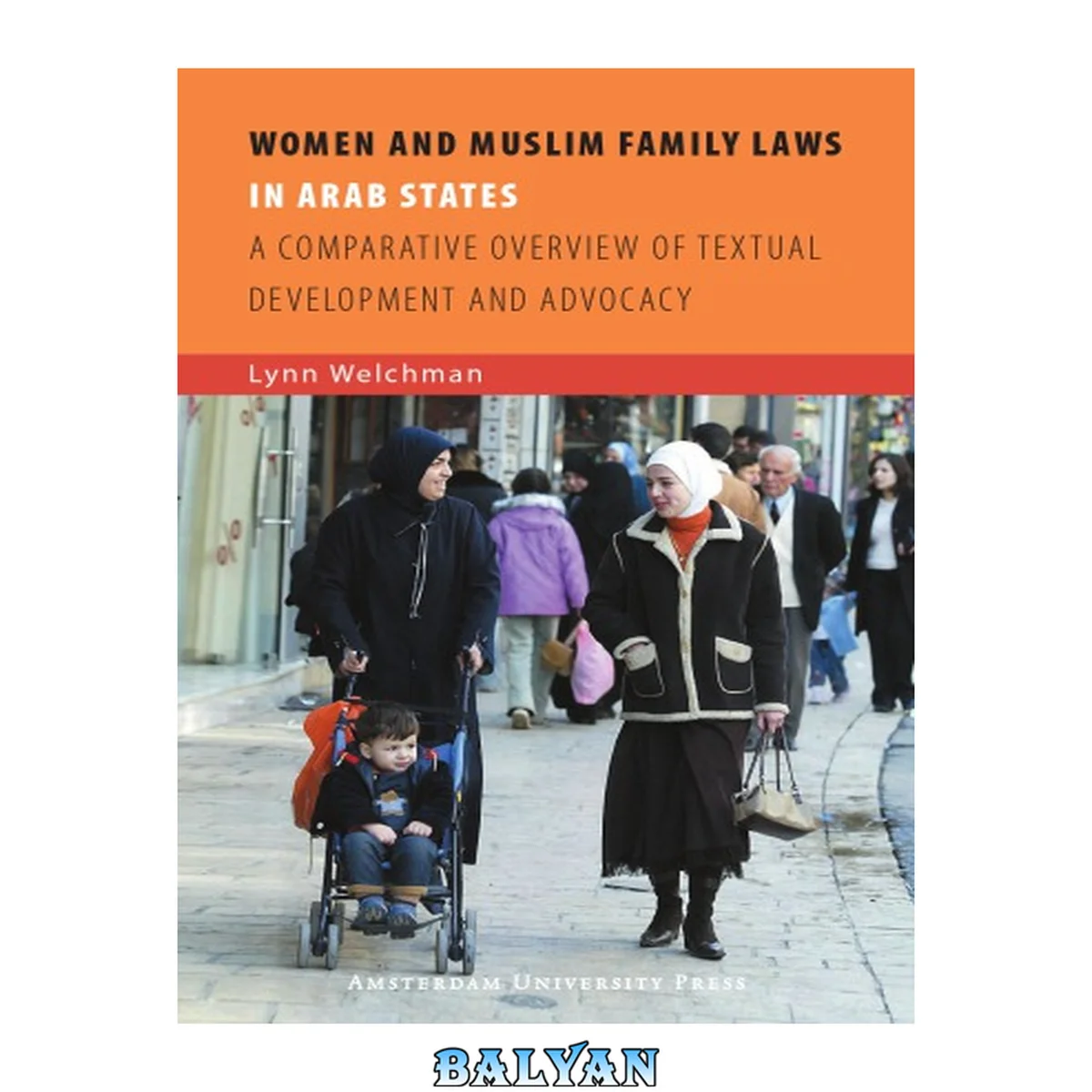
معرفی کتاب «زنان و قوانین خانواده مسلمان در کشورهای عربی: نگاهی مقایسهای به توسعه متنی و فعالیتهای حمایتی (انتشارات دانشگاه آمستردام - مجموعه مقالات ISIM)» (با عنوان لاتین Women and Muslim Family Laws in Arab States: A Comparative Overview of Textual Development and Advocacy (Amsterdam University Press - ISIM Papers series)) نوشتهٔ Lynn Welchman، منتشرشده توسط نشر Amsterdam University Press در سال 2007. این کتاب در فرمت pdf، زبان انگلیسی ارائه شده است.
Muslim family law—and its principles regarding marriage, divorce, personal maintenance, paternity, and child custody—is the one of the most widely applied family law systems in existence today. A number of states have recently codified Muslim family law for the first time or have issued significant amendments or new laws, spurred in many cases by interventions from women’s rights groups and other advocacy organizations. Women and Muslim Family Laws in Arab States combines an examination of women’s rights under Muslim family law in Arab states across the Middle East with discussions of the public debates surrounding the issues that have been raised during these processes of codification and amendment. Drawing on original legal texts and explanatory statements as well as extensive state-based secondary literature, Welchman places these discussions in a contemporary global context that internationalizes the domestic and regional particularities of Muslim family law. Accompanied by a full bibliography and an appendix providing translated extracts of the laws under examination Women and Muslim Family Law considers laws from the Gulf States to North Africa in order to illustrate the legal, social, and political dynamics of the current debates.Review'Since the last decades of the 20th century, the forces of political Islam,[-]globalization and new media have made Muslim family law a new site of[-]passionate debate and contestation that transcends national and regional[-]boundaries. This timely and much-needed book traces recent legislative[-]developments in what the author defines as the third phase of Muslim family[-]law reform - a phase that is still unfolding and is marked by divergent[-]forces and politics.[-][-]Lynn Welchman gives us a penetrating analysis of the different approaches to[-]the codification of Sharia-based rules and principles in number of Arab[-]states. Her rich and informative account is a must read for both scholars[-]and activists working on women?s rights and family law reform in the Muslim[-]world, and Welchman has done them a great service."[-][-]Ziba Mir-Hosseini, Visiting Global Law Professor, New York University - "This is a superb and unique study of family law reforms in Arab states, a clear and highly instructive clarification of the dynamic interaction of legal, political and social factors with practical initiatives that are shaping the theory and practice of family law in the Middle East. Scholarship of this high quality is indispensable for guiding and inspiring sustainable transformation of the social reality of Muslim women and their families."[-][-]Professor Abdullahi A. An-Na'im[-]Emory School of Law[-]Atlanta, Georgia About the AuthorLynn Welchman is senior lecturer in Islamic and Middle Eastern Laws at the School of Oriental and African Studies, University of London. [C:\Users\Microsoft\Documents\Calibre Library] A number of Arab states have recently either codified Muslim family law for the first time, or have issued amendments or new laws which significantly impact the statutory rights of women as wives, mothers and daughters. In Women and Muslim Family Laws in Arab States Lynn Welchman examines women's rights in Muslim family laws in Arab states across the Middle East while also surveying the public debates surrounding the issues. The author considers these new laws alongside older statutes to comment on the patterns and dynamics of change both in the texts of the laws, and in the processes through by which they are drafted and issued. She draws on original legal texts and explanatory statements as well as on extensive secondary literature particular to certain states for an insight into practice, and on; interventions by women's rights organizations and other parties to the debate in the press and in advocacy materials. The discussions are set in the contemporary global context that 'internationalises' the domestic and regional debates. The book considers laws in states from the Gulf to North Africa in regard to their approaches to issues of codification processes and issues of and of registration, capacity and guardianship in marriage, polygyny, the marital relationship, divorce and child custody. It has a full bibliography and includes an annex providing translated extracts of the laws under examination. Welchman richt zich in Women and Muslim Family Laws in Arab States op de rechten van de vrouw binnen het islamitische familierecht in Arabische landen. Welchman analyseert hoe het familierecht is vastgelegd in wetboeken en de publieke debatten die daaruit voortkomen. In de afgelopen decennia is het islamitische familierecht in een aantal landen voor het eerst vastgelegd of zijn belangrijke wijzigingen doorgevoerd. De auteur bespreekt deze nieuwe wetten in het licht van oudere statuten om de dynamiek van het islamitische familierecht te duiden. Zij beroept zich niet alleen op juridische bronnen, maar schenkt ook ruim aandacht aan de juridische praktijk. Door de reacties van vrouwenrechtenorganisaties, media en juristen te analyseren, wijst ze op controversiële kwesties. Bijzonder aan dit boek is de internationale en vergelijkende benadering. De auteur bestudeert discussies rondom huwelijk, polygamie, scheiding en voogdij vanuit het perspectief van verschillende landen. Nationale debatten worden op deze manier geplaatst in een mondiale context. Het boek beschikt over een volledige bibliografie en bijlagen met vertalingen van de behandelde wetsfragmenten Introduction: Behind The Walls : Re-appraising The Role And Importance Of Madrasas In The World Today / Farish A. Noor, Yoginder Sikand And Martin Van Bruinessen -- Voices For Reform In The Indian Madrasas / Yoginder Sikand -- Change And Stagnation In Islamic Education : The Dar Al-ʻulum Of Deoband After The Split In 1982 / Dietrich Reetz -- 'insde And Outside' In A Girls' Madrasa In New Delhi / Mareike Winkelmann -- Between Pakistan And Qom : Shiʻi Women's Madrasas And New Transnational Networks / Mariam Abou Zahab -- The Uncertain Fate Of Southeast Asian Students In The Madrasas Of Pakistan / Farish A. Noor -- Muslim Education In China : Chinese Madrasas And Linkages To Islamic Schools Abroad / Jackie Armijo -- From Pondok To Parliament : The Role Played By The Religious Schools Of Malaysia In The Development Of The Pan-malaysian Islamic Party (pas) / Farish A. Noor -- Traditionalist And Islamist Pesantrens In Contemporary Indonesia / Martin Van Bruinessen -- The Salafi Madrasas Of Indonesia / Noorhaidi Hasan. Farish A. Noor, Yoginder Sikand & Martin Van Bruinessen (eds.). Most Of These Essays Are Updated Versions Of Papers That Were First Presented At The International Conference 'the Madrasa In Asia: Transnational Linkages And Real Or Alleged Political Roles', In May 2004 In Leiden--p. 7. Includes Bibliographical References And Index. "Women and Muslim Family Laws in Arab States: A Comparative Overview of Textual Development and Advocacy combines an examination of women's rights in Muslim family law in Arab states from the Gulf to North Africa with discussions of the public debates surrounding the issues that are raised in processes of codification and amendment. A number of states have recently either codified Muslim family law, or have issued significant amendments or new laws on the subject. This study considers these new laws along with older statutes to comment on patterns and dynamics of change both in the texts of the laws and in the processes by which they are drafted and issued. It draws on original legal texts as well as on secondary literature for an insight into practice; interventions by women's rights organizations and other parties are drawn on to identify areas of the laws that remain contested. The discussions are set in the contemporary global context that internationalises the domestic and regional discussions."--book jacket. "Since the rise of the Taliban and Al Qaeda, the traditional Islamic schools known as madrasas have frequently been portrayed as hotbeds of terrorism. For much longer, modernisers have denounced madrasas as impediments to social progress, although others have praised them for their self-sufficiency and for providing 'authentic' grassroots education. For numerous poor Muslims In Asia, the madrasa still constitutes the only accessible form of education. Madrasa reform has been high on the political and social agendas of governments across Asia, but the madrasa itself remains a little understood institution." "The Madrasa in Asia: Political Activism and Transnational Linkages fills a major gap in understanding the dynamics of Muslim education and activism at the grassroots. The contributors, who all have extensive first-hand knowledge of the world of the madrasa, provide a balanced overview of the social, educational and political roles of madrasas across Asia, from China and Indonesia to Iran."--Jacket Since the rise of organizations like the Taliban and Al Qaeda, the traditional Islamic school known as the madrasa has frequently been portrayed as a terrorist hotbed. For much longer, the madrasa has been considered by some as a backward and petrified impediment to Islamic social progress. However, for an important segment of the poor Muslim populations of Asia, madrasas constitute the only accessible form of education and an opening to the wider world. This comprehensive volume presents a representative overview of the unknown world behind the walls of these institutions in nations such as China, Indonesia, Iran, and Pakistan, showcasing the educational changes and transnational networks that help to produce an alternative form of globalization. Abstract: Since the rise of the Taliban and Al Qaeda, the traditional Islamic schools known as the madrasa have frequently been portrayed as hotbeds of terrorism. For much longer, the madrasa has been considered by some as a backward and petrified impediment to social progress. However, for an important segment of the poor Muslim populations of Asia, madrasas constitute the only accessible form of education. This volume presents an overview of the madrasas in countries such as China, Indonesia, Malayisia, India and Pakistan
دانلود کتاب زنان و قوانین خانواده مسلمان در کشورهای عربی: نگاهی مقایسهای به توسعه متنی و فعالیتهای حمایتی (انتشارات دانشگاه آمستردام - مجموعه مقالات ISIM)