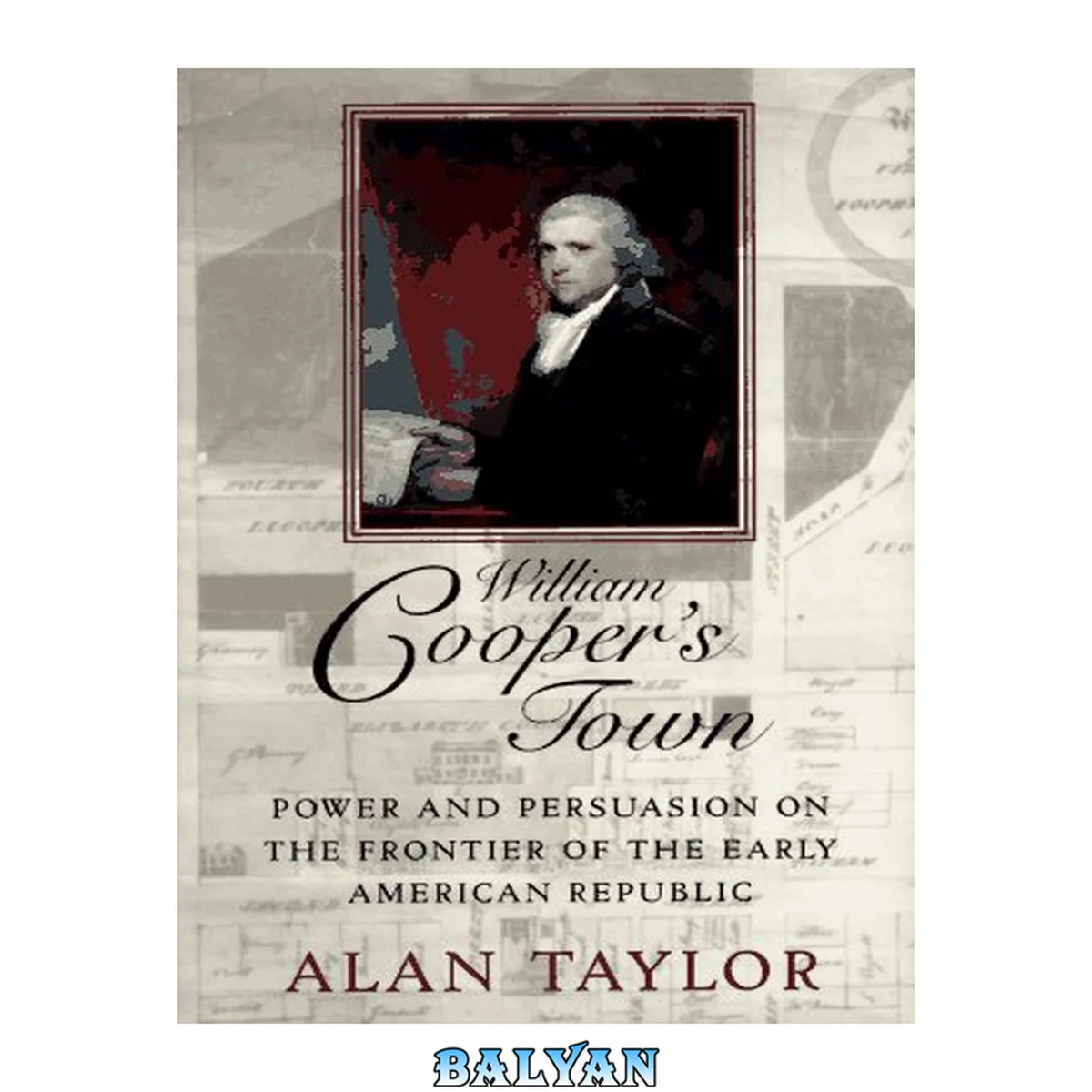
معرفی کتاب «William Cooper's Town : Power and Persuasion on the Frontier of the Early American Republic (Pulitzer Prize Winner)» نوشتهٔ Alan Taylor، منتشرشده توسط نشر A.A. Knopf : Distributed by Random House در سال 1996. این کتاب در فرمت epub، زبان انگلیسی ارائه شده است.
William Cooper and James Fenimore Cooper, a father and son who embodied the contradictions that divided America in the early years of the Republic, are brought to life in this Pulitzer Prize-winning book. William Cooper rose from humble origins to become a wealthy land speculator and U.S. congressman in what had until lately been the wilderness of upstate New York, but his high-handed style of governing resulted in his fall from power and political disgrace. His son James Fenimore Cooper became one of this country’s first popular novelists with a book, The Pioneers, that tried to come to terms with his father’s failure and imaginatively reclaim the estate he had lost. In William Cooper’s Town, Alan Taylor dramatizes the class between gentility and democracy that was one of the principal consequences of the American Revolution, a struggle that was waged both at the polls and on the pages of our national literature. Taylor shows how Americans resolved their revolution through the creation of new social reforms and new stories that evolved with the expansion of our frontier. "In this story of a frontier village in the early American republic, Alan Taylor explores the lives of Judge William Cooper and the novelist James Fenimore Cooper - father and son. As frontier speculator, landlord, and politician, the father played a leading role in the conquest, resettlement, and environmental transformation of the early nation. Drawing upon his childhood memories of the New York frontier, the son created the historical fictions that made him the most popular, influential, and controversial American novelist of the early nineteenth century. Taylor makes it clear that in a rapidly changing nation William Cooper's development of Cooperstown and his son's creation of the village of Templeton in The Pioneers were different stages of a common effort, over two generations, to create, sustain, and justify a wealthy and powerful estate. Both sought that unity of social, economic, political, and cultural authority idealized in colonial America but at odds with the legacy of the American Revolution. William Cooper's Town combines biography, social history, and literary analysis. By breaching the barriers that separate political, social, and literary history, Taylor reveals the interplay of frontier settlement and narrative-making in the early American Republic. He examines how Americans resolved their revolution through the creation of new property, new power, and new stories along their extensive frontier." William Cooper and James Fenimore Cooper, a father and son who embodied the contradictions that divided America in the early years of the Republic, are brought to life in this Pulitzer Prize-winning book. William Cooper rose from humble origins to become a wealthy land speculator and U.S. congressman in what had until lately been the wilderness of upstate New York, but his high-handed style of governing resulted in his fall from power and political disgrace. His son James Fenimore Cooper became one of this countrys first popular novelists with a book, The Pioneers, that tried to come to terms with his fathers failure and imaginatively reclaim the estate he had lost. In William Coopers Town, Alan Taylor dramatizes the clash between gentility and democracy that was one of the principal consequences of the American Revolution, a struggle that was waged both at the polls and on the pages of our national literature. Taylor shows how Americans resolved their revolution through the creation of new social reforms and new stories that evolved with the expansion of our frontier.
An innovative work of biography, social history, and literary analysis, this Pulitzer Prize-winning book presents the story of two men, William Cooper and his son, the novelist James Fennimore Cooper, who embodied the contradictions that divided America in the early years of the Republic. Taylor shows how Americans resolved their revolution through the creation of new social forms and new stories that evolved with the expansion of our frontier. of photos.
Combining biography, social history, and literary analysis, Taylor tells the story of William Cooper, a quintessential self-made man in the aftermath of the American Revolution. A shrewd land speculator and successful developer, Cooper became the dominant landlord, presiding judge, and U.S. congressman from central New York. Illustrations. Maps.
A dual history and biography profiles William Cooper, a shrewd land developer, presiding judge, and U.S. Congressman, against the backdrop of post-Revolutionary War America, and explains how his life reflected the nation ON NOVEMBER 12, 1774, A YOUNG couple seeking a marriage license appeared before "his Excellency William Franklin, Esqr., Governor of the Province of New Jersey." Alan Taylor. Includes Bibliographical References (p. [441]-532) And Index.