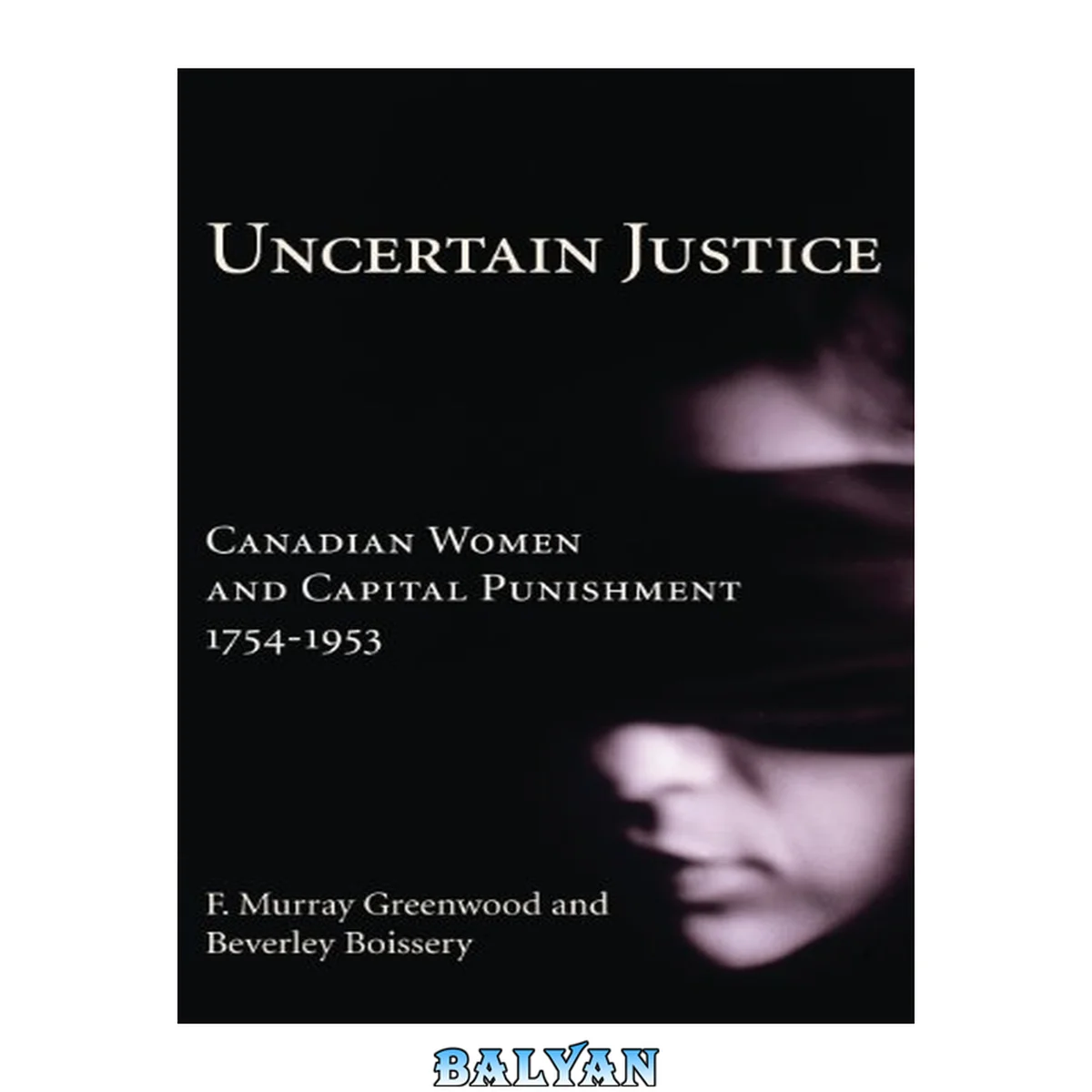
معرفی کتاب «Uncertain Justice : Canadian Women and Capital Punishment, 1754-1953» نوشتهٔ F. Murray Greenwood and Beverley Boissery، منتشرشده توسط نشر Dundurn Group / Dundurn Press در سال 2000. این کتاب در فرمت pdf، زبان انگلیسی ارائه شده است.
In 1754 Eleanor Powers was hung for a murder committed during a botched robbery. She was the first woman condemned to die in Canada, but would not be the last. In __Uncertain Justice__, Beverley Boissery and Murray Greenwood portray a cast of women characters almost as often wronged by the law as they have wronged society. Starting with the Powers trial and continuing to the not-too-distant past, the authors expose the patriarchal values that lie at the core of criminal law, and the class and gender biases that permeate its procedures and applications. The writing style is similar to that of a popular mystery: "Harriet Henry lay dead. Horribly and indubitably. Her body sprawled against the bed, the head twisted at a grotesque angle. Foam engulfed the grinning mouth." Scholarly analysis combines with the narrative to make Uncertain Justice a fascinating and engaging read. There is a wealth of information about the emerging and evolving legal system and profession, the state of forensic science, the roles of juries, and the political turmoil and growing resistance to a purely class-based aristocratic form of government. Table of Contents 6 Foreword 10 Acknowledgments 12 Introduction 14 Chapter One - The Eleanor Power Story 24 Chapter Two - The Many Trials of Marie-Josephte Corriveau 40 Chapter Three - “Beauty, Thou Pretty Plaything!”: Margaret Jordan — Murderer? Pirate? 62 Chapter Four - Julia Murdock — From “Comparative Innocence to ... Blackest Guilt”? 82 Chapter Five - The Capital Conviction of Innocent Persons 100 Chapter Six - “Sham Chivalry”: Canadian Women and the Criminal Jury in Capital Cases, 1867–1962 124 Chapter Seven - Elizabeth Workman — Sinner or Saint? 142 Chapter Eight - Annie Robinson — “More to be Pitied Than Censured”? 162 Chapter Nine - Jennie Hawkes — A Woman Wronged 182 Chapter Ten - Annie Rubletz and Mary Paulette — “The Far Side of Despair” 198 Conclusion 218 Endnotes 232 Endnotes to the Introduction 232 Endnotes to Chapter One 235 Endnotes to Chapter Two 239 Endnotes to Chapter Three 242 Endnotes to Chapter Four 245 Endnotes to Chapter Five 248 Endnotes to Chapter Six 251 Endnotes to Chapter Seven 256 Endnotes to Chapter Eight 260 Endnotes to Chapter Nine 261 Endnotes to Chapter Ten 262 Endnotes to the Conclusion 265 Selected Bibliography 270 Index 282
In 1754 Eleanor Powers was hung for a murder committed during a botched robbery. She was the first woman condemned to die in Canada, but would not be the last.
In Uncertain Justice, Beverley Boissery and Murray Greenwood portray a cast of women characters almost as often wronged by the law as they have wronged society. Starting with the Powers trial and continuing to the not-too-distant past, the authors expose the patriarchal values that lie at the core of criminal law, and the class and gender biases that permeate its procedures and applications.
The writing style is similar to that of a popular mystery: "Harriet Henry lay dead. Horribly and indubitably. Her body sprawled against the bed, the head twisted at a grotesque angle. Foam engulfed the grinning mouth." Scholarly analysis combines with the narrative to make Uncertain Justice a fascinating and engaging read.
There is a wealth of information about the emerging and evolving legal system and profession, the state of forensic science, the roles of juries, and the political turmoil and growing resistance to a purely class-based aristocratic form of government.