Transforming Damascus: Space and Modernity in an Islamic City (Library of Middle East History)
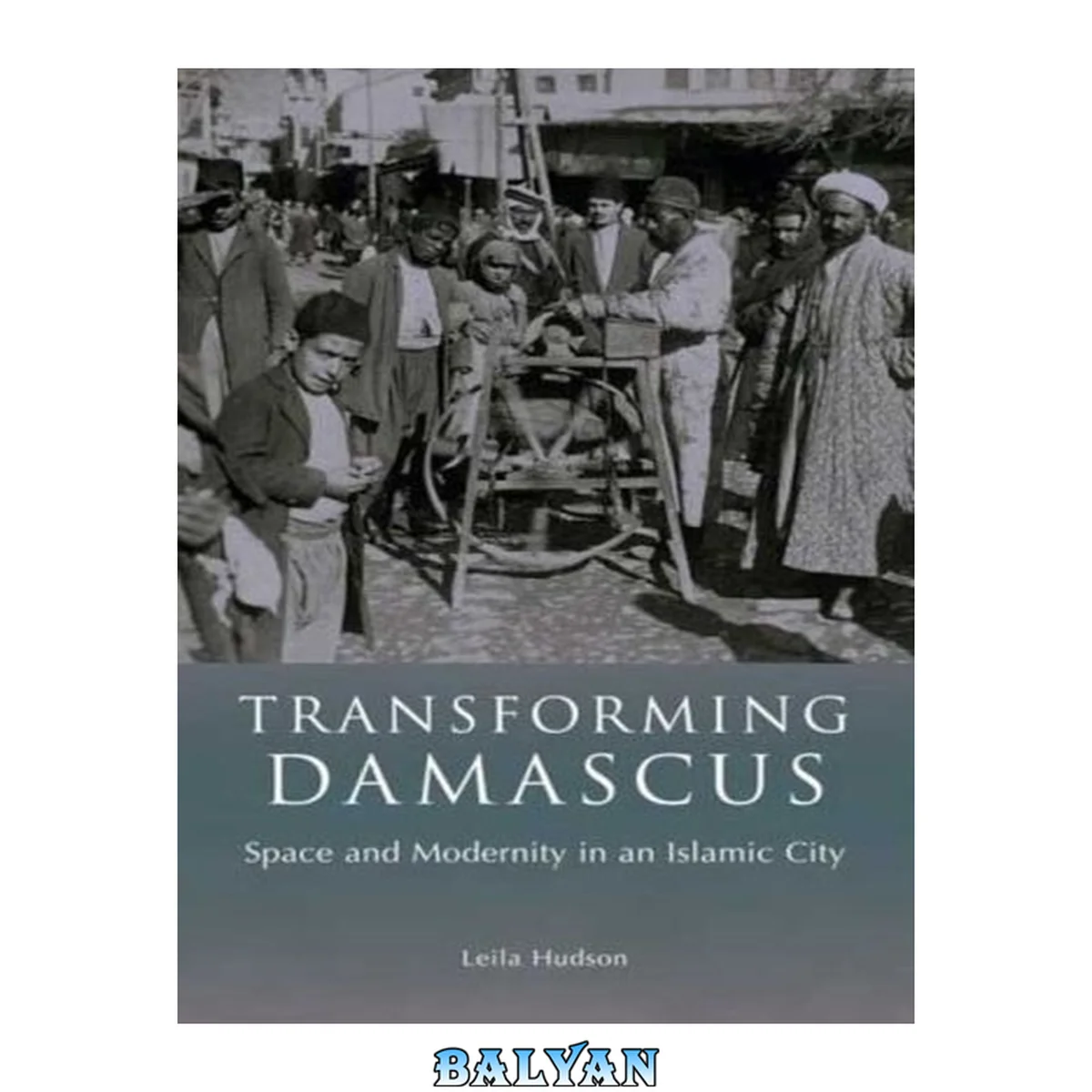
معرفی کتاب «Transforming Damascus: Space and Modernity in an Islamic City (Library of Middle East History)» نوشتهٔ Leila Hudson، منتشرشده توسط نشر Tauris Academic Studies در سال 2008. این کتاب در فرمت pdf، زبان انگلیسی ارائه شده است.
In 1860, Damascus was a sleepy provincial capital of the weakening Ottoman Empire, a city defined in terms of its relationship to the holy places of Islam in the Arabian Hijaz and its legacy of Islamic knowledge. Yet by 1918 Damascus had become a seat of Arab nationalism and a would-be modern state capital. How can this metamorphosis be explained? Here Leila Hudson describes the transformation of Damascus. Within a couple of generations the city changed from little more than a way-station on the Islamic pilgrimage routes that had defined the city‘s place for over a millennium. Its citizens and notables now seized the opportunities made available through transport technology on the eastern Mediterranean coast and in the European economy. Shifts in marriage patterns, class, education and power ensued. But just when the city‘s destiny seemed irrevocably linked to the Mediterranean world and economy, World War I literally starved the urban centre of Damascus and empowered its Bedouin hinterland. The consequences shaped Syria for the rest of the twentieth century and beyond. "To understand contemporary Irana??s notoriously complex politics, it is essential to grasp the monumental changes initiated by Mohammad Khatami. The previously little-known cleric stormed to victory in Irana??s 1997 presidential elections with nearly 70 percent of the vote, encouraging Irana??s reform movement to flourish during his eight year tenure as president. Ghoncheh Tazminia??s book offers a thought-provoking, astutely close-up yet systematic analysis of Khatami the man and the reform movement that supported him. She provides us with the first insight into Khatami and his politics, unravelling from the inside the dramatic emergence and consequences of Irana??s vibrant reform movement. Balanced and analytical, this book provides a comprehensive and finely detailed introduction to the subtleties of contemporary Irana??s complex political culture. At the same time it is an important reference point for a critical period of Irana??s post-revolutionary trajectory, especially given the controversial Post-Khatami developments in the country following the election of President Ahmadinejad. And with the Ahmadinejad view of Iranian politics creating a measure of discord in the country, Khatamia??s role as a player on the Iranian political scene remains firm."--Bloomsbury publishing "To understand contemporary Irana??s notoriously complex politics, it is essential to grasp the monumental changes initiated by Mohammad Khatami. The previously little-known cleric stormed to victory in Irana??s 1997 presidential elections with nearly 70 percent of the vote, encouraging Irana??s reform movement to flourish during his eight year tenure as president. Ghoncheh Tazminia??s book offers a thought-provoking, astutely close-up yet systematic analysis of Khatami the man and the reform movement that supported him. She provides us with the first insight into Khatami and his politics, unravelling from the inside the dramatic emergence and consequences of Irana??s vibrant reform movement. Balanced and analytical, this book provides a comprehensive and finely detailed introduction to the subtleties of contemporary Irana??s complex political culture. At the same time it is an important reference point for a critical period of Irana??s post-revolutionary trajectory, especially given the controversial Post-Khatami developments in the country following the election of President Ahmadinejad.And with the Ahmadinejad view of Iranian politics creating a measure of discord in the country, Khatamia? ?s role as a player on the Iranian political scene remains firm."--Bloomsbury publishing Contents......Page 8 Acknowledgments......Page 10 1 Bab al-Sham: Approaching Damascus......Page 14 2 Bab al-Hukm: On Political Capital, 1860-1880......Page 28 3 Bab al-Watha'iq: On Archival Capital......Page 46 4 Bab al-Mal: On Merchant Capital......Page 58 5 Bab al-Usra: On Human Capital......Page 80 6 Bab al-'Ilm: On Intellectual Capital......Page 98 7 Bab al-Watan: On Political Capital, 1897-1908......Page 112 8 Bab al-Harb: On Capital in Crisis, 1908-1918......Page 130 9 Conclusion......Page 152 Notes......Page 156 Index......Page 188 In 1860, Damascus was a sleepy provincial capital of the weakening Ottoman Empire, a city defined in terms of its relationship to the holy places of Islam in the Arabian Hijaz and its legacy of Islamic knowledge. This book describes the transformation of Damascus. Leila Hudson. Includes Bibliographical References (p. [143]-174) And Index.
دانلود کتاب Transforming Damascus: Space and Modernity in an Islamic City (Library of Middle East History)