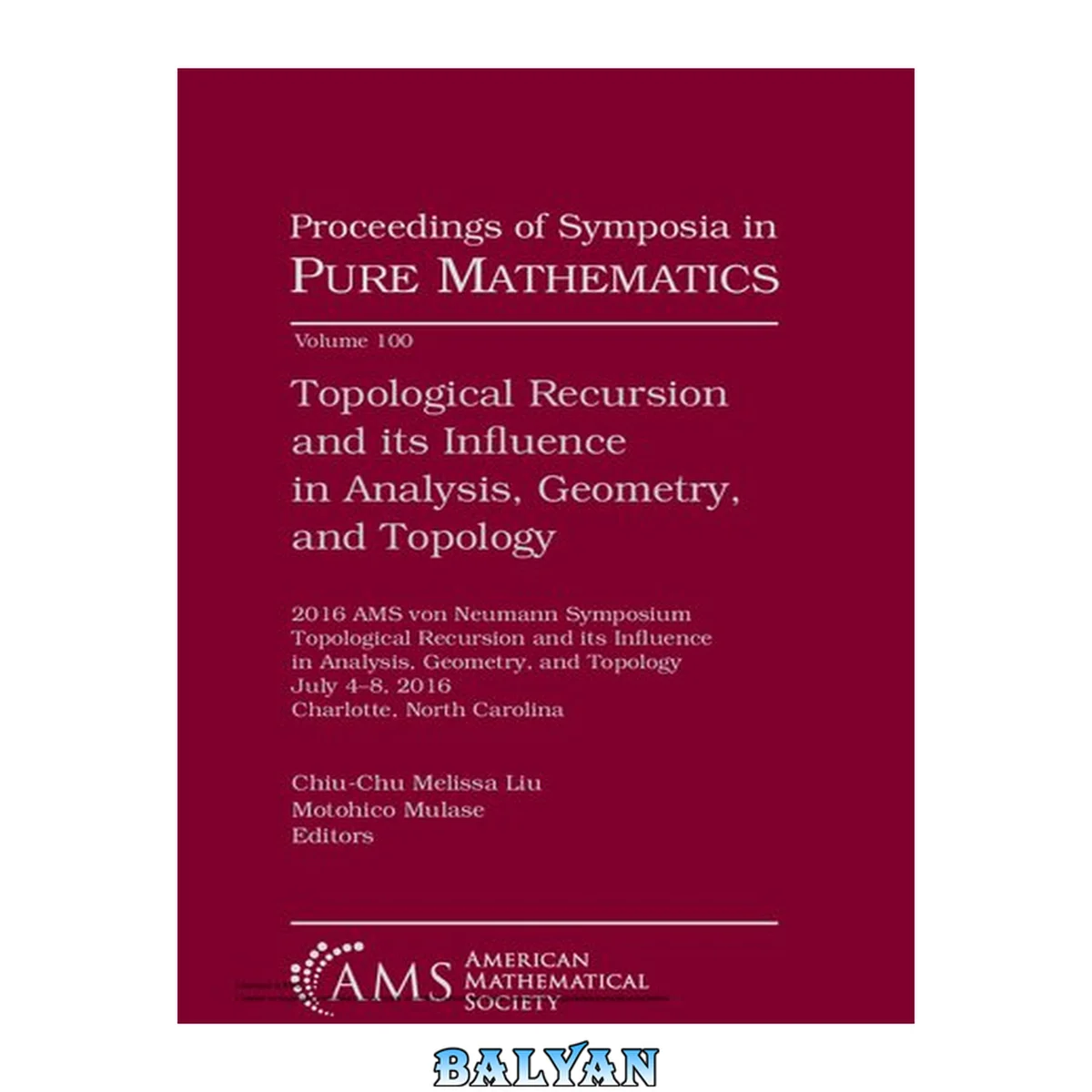
بازگشت توپولوژیکی و تأثیر آن در تحلیل، هندسه و توپولوژی: سمپوزیوم توپولوژیکی AMS و تأثیر آن در تحلیل، هندسه و توپولوژی، ۴-۸ ژوئیه ۲۰۱۶، شارلوت، کارولینای شمالی
Topological recursion and its influence in analysis, geometry, and topology : 2016 AMS von Neumann symposium topological recursion ans its influence in analysis, geometry, and topology, July 4-8, 2016, Charlotte, North Carolina
معرفی کتاب «بازگشت توپولوژیکی و تأثیر آن در تحلیل، هندسه و توپولوژی: سمپوزیوم توپولوژیکی AMS و تأثیر آن در تحلیل، هندسه و توپولوژی، ۴-۸ ژوئیه ۲۰۱۶، شارلوت، کارولینای شمالی» (با عنوان لاتین Topological recursion and its influence in analysis, geometry, and topology : 2016 AMS von Neumann symposium topological recursion ans its influence in analysis, geometry, and topology, July 4-8, 2016, Charlotte, North Carolina) نوشتهٔ Chiu-Chu Melissa Liu; Motohico Mulase، منتشرشده توسط نشر American Mathematical
Society در سال 2018. این کتاب در فرمت pdf، زبان انگلیسی ارائه شده است.
"This volume contains the proceedings of the 2016 AMS von Neumann Symposium on Topological Recursion and its Influence in Analysis, Geometry, and Topology, which was held from July 4{u2013}8, 2016, at the Hilton Charlotte University Place, Charlotte, North Carolina. The papers contained in the volume present a snapshot of rapid and rich developments in the emerging research field known as topological recursion. It has its origin around 2004 in random matrix theory and also in Mirzakhani's work on the volume of moduli spaces of hyperbolic surfaces. Topological recursion has played a fundamental role in connecting seemingly unrelated areas of mathematics such as matrix models, enumeration of Hurwitz numbers and Grothendieck's dessins d'enfants, Gromov-Witten invariants, the A-polynomials and colored polynomial invariants of knots, WKB analysis, and quantization of Hitchin moduli spaces. In addition to establishing these topics, the volume includes survey papers on the most recent key accomplishments: discovery of the unexpected relation to semi-simple cohomological field theories and a solution to the remodeling conjecture. It also provides a glimpse into the future research direction; for example, connections with the Airy structures, modular functors, Hurwitz-Frobenius manifolds, and ELSV-type formulas."--Publisher's description Cover Title page Contents Preface 1. The 2016 AMS von Neumann Symposium 2. What is topological recursion? 3. The origin 4. Topological recursion and semi-simple cohomological field theories 5. Topological recursion and toric mirror symmetry 6. A knot theory twist and quantum curves 7. Relation to the Hitchin theory of Higgs bundles, and quantum curves as opers 8. New developments Bibliography Modular functors, cohomological field theories, and topological recursion 1. Introduction 2. Construction of vector bundles from a modular functor 3. Cohomological field theories 4. Topological recursion 5. Example: Modular functors associated to finite groups 6. Example: WZW model for compact Lie groups 7. Discussion about global spectral curves Appendix A. Extra properties of the S-matrix Acknowledgments References On the Gopakumar–Ooguri–Vafa correspondence for Clifford–Klein 3-manifolds 1. Introduction 2. A 0-dimensional aperçu: Matrix models, the topological recursion and enumerative geometry 3. The GOV correspondence for S3 4. The GOV correspondence for Clifford–Klein 3-manifolds 5. Conclusions Acknowledgments References Bouchard-Klemm-Marino-Pasquetti conjecture for C3 1. Introduction 2. Marino-Vafa formula and Symmetrized Cut-Join Equation 3. The BKMP Conjecture 4. Residue Calculus 5. Some Formal Analysis 6. The Left Hand Side 7. The Right Hand Side References The hybrid Landau–Ginzburg models of Calabi–Yau complete intersections 1. Introduction 2. Setup 3. Calabi–Yau side 4. Hybrid Landau–Ginzburg side 5. The correspondence References Singular vector structure of quantum curves 1. Introduction 2. Higher level (Virasoro) quantum curves 3. Higher level (super-Virasoro) quantum curves 4. Summary Acknowledgments References Towards the topological recursion for double Hurwitz numbers 1. Introduction 2. Combinatorics of double Hurwitz numbers 3. Evidence for the conjecture 4. Towards a proof of the conjecture Appendix A. Table of double Hurwitz numbers Appendix B. Table of pruned double Hurwitz numbers References Quantization of spectral curves for meromorphic Higgs bundles through topological recursion 1. Introduction 2. A walk-through of the simplest example 3. Quantum curves for Higgs bundles 4. Geometry of spectral curves in the compactified cotangent bundle 5. The spectral curve as a divisor and its minimal resolution 6. Construction of the quantum curve 7. The classical differential equations as quantum curves Acknowledgments References Topological recursion and Givental’s formalism: Spectral curves for Gromov-Witten theories 1. Introduction 2. Preliminaries 3. Local spectral curves for cohomological field theories 4. Dubrovin’s superpotential as a global spectral curve Acknowledgments References Primary invariants of Hurwitz Frobenius manifolds 1. Introduction 2. Frobenius manifolds 3. Topological recursion and cohomological field theory 4. Hurwitz Frobenius manifolds 5. Topological recursion for compact spectral curves 6. Topological recursion for families of spectral curves References Hopf algebras and topological recursion 1. Introduction 2. The topological recursion of Eynard and Orantin 3. The Loday-Ronco Hopf algebra of planar binary trees 4. The solution of topological recursion 5. The antipode 6. Discussion and other topics References Graph sums in the remodeling conjecture 1. Introduction 2. Geometry and the A-model of a toric Calabi-Yau 3-orbifold 3. Mirror curves and the Landau-Ginzburg mirror 4. A quick review of the genus zero mirror theorem for toric orbifolds 5. A-model quantization: The orbifold Givental formula 6. B-model quantization: The topological recursion 7. Comparing the graph sums: Proving the Remodeling Conjecture Acknowledgments References Double quantization of Seiberg–Witten geometry and W-algebras 1. Introduction and summary 2. Seiberg–Witten spectral curve and 1st quantization 3. Operator formalism and 2nd quantization 4. From double quantization to Virasoro/W-algebra 5. Z-state 6. Quiver W-algebra 7. Affine quiver W-algebra 8. Quiver elliptic W-algebra Acknowledgments References Airy structures and symplectic geometry of topological recursion 1. Introduction 2. Airy structures 3. Comparison with topological recursion 4. Spectral curves 5. Affine symplectic connection and local embedding of the moduli space of spectral curves 6. Formal discs and universal Airy structure 7. Hamiltonian reduction and Holomorphic Anomaly Equation 8. Semi-affine Lagrangian embeddings 9. Two more speculations References Periods of meromorphic quadratic differentials and Goldman bracket 1. Introduction 2. Canonical covering of a Riemann surface 3. Second order equation with meromorphic potential on a Riemann surface 4. Variational formulas 5. Canonical symplectic structure on T*\Mcal_{g,n} via periods of Q 6. From canonical symplectic structure on T*\Mcal_{g,n} to Goldman bracket 7. Riemann sphere with four marked points Acknowledgments References On ELSV-type formulae, Hurwitz numbers and topological recursion 1. Introduction 2. Chiodo classes 3. From the spectral curve to the Givental R-matrix 4. Equivalence statements: A new proof of the Johnson-Pandharipande-Tseng formula References Quantum curves for simple Hurwitz numbers of an arbitrary base curve 1. Introduction and the main results 2. A cut-and-join equation for simple Hurwitz numbers 3. The discrete Laplace transform 4. A Schrödinger equation 5. The heat equation and its consequences 6. The quantum curve 7. Semi-classical limit References Back Cover Preface / Chiu-Chu Melissa Liu and Motohico Mulase -- Modular functors, cohomological field theories, and topological recursion / Jørgen Ellegaard Andersen, Gaëtan Borot, and Nicolas Orantin -- Quantum topology and curve counting invariants / Andrea Brini -- Bouchard-Klemm-Marino-Pasquetti conjecture for C3 / Lin Chen -- The hybrid Landau-Ginzburg models for Calabi-Yau complete intersections / Alessandro Chiodo and Jan Nagel -- Singular vector structure of quantum curves / Pawel Ciosmak, Leszek Hadasz, Masahide Manabe, and Piotr Sułkowski -- Towards the topological recursion for double Hurwitz numbers / Norman Do and Maksim Karev -- Quantization of spectral curves for meromorphic bundles through topological recursion / Olivia Dumitrescu and Motohico Mulase -- Topological recursion and Givental formalism: spectral curves for Gromov-Witten theories / Petr Dunin-Barkowski -- Primary invariants of Hurwitz Frobenius manifolds / Petr Dunin-Barkowski, Paul Norbury, Nicolas Orantin, Alexandr Popolitov, and Sergey Shadrin -- Hopf algebras and topological recursion / Joao N. Esteves -- Graph sums in the remodeling conjecture / Bohan Fang and Zhengyu Zong -- Double quantization of Seiberg-Witten geometry and w-algebras / Taro Kimura -- Airy structures and symplectic geometry of topological recursion / Maxim Kontsevich and Yan Soibelman -- Periods of meromorphic quadratic differentials and Goldman bracket / Dmitry Korotkin -- On ELSV-type formulae, Hurwitz numbers and topological recursion / Danilo Lewanski -- Quantum curves for simple Hurwitz numbers of an arbitrary base curve / Xiaojun Liu, Motohico Mulase, and Adam Sorkin