The Six Pillars of Calculus: Business Edition
معرفی کتاب «The Six Pillars of Calculus: Business Edition» نوشتهٔ Josh Malerman و Lorenzo Adlai Sadun، منتشرشده توسط نشر American Mathematical Society در سال 2020. این کتاب در فرمت pdf، زبان انگلیسی ارائه شده است.
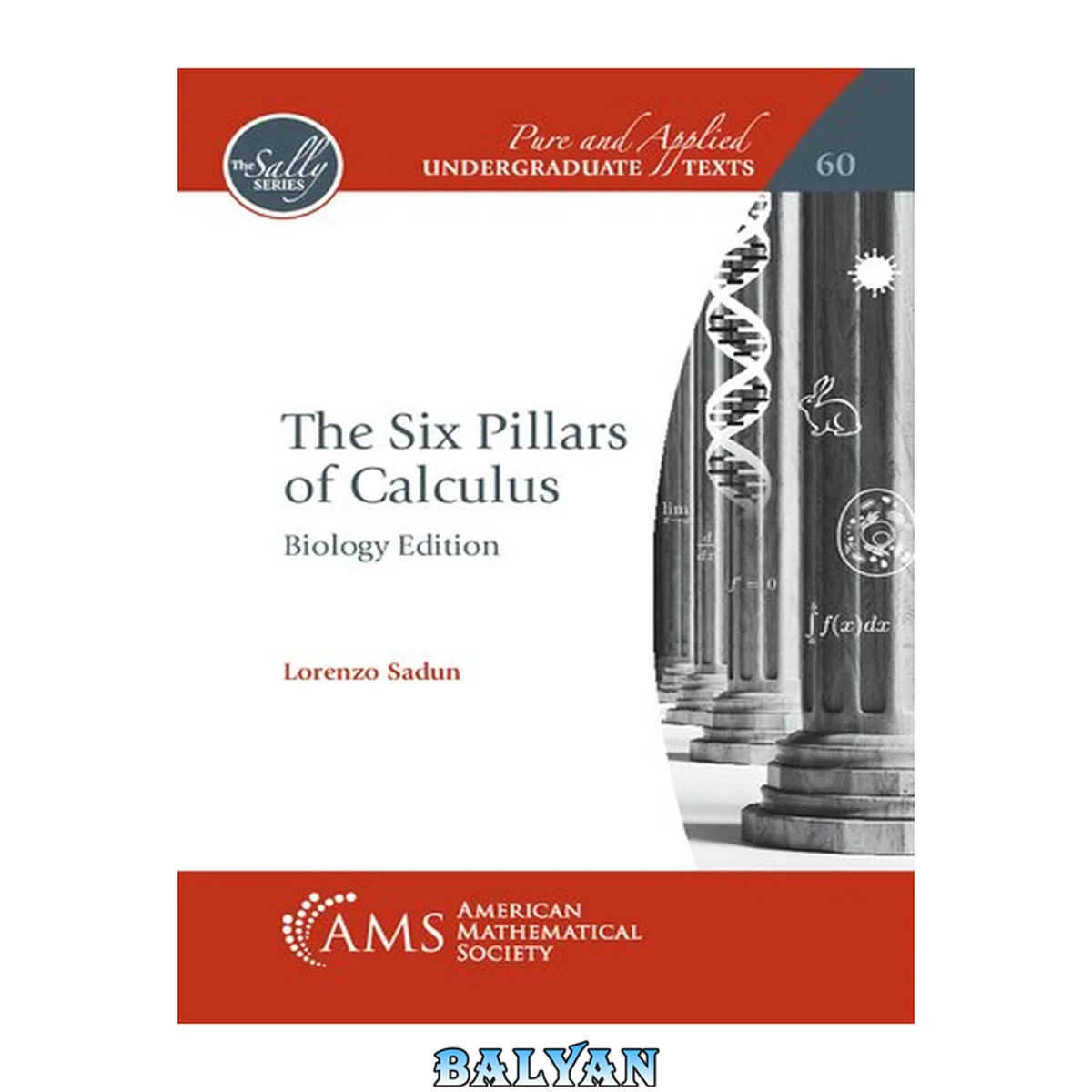
The Six Pillars of Calculus: Biology Edition is a conceptual and practical introduction to differential and integral calculus for use in a one- or two-semester course. By boiling calculus down to six common-sense ideas, the text invites students to make calculus an integral part of how they view the world. Each pillar is introduced by tackling and solving a challenging, realistic problem. This engaging process of discovery encourages students to wrestle with the material and understand the reasoning behind the techniques they are learning--to focus on when and why to use the tools of calculus, not just on how to apply formulas. Modeling and differential equations are front and center. Solutions begin with numerical approximations; derivatives and integrals emerge naturally as refinements of those approximations. Students use and modify computer programs to reinforce their understanding of each algorithm. The Biology Edition of the Six Pillars series has been extensively field-tested at the University of Texas. It features hundreds of examples and problems specifically designed for students in the life sciences. The core ideas are introduced by modeling the spread of disease, tracking changes in the amount of $\mathrm{CO}\_{2}$ in the atmosphere, and optimizing blood flow in the body. Along the way, students learn about optimal drug delivery, population dynamics, chemical equilibria, and probability. Cover Title page Copyright Contents Instructors’ Guide and Background Chapter 1. What is Calculus? The Six Pillars Chapter 2. Predicting the Future: The SIR Model 2.1. Worried Sick 2.2. Building the SIR Model 2.3. Analyzing the Model Numerically 2.4. Theoretical Analysis: What Goes Up Has to Stop Before It Comes Down 2.5. Covid-19 and Modified SIR Models 2.6. Same Song, Different Singer: SIR and Product Marketing 2.7. Chapter Summary 2.8. Exercises Chapter 3. Close is Good Enough 3.1. The Idea of Approximation 3.2. Functions 3.3. Linear Functions and Their Graphs 3.4. Linear Approximations and Microscopes 3.5. Euler’s Method and Compound Interest 3.6. The SIR Model by Computer 3.7. Solving Algebraic Equations 3.8. Chapter Summary 3.9. Exercises Chapter 4. Track the Changes 4.1. Atmospheric Carbon 4.2. Other Derivatives and Marginal Quantities 4.3. Local Linearity and Microscopes 4.4. The Derivative 4.5. A Global View 4.6. Chapter Summary 4.7. Exercises Chapter 5. Computing and Using Derivatives (What Goes Up Has to Stop Before It Comes Down) 5.1. Building Blocks 5.2. Adding, Subtracting, Multiplying, and Dividing Functions 5.3. The Chain Rule 5.4. Optimization 5.5. The Shape of a Graph 5.6. Newton’s Method 5.7. Chapter Summary 5.8. Supplemental Material: Small Angle Approximations 5.9. Exercises Chapter 6. Models of Growth and Oscillation 6.1. Modeling with Differential Equations 6.2. Exponential Functions and Logarithms 6.3. Simple Models of Growth and Decay 6.4. Two Models of Oscillation 6.5. More Sophisticated Population Models 6.6. Chemistry 6.7. Chapter Summary 6.8. Supplemental Material: A Crash Course in Trigonometry 6.9. Exercises Chapter 7. The Whole Is the Sum of the Parts 7.1. Slicing and Dicing 7.2. Riemann Sums 7.3. The Definite Integral 7.4. The Accumulation Function 7.5. Chapter Summary 7.6. Exercises Chapter 8. The Fundamental Theorem of Calculus (One Step at a Time) 8.1. Three Different Quantities 8.2. FTC2: The Integral of the Derivative 8.3. FTC1: The Derivative of the Accumulation 8.4. Anti-Derivatives and Ballistics 8.5. Computing Anti-Derivatives 8.6. Chapter Summary 8.7. Exercises Chapter 9. Methods of Integration 9.1. Integration by Substitution 9.2. Integration by Parts 9.3. Numerical Integration 9.4. Chapter Summary 9.5. Exercises Chapter 10. One Variable at a Time 10.1. Partial Derivatives 10.2. Linear Approximations 10.3. Double Integrals and Iterated Integrals 10.4. Chapter Summary 10.5. Exercises Chapter 11. Taylor Series 11.1. What Does π=3.14159265⋯ Mean? 11.2. Power Series 11.3. Taylor Polynomials and Taylor Series 11.4. Sines, Cosines, Exponentials, and Logs 11.5. Tests for Convergence 11.6. Intervals of Convergence 11.7. Chapter Summary 11.8. Exercises Index Back Cover Offers a conceptual and practical introduction to differential and integral calculus for use in a one- or two-semester course. By boiling calculus down to six common-sense ideas, the text invites students to make calculus an integral part of how they view the world. Each pillar is introduced by tackling and solving a challenging, realistic problem.
دانلود کتاب The Six Pillars of Calculus: Business Edition