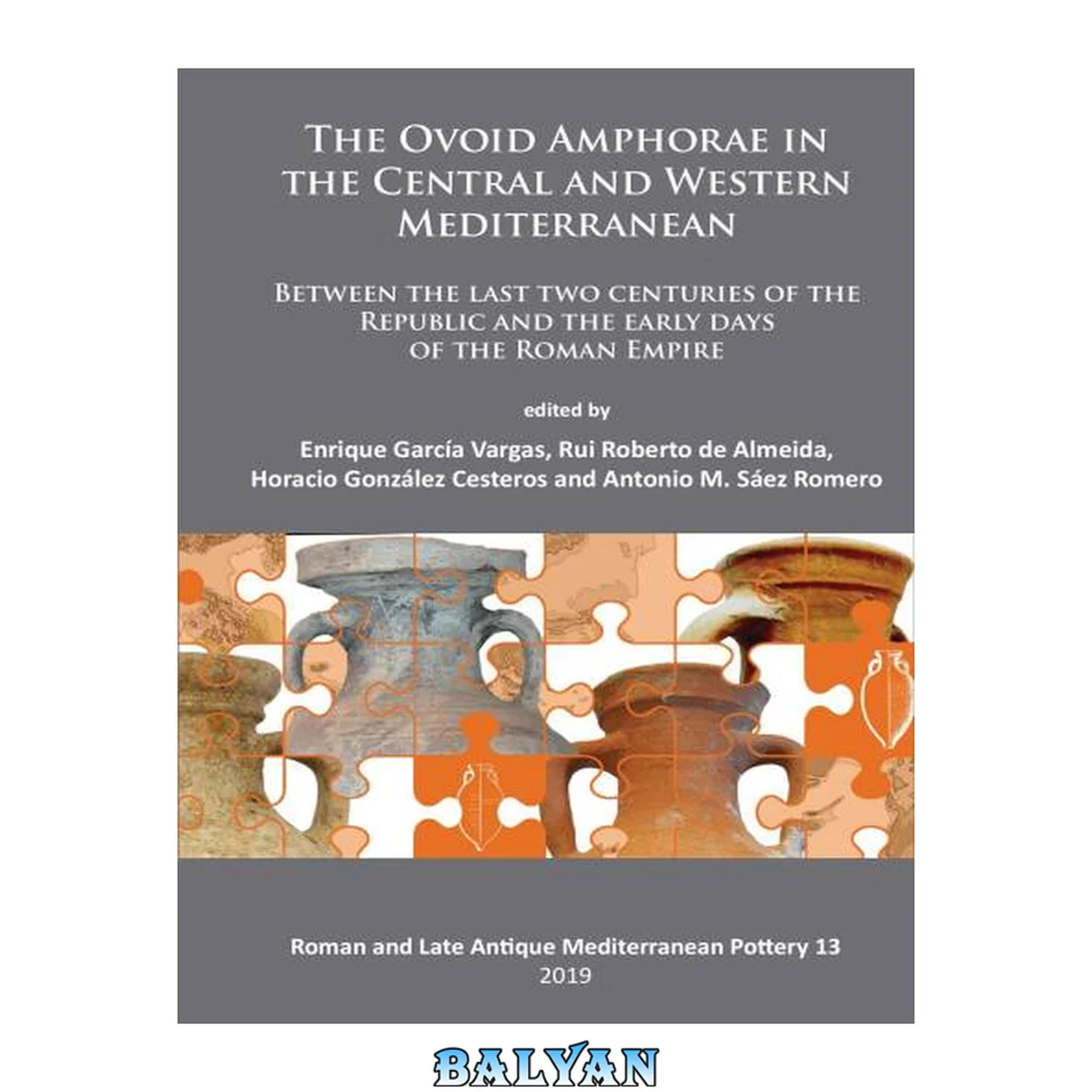
آمفورههای تخممرغی در مدیترانه مرکزی و غربی: بین دو قرن آخر جمهوری و روزهای اولیه امپراتوری روم (سرامیک مدیترانهای روم و اوایل قرون وسطی)
The Ovoid Amphorae in the Central and Western Mediterranean: Between the last two centuries of the Republic and the early days of the Roman Empire (Roman and Late Antique Mediterranean Pottery)
معرفی کتاب «آمفورههای تخممرغی در مدیترانه مرکزی و غربی: بین دو قرن آخر جمهوری و روزهای اولیه امپراتوری روم (سرامیک مدیترانهای روم و اوایل قرون وسطی)» (با عنوان لاتین The Ovoid Amphorae in the Central and Western Mediterranean: Between the last two centuries of the Republic and the early days of the Roman Empire (Roman and Late Antique Mediterranean Pottery)) نوشتهٔ Enrique García Vargas; Rui Roberto de Almeida; Antonio Saez Romero; Horacio González Cesteros، منتشرشده توسط نشر Archaeopress Access Archaeology در سال 2019. این کتاب در فرمت pdf، زبان انگلیسی ارائه شده است.
نویسنده
Enrique García Vargas; Rui Roberto de Almeida; Antonio Saez Romero; Horacio González Cesteros
ناشر
Archaeopress Access Archaeology
سال انتشار
2019
فرمت
pdf
زبان
en
شابک
9781789692969
دسته
بدون دستهبندی
The production of amphorae and the export of commodities transported in them was a key activity for the Mediterranean world in Antiquity. Consequently, their study is of enormous value for analysing the agricultural and fishing economy, and also the commercial mechanism of that period. Through the typological and chronological analysis of these ceramic containers, a high degree of knowledge has been achieved, especially for the production of the different Mediterranean societies from the second millennium BC to the Middle Ages. In The Ovoid Amphorae in the Central and Western Mediterranean between the last two centuries of the Republic and the early days of the Roman Empire, several series of amphorae created in the Late Republican Roman period (2nd and 1st centuries BC) have been studied – a group of material until now little studied. All of these groups of containers share a common feature in the shape of their bodies which is generally ovoid. The fact that they were conceived and developed in the economic and political context in which Rome expanded throughout the Mediterranean, transferring to its new territories its production and commercialization procedures, bears witness to the almost total integration of the Mediterranean markets. This publication is based on the proceedings of the workshop held at Seville University in December 2015. The book brings together contributions on the main production areas of these ovoid amphorae from the Atlantic to the Greek mainland / North Peloponnese, analysing in detail the origins, evolution and disappearance of their main series. It also includes case studies that are particularly relevant in relation to their distribution, consumption patterns, contents and relationship with other groups of amphorae manufactured in the Roman Imperial era. The aim of this publication has been to present an updated and complete synthesis of the so-called ovoid amphorae, from an interdisciplinary, international and diachronic standpoint. The production of amphorae and the export of commodities transported in them was a key activity for the Mediterranean world in Antiquity. Consequently, their study is of enormous value for analysing the agricultural economy and commercial mechanism of that period. Through the typological and chronological analysis of these ceramic containers, a high degree of knowledge has been achieved, especially for the production of the different Mediterranean societies from the second millennium BC to the Middle Ages. In this book, several series of amphorae created in the Late Republican Roman period (2nd and 1st centuries BC) have been studied – a group of material until now little studied. All of these groups of containers share a common feature in the shape of their bodies which is generally ovoid. The fact that they were conceived and developed in the economic and political context in which Rome expanded throughout the Mediterranean, transferring to its new territories its production and commercialization procedures, bears witness to the almost total integration of the Mediterranean markets. This publication is based on the proceedings of the workshop ‘A family business’ held at Seville University in December 2015. The book brings together contributions on the main production areas of these ovoid amphorae from the Atlantic to the Greek mainland / North Peloponnese, analysing in detail the origins, evolution and disappearance of their main series. It also includes case studies that are particularly relevant in relation to their distribution, consumption patterns, contents and relationship with other groups of amphorae manufactured in the Roman Imperial era. The aim of this publication has been to present an updated and complete synthesis of the so-called ovoid amphorae, from an interdisciplinary, international and diachronic standpoint. Cover 1 EDITORIAL BOARD 3 Sponsors 4 Title Page 5 Copyright Page 6 Contents 7 Prologue 9 Introduction 9 Figure 1. Aspect of the lectures of the first session ‘Ovoid amphorae production in the Mediterranean’: 0. Banner of the workshop; 1. Daniele Manacorda; 2. Alessia Contino and Claudio Capelli; 3. Enrique García Vargas, Rui Roberto de Almeida and Horacio 13 Figure 2. Aspect of the lectures of the second session ‘Case studies: commercial routes, consumption contexts and contents’: 7. Alessia Contino, Lucilla D’Alessandro, Albert Ribera i Lacomba and Guillermo Pascual Berlanga; 8. Kevin Quillon and Max Luaces; 14 Figure 3. Some moments of productive discussion: 10. Michel Bonifay; 11. Alessia Contino; 12. Carlos Fabião; 13. Dario Bernal Casasola. 14 Figure 4. General overview of the Poster Session: 14-20. 15 Figure 5. Visit to the Municipal Historical Museum of San Fernando and display of amphorae (including both the museum’s funds and contributions by some of the participants) which represented different Hispanic production areas, fabrics and typologies. 16 Figure 6. Roman wines and garum sponsored by Baetica Wines and Flor de Garum-Majuelo, and the ‘family-photo’ with all the participants of the Workshop. 17 Part I 19 The ovoid amphorae from Aigion, in the north-west Peloponnese. The connections with Corinth and the Brindisi area1 21 Konstantinos Filis 21 Figure 1. Aigion. Urban plan with the workshop areas (from Google Earth). 22 Figure 2. Aigion. Sarantaporou Str. Part of a stoa building (© E.A.A.). 23 Figure 3. Aigion. Messinezis 1 Str. Well – depository, adjacent to a kiln structure, full of broken amphorae (© E.A.A.). 23 Figure 4. Aigion. Mitropoleos and Kleomenous Oikonomou Str. Kiln, tank and building remains from workshop (© E.A.A.). 23 Figure 5. Aigion. Mitropoleos and Kleomenous Oikonomou Str. Road with drainage channel in the middle (© E.A.A.). 24 Figure 6. Aigion. Waste pits on Aigialeos 33 Str. (© E.A.A.). 24 Figure 10. Aigion. Trefoil jug (Photo: K. Filis © E.A.A.). 25 Figure 11. Aigion. Black-glazed feeder (Photo: K. Filis © E.A.A.). 25 Figure 7. Aigion. Mouldmade bowl 25 Figure 8. Aigion. Lamp fragment 25 Figure 9. Aigion. Mouldmade bowl (Photo: K. Filis © E.A.A.). 25 Figure 12. Aigion. Red-glazed (terra sigillata) pottery (Photo: K. Filis © E.A.A.). 26 Figure 13. Aigion. Amphora stands (Photo: K. Filis © E.A.A.). 26 Figure 14. Aigion. Kiln supports (Photo: K. Filis © E.A.A.). 27 Figure 15. Fine micaceous chert Fabric group I (Photo: K. Filis © E.A.A.). 27 Figure 16. Fine micaceous chert Fabric group II, plus argillaceous fragments (Photo: K. Filis © E.A.A.). 28 Figure 17. Aigion amphora type I (Photo: K. Filis © E.A.A.). 29 Figure 18. Aigion amphora type II (Photo: K. Filis © E.A.A.). 31 Figure 19. Aigion amphora type III (Photo: K. Filis © E.A.A.). 32 Figure 20. Stamped amphora handles: Κέρδωνος, Ζωίλου and Σωτήριχου (Photo: K. Filis © E.A.A.). 33 Figure 21. Aigion amphora type I and stamps (Photo and Drawings: K. Filis © E.A.A.). 46 Figure 22. Aigion amphora type I (no. 1-3, 7-8), type II (no. 6), lid (no. 4) and a probably local rectangular stamp (no. 5) (Photo and Drawings: K. Filis © E.A.A.). 47 Figure 23. Aigion amphora type I (no. 1-2 and 8) and type II (no. 3-7 and 9-10) (Photo and Drawings: K. Filis © E.A.A.). 48 Figure 24. Aigion amphora type III (no. 1-6) (Photo: K. Filis © E.A.A.). 49 Produzioni di anfore ovoidi di area brindisina 53 Daniele Manacorda 53 Figura 1. Anfore prodotte a Giancola (Brindisi) nella prima fase (prima metà del I secolo a.C.). 54 Figura 2. Anfore prodotte a Giancola (Brindisi) nella seconda fase (prima e media età augustea). 57 Late Republican and Early Imperial ovoid amphorae: the African production 61 Alessia Contino and Claudio Capelli 61 Figure 1. Rome. Nuovo Mercato Testaccio. The excavation area. (photo Akhet) 61 Figure 2. Rome. Nuovo Mercato Testaccio. Plan of the excavation area. (drawing G. Verde) 62 Figure 3. Rome. Nuovo Mercato Testaccio. Western sector. The Horreum. (photo Akhet) 63 Figure 4. Rome. Nuovo Mercato Testaccio. Eastern sector. The deposit/dump. (photo D. Putortì) 63 Figure 5. Rome. Nuovo Mercato Testaccio. Amphora manufacture. 64 Figure 6. Apani type VII amphora. (Palazzo 2013) 65 Figure 7. M. Tuccius l. f. Galeus amphorae. (Scardozzi 2007) 65 Figure 8. Ancient African Amphorae. Typology 1-3. Triangular rim. Vessels from La Longarina (Ostia) and Nuovo Mercato Testaccio (Rome); 4-6. Rectangular rim. Vessels from Pompeii (Granai del Foro), El Mnhila (Tunisia) and Nuovo Mercato Testaccio (Roma). 67 Figure 9. Ancient African Amphorae. From the ovoid shape to the pseudo-cylindrical shape. Containers from La Longarina (Ostia) and Pompeii (Granai del Foro). (drawings A. Contino) 68 Figure 10. Ovoid amphorae from Jaumegarde B shipwreck. (top, photo A. Contino; below, Carrazé 1977). 69 Figure 11. 1. Ancient African Amphora; 2. Ovoid Italic amphora (?), both from Plane 5 shipwreck. 69 Figure 12. Ancient African Amphora (left) and ovoid Italian amphora (?) (right), both from Cap Camarat 2shipwreck. (photo A. Contino). 70 Table 1 71 Figure 13. Ancient African Amphorae. Typo-petrographical family A (drawings A. Contino, micro-photo C. Capelli). 72 Figure 14. Ancient African Amphorae. Typo-petrographical family B (drawings A. Contino, micro-photo C. Capelli). 73 Figure 15. Ancient African Amphorae. Typo-petrographical family C. (drawings A. Contino, micro-photo C. Capelli). 74 Ovoid amphorae production in the Bay of Cadiz and the southern coast of the Ulterior/Baetica (Late Republican and Early Imperial periods) 130 Enrique García Vargas and Antonio M. Sáez Romero 130 Figure 1. Distribution map of the main sites located in the Bay of Cadiz mentioned in the text: Gregorio Marañón (1), Javier de Burgos (2), Jardín de Cano (3), Verinsur (4), Cerro de la Batería (5), Asteroides st. (6) and Gallineras – Cerro de los Mártire 133 Figure 2. Amphorae from Gallineras (San Fernando, Cadiz). 136 Figure 3. Amphorae found at Gallineras (context excavated in 1999): Gaditan Ovoid (1-4), local Dressel 1C (5-6), T-7.4.3.3 (7), Ovoid 5 from Guadalquivir (8), late Punic Tunisian import (9), tegulae and tile (10-13). 137 Figure 4. Amphorae from Asteroides St. (San Fernando, Cadiz). 138 Figure 5. Local amphorae from a well excavated at Cerro de la Batería (San Fernando, Cadiz): Gaditan Ovoid (1-11) and T-7.4.3.3 (12-18). 140 Figure 6. Pottery found in a well excavated at Cerro de la Batería (San Fernando, Cadiz): local red slip finewares (1-3), black-gloss ware (4-5), Dressel 1C (6-12), Ovoid 5 and 1 (13-14) and Oberaden 83/Haltern 71 from the Guadalquivir valley (16-18) and 141 Figure 7. Amphorae from a little dump at Cerro de la Batería (San Fernando, Cádiz): Gaditan Ovoids rims (1-8), ‘black-gloss ceramic’ in grey fabric (9), local common wares (10-12), late Punic pot (13). 142 Figure 8. Production structures and ceramic dumps from Gregorio Marañón St. (Cadiz). 144 Figure 9. Ceramic kilns excavated at Jardín de Cano site (Puerto de Santa Maria, Cadiz) (after López Rosendo 2008). 147 Figure 10. Clay levigation vats found at Jardín de Cano site (Puerto de Santa Maria, Cadiz) (after López Rosendo 2008). 148 Figure 11. T-7.4.3.3 amphorae and stamps from Jardín de Cano site (Puerto de Santa Maria, Cadiz) (after López Rosendo 2008). 148 Figure 12. Local Dressel 1C amphorae from Jardín de Cano site (Puerto de Santa Maria, Cadiz) (after López Rosendo 2008). 149 Figure 13. Local ovoid and early Dressel 7-11 amphorae from Jardín de Cano site (Puerto de Santa Maria, Cadiz) (after López Rosendo 2008). 150 Figure 14. Amphorae from Javier de Burgos site (Puerto de Santa Maria, Cadiz) (after García Vargas 1998). 152 Figure 15. Amphorae from Javier de Burgos (Puerto de Santa Maria, Cadiz) (after García Vargas 1998). 153 Figure 16. Typological variants of ovoid amphorae series from Cadiz area. 154 Figure 17. Gaditan Ovoid amphorae variants found at the Titan wreck (Île de Levant) (after Quillon and Luaces, in this volume). 155 Figure 18. Individuals of early variants of the Dressel 9 type. 156 Figure 19. Ceramic fabrics of ovoid amphorae from Cádiz insular kiln sites: Gallineras (above) and aCerro de la Batería (below). 157 Figure 20. Republican productions of the suburbs of Malaca: 1-4, finds from Calle Granada 67; 5-17, unpublished local amphorae from various contexts excavated at the Avenida Juan XXIII workshop. 160 Enrique García Vargas 130 Antonio M. Sáez Romero 130 Ánforas ovoides del noreste de la Hispania Citerior Tarraconensis en época tardorepublicana. Ensayo de síntesis 166 Jordi Miró Canals y Ramón Járrega Domínguez 166 Figura 1. Tarraconense 1 a 3 (según López Mullor y Martín Menéndez 2008a: fig. 2). 167 Figura 2. Tarraconense 1 ‘ovoides’. no 1 a 4: Tar. 1A (no 1-3: pecio Cala Bona I; no 4: pecio de Illes Formigues); no 5 y 6: Tar. 1C (Cala Bona I); no 7: Tar. 1D (Castellarnau, Sabadell) (según López Mullor y Martín Menéndez 2008: fig. 5 y 6) 169 Figura 3. Bordes y asa de Tarraconense 2 de Fenals (Lloret de Mar) (según Tremoleda i Trilla 2000: fig. 80). 170 Figura 4. Tarraconense 3. no 1: La Fornaca (Vilassar de Dalt) (Según López Mullor y Martín Menéndez 2008: fig. 5); no 2: El Vilarenc (Calafell) (según Revilla Calvo 2008: fig. 9.3). 171 Figura 5. Hipótesis reconstructiva de la formación de los tipos anfóricos propios de la Península ibérica (según Molina Vidal 1997: fig. 58). 172 Figura 6. Ovoide 4 (según García Vargas, Almeida y González Cesteros 2011: fig. 16) (arriba) y Ovoide 1 (segúnGarcía Vargas, Almeida y González Cesteros 2011: fig. 13) (abajo). 173 Figura 7. Mapa de localización y agrupamiento por zonas de los principales centros de producción de ánforas romanas en Cataluña (Según Tremoleda i Trilla 2008: fig. 2). 174 Figura 8. Planta del centro de Collet de Sant Antoni (Girona) (segúnTremoleda i Trilla 2008: fig. 15). 175 Figura 9. Planta del centro de Fenals (Girona) (Según Tremoleda i Trilla 2008: fig. 16). 175 Figura 10. Mapa de centros de producción de Tarraconense 1-3 ovoides (mapa base de Berni Millet 2015: fig. 6). 1: Llafranc; 2: Collet de Sant Antoni; 3: Fenals; 4: El Roser; 5: El Sot del Camp; 6: Horta Nova; 7: Les Casetes; 8: Can Notxa; 9: Can Portell 176 Figura 11. Planta general de los sectores excavados o prospectados en Ca l’Arnau/Can Mateu en Cabrera de Mar. 176 Figura 12. Planimetría del horno de Ca l’Arnau (según Martín Menéndez, reproducidos en Martínez Ferreras 2014: fig. 100 y 101). 177 Figura 13. Villa de La Salut (Sabadell) (Martínez Ferreras 2014: fig. 46). 177 Figura 14. Planta de la villa de El Vilarenc (Calafell) (según Revilla Calvo 2010: fig. 1). 177 Figura 15. Cuadro de los centros donde además de Tarraconense 1 se fabricaban otras ánforas. 178 Figura 16. Estampillas del pecio de Cala Bona I: marcas sobre Tar. 1A (no 1-8) y Tar. 1C (no 9-11) (según Martín Menéndez 2008: fig. 11 y 12). 180 Figura 17. Otras estampillas. no 1 y 2: Baetulo (según M. Comas i Solà 1997, no 2 y 9); no 3: pecio de Illes Formigues sobre Tar. 1A (según Pascual i Guasch 1991: no 275). 182 Figura 18. Mapa de difusión de las ánforas ovoides de la Tarraconense citerior. 1: Port-la-Nautique; 2: Narbonne; 3: Lattes; 4: Arles; 5: Nîmes; 6: Vienne; 7: Lyon; 8: Bibracte; 9: Vieille-Toulouse; 10: Agen; 11: Burdigala; 12: Libourne; 13: Périgueux; 14 186 The ‘early production’ of Roman amphorae in Ulterior / Lusitania. 193 Rui Roberto de Almeida 193 Carlos Fabião 193 Rui Roberto de Almeida and Carlos Fabião 193 Figure 1. Map of Hispania, with emphasis on Lusitania, indicating the main geographical and/or pottery-making entities mentioned in the text: 1) Central Atlantic Coast; 2) Tagus valley; 3) Sado valley; 4) Central Alentejo; 5) Augusta Emerita territory; 6) 194 Figure 2. a) Lusitana 12 on the typology of Dias Diogo (Diogo 1987); b) Lusitana 12 specimens and morphometric study of some examples at Troia (Diogo and Trindade 1998). 195 Figure 3. Types of amphorae produced at Lusitanian workshops and attributable to the Early Principate: 1) Largo da Misericórdia (Silva 1996); 2) Abul (Mayet and Silva 2002); 3) Morraçal da Ajuda, Peniche (Cardoso et alii 2016). 197 Figure 4. Several fragmented amphorae attributable to ‘ovoid Lusitanian’ amphorae from today’s Galicia and Northern Portugal settlements (according to Morais 2004). 199 Figure 5. Several fragmented amphorae attributable to ‘ovoid Lusitanian’ amphorae from: 1) Santarém/Scallabis (Arruda, Veigas and Bargão 2006); 2) Castelo da Lousa (Morais and Fabião 2007; Morais 2010); 3) Monte dos Castelinhos (Pimenta and Mendes 2014); 200 Figure 6. Amphorae produced in the kilns of: 1) Parvoíce, Alcácer do Sal (Pimenta, Ferreira and Cabrita 2016); 2) Rua António Granjo, Setúbal (Mayet and Silva 2016: 64-65). 201 Figure 7. Synthesis of the main rim categories: I) thickened sub-rectangular profiles, with a projection in their lower section, at the point rim-to-neck transition; II) plain sub-rectangular profiles, forming ‘collar’ shaped rims; III) profiles with comp 203 Figure 8. Comparison between Lusitana 12 (a), Lusitanian ‘Haltern 70’ (b) and the so-called Dressel 14 var. A from the Sado valley (c). 204 Figure 1. Map of Hispania, with emphasis on Lusitania, indicating the main geographical and/or pottery-making entities mentioned in the text: 1) Central Atlantic Coast; 2) Tagus valley; 3) Sado valley; 4) Central Alentejo; 5) Augusta Emerita territory; 6) Algarve. 194 Figure 2. a) Lusitana 12 on the typology of Dias Diogo (Diogo 1987); b) Lusitana 12 specimens and morphometric study of some examples at Troia (Diogo and Trindade 1998). 195 Figure 3. Types of amphorae produced at Lusitanian workshops and attributable to the Early Principate: 1) Largo da Misericórdia (Silva 1996); 2) Abul (Mayet and Silva 2002); 3) Morraçal da Ajuda, Peniche (Cardoso et alii 2016). 197 Figure 4. Several fragmented amphorae attributable to ‘ovoid Lusitanian’ amphorae from today’s Galicia and Northern Portugal settlements (according to Morais 2004). 199 Figure 5. Several fragmented amphorae attributable to ‘ovoid Lusitanian’ amphorae from: 1) Santarém/Scallabis (Arruda, Veigas and Bargão 2006); 2) Castelo da Lousa (Morais and Fabião 2007; Morais 2010); 3) Monte dos Castelinhos (Pimenta and Mendes 2014); 4) Lisbon, Rua dos Bacalhoeiros (Filipe 2008b); 5) Lisbon, Roman theatre (Filipe 2015). 200 Figure 6. Amphorae produced in the kilns of: 1) Parvoíce, Alcácer do Sal (Pimenta, Ferreira and Cabrita 2016); 2) Rua António Granjo, Setúbal (Mayet and Silva 2016: 64-65). 201 Figure 6. Amphorae produced in the kilns of: 1) Parvoíce, Alcácer do Sal (Pimenta, Ferreira and Cabrita 2016); 2) Rua António Granjo, Setúbal (Mayet and Silva 2016: 64-65). 203 Figure 7. Synthesis of the main rim categories: I) thickened sub-rectangular profiles, with a projection in their lower section, at the point rim-to-neck transition; II) plain sub-rectangular profiles, forming ‘collar’ shaped rims; III) profiles with complex outlines. 203 Figure 8. Comparison between Lusitana 12 (a), Lusitanian ‘Haltern 70’ (b) and the so-called Dressel 14 var. A from the Sado valley (c). 204 De la producción de ánforas Ovoide 1 gaditanas: aportaciones del alfar de Verinsur 209 Darío Bernal-Casasola, José J. Díaz Rodríguez, María Luisa Lavado-Florido y Rosario García-Giménez 209 Figura 1. Mapa de localización de la bahía de Cádiz, con la señalización (en rojo) de la ubicación del alfar de Verinsur y su relación con el resto de talleres alfareros de época romana (A); orto-fotografía del vuelo interministerial (1973-1986) procedent 210 Figura 2. Selección de material datante de los contextos excavados en Verinsur: barniz negro –campaniense B- (1.- Lamboglia 2 – V/17/1/41; 2.- Lamboglia 3 – V17/1/12; 6-9.- Fondos de páteras de la forma Lamboglia 5 o 7 – V/17/1/8, con letras grafitadas en 214 Figura 3. Defectos de cocción de ánforas ovoides en las fosas al norte del horno (A, B.- Fosa 2), y fragmentos hiper-cocidos y deformados asociados a Dressel 1 (1), ovoides (2, 3, 4) y T-7.4.3.3 (5 – 7). 216 Figura 4. Síntesis de la cuantificación de las producciones anfóricas del taller de Verinsur. 217 Figura 5. Selección de ánforas de producción local, tanto tardo-púnicas del tipo T-7.4.3.3 (1 – 11) como Dressel 1 (12- 20). 219 Figura 6. Ovoide 1 gaditana de Verinsur, con detalles de las diferentes partes del envase. 220 Figura 7. Bocas (1-10, 13-16) y pivotes (11-12) de las Ovoide 1 de Verinsur. 222 Figura 8. Análisis mineralógico semi-cuantitativo (A), de elementos mayores (B) y de elementos menores y trazas (c) de las muestras y de los patrones (n.d. = no detectado). 224 Figura 9. Análisis mineralógico de las muestras y patrones de arcilla (A), con detalle de las pastas amarillentas (B) y de las de coloración rojiza (C). 225 Case studies, commercial routes, consumption contexts and contents 231 Ovoid Amphoras found in Hellenistic Southern Levant contexts: their chronology and need for proveniences 233 Gerald Finkielsztejn 233 Northern Peloponnesian amphorae with convex-concave rims from the Styra A Shipwreck 246 Lucie S. Vidličková 246 Ovoid African and Hispanic amphorae in Italy Some examples from Ostia and Pompeii 255 Alessia Contino, Lucilla D’Alessandro, Guillermo Pascual Berlanga and Albert Ribera i Lacomba 255 The Italic ovoid amphorae in the Toulouse area at the end of the Iron Age (Midi-Pyrénées, France) 292 Laurence Benquet1 292 The diffusion of south-Hispanic ovoid amphorae in Gaul, between the Late Republican and Early Empire times 316 Kevin Quillon and Max Luaces 316 Distribution of ovoid amphorae in north-west Europe. Consumption contexts and main trade routes 332 Horacio González Cesteros 332 Amphorae of the Brindisi area in Gallia Belgica: The example of Titelberg (Luxembourg) 355 Debora C. Tretola Martinez 355 Ovoid amphorae in Hispania Citerior/Tarraconenis: consumption contexts and main trade areas 364 Daniel Mateo Corredor and Jaime Molina Vidal 364 La importación de ánforas ovoides en la Tarraco republicana 385 Moisés Díaz García 385 Are you Local?1 394 Imported and locally produced amphorae in Alto Alentejo (Portugal) 394 Rui Mataloto, Joey Williams and Conceição Roque 394 Preliminary organic residue analysis of Ovoid 1 and Ovoid 5 amphorae from the Guadalquivir valley 409 Darío Bernal-Casasola, Alessandra Pecci and Antonio M. Sáez Romero 409 Ovoid Amphorae in the Mediterranean (2nd-1st centuries BC). State of the play and future research perspectives 421 Part II 231 Ovoid amphorae throughout the Mediterranean. Case studies, commercial routes, consumption contexts and contents 231 Ovoid Amphoras found in Hellenistic Southern Levant contexts: their chronology and need for proveniences 233 Gerald Finkielsztejn 233 Figure 1. a. Southern Levant: map of the geo-ethnical regions; b. Southern Levant: map of the main cities and sites mentioned. 234 Figure 2. Mazor: plan of the buildings (© Y. Zelinger). 235 Figure 3. Mazor: the ovoid amphoras. 236 Figure 4. Khirbet el-Eika: the amphora storeroom with the ovoid amphora (© U. Liebner). 237 Figure 5. Khirbet el-Eika: the top of the ovoid amphora. 238 Figure 7. Ascalon-Barnea (Peretz): the ovoid amphora bases. 239 Figure 8. Maresha: map of the acropolis and the subterranean complexes (with numbers of those mentioned) (© A. Kloner). 239 Figure 10. Maresha: the compared quantities of the main classes of amphoras of the last phase of occupation (c. 143/2-108/7 BC). 240 Figure 9. Maresha: chronological breakdown of the dated eponym stamps. 240 Figure 11. Maresha: African ovoid amphoras. 241 Figure 12. Maresha: Italian (?) ovoid amphoras. 242 Figure 13. Jerusalem, Jewish Quarter: map of the excavations with Areas E and J in the centre (© N. Avigad). 243 Figure 14. Jerusalem, Jewish Quarter: the ovoid amphora rims and necks. 243 Northern Peloponnesian amphorae with convex-concave rims from the Styra A shipwreck 246 Lucie S. Vidličková 246 Figure 1. Location of the Styra Island (above) and the shipwrecks discovered (below). 247 Figure 2. Detailed plan of the cargo of the Styra A Shipwreck. 248 Figure 3. Intact full-sised amphorae recovered from the Styra A shipwreck. 249 Figure 4. Koan type vessel recovered on the shipwreck’s upper layer. 250 Figure 5. Athenian Agora, Mask Cistern. Rim fragment (P 37601 a) related with the ones documented at the Styra A shipwreck. 250 Figure 6. Accompanying finds from the Styra A Shipwreck. 1: lagynos; 2: unglazed plate; 3: on-board vessel with conical body and flat ring-base; 4: unusual vessel resembling a table amphora from Corinth. 251 Figure 7. Thin section petrograph photos from the vessels from the Styra A shipwreck. 252 Ovoid African and Hispanic amphorae in Italy Some examples from Ostia and Pompeii 255 Alessia Contino, Lucilla D’Alessandro, Guillermo Pascual Berlanga and Albert Ribera i Lacomba 255 Figure 1. Location of Longarina sites (P: Longarina 2 = excavations 2005; Q: Longarina 1 = excavations 1975) at the suburb of Ostia in Roman times (Pannuzi 2007: table. I, by G. July). 256 Figures 2 and 3. Location and topographic relief of amphorae deposits in Longarina 2 (Pannuzi et al., 2006: figs. 28-29. Drawing by F. Cenciotti). 258 Figure 4. Longarina-Ostia. Ancient African amphorae. Ovoid body. 1. Lon 33549; 2. Lon 33538; 3. Lon P2757; 4. Lon 33546; 5. Lon 33587. (drawings by A. Contino). 260 Figure 5. Longarina-Ostia. Ancient African amphorae. 1. Lon 33549; 2. Lon P2757; 3. Lon 33546; 4. Lon 33587. (photos by R. Sebastiani). 261 Figure 6. Longarina-Ostia. Ancient African amphorae. 6-7. Lon P2761-Lon 33583. Pseudo-cylindrical body. 8. Lon p2763. Ancient African similis. 9. Lon 33709. Fragmentary Ancient African. 10-11. Lon P2756 and Lon 33567. Small format Amphora. (drawings by A. 262 Figure 7. Pompeii, Granai del Foro. Late Ancient African amphorae with a pseudo-cylindrical body. 1. Pom 26037; 2. Pom 43184; 3. Pom sn 189. (drawings by A. Contino). 263 Figure 8. Longarina-Ostia. Ancient African amphorae of small format. Lon P2756 and Lon 33567. (photo by R. Sebastiani). 263 Figure 9. Longarina-Ostia. Ancient African amphorae. Petrographic analysis and indications of origin. (microphotograph by C. Capelli). 265 Figure 10. 1-2. Longarina-Ostia. Lon 33542, Lon 33510. Ovoid Tripolitanian amphorae (?). 3. Nuovo Mercato Testaccio. NMT 1.88. Ovoid Tripolitanian amphora (?); 4. Longarina-Ostia. Lon p2755. Early African amphora. (drawings by A. Contino). 266 Figure 11. Longarina-Ostia. Ovoid Hispanic amphorae related to the type Oberaden 83 (photo by A. Contino). 267 Table 1. La Longarina 1, Ostia, Horrea Epagathiana. Ancient African and Early Tripolitanian Amphorae (A.C.) 268 Figure 12. Longarina 2. Ovoid amphora of Gaditan production, inv. 59256, amphora 3 (photo by G. Sanguinetti ©, Soprintendenza Speciale per il Colosseo, il Museo Nazionale Romano e l’area archeologica di Roma, sede di Ostia). 269 Figure 13. Longarina 2. Ovoid amphora, inv. 59286, amphora 33, possibly Tarraconense 1 (photo by G. Sanguinetti ©, Soprintendenza Speciale per il Colosseo, il Museo Nazionale Romano e l’area archeologica di Roma, sede di Ostia). 269 Figure 14. Longarina 2. Ovoid amphora, inv. 59266, amphora 13, possibly a Catalan production (photo by G. Sanguinetti ©, Soprintendenza Speciale per il Colosseo, il Museo Nazionale Romano e l’area archeologica di Roma, sede di Ostia). 270 Figure 15. Longarina 2. Amphora inv. 59278, amphora 25 (photo by G. Sanguinetti ©, Soprintendenza Speciale per il Colosseo, il Museo Nazionale Romano e l’area archeologica di Roma, sede di Ostia). 271 Figure 16. Longarina 2. Amphora inv. 59271, amphora 18 (photo by G. Sanguinetti ©, Soprintendenza Speciale per il Colosseo, il Museo Nazionale Romano e l’area archeologica di Roma, sede di Ostia). 272 Figure 17. Longarina 2. Flat-bottomed amphora, inv. 59259, amphora 6 (photo by G. Sanguinetti ©, Soprintendenza Speciale per il Colosseo, il Museo Nazionale Romano e l’area archeologica di Roma, sede di Ostia). 273 Figure 18. Rome. Ancient African amphorae. 1-3; Nuovo Mercato Testaccio. Fragmented amphorae (drawings by A. Contino); 4. Vigna Barberini. Fragmented amphora (Rizzo 2003); 5. Rome, Via Nelli. Amphora (Lissi Caronna 1968). 274 Figure 19. Amphorae groups from Pompeii. 276 Table 2. La Longarina 1 and 2 deposits comparison. 276 Figure 20. Map showing the location of the House of Ariadne and via degli Augustali. 277 Table 3. Amphorae from the House of Ariadne. 278 Figure 21. Amphorae dated in the Late-Samnite period (100-80 BC). Ancient African (2019-29) and Brindisi (2019-21). 279 Figure 22. Punic amphorae from the House of Ariadne. 281 Figure 23. Amphorae dated in the Julio-Claudian period. Ancient African (2304-5, 105, 106) and Brindisi amphorae (2304-17). 282 Figure 24. Amphorae recovered from the fill of the basin 32. Ancient African (4255-17). 283 Figure 25. Amphora with the titulus TAVR recovered from the fill of the basin 30. 284 Figure 26. Amphorae found in the ‘cantina’ from the House of Ariadne at Pompeii. 79 AD. 285 The diffusion of south-Hispanic ovoid amphorae in Gaul, between the Late Republican and Early Empire times 316 Kevin Quillon 316 Max Luaces 316 Kevin Quillon and Max Luaces 316 Figure 1. Drawing and picture of a Gaditan ovoid amphora from southern France (from Sáez Romero and Luaces 2014). 317 Figure 2. Map of the Western Mediterranean, with some of the major cities in the Gallia Narbonensis and Hispania Ulterior provinces. Various shipwrecks with Hispanic ovoid amphorae are presented, along with the contexts that will be studied here (number s 318 Figure 3. Ovoid amphora from French Mediterranean shipwrecks: 1. Cap Sicié; 2. Dramont A; 3-4. Planier 5; 5. Titan (1, from Tchernia 1969; 2, from Benoit 1958; 3-4, from Benoit 1962; 5, from Benoit 1956). 319 Figure 4. Gaditan ovoid amphora types 1 and 2 from the Grand-Congloué 3 shipwreck (original drawings by Kevin Quillon). 321 Figure 5. Gaditan ovoid amphorae types 3 and 4 from the Grand-Congloué 3 shipwreck (drawings 1, 2 and 4 by Kevin Quillon; 3 and 5 from Liou 2000). 322 Figure 6. Guadalquivir ovoid amphorae types 3 and 4 according to Almeida’s typology and Lomba do Canho 67 amphora from the Grand-Congloué 3 shipwreck (drawings 1, 2, 3 and 4 by Kevin Quillon; 5 and 6 from Liou 2000). 323 Figure 7. Dressel 12 and Dressel 1C from the Grand-Congloué 3 shipwreck (original drawings by Kevin Quillon). 324 Figure 8. Drawings of early Hispanic ovoid amphorae from Ensérune. Rim fragment 1 being almost certainly a Gaditan ovoid type (original drawing by Max Luaces). 324 Figure 9. Updated map of the remains at the mining site of Lascours (drawing by Max Luaces). 326 Figure 10. Drawing of the Gaditan ovoid amphora sherd from Lascours, no L 85 V (original drawing by Max Luaces). 327 Figure 11. Updated map of the Sanctuary of Cybele site in modern Lyon (from Desbat 1998: 243). 327 Figure 12. Various sherds of amphorae defined as Gaditan ovoid from the Sanctuary of Cybele. Material discovered in the first stratum of occupation in the A8 survey. 328 Figure 13. A set of south-Hispanic Amphorae from the site of Ensérune, with the same fabric (maybe from Gadir?), but with distinct and separate chronologies: end of the 2nd century BC (numbers 1 and 2), first half of the 1st century BC (numbers 3 and 4, m 329 Distribution of ovoid amphorae in north-west Europe. Consumption contexts and main trade routes 332 Horacio González Cesteros 332 Figure 1. Map of the north-western regions of the Roman Empire. 334 Figure 2. Amphorae from different tombs of Goblingen-Nospelt (Martin-Kilcher, Tretola and Vogt 2009). 335 Figure 3. Dressel 9 from Clemency (left: Martin-Kilcher 1994; right: Metzler et al. 1991). 336 Figure 4. Gaditan Ovoid from the Rheinisches Landesmuseum in Trier. Personal photo of the author. 339 Figure 5. Ovoid amphorae found in different contexts in Lyon. 342 Figure 6. Early Oberaden 83 with a red-ink inscription found in the military fort of Neuss. 343 Figure 7. Brindisian amphorae found in the military fort of Neuss. 344 Figure 8. Rim of ‘ante Dressel 6B’ from Neuss. 344 Figure 9. Map of the most important productive
دانلود کتاب آمفورههای تخممرغی در مدیترانه مرکزی و غربی: بین دو قرن آخر جمهوری و روزهای اولیه امپراتوری روم (سرامیک مدیترانهای روم و اوایل قرون وسطی)