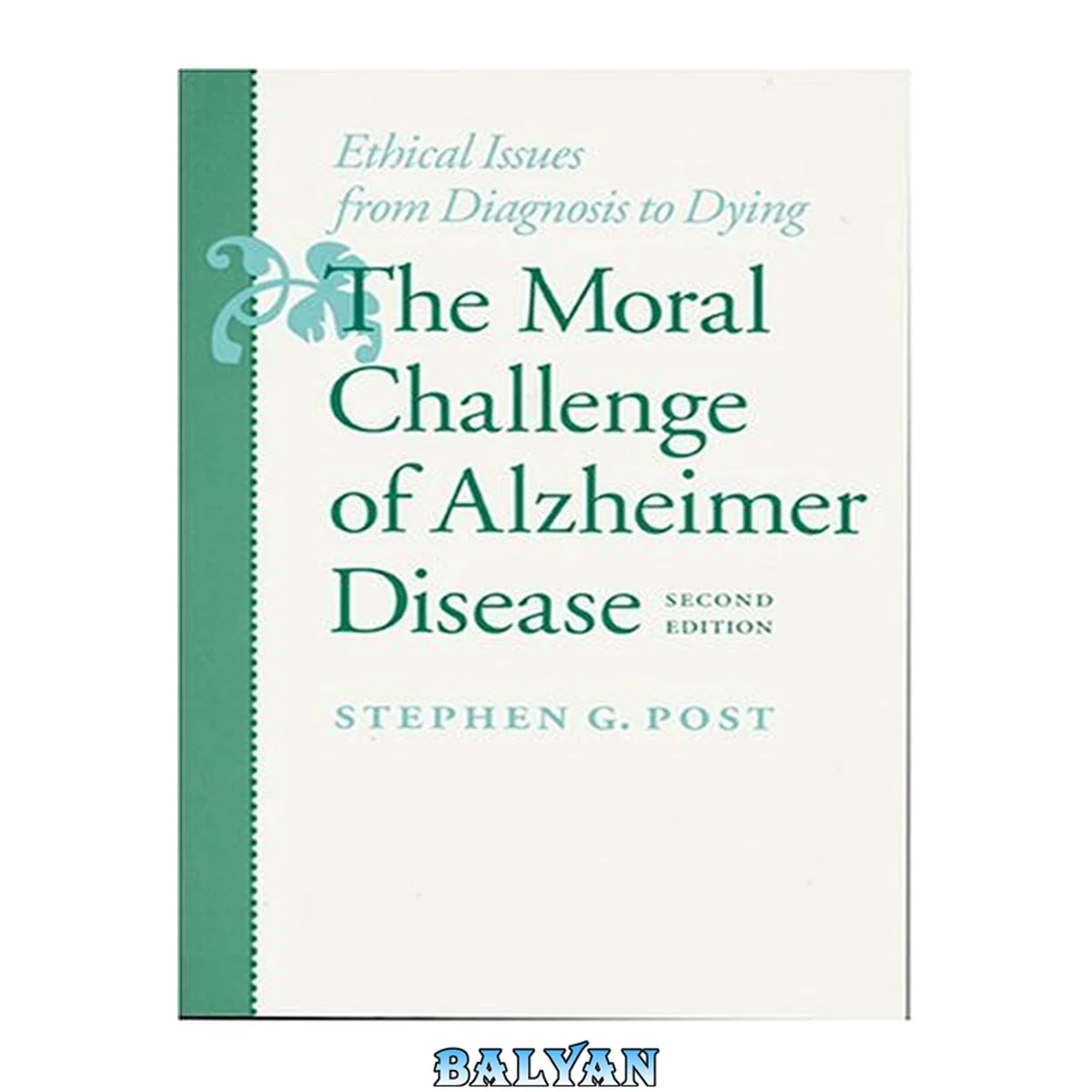
معرفی کتاب «The Moral Challenge of Alzheimer Disease: Ethical Issues from Diagnosis to Dying (Gerontology)» نوشتهٔ Stephen Garrard Post; NetLibrary, Inc، منتشرشده توسط نشر The Johns Hopkins University Press; Johns Hopkins University Press در سال 2000. این کتاب در فرمت pdf، زبان انگلیسی ارائه شده است.
Society today, writes Stephen Post, is "hypercognitive": it places inordinate emphasis on people's powers of rational thinking and memory. Thus, Alzheimer disease and other dementias, which over an extended period incrementally rob patients of exactly those functions, raise many dilemmas. How are we to view—and value—persons deprived of what some consider the most important human capacities? In the second edition of The Moral Challenge of Alzheimer Disease , Post updates his highly praised account of the major ethical issues relating to dementia care. With chapters organized to follow the progression from mild to severe and then terminal stages of dementia, Post discusses topics including the experience of dementia, family caregiving, genetic testing for Alzheimer disease, quality of life, and assisted suicide and euthanasia. New to this edition are sections dealing with end-of-life issues (especially artificial nutrition and hydration), the emerging cognitive-enhancing drugs, distributive justice, spirituality, and hospice, as well as a critique of rationalistic definitions of personhood . The last chapter is a new summary of practical solutions useful to family members and professionals. Society today, writes Stephen Post, is "hypercognitive": it places inordinate emphasis on people's powers of rational thinking and memory. Thus, Alzheimer disease and other dementias, which over an extended period incrementally rob patients of exactly those functions, raise many dilemmas. How are we to view -- and value -- persons deprived of what some consider the most important human capacities?In the second edition of The Moral Challenge of Alzheimer Disease, Post updates his highly praised account of the major ethical issues relating to dementia care. With chapters organized to follow the progression from mild to severe and then terminal stages of dementia, Post discusses topics including the experience of dementia, family caregiving, genetic testing for Alzheimer disease, quality of life, and assisted suicide and euthanasia. New to this edition are sections dealing with end-of-life issues (especially artificial nutrition and hydration), the emerging cognitive-enhancing drugs, distributive justice, spirituality, and hospice, as well as a critique of rationalistic definitions of personhood. The last chapter is a new summary of practical solutions useful to family members and professionals.Praise for The Moral Challenge of Alzheimer Disease:"Health professionals who deal with dementia, as well as family members who care for relatives who become disabled, will find this book thoughtful, engaging, and provocative." -- New England Journal of Medicine"The genuine concern and caring that permeates this well-researched, informative and moving book leads me to recommend it highly both to academic and general readers."-- Heythrop Journal"This is a much needed and inspirational addition to the literature of Alzheimer's disease... Ethics Committees will find it invaluable as will nursing home administrators, directors of nursing, and all who care for people no longer able to care for themselves." -- Journal of Long-Term Care Administration"An intelligent and morally informed treatment of dementia in the aged." -- First Things"Full of nourishing food for thought... The Moral Challenge of Alzheimer Disease presents the reader with a clear offering of concerns, ideas, and issues about the quality of life and quality of choice issues." -- American Journal of Alzheimer's Disease"Stephen Post has produced an outstanding, potentially classic book. It is well written, clear, patiently argued, and broadly referenced. Readers can learn much about Alzheimer's disease from this book." -- Health Affairs Society today, writes Stephen Post, is "hypercognitive": it places inordinate emphasis on people's powers of rational thinking and memory. Thus, Alzheimer disease and other dementias, which over an extended period incrementally rob patients of exactly those functions, raise many dilemmas. How are we to view -- and value -- persons deprived of what some consider the most important human capacities?In the second edition of The Moral Challenge of Alzheimer Disease, Post updates his highly praised account of the major ethical issues relating to dementia care. In chapters organized to follow the progression from mild to severe and then terminal stages of dementia, Post discusses topics including the experience of dementia, family caregiving, genetic testing for Alzheimer disease, quality of life, and assisted suicide and euthanasia. For the second edition, Post has added new sections dealing with end-of-life issues (especially artificial nutrition and hydration), the emerging cognitive-enhancing drugs, distributive justice, spirituality, and hospice, as well as a critique of rationalistic definitions of "personhood". The last chapter is a new summary of practical solutions useful to family members and professionals. Society today, writes Stephen Post, is "hypercognitive": it places inordinate emphasis on people's powers of rational thinking and memory. Thus, Alzheimer disease and other dementias, which over an extended period incrementally rob patients of exactly those functions, raise many dilemmas. How are we to view—and value—persons deprived of what some consider the most important human capacities? In the second edition of The Moral Challenge of Alzheimer Disease , Post updates his highly praised account of the major ethical issues relating to dementia care. With chapters organized to follow the progression from mild to severe and then terminal stages of dementia, Post discusses topics including the experience of dementia, family caregiving, genetic testing for Alzheimer disease, quality of life, and assisted suicide and euthanasia. New to this edition are sections dealing with end-of-life issues (especially artificial nutrition and hydration), the emerging cognitive-enhancing drugs, distributive justice, spirituality, and hospice, as well as a critique of rationalistic definitions of personhood . The last chapter is a new summary of practical solutions useful to family members and professionals. Cover......Page 1 Contents......Page 6 Preface......Page 8 Acknowledgments......Page 10 1. The Moral Challenge of Alzheimer Disease......Page 12 2. The Family Caregiver......Page 31 3. Fairhill Guidelines on Ethics and the Care of People with Alzheimer Disease......Page 55 4. Genetic Education for a Too-Hopeful Public......Page 77 5. The Humane Goal: Enhancing the Well-being of Persons with Dementia......Page 89 6. Dying with Dignity - The Case against Artificial Nutrition and Hydration......Page 107 7. An Argument against Assisted Suicide and Euthanasia in the Context of Progressive Dementia......Page 121 8. Toward a New Ethics Dementia Care......Page 138 References......Page 154 Index......Page 168
"Gives a highly readable strategy for dealing with end-of-life issues, such as artificial tube feeding and dehydration. In his characteristically clear manner, Post equips us with the necessary facts and then cogently suggest how to proceed humanely and with absolute consideration of the person who should be at the center of concern." -- Perspectives in Biology and Medicine
Journal of Long-Term Care Administration
This is a much needed and inspirational addition to the literature of Alzheimer's disease... Ethics Committees will find it invaluable as will nursing home administrators, directors of nursing, and all who care for people no longer able to care for themselves.
The Moral Challenge Of Alzheimer Disease : Defining The Task -- The Family Caregiver : Partnership In Hope -- Fairhill Guidelines On Ethics And The Care Of People With Alzheimer Disease / With Peter J. Whitehouse -- Genetic Education For A Too-hopeful Public -- The Humane Goal : Enhancing The Well-being Of Persons With Dementia -- Dying With Dignity : The Case Against Artificial Nutrition And Hydration / With Margaret M. Circirella -- An Argument Against Assisted Suicide And Euthanasia In The Context Of Progressive Dementia -- Toward A New Ethics Of Dementia Care. Stephen G. Post. Includes Bibliographical References (p. 143-155) And Index. Seldom does human experience require more courage than in living with the diagnosis and the gradual decline of irreversible progressive dementia.