The Mathematics of Voting and Elections: A Hands-on Approach: Second Edition (Mathematical World) (Mathematical World, 30)
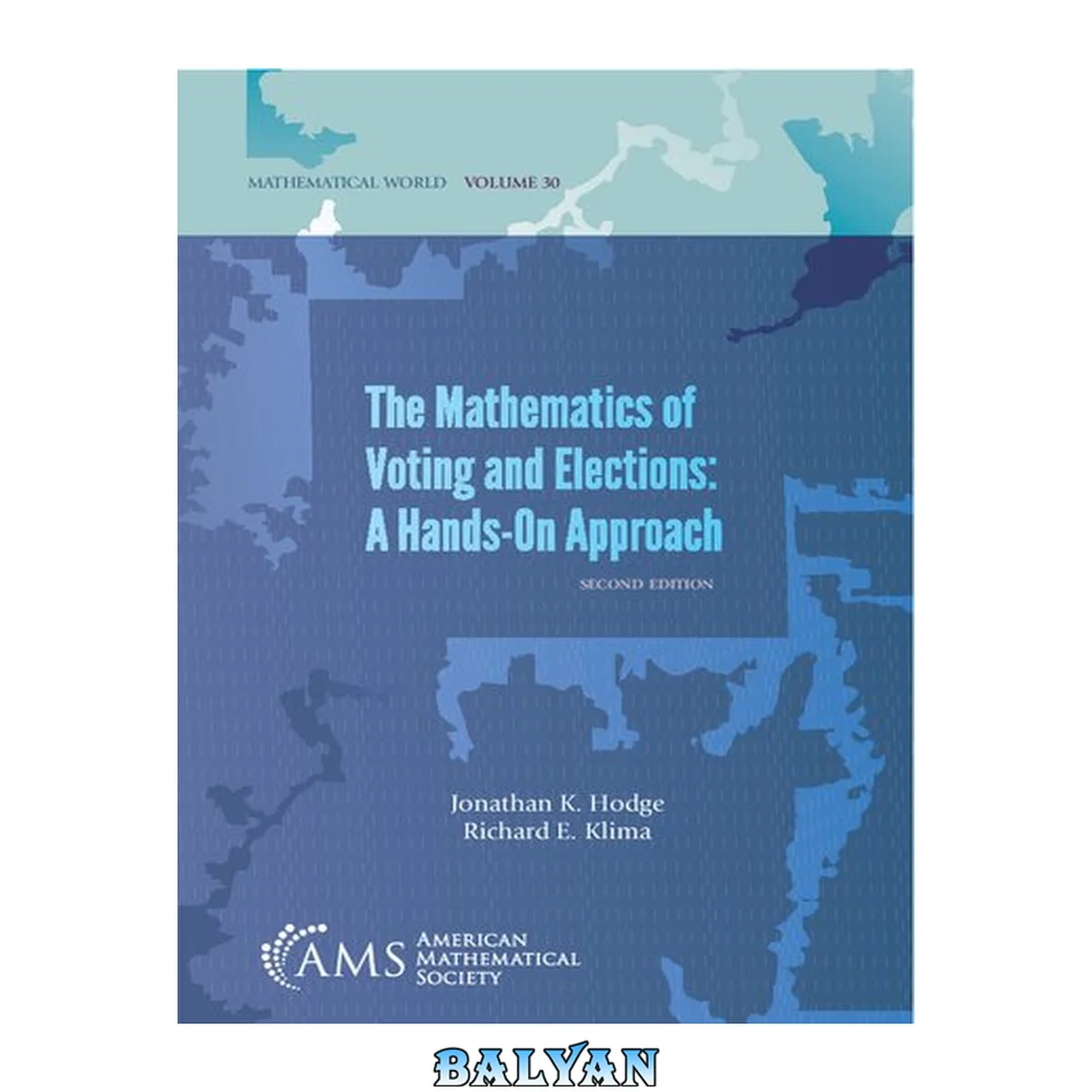
معرفی کتاب «The Mathematics of Voting and Elections: A Hands-on Approach: Second Edition (Mathematical World) (Mathematical World, 30)» نوشتهٔ Ilan Pappé و Richard Ervin Klima; Jonathan K. Hodge، منتشرشده توسط نشر AMS در سال 2018. این کتاب در فرمت pdf، زبان انگلیسی ارائه شده است.
THE MATHEMATICS OF VOTING AND ELECTIONS: A HANDS-ON APPROACH, SECOND EDITION, is an inquiry-based approach to the mathematics of politics and social choice. The aim of the book is to give readers who might not normally choose to engage with mathematics recreationally the chance to discover some interesting mathematical ideas from within a familiar context, and to see the applicability of mathematics to real-world situations. Through this process, readers should improve their critical thinking and problem solving skills, as well as broaden their views of what mathematics really is and how it can be used in unexpected ways. The book was written specifically for nonmathematical audiences and requires virtually no mathematical prerequisites beyond basic arithmetic. At the same time, the questions included are designed to challenge both mathematical and non-mathematical audiences alike. More than giving the right answers, this book asks the right questions.The book is fun to read, with examples that are not just thought-provoking, but also entertaining. It is written in a style that is casual without being condescending. But the discovery-based approach of the book also forces readers to play an active role in their learning, which should lead to a sense of ownership of the main ideas in the book. And while the book provides answers to some of the important questions in the field of mathematical voting theory, it also leads readers to discover new questions and ways to approach them.In addition to making small improvements in all the chapters, this second edition contains several new chapters. Of particular interest might be Chapter 12 which covers a host of topics related to gerrymandering.ReadershipUndergraduate students and general readers interested in mathematical aspects of various voting procedures. Cover 1 Title page 4 Preface 10 Acknowledgments 14 Chapter 1. What’s So Good About Majority Rule? 16 The Mayor of Stickeyville 16 Anonymity, Neutrality, and Monotonicity 18 Majority Rule and May’s Theorem 20 Quota Systems 21 Back to May’s Theorem 23 Questions for Further Study 25 Answers to Starred Questions 27 Chapter 2. Le Pen, Nader, and Other Inconveniences 30 The Plurality Method 32 The Borda Count 33 Preference Orders 35 Back to Borda 37 May’s Theorem Revisited 38 Questions for Further Study 40 Answers to Starred Questions 45 Chapter 3. Back into the Ring 48 Condorcet Winners and Losers 50 Sequential Pairwise Voting 53 Instant Runoff 57 Putting It All Together 60 Questions for Further Study 61 Answers to Starred Questions 64 Chapter 4. Trouble in Democracy 68 Independence of Irrelevant Alternatives 69 Arrow’s Theorem 73 Pareto’s Unanimity Condition 78 Concluding Remarks 80 Questions for Further Study 80 Answers to Starred Questions 83 Chapter 5. Explaining the Impossible 86 Proving Arrow’s Theorem 87 Potential Solutions 94 Concluding Remarks 100 Questions for Further Study 101 Answers to Starred Questions 103 Chapter 6. Gaming the System 106 Strategic Voting 107 The Gibbard-Satterthwaite Theorem 108 Proving the Gibbard-Satterthwaite Theorem 110 Concluding Remarks 116 Questions for Further Study 117 Answers to Starred Questions 118 Chapter 7. One Person, One Vote? 120 Weighted Voting Systems 121 Dictators, Dummies, and Veto Power 124 Swap Robustness 125 Trade Robustness 128 Questions for Further Study 130 Answers to Starred Questions 133 Chapter 8. Calculating Corruption 136 The Banzhaf Power Index 137 The Shapley-Shubik Power Index 140 Banzhaf Power in Psykozia 143 A Splash of Combinatorics 145 Shapley-Shubik Power in Psykozia 148 Questions for Further Study 150 Answers to Starred Questions 153 Chapter 9. The Ultimate College Experience 158 The Electoral College 159 The Winner-Take-All Rule 161 Some History 163 Power in the Electoral College 164 Swing Votes and Perverse Outcomes 168 Alternatives to the Electoral College 172 Questions for Further Study 173 Answers to Starred Questions 177 Chapter 10. Trouble in Direct Democracy 178 Even More Trouble 180 The Separability Problem 181 Binary Preference Matrices 183 Testing for Separability 184 Some Potential Solutions 188 Questions for Further Study 194 Answers to Starred Questions 197 Chapter 11. Proportional (Mis)representation 200 The U.S. House of Representatives 201 Hamilton’s Apportionment Method 202 Jefferson’s Apportionment Method 205 Webster’s Apportionment Method 210 Three Apportionment Paradoxes 211 Hill’s Apportionment Method 213 Another Impossibility Theorem 215 Concluding Remarks 216 Questions for Further Study 217 Answers to Starred Questions 220 Chapter 12. Choosing Your Voters 222 Gerrymandering 224 Rules for Redistricting 229 Geometry and Compactness 230 Partisan Symmetry 233 The Efficiency Gap 236 Concluding Remarks 238 Questions for Further Study 239 Answers to Starred Questions 242 Bibliography 244 Index 248 Back Cover 255 The Mathematics of Voting and Elections: A Hands-On Approach, Second Edition, is an inquiry-based approach to the mathematics of politics and social choice. The aim of the book is to give readers who might not normally choose to engage with mathematics recreationally the chance to discover some interesting mathematical ideas from within a familiar context, and to see the applicability of mathematics to real-world situations. Through this process, readers should improve their critical thinking and problem solving skills, as well as broaden their views of what mathematics really is and how it can be used in unexpected ways. The book was written specifically for nonmathematical audiences and requires virtually no mathematical prerequisites beyond basic arithmetic. At the same time, the questions included are designed to challenge both mathematical and non-mathematical audiences alike. More than giving the right answers, this book asks the right questions. The book is fun to read, with examples that are not just thought-provoking, but also entertaining. It is written in a style that is casual without being condescending. But the discovery-based approach of the book also forces readers to play an active role in their learning, which should lead to a sense of ownership of the main ideas in the book. And while the book provides answers to some of the important questions in the field of mathematical voting theory, it also leads readers to discover new questions and ways to approach them. In addition to making small improvements in all the chapters, this second edition contains several new chapters. Of particular interest might be Chapter 12 which covers a host of topics related to gerrymandering. Provides an inquiry-based approach to the mathematics of politics and social choice. The aim of the book is to give readers who might not choose to engage with mathematics recreationally the chance to discover some interesting mathematical ideas from within a familiar context, and to see the applicability of mathematics to real-world situations.
دانلود کتاب The Mathematics of Voting and Elections: A Hands-on Approach: Second Edition (Mathematical World) (Mathematical World, 30)