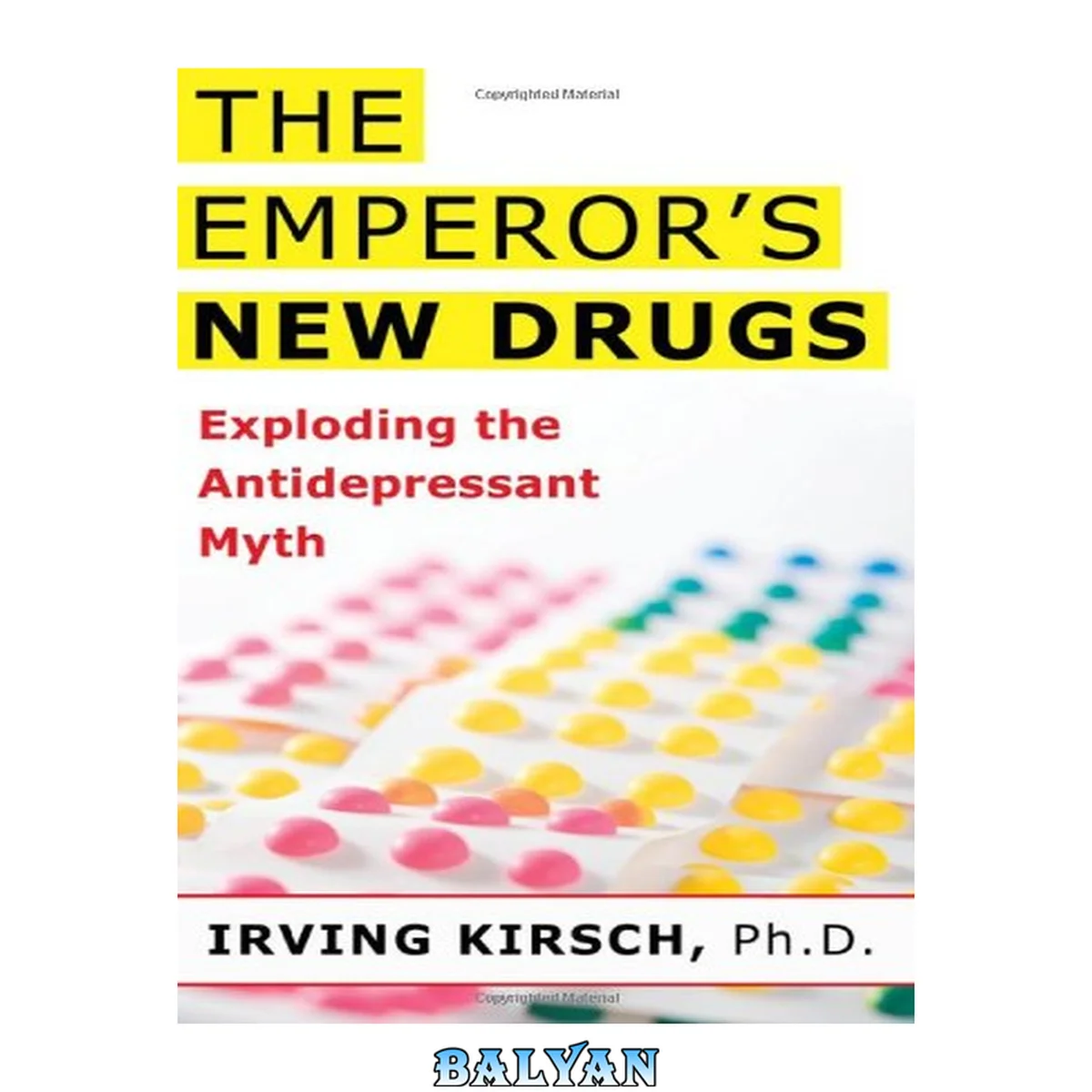
معرفی کتاب «The Emperor's New Drugs : Exploding the Antidepressant Myth» نوشتهٔ Beanie Harper و Irving Kirsch, Ph.D.، منتشرشده توسط نشر Basic Books Perseus Books Group [distributor در سال 2011. این کتاب در فرمت pdf، زبان انگلیسی ارائه شده است.
My first awareness of Dr. Kirsch was on a DVD called Placebo: Mind Over Medicine?, where he participated in a segment regarding antidepressants. It's available from Films for the Humanities and Sciences. It's a real eye opener with respect to the placebo effect! Both informative and entertaining, The Emperor's New Drugs tell a chilling tale of Big Pharma, Inc, and the machinery that brings to market the drugs that are the mainstay of modern medicine. While we have many life enhancing drugs available to us, the history of antidepressants is both revealing and disturbing. It appears that the creation and propagation of antidepressants is less about science's quest to treat a debilitating condition, and more about profits made at the expense of the uninformed consumer. Kirsch doesn't argue that antidepressants don't work, but reveals that the reason they work is largely the result of the placebo effect. In other words, what makes them effective is our belief in them, not the active ingredient in the pills themselves. Maybe it's time for placebo pills to make a come back from the early days of medicine, where the active ingredient is belief, and there are no dangerous side effects. If patients understood how to leverage the power of beliefs to trigger the self-healing response, modern medicine would take a giant leap forward, and patients could take a more active role in their own healing process. In addition to the research about antidepressants, I believe the most important message in Kirsch's book to clinicians and lay people alike, is that our beliefs can powerfully affect our health and general wellbeing. When will modern medicine stop trying to factor the placebo effect out of the equation for health, and start figuring out how to leverage the mind as medicine? The honest answer is, the day the placebo effect can be bottled and sold commercially. Sad, but probably true. It seems that the use of the mind as medicine will be left to mind/body researchers who are willing to look beyond the current medical model. Everyone knows that antidepressant drugs are miracles of modern medicine. By targeting a chemical imbalance in the brain they have restored millions of people to mental health. They are safe and effective and there is a mountain of data to prove it. When Irving Kirsch began to look at that data he knew all this as well as anyone. But, as Kirsch discovered in the course of his research, there's a problem with what everyone knows about antidepressant drugs. It isn't true. When Kirsch analysed clinical trials, he found that antidepressants are not much better than placebos - dummy pills with no active ingredients in them at all. But that was only part of the story. Many of the studies sponsored by the drug companies were never published at all. They had been withheld from the public and even from the doctors who prescribe these medications. Using the Freedom of Information Act, Kirsch obtained the data from the hidden trials and found that the difference between drug treatment and placebo is not clinically significant. Indeed it turns out that antidepressant drugs are less effective - and significantly more dangerous - than other forms of treatment. Yet they are used on a massive scale around the world and are worth serious money to the companies that sell them. In the United States alone the market is worth $12 billion annually. So how did antidepressant drugs gain their reputation as a magic bullet for depression? And why has it taken so long for the story to become public? Answering these questions takes us to the point where science and commerce meet, where the lines between clinical research and marketing strategies blur or disappear altogether. Irving Kirsch documents how the data were suppressed by the drug companies and how government regulatory agencies collaborated in withholding them from public view. He shows that the chemical imbalance theory is simply wrong and that it has been disproven by scientific evidence. This is not a book about alternative medicine and its outlandish claims. This is a book about fantasy and wishful thinking in the heart of clinical medicine, about the seductions of myth, and the final stubbornness of facts
A devastating argument that most antidepressants are little better than souped-up sugar pills, with far-reaching implications for how psychiatry treats depression
Publishers Weekly
Starred Review.
When he began a new research project on antidepressants and placebos (a "meta-analysis" of a large number of published studies), practicing psychotherapist and research psychologist Kirsch (How Expectancies Shape Experience) was surprised to uncover evidence that inadequate supervision by the FDA had allowed pharmaceutical companies to cherry-pick test results for publication and submission to the feds, suppressing unwanted outcomes; further, apparent evidence of active drugs' effectiveness when compared to placebos could often be attributed to patients correctly guessing which group they were in based on the side effects (or the lack thereof) they had come to expect in conjunction with anti-depressants. When his results were published in early 2008, Kirsch was surprised to find himself and his research the subject of front page newspaper stories, TV and radio coverage, and a vigorous debate in the medical community that continues to this day. Writing with a broad audience in mind, Kirsch expands on this important topic in a lively style with clear, cogent explanations of the science involved, and many examples of the differences between solid and flawed research. The result is a fascinating book with broad implications for science policy.
Copyright © Reed Business Information, a division of Reed Elsevier Inc. All rights reserved.
Everyone knows that antidepressant drugs are miracles of modern medicine. Professor Irving Kirsch knew this as well as anyone. But, as he discovered during his research, there is a problem with what everyone knows about antidepressant drugs. It isn't true. How did antidepressant drugs gain their reputation as a magic bullet for depression? And why has it taken so long for the story to become public? Answering these questions takes us to the point where the lines between clinical research and marketing disappear altogether. Using the Freedom of Information Act, Kirsch accessed clinical trials that were withheld, by drug companies, from the public and from the doctors who prescribe antidepressants. What he found, and what he documents here, promises to bring revolutionary change to the way our society perceives, and consumes, antidepressants. The Emperor's New Drugs exposes what we have failed to see before: depression is not caused by a chemical imbalance in the brain; antidepressants are significantly more dangerous than other forms of treatment and are only marginally more effective than placebos; and, there are other ways to combat depression, treatments that don't only include the empty promise of the antidepressant prescription. This is not a book about alternative medicine and its outlandish claims. This is a book about fantasy and wishful thinking in the heart of clinical medicine, about the seductions of myth, and the final stubbornness of facts. Do antidepressants work? Of course -- everyone knows it. Like his colleagues, Irving Kirsch, a researcher and clinical psychologist, for years referred patients to psychiatrists to have their depression treated with drugs before deciding to investigate for himself just how effective the drugs actually were. Over the course of the past fifteen years, however, Kirsch's research -- a thorough analysis of decades of Food and Drug Administration data -- has demonstrated that what everyone knew about antidepressants was wrong. Instead of treating depression with drugs, we've been treating it with suggestion.The Emperor's New Drugs makes an overwhelming case that what had seemed a cornerstone of psychiatric treatment is little more than a faulty consensus. But Kirsch does more than just criticize: he offers a path society can follow so that we stop popping pills and start proper treatment for depression. Kirsch, A Researcher And Clinical Psychologist, For Years Referred Patients To Psychiatrists To Have Their Depression Treated With Drugs Before Deciding To Investigate For Himself Just How Effective The Drugs Actually Were. His Research Has Demonstrated That What Everyone Knew About Antidepressants Was Wrong. Instead Of Treating Depression With Drugs, We've Been Treating It With Suggestion. Listening To Prozac, But Hearing Placebo -- The Dirty Little Secret -- Countering The Critics -- The Myth Of The Chemical Imbalance -- The Placebo Effect And The Power Of Belief -- How Placebos Work -- Beyond Antidepressants. Irving Kirsch. Originally Published: London : Bodley Head, 2009. Includes Bibliographical References (p. [182]-218) And Index. Annotation Irving Kirsch has the world doubting the efficacy of antidepressants. Based on fifteen years of research, The Emperor's New Drugs makes an overwhelming case that what the medical community considered a cornerstone of psychiatric treatment is little more than a faulty consensus. But Kirsch does more than just criticize: He offers a path society can follow to stop popping pills and start proper treatment Contents......Page 10 Brand Names......Page 12 Acknowledgements......Page 14 Preface......Page 16 1......Page 22 2......Page 38 3......Page 69 4......Page 96 5......Page 116 6......Page 146 7......Page 164 Epilogue......Page 192 Notes......Page 197 Bibliography......Page 209 Index......Page 234