The Cognitive Neurosciences (The MIT Press)
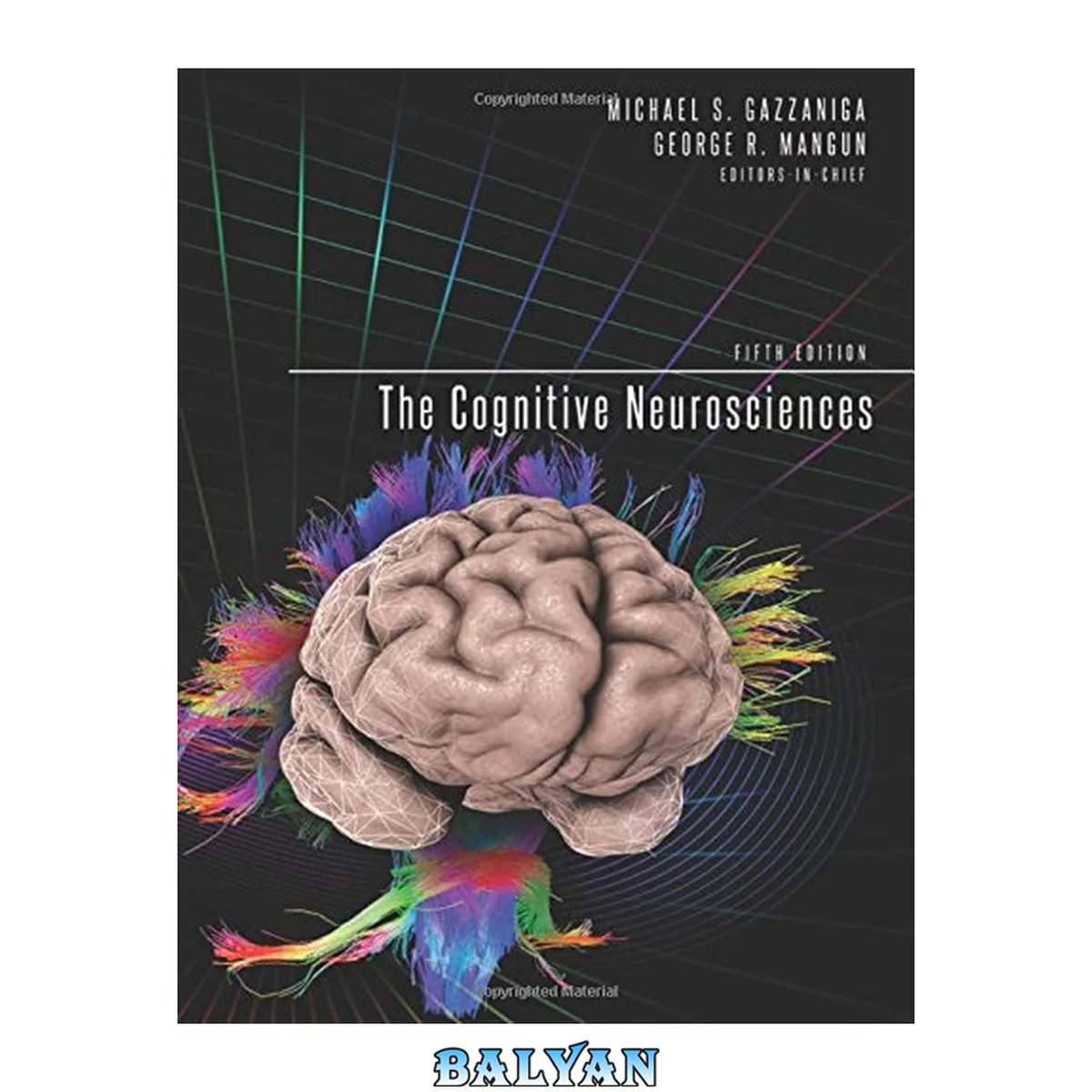
معرفی کتاب «The Cognitive Neurosciences (The MIT Press)» نوشتهٔ Michael S. Gazzaniga (editor), George R. Mangun (editor)، منتشرشده توسط نشر A Bradford Book;The MIT Press در سال 2014. این کتاب در فرمت pdf، زبان انگلیسی ارائه شده است.
Each edition of this classic reference has proved to be a benchmark in the developing field of cognitive neuroscience. The fifth edition of The Cognitive Neurosciences continues to chart new directions in the study of the biological underpinnings of complex cognitio -- the relationship between the structural and physiological mechanisms of the nervous system and the psychological reality of the mind. It offers entirely new material, reflecting recent advances in the field. Many of the developments in cognitive neuroscience have been shaped by the introduction of novel tools and methodologies, and a new section is devoted to methods that promise to guide the field into the future -- from sophisticated models of causality in brain function to the application of network theory to massive data sets. Another new section treats neuroscience and society, considering some of the moral and political quandaries posed by current neuroscientific methods. Other sections describe, among other things, new research that draws on developmental imaging to study the changing structure and function of the brain over the lifespan; progress in establishing increasingly precise models of memory; research that confirms the study of emotion and social cognition as a core area in cognitive neuroscience; and new findings that cast doubt on the so-called neural correlates of consciousness. Contents 6 Preface 14 Part I: Developmental and Evolutionary Cognitive Neuroscience 18 Introduction 20 1 Infant Social Cognition 24 2 Structural Brain Development During Childhood and Adolescence 32 3 Cognitive Control and Affective Decision Making in Childhood and Adolescence 40 4 The Social Brain in Adolescence 50 5 Evolution of the Neural Bases of Higher Cognitive Function in Humans 58 6 The Primate Prefrontal Cortex in Comparative Perspective 68 7 Animal Models of the Human Brain 76 8 Molecular and Cellular Mechanisms of Human Brain Development and Evolution 84 Part II: Plasticity and Learning 92 Introduction 94 9 Organizing Principles of Cortical Circuits and Their Function 96 10 Cost, Efficiency, and Economy of Brain Networks 108 11 Plasticity of Sensory and Motor Systems After Injury in Mature Primates 120 12 Modularity, Plasticity, and Development of Brain Function 136 13 Specificity of Experiential Effects in Neurocognitive Development 146 14 Auditory Cortical Plasticity as a Consequence of Experience and Aging 160 15 The Contribution of Genetics, Epigenetics, and Early Life Experiences to Behavior 168 Part III: Visual Attention 178 Introduction 180 16 Theoretical and Behavioral Aspects of Selective Attention 184 17 Representations of Space and Feature-Based Attentional Priority in Human Visual Cortex 194 18 Electrophysiology of Visual Attentionin Humans 204 19 Spatial Neglect and Attention Networks 214 20 Attentional Modulation of Receptive Field Profiles in the Primate Visual Cortex 228 21 Attentional Selection Through Rhythmic Synchronization at Multiple Frequencies 238 22 Neural Signatures, Circuitry, and Modulators of Visual Selective Attention 250 23 Computational Models of Attention 262 Part IV: Sensation and Perception 272 Introduction 274 24 Constraints on Sensory Processing 278 25 Are Neural Circuits the Best They Can Be? 288 26 Adaptation and Natural Stimulus Statistics 300 27 Perception as an Inference Problem 312 28 Neural Computation in Sensory Systems 322 29 Noise, Correlations, and Informationin Neural Population Codes 336 30 Population-Based Representations 354 31 Relating the Activity of Sensory Neurons to Perception 366 32 Characterizing the Effects of Stimulus and Neural Variability on Perceptual Performance 380 33 Neural Coding of Tactile Perception 392 34 Inferential Models of the Visual Cortical Hierarchy 406 35 The Functional Architecture of Human Ventral Temporal Cortex and Its Role in Visual Perception 422 Part V: Motor Systems and Action 432 Introduction 434 36 Basal Ganglia and Cerebellar Circuits with the Cerebral Cortex 436 37 Basal Ganglia Function 452 38 Cerebellar Function 468 39 Computational Approaches for Goal-Directed Movement Planning and Execution 478 40 Multineuronal Views of Information Processing 494 41 Action Vocabularies and Motor Commands 508 42 Choice Values 518 43 Finding the Actor in Reciprocal Affordance 530 Part VI: Memory 538 Introduction 540 44 Short-Term Memory 544 45 The Medial Temporal Lobeand Memory 556 46 The Contribution of Hippocampal Subregions to Memory Coding 564 47 The Role of Context in Episodic Memory 574 48 Parietal Lobe Mechanisms Subserving Episodic Memory Retrieval 584 49 Memory as Decision Making 594 50 Habits and Reinforcement Learning 608 51 Prediction, Imagination, and Memory 622 Part VII: Language and Abstract Thought 630 Introduction 632 52 Cytoarchitectonics, Receptorarchitectonics, and Network Topology of Language 636 53 The Neurophysiology and Evolution of the Speech Rhythm 646 54 Morphological Systems in Their Neurobiological Contexts 656 55 The “Negatives” and “Positives” of Prediction in Language 666 56 Language in Our Hands 674 57 Neuropragmatics 684 58 Cultural Recycling of Neural Substrates During Language Evolution and Development 692 59 The Emerging Standard Model of the Human Decision-Making Apparatus 700 Part VII: Social Neuroscience and Emotion 710 Introduction 712 60 The Cognitive Neuroscience of Fear and Its Control 714 61 Self-Regulation and Its Failures 726 62 What Is the Role of Control in Emotional Life? 736 63 Emotional Reactivity and Regulation Across Development 748 64 The Amygdala 758 65 Sensory Foundations of Socioemotional Perception 768 66 The Role of the Amygdala in Face Processing 784 67 The Cultural Neuroscience of Human Perception 794 Part IX: Consciousness 804 Introduction 806 68 Neural Correlates of Consciousness 808 69 Toward an Objective Index of Consciousness 818 70 Consciousness Alterations After Severe Brain Injury 828 71 Consciousness and Seizures 838 72 On the Relationship Between Consciousness and Attention 856 73 Consciousness and Its Access Mechanisms 872 74 Bodily Self-Consciousness 882 75 Intention and Agency 892 Part X: Advances in Methodology 904 Introduction 906 76 Computational Causal Modeling of High-Resolution Functional MRI Data 910 77 Multivoxel Pattern Analysis of Functional MRI Data 928 78 Quantitative Magnetic Resonance Imaging 938 79 Network Methods to Characterize Brain Structure and Function 952 80 Using Computational Models to Understand Robustness and Variabilityin Nervous Systems 966 81 Studies of Human Visual Perception Using Cortical Electrical Stimulation 976 82 Optogenetics in the Study of Mammalian Behavior 988 83 Neuroimaging Informatics 998 Part XI: Neuroscience and Society 1006 Introduction 1008 84 The Cognitive Neuroscience of Person Perception 1012 85 Mindreading and Privacy 1020 86 The Cognitive Neuroscience of Moral Judgment and Decision Making 1030 87 Cognitive Neuroscience and Criminal Responsibility 1042 88 Society and Addiction 1052 89 Neuroscience of Antisocial Behavior 1060 90 Neuropharmacology and Society 1072 91 Neuroeconomics 1080 92 The Significance of Cognitive Neuroscience 1088 Contributors 1096 Index 1102 Color Plates 1124 Each edition of this classic reference has proved to be a benchmark in the developing field of cognitive neuroscience. The fifth edition of __The Cognitive Neurosciences__ continues to chart new directions in the study of the biological underpinnings of complex cognitio -- the relationship between the structural and physiological mechanisms of the nervous system and the psychological reality of the mind. It offers entirely new material, reflecting recent advances in the field. Other sections describe, among other things, new research that draws on developmental imaging to study the changing structure and function of the brain over the lifespan; progress in establishing increasingly precise models of memory; research that confirms the study of emotion and social cognition as a core area in cognitive neuroscience; and new findings that cast doubt on the so-called neural correlates of consciousness.
دانلود کتاب The Cognitive Neurosciences (The MIT Press)