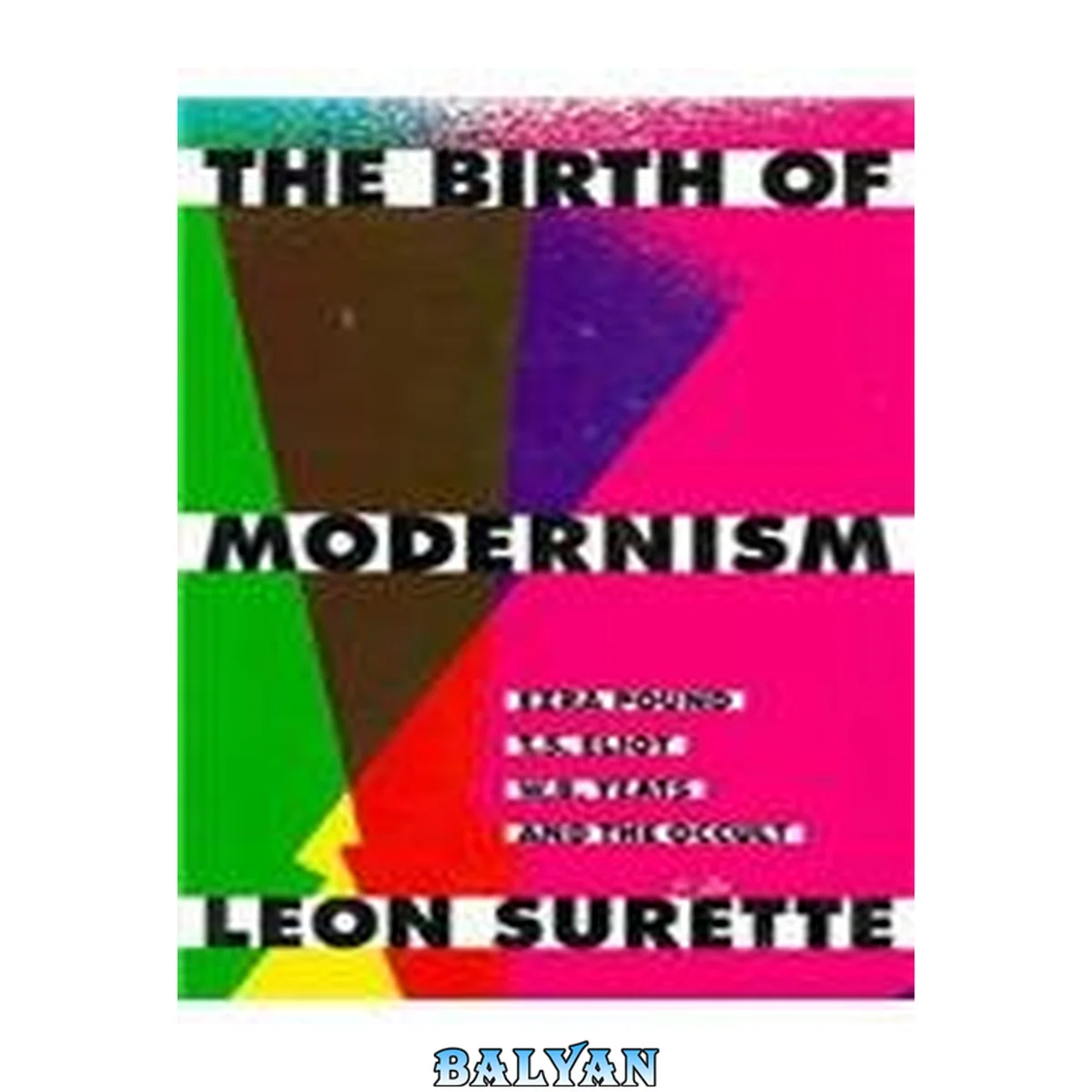
معرفی کتاب «The birth of modernism : Ezra Pound, T.S. Eliot, W.B. Yeats, and the occult» نوشتهٔ Horne، Misha و Eliot, Thomas Stearns; Eliot, Thomas S.; Pound, Ezra; Pound, Ezra; Yeats, William Butler; Yeats, William B.; Pound, Ezra; Yeats, Yeats William Butler.; Eliot, Eliot Thomas Stearns.; Surette, Leon، منتشرشده توسط نشر ACP - McGill Queen's University Press در سال 1993. این کتاب در فرمت pdf، زبان انگلیسی ارائه شده است.
From the back cover of "The Birth of Modernism" - In The Birth of Modernism, Leon Surrete offers a radical revision of our understanding of high modernism. He develops a portrait of Modernism that demonstrates its continuity with American transcendentalism, French symbolisme, and English aestheticism and documents, for the first time, the origins of modernist aesthetics in the occult. Yeats' occultism has long been acknowledged, but this is the first study to show that Pound's early intimacy with Yeats was based largely on a shared interest in the occult sciences, and that Pound's epic of the modern age, The Cantos, is a deeply occult work In The Birth of Modernism Leon Surette offers a radical revision of our understanding of high modernism. Acknowledging that current post-modern and theoretical critiques have provoked fresh examination of the high culture of the first half of this century, Surette rejects their characterization of modernism as positivistic and absolutist, despite the statements in the 1920s of modernists such as Pound, Eliot, and Joyce. He also rejects the diametrically opposed New Critical view of modernism as sceptical and relativistic. Through an explanation of both familiar and little-known theoretical writings of the late nineteenth and early twentieth century -- the work of Friedrich Nietzsche receives particular attention -- Surette develops a portrait of modernism that demonstrates its continuity with American transcendentalism, French symbolisme, and English aestheticism. His account is, in many ways, a revival of an early view of modernism as the heir of symbolisme, but Surette documents, for the first time, the origins of modernist aesthetics in the occult. Yeats' occultism has long been acknowledged, but this is the first study to show that Pound's early intimacy with Yeats was based largely on a shared interest in the occult sciences, and that Pound's epic of the modern age, The Cantos, is a deeply occult work. To substantiate these claims Surette formulates a theory of the occult and analyses the occult speculations of several of Pound's close associates during his London years, relating these to the work of influential Continental occultists and Wagnerians. The author also examines the place of myth and mythopoeia in modernist literature. He scrutinizes the complex provenance of the theories of myth, to which modernists and their apologists appeal, and demonstrates that positive anthropology, Nietzschean philology, Wagnerian opera, symbolisme, and occultism all contribute to the theories expressed by Pound and, to some extent, to Eliot's poetry. In light of these discoveries Surette considers Pound's editing of Eliot's The Waste Land and concludes that the work's early reception as an expression of scepticism and relativism has obscured aspects of the poem that are consistent with Eliot's earlier and later piety. Pound's ruthless cutting of the manuscript, Surette asserts, was not motivated primarily by stylistic concerns, as has generally been contended in the formalist arguments of the New Critics, but by thematic considerations. It was precisely because Eliot knew Pound to be well-informed about the occult that he asked far his assistance with The Waste Land Annotation In The Birth of Modernism Leon Surette offers a radical revision of our understanding of high modernism. Acknowledging that current post-modern and theoretical critiques have provoked fresh examination of the high culture of the first half of this century, Surette rejects their characterization of modernism as positivistic and absolutist, despite the statements in the 1920s of modernists such as Pound, Eliot, and Joyce. He also rejects the diametrically opposed New Critical view of modernism as sceptical and relativistic. Through an explanation of both familiar and little-known theoretical writings of the late nineteenth and early twentieth century - the work of Friedrich Nietzsche receives particular attention - Surette develops a portrait of modernism that demonstrates its continuity with American transcendentalism, French symbolisme, and English aestheticism. His account is, in many ways, a revival of an early view of modernism as the heir of symbolisme, but Surette documents, for the first time, the origins of modernist aesthetics in the occult. Yeats' occultism has long been acknowledged, but this is the first study to show that Pound's early intimacy with Yeats was based largely on a shared interest in the occult sciences, and that Pound's epic of the modern age, The Cantos, is a deeply occult work. To substantiate these claims Surette formulates a theory of the occult and analyses the occult speculations of several of Pound's close associates during his London years, relating these to the work of influential Continental occultists and Wagnerians. The author also examines the place of myth and mythopoeia in modernist literature. He scrutinizes the complex provenance of thetheories of myth, to which modernists and their apologists appeal, and demonstrates that positive anthropology, Nietzschean philology, Wagnerian opera, symbolisme, and occultism all contribute to the theories expressed by Pound and "To substantiate these claims Surette formulates a theory of the occult and analyses the occult speculations of several of Pound's close associates during his London years, relating these to the work of influential Continental occultists and Wagnerians. The author also examines the place of myth and mythopoeia in modernist literature. He scrutinizes the complex provenance of the theories of myth, to which modernists and their apologists appeal, and demonstrates that positive anthropology, Nietzschean philology, Wagnerian opera, symbolisme, and occultism all contribute to the theories expressed by Pound and, to some extent, to Eliot's poetry." "In light of these discoveries Surette considers Pound's editing of Eliot's The Waste Land and concludes that the work's early reception as an expression of scepticism and relativism has obscured aspects of the poem that are consistent with Eliot's earlier and later piety. Pound's ruthless cutting of the manuscript, Surette asserts, was not motivated primarily by stylistic concerns, as has generally been contended in the formalist arguments of the New Critics, but by thematic considerations. It was precisely because Eliot knew Pound to be well-informed about the occult that he asked far his assistance with The Waste Land."--Résumé de l'éditeur
in The Birth Of Modernism Leon Surette Challenges Our Traditional Understanding Of Modernism By Situating The Origins Of Modernist Aesthetics In The Occult.
publishers Weekly
although W. B. Yeats's Participation In Seances And Spirit Manipulation Is Well Known, Critics Tend To Dismiss This As Peripheral To His Writing. Not So, According To Surette, An English Professor At The University Of Western Ontario, Who Views Yeats's Poetry As Steeped In The Occult. A Radical Revision Of The Standard Interpretation Of Literary Modernism, This Scholarly, Intricate Study Argues That Ezra Pound Was As Thoroughly Imbued With The Occult As Yeats Was. Pound's Mentors Included Yeats And A. R. Orage, A London Occultist And Nietzschean From Whom Pound Imbibed Madam Helena Blavatsky's Theosophical Wisdom. In Surette's Reading, Pound's Cantos Articulate A Theosophical Vision Of History. Surette Is Less Successful In Fitting T. S. Eliot Into His Overarching Thesis That Modernism Has Roots In The Occult. He Detects Pagan, Gnostic And Hindu Sources In Eliot's The Waste Land , Which He Reads As An Anguished Exploration Of Religious Doubt. (apr.)
While W.B. Yeats' occultism has long been acknowledged, Surette is the first to show that Ezra Pound's early intimacy with Yeats was based largely on a shared interest in the occult, and that Pound's The Cantos is a deeply occult work. Surette argues that Pound's editing of T.S. Eliot's The Waste Land was not motivated primarily by stylistic concerns, as has generally been contended by the New Critics, but by thematic considerations. In fact, it was precisely because Eliot knew Pound to be well informed about the occult that he asked for Pound's assistance with The Waste Land. Content: ""Contents"" ""Preface"" ""Introduction"" ""1 Discovering the Past"" ""2 The Occult Tradition in The Cantos"" ""3 Nietzsche, Wagner, and Myth"" ""4 Pound's Editing of The Waste Land"" ""Conclusion"" ""Bibliography"" ""Index"" ""A"" ""B"" ""C"" ""D"" ""E"" ""F"" ""G"" ""H"" ""I"" ""J"" ""K"" ""L"" ""M"" ""N"" ""O"" ""P"" ""Q"" ""R"" ""S"" ""T"" ""U"" ""V"" ""W"" ""Y"" ""Z""