مبارزات برای قدرت در پادشاهی ایتالیا: هیوکپولدها، حدود ۸۵۰ تا ۱۱۰۰
Struggles for power in the Kingdom of Italy : The Hucpoldings, c. 850-c. 1100
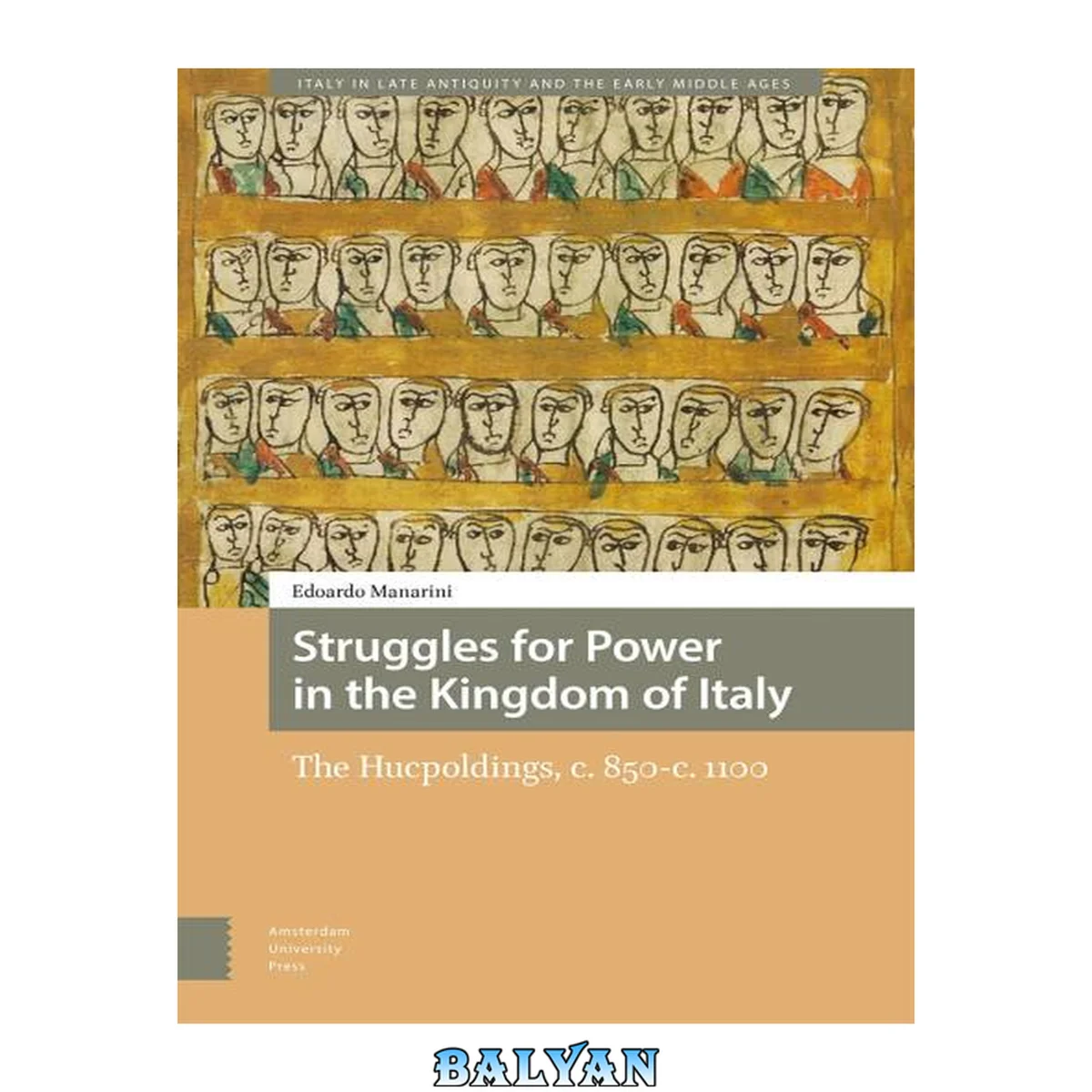
معرفی کتاب «مبارزات برای قدرت در پادشاهی ایتالیا: هیوکپولدها، حدود ۸۵۰ تا ۱۱۰۰» (با عنوان لاتین Struggles for power in the Kingdom of Italy : The Hucpoldings, c. 850-c. 1100) نوشتهٔ DR EDOARDO. MANARINI، منتشرشده توسط نشر Amsterdam University Press در سال 2022. این کتاب در فرمت pdf، زبان انگلیسی ارائه شده است.
This book presents a detailed study of the Hucpoldings, an elite group in Carolingian and post-Carolingian Italy. Though the Hucpoldings have not received extensive treatment in previous anglophone scholarship, they had a key influence in much of what was happening in this period. Manarini's groundbreaking study highlights the dramatic geopolitical changes surrounding this kinship group in the kingdom of Italy across three crucial centuries. The research reconstructs political events associated with every identifiable member of the kinship, as well as inquiring into their patrimony and their networks of relationships and patronage. Finally, it examines the distinctive characteristics of the group to gain a clearer picture of the nature of their power, their memory strategies and the shared perceptions and self-awareness of group members--Publisher Cover 1 Table of Contents 8 Prefatory Note 10 Acknowledgements 12 Abbreviations 16 Preface 20 Introduction 22 Documentary Evidence: Dispersal of Properties, Archival Geography 26 Narrative Sources 33 Bibliography 35 Part I: Kinship and Political Relations 42 1. The Hucpoldings’ Involvement in the Political Struggles of the Kingdom of Italy (847–945) 46 Hucpold, Count Palatine of Louis II 49 Faction and Endeavour: Hubald I 58 The Aristocratic Career of Boniface dux et marchio between Rudolf II and Hugh of Arles 65 Bibliography 73 2. Family Patterns and Political Affirmation (945–1012) 84 The Duchy of Spoleto and Tuscany 88 Eastern Emilia and the Exarchate of Ravenna 96 The March of Tuscany 107 Bibliography 116 3. The Local Basis of Power in a Wide Political Network (1012–1116) 126 Hugh II and His Lineage in Bologna and Ferrara 131 The Ties that Bind: Boniface of Canossa and Kinship Networks across the Apennines 141 The Counts of Romena-Panico 149 Bibliography 153 Part II: Properties and Patronage 160 4. The Exarchate 166 Land Possession and Relations in the Ninth Century 168 The Troubled Years, c.960–c.1000 175 Persistence in the comitatus Faentinus and the 1034 Pact 179 Bibliography 182 5. The March of Tuscany 186 The Family Group Estates in the Ninth Century 188 Marchisal Fisc and Monastic Foundations 193 Centres of Power, Patronage Networks 202 Bibliography 213 6. Ruling on the Border: Landed Possessions from the Po Valley to the Apennines in Bononia’s Diocese 218 Acquisitions, Exchanges, Organization of Lands in the Tenth Century 222 Landed Wealth and Hegemony 230 Lands, People and Castles (Tenth–Twelfth Centuries) 239 Estate Management: Between Territorial Consolidation and Dispersal 248 Bibliography 257 Part III: Power, Relationships, Memory 264 7. Kinship, Self-awareness and Memory 268 Onomastic Choices 273 The lex Ribuaria profession 278 The Role of Monastic Foundations: Family Memory, Politics and Identity 285 Kinship Representations between Perceptions and Self-awareness 291 Evolution and Hierarchy of Kinship Cohesion 301 Bibliography 303 8. Features and Practices of Power: From Officials to Lords 312 Firsts Steps at Court: Offices and Responsibilities in the Kingdom of Italy 314 The Marchisal Achievement and the Gaining of Ecclesiastical Offices 320 Dinastizzazione of the Title of comes and the Development of Seigneurial Rule in a Border Region 328 Bibliography 332 9. Discontinuity between Public Powers and Private Seigneurial Rule 336 Bibliography 341 Genealogical Tables 344 Bibliography 346 Bibliography 354 Archival Primary Sources 354 Printed Primary Sources 354 Secondary Sources 360 Index 386 Maps and Tables 14 Maps 14 Map 1. Monasteries cited 32 Map 2. Places related to the iudiciaria Mutinensis (c.890–c.950) 68 Map 3. Places mentioned in Romagna and in the Apennines south of Faenza 174 Map 4. Places mentioned in the march of Tuscia 197 Map 5. Places mentioned in the plain north of Bologna and in the mountains to the south 238 Tables 14 Table 1. The Hucpoldings’ charters: a general overview (847–1130) 28 Table 2. The Hucpoldings’ charters in the territory of Bologna: lay people and religious houses (c.900–1130) 221 Genealogical Tables 14 Table G1. The Hucpoldings and the elites of the kingdom of Italy (c.850–c.930) 347 Table G2. Boniface I’s descendants (c.900–c.1050) 348 Table G3. Kinship ties among the marquises of Tuscia (c.950–c.1050): Hucpolding women and the legitimation of the Adalbertings 349 Table G4. Marquis Almericus II’s ancestry (c.850–c.950) 350 Table G5. Kinship ties in Romagna (c.900–c.1050) 351 Table G6. Hucpolding lineages in the Bolognese (c.1030–c.1130) 352 Table G7. The descendants of Count Adimarus (c.990–c.1130) 353 This book presents a detailed study which focuses upon the Hucpoldings, an elite group in Carolingian and post-Carolingian Italy. Though the Hucpoldings have not received extensive treatment in previous Anglophone scholarship, they are a key clan in this period. Manarini's ground-breaking study uses this kinship group to highlight and pinpoint the dramatic geopolitical changes in the kingdom of Italy across three crucial centuries. The research deals with the reconstruction of the political events of every identifiable member of the kinship, as well as the inquiry into their patrimony and their networks of relations and patronage throughout the kingdom of Italy. Finally, it examines the particular elements of the group, from which emerges a clearer picture of the nature of their power, their memory strategies and the shared perceptions and self-awareness among the group members
دانلود کتاب مبارزات برای قدرت در پادشاهی ایتالیا: هیوکپولدها، حدود ۸۵۰ تا ۱۱۰۰