Structural Dynamics Fundamentals and Advanced Applications, Volume I: Volume I
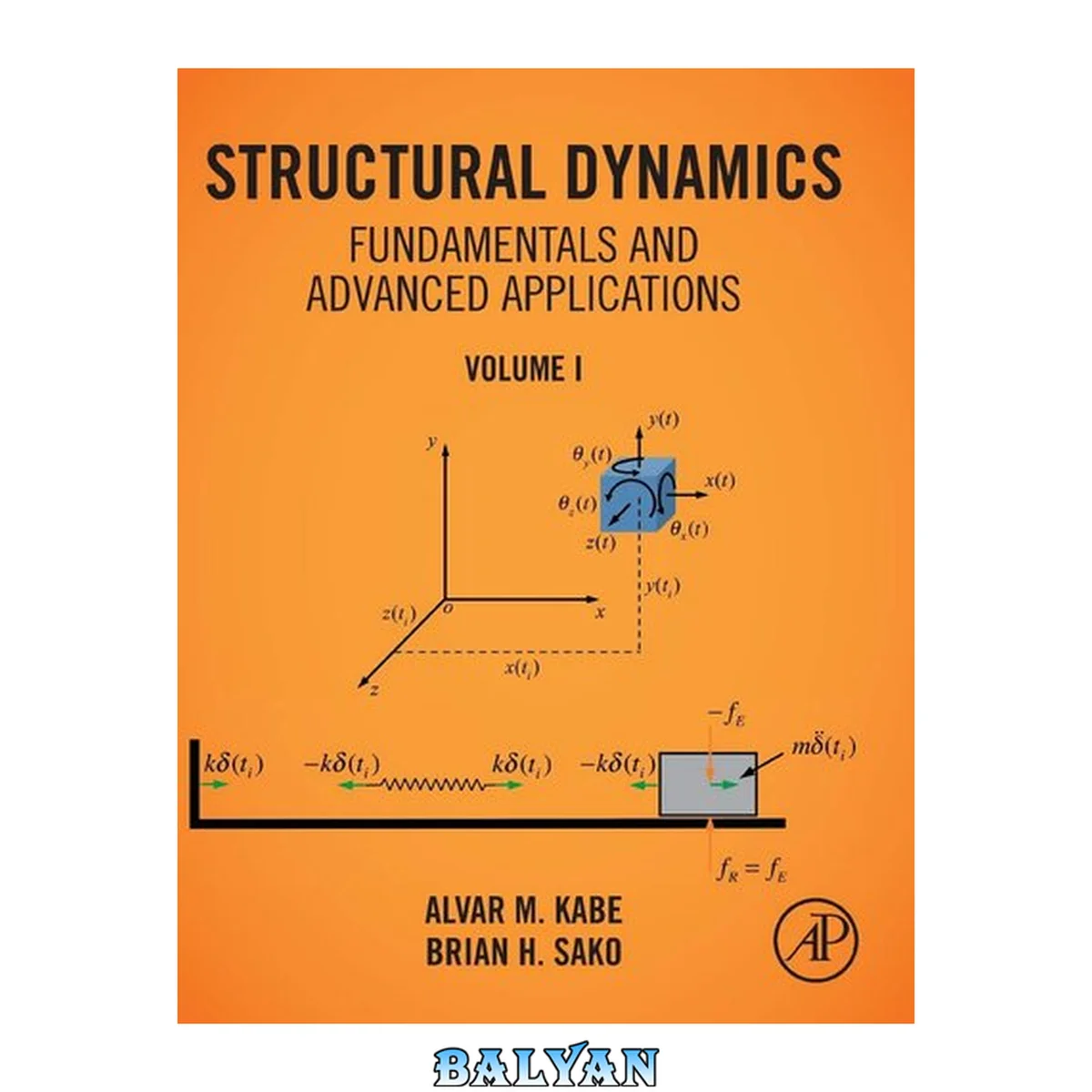
معرفی کتاب «Structural Dynamics Fundamentals and Advanced Applications, Volume I: Volume I» نوشتهٔ Xiran Jay Zhao و Alvar M. Kabe, Brian H. Sako، منتشرشده توسط نشر Academic Press در سال 2020. این کتاب در فرمت pdf، زبان انگلیسی ارائه شده است.
The two-volume work, __Structural Dynamics Fundamentals and Advanced Applications__, is a comprehensive work that encompasses the fundamentals of structural dynamics and vibration analysis, as well as advanced applications used on extremely large and complex systems. Volume I covers Newton’s Laws, single-degree-of-freedom systems, damping, transfer and frequency response functions, transient vibration analysis (frequency and time domain), multi-degree-of-freedom systems, forced vibration of single and multi-degree-of-freedom systems, numerical methods for solving for the responses of single and multi-degree-of-freedom systems, and symmetric and non-symmetric eigenvalue problems. In addition, a thorough discussion of real and complex modes, and the conditions that lead to each is included. Stochastic methods for single and multi-degree-of-freedom systems excited by random forces or base motion are also covered. Dr. Kabe’s training and expertise are in structural dynamics and Dr. Sako’s are in applied mathematics. Their collaboration has led to the development of first-of-a-kind methodologies and solutions to complex structural dynamics problems. Their experience and contributions encompass numerous past and currently operational launch and space systems. Structural Dynamics Fundamentals and Advanced Applications Copyright Dedication About the authors Preface 1 - Structural dynamics 1. Introduction 1.1 Newton's laws of motion 1.1.1 Newton's First Law 1.1.2 Newton's Second Law 1.1.3 Newton's Third Law 1.2 Reference frames 1.3 Degrees of freedom 1.3.1 Newton's Second Law and rotational motion 1.4 Absolute and relative coordinates 1.5 Constraints 1.6 Distributed coordinates 1.7 Units 1.7.1 International System of Units 1.7.2 US Customary units Problems Problem 1.1 Solution 1.1 Problem 1.2 Solution 1.2 Problem 1.3 Solution 1.3 Problem 1.4 Solution 1.4 Problem 1.5 Solution 1.5 Problem 1.6 Solution 1.6 Problem 1.7 Solution 1.7 Problem 1.8 Solution 1.8 Problem 1.9 Solution 1.9 Problem 1.10 Solution 1.10 Problem 1.11 Solution 1.11 Problem 1.12 Solution 1.12 Problem 1.13 Solution 1.13 Problem 1.14 Solution 1.14 Problem 1.15 Solution 1.15 Problem 1.16 Solution 1.16 Problem 1.17 Solution 1.17 Problem 1.18 Solution 1.18 Problem 1.19 Solution 1.19 References 2 - Single-degree-of-freedom systems 2. Introduction 2.1 Vibration 2.2 Rayleigh—energy 2.3 Vibration with viscous damping 2.3.1 Oscillatory damped vibration 2.3.2 Nonoscillatory damped vibration 2.4 Free vibration with Coulomb friction (damping) 2.5 Forced vibration 2.5.1 Harmonic excitation 2.5.1.1 Displacement quadrature and coincident responses 2.5.1.2 Acceleration quadrature and coincident responses 2.5.1.3 Frequency of peak response 2.5.1.4 Relationships between response quantities 2.5.1.5 Magnitude and phase of response 2.5.2 Sudden cessation of harmonic excitation 2.5.3 Beating 2.6 Base excitation 2.6.1 Base excitation equations of motion 2.6.2 Harmonic base excitation 2.6.3 Sudden cessation of harmonic excitation 2.7 Frequency sweep effects 2.7.1 Linear sweep 2.7.2 Octave sweep 2.7.3 Single-degree-of-freedom response Problems Problem 2.1 Solution 2.1 Problem 2.2 Solution 2.2 Problem 2.3 Solution 2.3 Problem 2.4 Solution 2.4 Problem 2.5 Solution 2.5 Problem 2.6 Solution 2.6 Problem 2.7 Solution 2.7 Problem 2.8 Solution 2.8 Problem 2.9 Solution 2.9 Problem 2.10 Solution 2.10 Problem 2.11 Solution 2.11 Problem 2.12 Solution 2.12 Problem 2.13 Solution 2.13 Problem 2.14 Solution 2.14 Problem 2.15 Solution 2.15 Problem 2.16 Solution 2.16 Problem 2.17 Solution 2.17 Problem 2.18 Solution 2.18 Problem 2.19 Solution 2.19 Problem 2.20 Solution 2.20 Problem 2.21 Solution 2.21 Appendix 2.1 L’Hôpital's Rule References 3 - Transfer and frequency response functions 3. Introduction 3.1 Laplace transform 3.1.1 Laplace transform and harmonic excitation 3.2 Fourier transform 3.2.1 Frequency response functions 3.2.2 Base excitation frequency response functions 3.2.3 Fourier transforms of useful functions 3.2.3.1 Boxcar 3.2.3.2 Unit impulse (Dirac delta) 3.2.3.3 Unit impulse sifting property 3.2.3.4 Constant 3.2.3.5 Cosine and sine 3.2.4 Multiplication of Fourier transformed functions and convolution 3.2.5 Convolution and dynamic response 3.2.6 Multiplication of functions and frequency domain convolution 3.2.7 Unit impulse and convolution 3.2.8 Relationship between boxcar function and unit impulse Problems Problem 3.1 Solution 3.1 Problem 3.2 Solution 3.2 Problem 3.3 Solution 3.3 Problem 3.4 Solution 3.4 Problem 3.5 Solution 3.5 Problem 3.6 Solution 3.6 Problem 3.7 Solution 3.7 Problem 3.8 Solution 3.8 Problem 3.9 Solution 3.9 Problem 3.10 Solution 3.10 Problem 3.11 Solution 3.11 Problem 3.12 Solution 3.12 Problem 3.13 Solution 3.13 Problem 3.14 Solution 3.14 Problem 3.15 Solution 3.15 Problem 3.16 Solution 3.16 Problem 3.17 Solution 3.17 Appendix 3.1 Integration by parts Appendix 3.2 Laplace transform Appendix 3.3 Integration References 4 - Damping 4. Introduction 4.1 Viscous damping from coincident component of response 4.2 Damping from half-power points of total response 4.3 Logarithmic decrement 4.3.1 Damping from nonsequential cycles 4.3.2 Damping from least squares fit of data 4.4 Work, strain energy, and kinetic energy 4.5 Equivalent viscous damping 4.6 Equivalent viscous damping and Coulomb damping 4.7 Equivalent viscous damping and fluid resistance 4.8 Structural damping and complex stiffness 4.8.1 Quadrature/coincident response with structural damping 4.8.2 Structural damping from coincident response 4.9 Hysteresis Problems Problem 4.1 Solution 4.1 Problem 4.2 Solution 4.2 Problem 4.3 Solution 4.3 Problem 4.4 Solution 4.4 Problem 4.5 Solution 4.5 Problem 4.6 Solution 4.6 Problem 4.7 Solution 4.7 Problem 4.8 Solution 4.8 Problem 4.9 Solution 4.9 Problem 4.10 Solution 4.10 Problem 4.11 Solution 4.11 Problem 4.12 Solution 4.12 Problem 4.13 Solution 4.13 Appendix 4.1 Taylor series expansion Appendix 4.2 Area of an ellipse References 5 - Transient excitation 5. Introduction 5.1 Ramp, step, and boxcar excitation 5.1.1 Step excitation 5.1.2 Ramp excitation 5.1.3 Ramp excitation and response behavior 5.1.4 Boxcar excitation 5.1.5 Boxcars of short time duration 5.2 Impulse, impulsive forces, and superposition 5.3 Convolution and Duhamel's integrals 5.3.1 Step function response using Duhamel's integral 5.3.2 Duhamel's integral and initial conditions 5.4 Response Spectra and Shock Response Spectra 5.5 Random response analysis 5.5.1 Mean square value and Power Spectral Density 5.5.1.1 Autocorrelation function 5.5.2 Pseudo acceleration response to random base excitation 5.5.3 Absolute acceleration response to random base excitation 5.5.4 Absolute acceleration response to external random forces 5.5.5 Pseudo and absolute acceleration response with frequency limits 5.6 Time domain random response analysis 5.6.1 Time domain root mean square computation 5.7 Swept frequency excitation 5.7.1 Octave sweep rates 5.7.2 Linear sweep rates 5.7.3 Closed-form solutions 5.7.3.1 Octave sweep 5.7.3.2 Linear sweep Problems Problem 5.1 Solution 5.1 Problem 5.2 Solution 5.2 Problem 5.3 Solution 5.3 Problem 5.4 Solution 5.4 Problem 5.5 Solution 5.5 Problem 5.6 Solution 5.6 Problem 5.7 Solution 5.7 Problem 5.8 Solution 5.8 Problem 5.9 Solution 5.9 Problem 5.10 Solution 5.10 Problem 5.11 Solution 5.11 Problem 5.12 Solution 5.12 Problem 5.13 Solution 5.13 Problem 5.14 Solution 5.14 Problem 5.15 Solution 5.15 Problem 5.16 Solution 5.16 Problem 5.17 Solution 5.17 Problem 5.18 Solution 5.18 Problem 5.19 Solution 5.19 Appendix 5.1 Derivation of Parseval's theorem Appendix 5.2 Contour integral Appendix 5.3 Integrals for pseudo and absolute acceleration response to base excitation, and for absolute acceleration to f ... Appendix 5.4 atan2(x, y) function Appendix 5.5 Octave sweep rate attenuation; Hz, octave, minute Appendix 5.6 Linear sweep rate attenuation; Hz, minute References 6 - Multi-degree-of-freedom systems 6. Introduction 6.1 Two-degree-of-freedom systems 6.2 Mode shapes 6.2.1 Rigid body modes 6.2.2 Natural frequencies 6.3 Mode shape orthogonality 6.4 Normalization of mode shapes 6.5 Modal coordinates 6.6 Vibration initiated with initial conditions 6.7 Free vibration with viscous damping 6.8 Rotational degrees of freedom 6.9 Mass matrix of a rigid body 6.10 Classical normal modes 6.10.1 Proportional damping 6.10.2 Damping that yields classical normal modes 6.10.2.1 Mode superposition damping 6.10.2.2 Modified Caughey series damping 6.11 Nonclassical, complex modes 6.11.1 First-order systems 6.11.2 Multi-degree-of-freedom systems with complex modes 6.11.3 Left and right eigenvectors 6.11.3.1 Orthogonality of complex mode shapes 6.11.4 First-order solution for systems with classical normal modes 6.11.5 Complex solution for systems with nonclassical modes 6.11.5.1 Approximate classically damped systems 6.11.6 Complex modes response with rigid body modes 6.12 Modes of vibration 6.12.1 Rayleigh's quotient 6.12.2 Stationarity and convexity of Rayleigh's quotient 6.12.3 Rayleigh-Ritz 6.12.4 Modes of vibration Problems Problem 6.1 Solution 6.1 Problem 6.2 Solution 6.2 Problem 6.3 Solution 6.3 Problem 6.4 Solution 6.4 Problem 6.5 Solution 6.5 Problem 6.6 Solution 6.6 Problem 6.7 Solution 6.7 Problem 6.8 Solution 6.8 Problem 6.9 Solution 6.9 Problem 6.10 Solution 6.10 Problem 6.11 Solution 6.11 Problem 6.12 Solution 6.12 Problem 6.13 Solution 6.13 Problem 6.14 Solution 6.14 Problem 6.15 Solution 6.15 Problem 6.16 Solution 6.16 Problem 6.17 Solution 6.17 Problem 6.18 Solution 6.18 Appendix 6.1 Rotation of complex vectors References 7 - Forced vibration of multi-degree-of-freedom systems 7. Introduction 7.1 Modal forces 7.2 Harmonic excitation 7.2.1 Steady-state harmonic response 7.2.2 Quadrature and coincident components of response 7.3 Beating 7.3.1 Superposition of harmonic functions 7.3.2 Multi-degree-of-freedom systems 7.4 Sweep rate effects 7.5 Short transient excitation 7.5.1 Step excitation 7.5.2 Impulse excitation 7.6 Base excitation 7.6.1 Unidirectional motion 7.6.2 Translation plus rotation 7.6.3 Multipoint excitation 7.6.4 Harmonic excitation 7.6.5 Practical considerations 7.6.5.1 Mode participation factors 7.6.5.2 Sweep rate effects 7.6.5.3 Shake table—test article interaction 7.7 Random response analysis 7.7.1 Forced vibration 7.7.1.1 Acceleration response 7.7.1.2 Loads computation 7.7.1.3 Implementation 7.7.2 Base excitation 7.8 Time-domain random response analysis 7.9 Truncated modal coordinates 7.9.1 Mode acceleration 7.9.2 Mode acceleration and unconstrained systems 7.9.2.1 Three-degree-of-freedom example 7.9.3 Computation of loads and stresses 7.9.4 Residual flexibility 7.10 Dynamic behavior as a function of response 7.10.1 Instantaneous displacement-proportional feedback 7.10.2 Gyroscopic moments 7.10.3 Whirl 7.10.3.1 Symmetric systems 7.10.3.2 Slightly nonsymmetric systems 7.10.3.3 Rotating symmetric systems with gyroscopic effects 7.10.3.4 Rotating systems with gyroscopic effects and excitation 7.10.3.5 Complex modal coordinates solution 7.10.3.6 Complex modal forces 7.10.3.7 Nonsymmetric systems 7.10.3.8 Dynamic imbalance 7.10.4 Gyroscopic moments and energy dissipation 7.11 Fluid–structure interaction 7.11.1 Aerodynamic instability 7.11.1.1 Aerodynamic instability and complex modes 7.11.2 Pogo Problems Problem 7.1 Solution 7.1 Problem 7.2 Solution 7.2 Problem 7.3 Solution 7.3 Problem 7.4 Solution 7.4 Problem 7.5 Solution 7.5 Problem 7.6 Solution 7.6 Problem 7.7 Solution 7.7 Problem 7.8 Solution 7.8 Problem 7.9 Solution 7.9 Problem 7.10 Solution 7.10 Problem 7.11 Solution 7.11 Problem 7.12 Solution 7.12 Problem 7.13 Solution 7.13 Problem 7.14 Solution 7.14 Problem 7.15 Solution 7.15 Problem 7.16 Solution 7.16 Problem 7.17 Solution 7.17 Problem 7.18 Solution 7.18 Problem 7.19 Solution 7.19 Problem 7.20 Solution 7.20 Problem 7.21 Solution 7.21 Problem 7.22 Solution 7.22 Problem 7.23 Solution 7.23 Problem 7.24 Solution 7.24 Appendix 7.1 Work and coordinate transformations Appendix 7.2 Beating Appendix 7.3 Periodicity and Lissajous graphs References 8 - Numerical methods 8. Introduction 8.1 Numerical solution of differential equations of motion 8.1.1 One-step methods 8.1.1.1 Euler’s method 8.1.1.1 Euler’s method 8.1.1.2 Runge–Kutta methods 8.1.1.2 Runge–Kutta methods 8.1.1.3 Analysis of one-step methods 8.1.1.3 Analysis of one-step methods 8.1.1.4 First-order formulation for Single‐degree-of-freedom systems 8.1.1.4 First-order formulation for Single‐degree-of-freedom systems 8.1.2 Duhamel’s method 8.1.3 Newmark’s method 8.1.4 Comparison of methods 8.1.4.1 Stability 8.1.4.1 Stability 8.1.4.2 Frequency response 8.1.4.2 Frequency response 8.1.4.3 Numerical comparisons 8.1.4.3 Numerical comparisons 8.1.4.4 Rigid-body response 8.1.4.4 Rigid-body response 8.2 Multi-degree-of-freedom system numerical integration 8.2.1 Classically damped systems 8.2.2 Nonclassically damped systems 8.2.3 General methods 8.2.3.1 Complex modal superposition 8.2.3.1 Complex modal superposition 8.2.3.2 Direct integration using first-order formulation 8.2.3.2 Direct integration using first-order formulation 8.2.3.3 Direct integration using second-order formulation 8.2.3.3 Direct integration using second-order formulation 8.3 Solution of systems of linear equations 8.3.1 Matrix computation preliminaries 8.3.1.1 Vector and matrix norms 8.3.1.1 Vector and matrix norms 8.3.1.2 Floating point representation and arithmetic 8.3.1.2 Floating point representation and arithmetic 8.3.1.3 Problem sensitivity 8.3.1.3 Problem sensitivity 8.3.2 LU factorization 8.3.2.1 Gaussian elimination 8.3.2.1 Gaussian elimination Direct LU factorization Direct LU factorization Forward substitution Forward substitution Backward substitution Backward substitution 8.3.2.2 Gaussian elimination with partial pivoting 8.3.2.2 Gaussian elimination with partial pivoting LU factorization with partial pivoting LU factorization with partial pivoting Forward substitution with partial pivoting Forward substitution with partial pivoting 8.3.2.3 Error analysis 8.3.2.3 Error analysis 8.3.3 Factorization for symmetric positive-definite matrices 8.3.3.1 Cholesky factorization 8.3.3.1 Cholesky factorization Cholesky factorization Cholesky factorization 8.3.3.2 Error analysis 8.3.3.2 Error analysis 8.3.4 Iterative methods 8.3.4.1 Classical iterative methods 8.3.4.1 Classical iterative methods 8.3.4.2 Convergence of iterative methods 8.3.4.2 Convergence of iterative methods 8.4 Linear least-square problems 8.4.1 Normal equation 8.4.2 QR factorization 8.4.2.1 Orthogonal projectors 8.4.2.2 Classical Gram-Schmidt method Classical Gram-Schmidt algorithm Classical Gram-Schmidt algorithm 8.4.2.3 Modified Gram-Schmidt method Modified Gram-Schmidt algorithm Modified Gram-Schmidt algorithm 8.4.2.4 Householder transformation method Householder QR algorithm Householder QR algorithm 8.4.2.5 Givens transformation method Givens QR algorithm Givens QR algorithm 8.4.3 Singular value decomposition 8.4.3.1 Singular value decomposition theorem 8.4.3.2 Pseudo-inverse 8.4.4 Error analysis 8.5 Matrix eigenvalue problem 8.5.1 Symmetric eigenvalue problem 8.5.1.1 QR iteration 8.5.1.1 QR iteration QR iteration QR iteration 8.5.1.1.1 Vector iteration methods 8.5.1.1.1 Vector iteration methods Power iteration algorithm Power iteration algorithm Inverse iteration algorithm Inverse iteration algorithm Rayleigh quotient iteration Rayleigh quotient iteration 8.5.1.1.2 Orthogonal iteration 8.5.1.1.2 Orthogonal iteration Orthogonal iteration algorithm Orthogonal iteration algorithm 8.5.1.1.3 QR iteration convergence 8.5.1.1.3 QR iteration convergence 8.5.1.1.4 Relation to power and inverse iterations 8.5.1.1.4 Relation to power and inverse iterations 8.5.1.1.5 Incorporating shifts 8.5.1.1.5 Incorporating shifts 8.5.1.1.6 Tridiagonal reduction 8.5.1.1.6 Tridiagonal reduction Householder tridiagonalization algorithm Householder tridiagonalization algorithm Product of householder transformations Product of householder transformations 8.5.1.1.7 QR iteration for tridiagonal matrices 8.5.1.1.7 QR iteration for tridiagonal matrices QR iteration on tridiagonal system with Rayleigh shifts QR iteration on tridiagonal system with Rayleigh shifts 8.5.1.1.8 Implicit shifts 8.5.1.1.8 Implicit shifts 8.5.1.2 Divide-and-conquer method 8.5.1.2 Divide-and-conquer method 8.5.1.3 Lanczos method 8.5.1.3 Lanczos method Basic Lanczos algorithm Basic Lanczos algorithm 8.5.2 Nonsymmetric eigenvalue problem 8.5.3 Error analysis Problems Problem 8.1 Solution 8.1 Problem 8.2 Solution 8.2 Problem 8.3 Solution 8.3 Problem 8.4 Solution 8.4 Problem 8.5 Solution 8.5 Problem 8.6 Solution 8.6 Problem 8.7 Solution 8.7 Problem 8.8 Solution 8.8 Problem 8.9 Solution 8.9 Problem 8.10 Solution 8.10 Problem 8.11 Solution 8.11 Problem 8.12 Solution 8.12 Problem 8.13 Solution 8.13 Problem 8.14 Solution 8.14 Problem 8.15 Solution 8.15 Problem 8.16 Solution 8.16 Problem 8.17 Solution 8.17 Problem 8.18 Solution 8.18 Problem 8.19 Solution 8.19 Problem 8.20 Solution 8.20 Problem 8.21 Solution 8.21 Problem 8.22 Solution 8.22 Problem 8.23 Solution 8.23 Problem 8.24 Solution 8.24 Problem 8.25 Solution 8.25 Problem 8.26 Solution 8.26 Problem 8.27 Solution 8.27 Problem 8.28 Solution 8.28 Problem 8.29 Solution 8.29 Problem 8.30 Solution 8.30 Problem 8.31 Solution 8.31 Problem 8.32 (This problem requires access to a numerical software tool) Solution 8.32 Problem 8.33 (This problem requires access to a numerical software tool) Solution 8.33 Problem 8.34 (This problem requires access to a numerical software tool) Solution 8.34 Problem 8.35 (This problem requires access to a numerical software tool) Solution 8.35 References Index A B C D E F G H I J K L M N O P Q R S T U V W Z
دانلود کتاب Structural Dynamics Fundamentals and Advanced Applications, Volume I: Volume I