Stone Tools in the Ancient Near East and Egypt: Ground stone tools, rock-cut installations and stone vessels from Prehistory to Late Antiquity (Archaeopress Ancient Near Eastern Archaeology)
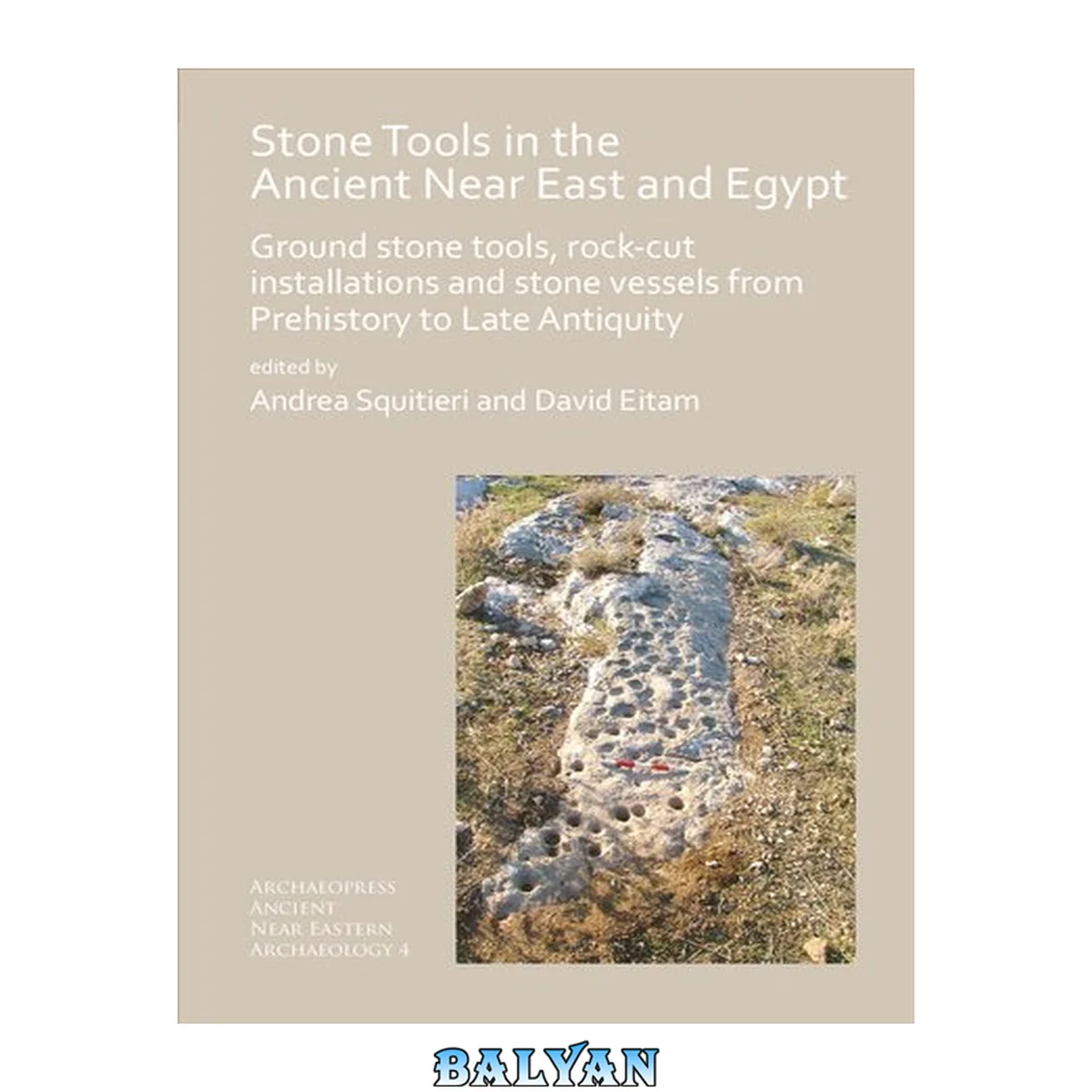
معرفی کتاب «Stone Tools in the Ancient Near East and Egypt: Ground stone tools, rock-cut installations and stone vessels from Prehistory to Late Antiquity (Archaeopress Ancient Near Eastern Archaeology)» نوشتهٔ Selva Almada، Annie McDermott و Andrea Squitieri, David Eitam، منتشرشده توسط نشر Archaeopress Access Archaeology در سال 2019. این کتاب در فرمت pdf، زبان انگلیسی ارائه شده است.
Stone Tools in the Ancient Near East and Egypt: Ground stone tools, rock-cut installations and stone vessels from Prehistory to Late Antiquity is about groundstone tools, stone vessels, and devices carved into rock throughout the Near East and Egypt from Prehistory to the late periods. These categories of objects have too often been overlooked by archaeologists, despite their frequent occurrence in the archaeological record. Most importantly, a careful study of these tools reveals crucial insights into ancient societies. From the procuring of raw materials to patterns of use and discard, they provide us with a wealth of information about the activities they were involved in and how these activities were organised. These tools reveal patterns in the trade of both raw materials and finished products, inform us about economic aspects of food production and consumption, cast light on industrial activities, help establish intercultural connections, and offer hints about the relationship between sites and their environment. The aim of this book is to explore all aspects of these ubiquitous tools and to stimulate debate about the new methodologies needed to approach this material. Cover 1 Title Page 3 Copyright Page 4 Cover 4 Dedication 5 Contents Page 7 List of Figures and Tables 9 List of Authors 14 David Eitam and Andrea Squitieri 17 Introduction 17 Methodology and Classification 23 D. Mudd: The archaeology of discard and abandonment 25 David Mudd 25 The archaeology of discard and abandonment: presence and absence in the ground stone assemblage from Early Neolithic Bestansur, Iraqi Kurdistan 25 Figure 1. Plan of the Bestansur site. Image – CZAP. 28 Figure 2. Composite plan of excavated walls, spaces and features in Trench 10, end of Spring 2017 season. Walls of Building 5 follow the alignment and plan of earlier Building 8. Image – CZAP. 30 Figure 3. Net sinkers SF0317 in situ. Image – CZAP. 33 Figure 4. Stone from SF0317 showing worm casing and boring. Image – author. 33 Figure 5. Debitage from stoneworking C1752. Note the smaller quantities of harder sandstone (darker colour) from the tools used to work the softer limestone (lighter). The opinion of the excavator should be ignored. Image – author. 34 Figure 6. Plan of Trench 7. Image – CZAP. 35 Figure 7. Space 16, before excavation, facing northwest, showing gridlines. Image – CZAP. 35 Figure 8. Space 16 C1243 and C1255, showing ground stone classes and identification numbers. Some very small fragments omitted. Image – CZAP. 36 Figure 9. Flat oval river cobbles BF520 and BF522 in situ. Image – CZAP. 37 Figure 10. Possible stages in the life history of a stone tool. The artefact could enter the archaeological record from any of these stages. 38 D. Eitam: Survey of Rock-Cut Installations at Tel Bareqet (Israel) 43 David Eitam 43 Survey of Rock-Cut Installations at Tel Bareqet (Israel): Food Processor devices in Epipaleolithic, PPNA and the Early Bronze 43 Figure 1. General plan of the Tel and excavations areas. 44 Figure 2. General plan of the rock-cut installations. 46 Figure 3. L. 3020: EB winepress with pressing surface drained to collecting vat, adjacent vat on the west of the press, and 2 cupmarks on the east. 47 Figure 4. L. 3020: collecting vat of EB winepress (side of vat was cut in recent time). 47 Figure 5. L. 3030: round large basin cut into oblong bedrock (possibly EB), a cupmark, and a small round basin. 47 Figure 7. Plan of L. 3039: PPNA threshing floor with cupmarks cut on an unlevelled oblong bedrock exposure. 48 Figure 8. L. 3039: PPNA threshing floor with many rock-cut cupmarks and 4 shallow basins. 48 Figure 10. L. 3041.20: Natufian narrow conical mortar halted by a hard stone at bottom (part of rock formation). 49 Figure 11. L. 3042.21: Natufian narrow conical mortar, reused and cut into an EB oval deep basin. 49 Figure 9. General plan of L. 3041: complex RCI with Late Natufian narrow conical mortar, reused during the EB as a collection vat for a large basin, Natufian small wide conical mortar, and cupmarks. 49 Figure 12. L. 3941.22: EB deep concave basin. 50 Figure 13. L. 3942.24: Natufian small concave conical mortar. 50 Figure 15. L. 3042.1: deep concave EB basin, with reused Natufian narrow conical mortar. 50 Figure 16. Plans of L. 3042.1: with EB round deep basin, reused narrow conical mortar, and small mortar eroded in bottom; L. 3063.1: oval deep EB basin, reused Natufian narrow conical mortar, 2, 3 and 5: small deep basins with cup at bottom. 51 Figure 17. L. 3053: cupmarks cut on top of a rock. 51 Figure 19. L. 3948: oval deep basin cut by a shallow small bowl (both possibly EB). 52 Figure 20. L. 3063: EBII oval basin which reuses a Natufian narrow conical mortar as collection vat. 53 Table 1. Types of rock-cut installations; average measurements in cm; abbreviations: NCM – narrow conical mortar; RCI – rock-cut installation. 54 Rock-cut installations at Tel Bareqet. 58 Ayn Asil and Elephantine (Egypt): remarks on classification and function of ground stone implements 68 C. Jeuthe: Ayn Asil and Elephantine (Egypt) 68 Clara Jeuthe 68 Figure 1. Overview Balat and research areas (D. Laisney, G. Soukiassian, after Jeuthe in print c, figure 1, Laisney 2011, figure 12, copyright IFAO). 69 Figure 2. Overview Elephantine Island and research areas (after Kopp et al. in print, figure 1, Ziermann 2003, figure 1, Ziermann 1993, figure 2, Laisney 2011, figure 12, copyright DAI). 70 Figure 3. Tools of the first category from Ayn Asil: ‘wheel hammer’ 2666-7, ‘cubit hammer’ 3655-11, ‘pebble hammer’ 3688-14, 3652-1, 3579-2, ‘pick-like’ 3567-32, ‘adze-like’ 3318-1 (scale 1:2, drawn by A. Hussein, C. Jeuthe, copyright IFAO). 74 Figure 4. Tools of the second category from Ayn Asil: slab 3576-1, handstone 3623-22 (scale 1:2, drawn by A. Hussein, copyright IFAO). 75 Figure 5. Tools of the third category from Ayn Asil: abrasive stones 3635-25, 3906-13, 3535-2, 3906-12 and whetstones 3567-11, 3927-37, 2667-1 (scale 1:2, drawn by E. Gossens, A. Hussein, C. Jeuthe, copyright IFAO). 76 Figure 6. Tools of the fourth category from Ayn Asil: netherstones 3621-16, 3527-24, 3824-5 (scale 1:2, drawn by E. Gossens, A. Hussein, copyright IFAO). 78 Table 1. Ayn Asil: raw materials of stone implements attested and their frequency rates within the individual categories. 79 Table 2. Elephantine: raw materials of stone implements attested and their frequency rates within the individual categories. 80 Table 3. Balat/Sheikh Muftah: raw materials of stone implements attested and their frequency rates within the individual categories. 81 Table 4. Frequency rates of functional categories within the sites and individual research areas. 82 Documentation: Non-Archaeological and Archaeological Sources in Comparison 85 Figure 1. Susa. Uruk period. Clay sealing with grinding scene (after Ellis 1995: Fig. 1). 87 L. Bombardieri: Mill-songs 87 Luca Bombardieri 87 Mill-songs. The soundscape of collective grinding in the Bronze and Iron Age Near East and eastern Mediterranean 87 Figure 2. Balawat/Imgur-Enlil. Neo-Assyrian period. Scene incised on decorated bronze bands, with two soldiers in the Assyrian camp of king Shalmaneser III (after Trokay 2000: Fig. 5). 88 Figure 4. Ninive. SW Palace. Room XXXIII. Particular of the wall relief with two Babylonian prisoners forced to grind their father’s bones (adapted from Layard 1853: Pl. XLV-XLVI; drawn by G. Albertazzi). 89 Figure 5. Provenace unknown. RP amphora with modelled complex scenic composition. Musée National de Céramique at Sèvres (after Morris 1985: fig. 493). 90 Figure 6. Provenance unknown. Red Slip terracotta. Musée du Louvre, Paris (adapted from Caubet et al. 1992: 34-35; drawn by G. Albertazzi). 91 Figure 7. Provenance unknown. Red Slip terracotta. Musée du Louvre, Paris. Detail of the standing woman holding her child (adapted from Caubet et al. 1992: 34). 92 Figure 8. Thebes, Boeotia. Terracotta. Musée du Louvre, Paris (after Pottier 1899: Fig. 8). 92 J. Ebeling: Rotary Querns and the Presentation of the Past 97 Jennie Ebeling 97 Rotary Querns and the Presentation of the Past 97 Figure 1. ‘Two women at the mill.’ Matson Photographic Collection, Library of Congress, Prints and Photographs Division [LC-DIG-matpc-07552]. 98 Figure 2. A rotary quern still in use in northern Jordan. Photograph by Dia’a Mazari Gharaibeh. 99 Figure 4. Joe Alon Museum of Bedouin Culture, Lahav, Israel. Photograph by Jennie Ebeling. 100 Figure 5. Museum of Jordanian Heritage at Yarmouk University, Irbid, Jordan. Photograph by Jennie Ebeling. 101 Figure 7. Palestinian Heritage Center, Bethlehem, Palestine. Photograph by Jennie Ebeling. 102 Figure 8. Image from the collection of the Palestinian Heritage Center, Bethlehem, Palestine. Photograph copyright Maha Saca, Palestinian Heritage Center. 103 Figure 9. Bedouin Heritage Center, Shibli, Mt. Tabor, Israel. Photograph by Jennie Ebeling. 103 Figure 10. Rotary quern from the Golan Heights. Man and His Work Center in the Eretz Israel Museum, Tel Aviv, Israel. Photograph by Jennie Ebeling. 104 Figure 12. Beit Al-Turath Handicraft Company, Amman, Jordan. Photograph by M. Rogel. 105 Figure 14. Embroidered artwork of a woman with a rotary quern. Photograph by Jennie Ebeling. 106 Bourgul in Talmudic and Classical Literature, and Today1 109 R. Frankel: Bourgul in Talmudic and Classical Literature, and Today 109 Rafael Frankel 109 Figure 1. Crushing the grain, Yarka, Western Galilee. 110 Figure 2. The four sieves of the Salman abu Yusef family from Yarka, Western Galilee. 111 T. Lewit and P. Burton: Wine and oil presses in the Roman to Late Antique Near East and Mediterranean 113 Tamara Lewit and Paul Burton 113 Wine and oil presses in the Roman to Late Antique Near East and Mediterranean: Balancing textual and archaeological evidence 113 Figure 1. Lever and drum press, reconstructed according to Cato’s description in 1996 under the supervision of J.-P. Brun at Beaucaire (Gard), copyright Mas des Tourelles www.tourelles.com. Reproduced with permission. 114 Figure 3. Traditional direct screw press, similar to that used in ancient southern Levant and elsewhere. Probably from Western Galilee. Upper nut beam made from Atlantic Terebinth, with oak screw. Reconstructed stone piers. Collection of Eretz Israel Muse 114 Figure 4. Reconstruction of the lever and weights press at Oilery FVIII, Chhîm, Lebanon, by Marek Puszkarski. Reproduced from Waliszewski, T. (2014). Elaion. Olive Oil Production in Roman and Byzantine Syria – Palestine, PAM Monographs 6. Warsaw, Fig. 4 115 Figure 5. Typical limestone weight from a Levantine style lever and weights press, probably Byzantine, probably from the Galilee (Collection number MHW83.2011). Collection of Eretz Israel Museum, Tel Aviv, Israel. Reproduced with permission. 116 Figure 6. View of late 5th-6th century lever and weights press at Oilery FVIII, Chhîm, Lebanon (photo by Kazimierz Kotlewski). Reproduced from Waliszewski, T. (2014). Elaion. Olive Oil Production in Roman and Byzantine Syria – Palestine, PAM Monographs 6. 116 Raw Material and Manufacture 127 L. Jirásková: Tool marks on Old Kingdom limestone vessels from Abusir 129 Lucie Jirásková 129 Tool marks on Old Kingdom limestone vessels from Abusir – production of canopic jars and model vessels 129 Figure 1. Base of the canopic jar 24/AS37/2007 with copper chisel cut marks (photo L. Jirásková). 130 Figure 2. Cross-section of the canopic jar 5/AS37/2007. The lower part remained narrow after the application of a copper shaft drill and probably of figure-of-eight stone drills, whereas the upper part was widened using a copper chisel (drawing L. Jirásko 131 Figure 3a. Cross section of the canopic jar 24/AS37/2007, which was completely gouged out using a copper chisel (drawing L. Jirásková) 131 Figure 3b. Detail of the interior of 24/AS37/2007 with unsmoothed cut marks (photo L. Jirásková). 132 Figure 4. Wavy interior of the canopic jar 388_1/AS68/2014, which was modelled by a figure-of-eight stone drill (photo M. Frouz). 132 Figure 5. Roughly shaped unsmoothed exterior of the bowl 19_9/AS37/2007 with planes left after the use of a copper adze (photo L. Jirásková). 133 Figure 6a. Depression of the bowl 6_27/AS67/2012 with triangular boring traces (photo L. Jirásková). 133 Figure 6b. Depression of the bowl 16_30/AS67/2012 with circular boring traces (photo L. Jirásková). 133 Figure 7. Depression of the bowl 19_25/AS37/2007 which was not bored but gouged out using a copper chisel (photo L. Jirásková). 134 Figure 8. The symbolic shallow interior of the jar 383_16/AS68/2014 was worked with a copper chisel or a pick (photo L. Jirásková). 134 J. A. Beller et al.: Raw material variety and acquisition of the EB III ground stone assemblage 137 Jeremy A. Beller, Haskel J. Greenfield, Mostafa Fayek, Itzhaq Shai, and Aren M. Maeir 137 Raw material variety and acquisition of the EB III ground stone assemblage of Tell es-Safi/Gath (Israel) 137 Figure 1. Notable sites of the EB II-III southern Levant. 138 Figure 2. Excavation areas of Tell es-Safi/Gath. 140 Figure 3. Typology of ground stone assemblage (by count). 141 Figure 4. Typology of ground stone assemblage (by % frequency). 141 Figure 5. Lower grinding stone (Basket #16E94A011). 145 Figure 6. Upper grinding stone (Basket #16E84A007). 146 Figure 7. Perforated stone weight (Basket #16E83C087). 146 Figure 8. Vessel (Basket #1143010). 146 Figure 9. Pounder (Basket #748124). 146 Figure 10. Mortar/socket (Basket #748122). 147 Figure 11. Material of ground stone objects. 148 Figure 12. XRD results of limestone artefact (Basket #845008). 149 Figure 13. Breakdown of material and select ground stone types. 150 Figure 14. Selected basalt sources of Near East. 153 Figure 15. Total alkali-silica diagram of samples for sources. 155 Figure 16. Total alkali-silica diagram of source averages. 155 Figure 17. SiO2 vs. Na2O+K2O scatter plot of sources and artifacts samples. 157 Figure 18. SiO2 vs. Na2O+K2O plot of source averages and artifact samples along with baskets associated with the discussed groups. 158 Figure 19a. TiO2 vs. SiO2 plot of selected source averages and artifact samples (baskets). 19b. TiO2 vs. Fe2O3(t) plot of selected source averages and Basket #1042042. 159 Table 4. Association between Near East basalt sources and Tell es-Safi/Gath artifacts. 160 Function and Uses 167 The ground stone assemblage from the Early Bronze Age I site Wadi Fidan 4: Gender aspects 169 Y. Abadi-Reiss et al.: The ground stone assemblage from the Early Bronze Age I site Wadi Fidan 4 169 Yael Abadi-Reiss, Mohammad Najjar and Thomas E. Levy 169 Figure 1. Site location map. 170 Figure 2. Grinding stones: A, B, Lower grinding slabs. C, D, Upper grinding stone. 171 Figure 3. Selected hammer stones. 172 Table 4. Hammerstone subtypes from WFD4 (n=21). 172 Cereal processing in stone agri-technological system at late Natufian Huzuq Musa in the Jordan Valley 178 D. Eitam: Cereal processing in stone agri-technological system at late Natufian Huzuq Musa 178 David Eitam 178 Figure 1. Huzuq Musa, view to the south: front, a large central structure and cliff; left, northern dwelling area; centre, southern dwelling area and possible cemetery; in front of cliff with caves, large open-space zone with terrace wall on left; far-lef 178 Figure 2. Map of Natufian sites with rock-cut installations in the Southern Levant, including Hruq Musa (another name of Huzuq Musa). 179 Figure 3. Map of Huzuq Musa with surface architectural remains and rock-cut installations (marked by black dots). These include stone-wall huts (A-J, N-T); a central large structure (VII, K, L); terrace wall (double-wall line X1-X, Y and single-wall line 180 Figure 4. Plan and sections of the northern dwelling area with huts (A-I, O), double terrace wall and installations cut on large rock surface. 181 Figure 5. Plan and sections of central dwelling huts area IV (N, P-T), part of the large structure (K, L) and terrace wall; marked and numbered installations cut in rocks and boulders; additional zone surrounded by huts (perhaps a burial area). 182 Figure 6. Legend of ground stones and rock-cut installations with fabrication marks, usewear and striations; up: pestles and pounder (see also Figure 11); wide conical mortar of threshing floor II, the pierced bottom was redesigned but work halted because 185 Figure 7. Boulder pierced-bottom narrow conical mortar: (1) Bottom of repaired, pierced rock-cut narrow conical mortar with pebble adjusted to hole by flaking, pecking and fine abrading; (2a) narrow conical mortar broken in half with a fine-pecked funnel 186 Figure 8. Huzuq Musa, selection of flint tools collected on surface: 1-8: Borers; 9-12: Sickle blades; 13-15: Microlithes; 16: Micro-end scraper; 17: End scraper; 18. Burin (after Winter 2005: Figs. 418-420). 188 Figure 9. Rock-cut installations of Huzuq Musa: (1) Narrow conical mortar with eroded upper part; (2) Narrow conical mortar with funnel upper part; (3) Narrow conical mortar halted by hard stone at bottom; (4) Narrow conical mortar with pierce bottom by w 189 Figure 10. Threshing floors at complex VI: (L) Threshing floor I on top of the cliff: straitened rock surface with wide conical mortar (in front of the photo); (R) Threshing floor II, located on 2nd rock step, includes: rock-straitened surface with wide c 190 Figure 11. Ground stone tools found on the surface of the site: (1) Small conical basalt pestle, grooved, reused as anvil; (2) Small cigar-shaped basalt pestle; (3) Hard sandstone pounder reused as handstone; (4) Limestone pebble possibly used for polish 191 Cuboid-Spheroid Stone Object – an Archaic Scale Weight – Public Weighting-Systems in Iron Age Israel 195 D. Eitam: Cuboid-Spheroid Stone Object – an Archaic Scale Weight 195 David Eitam 195 Figure 1. Five Cuboid-Spheroid Objects: 196 Figure 2. Cuboid-Spheroid Objects: four Groups: Fig. 2.2-4. Large weights of ca. 431 g, chert, B98828, fine feldspar basalt, B185323, flint, B99022; Fig. 2.5-6, 8-10, 15. Medium–large weights of ca. 247 g, 2 made of hard limestone, B96136, B96450 and 4 ma 197 Table 1. Cubic-Spheroid Stone Objects. 198 A. Greener and E. Ben-Yosef: Groundstone Tools from Site 35 – an Early Iron Age Copper Smelting Site 205 Aaron Greener and Erez Ben-Yosef 205 Groundstone Tools from Site 35 – an Early Iron Age Copper Smelting Site in the Timna Valley (Israel) 205 Figure 1. Map of major copper production sites in the Southern Levant; the production intensity is illustrated by the size of the red dots (this map was created using ArcGIS software by ESRI). Sources: US National Park Service, ESRI, DeLorme, MaymyIndia, 206 Figure 2. Archaeological sites in Timna Valley and the location of Site 35 (after Rothenberg 1990: 2). 207 Figure 4. Slag Scatter at Site 35. 208 Figure 5. Site 35 excavation areas, major architectural elements and slag scatter. 209 Figure 7. Area B4, storage pit. 210 Figure 8. Timna Valley Geological Map with the location of the sites studied as part of the current research. The nearest outcrops of PSC sandstone (#1) and granite (#2) are marked. Key for major rock types in the map: Klam (light green) = Amir Formation 211 Figure 9. Area A grinding stones, anvils and abraders. (1) 13149: lower grinding stone; (2) 13009b: lower grinding stone; (3) 13134: anvil; (4) 13171: abrader; (5) 13092: anvil. 212 Figure 10. Area A pounders. (1) 13174; (2) 13138; (3) 13005; (4) 13042; (5) 13310. 213 Figure 11. Areas B and C pounders. (1) 18124; (2) 18165; (3) 19015; (4) 19049. 214 Figure 12 & 13. Ground stone and rock type distributions at the different excavation areas of Site 35. 215 Figure 14. Area B4 pit during the excavations. The tools and stones can be seen inside. 215 Figure 15. Area B4 (pit) anvils and grinding stones. (1) 18236: upper grinding stone; (2) 18196: anvil; (3) 18178: lower grinding stone; (4) B4-4: anvil; (5) B4-5: anvil; (6) 18199: upper grinding stone; (7) 18197: anvil. 216 Figure 16. Area B4 (pit) pounders. (1) B4-1; (2) B4-2; (3) B4-7; (4) 18237; (5) B4-3. 217 Figure 17. The occurrence of ‘ad hoc’ tools in Areas A and B4 (one ad hoc pounder and one pounder/anvil from Area B4 were originally grinding stones. This is also the case with two of the ad hoc pounders from Area A). 217 Figure 18. Ground stone tools collected during the survey. (1) 64: grooved lower grinding stone; (2) 50: upper grinding stones; (3) 117: grinding stone; (4) 2: abrader; (5) 110: abrader. 218 Figure 19. Pounders collected during the survey. (1) 129; (2) 130; (3) 38; (4) 138; (5) 133. 219 Figure 20. Ground stone and rock type distributions of the Site 35 survey collection (N=143). 219 Figure 21. Modern experiments using grinding stones used to grind the local copper ore. 220 Figure 22. Grinding slab with traces of malachite from the Chalcolithic site of Tall Hujayrat al-Ghuzlan near Aqaba (from Pfeiffer 2009: Fig. 1; courtesy of Irmgard Wagner and Kristina Pfeiffer). 221 Figure 23. Crushed slag fragments from Timna. 221 Figure 24. The small dimpled pounders (situated by us) on top of an anvil with multiple cup marks. 221 Figure 25. Ground stone and rock type distributions at the different areas of Site 34. 222 Figure 27. Ground stone and rock type distributions at the Site 34 survey (N=1171). 222 A. Squitieri: The Iron Age stone tool assemblage of Gird-i Bazar 226 Andrea Squitieri 226 The Iron Age stone tool assemblage of Gird-i Bazar, in the Kurdish Autonomous Region of Iraq 226 Figure 1. The location of Gitrd-i Bzaar in the Peshdar Plain. Inset: the location of the Peshdar Plain in Iraq. Source: Google Earth Satellite Image, accessed in August 2018. 227 Figure 2. Drone image showing the excavations (in yellow) conducted by the Peshdar Plain Project in the Bora Plain overlying J. Fassbinder’s megnetogram of the lower town of the Dinka Settlement Complex. Drone image by ICONEM (Paris), courtesy of Un Fil 228 Figure 3. Drone image by ICONEM (courtesy of Un Film à la Patte (Strasbourg) and Jessica Giraud) overlaid by the orthophoto prepared by Andrea Squitieri showing the 2015-2017 excavated areas at Gird-i Bazar. The letters indicate the building names. 229 Figure 4. A. The western part of the excavated area at Gird-i Bazar. B: Room 46 where the pivoted stone for the potter’s slow-wheel was found; C: Courtyard 18 where a large amount of smashed pottery vessels and stone tools was found. Photo A by Andrea Squ 230 Figure 5. Pebble mortars from Gird-i Bazar. Photo by Peter Bartl. 231 Figure 6. Pounder from Gird-i Bazar. Photo by Peter Bartl. 232 Figure 7. Polisher from Gird-i Bazar. Photo by Peter Bartl. 232 Figure 8. A pounder/polisher from Gird-i Bazar. Photo by Andrea Squitieri. 232 Figure 10. A perforated stone from Gird-i Bazar. Photo by Andrea Squitieri. 233 Figure 9. A weight from Gird-i Bazar. Photo by Andrea Squitieri. 233 Figure 11. The pivoted stone found at Gird-i Bazar used in combination with a socketed stone for a potter’s slow-wheel. Photo by Jean-Jacques Herr. 234 Figure 12. Distribution map of the small finds from western part of Gird-i Bazar. Prepared by Andrea Squitieri. 235 Sites and Tools 237 Macrolithics and the on-going use of stone tools in Qantir-Piramesse and Tell el-Dabʿa-Avaris, Eastern Delta/Egypt1 239 S. Prell: Macrolithics and the on-going use of stone tools in Qantir-Piramesse and Tell el-Dabʿa-Avaris 239 Silvia Prell 239 Figure 1. Location of Qantir-Piramesse and Tell el-Dabʿa – Avaris in the Eastern Delta (after Herold 1999: Figure 2). 240 Figure 2. Location of site Q I and Q IV south of the modern village of Qantir (after Herold 2006: Figure 11). 241 Figure 3. Overall distribution of stone tools in site Q I (plot: S. Prell). 242 Figure 4. Examples for hammerstones and pounders from site Q I (photographs A. Krause). 242 Figure 5. Examples for abrasive stones from site Q I (photographs A. Krause). 243 Figure 6. Examples for polishing stones from site Q I (photographs A. Krause). 243 Figure 8. Tools of comparable shape are used for: a) Embossing metal vessels; b) Smoothing wood; c) Embossing metal sheets (after Davies 1943: pl. LIII and pl. LV and Herold 2006: 61). 244 Figure 10. Polishing tool for bone pins/arrowheads made from steatite (photograph A. Krause). 245 Figure 11. Pressure stone for wooden bow drill (photograph A. Krause). 245 Figure 9. Polishing tool for bone pins/arrowheads made from phyllite (photograph A. Krause). 245 Figure 13. Overall distribution of stone tools in site R/III (plot: S. Prell). 246 Figure 14. Quern from site R/III with concave grinding surface and diagonal grooves (drawing S. Prell). 246 Figure 15. Examples for grinding equipment from site R/III showing extremely bad stone quality with inclusion of big flint and quartz pebbles (photograph S. Prell). 247 Figure 17. Combined hammerstone made from gneiss deriving from earlier layers in site R/III; from the trench in square R/III-r/5 (photograph A. Krause). 248 Millstones, Mortars, and Stone Bowls from Tel Dover and the Southern Levant1 250 R. Frankel: Millstones, Mortars, and Stone Bowls from Tel Dover and the Southern Levant 250 Refael Frankel 250 Figure 1. Saddle Querns Nos. 1-8. Appendix A: photo nos. 603265 (1), 603308 (2). 252 Figure 2. Mortars and Bowls Nos. 10-19. Appendix A: photo nos. 603306 (10), 601544 (11), 601553 (12), 603314 (13), 603315 (14), 603318 (15), 603330 (16), 603331 (17), 603271-2 (18), 603275 (19). 254 Figure 3. Mortars and Bowls Nos. 20-24. Appendix A: photo nos. 603285 (20), 603274 (22), 601554 (23), 603307 (24). 254 Figure 4. Mortars and Bowls Nos. 25-28. Appendix A: photo nos. 603332 (25), 603309 (26), 603310 (28). 255 Figure 5. Footed Stone Bowls Nos. 30-32. Appendix A: photo nos. 603326 (30), 603269 (32). 255 Figure 6. Footed Stone Bowls Nos. 33-35. 256 Figure 7. Olynthus Mulls Nos. 36-37. Appendix A: photo no. 603322 (37). 257 Figure 8. Olynthus Mills Nos. 39-43. Appendix A: photo nos. 603327 (39), 603324 (40). 258 Figure 9. Rotary Hand Mills Nos. 45-47. Appendix A: photo nos. 603317 (45), 603266 (46), 603264 (47). 264 Figure 10. Rotary Hand Mills Nos. 48-52. Appendix A: photo nos. 603323 (48). 265 Figure 11. Rotary Hand Mills Nos. 53-58. Appendix A: photo nos. 603628 (54), 603329 (55), 603263 (56), 603312 (57), 603286 (58). 266 Figure 12. Rotary Hand Mills Nos. 59-63. Appendix A: photo nos. 603286 (59), 603283 (60), 603321 (61), 603284 (63). 267 Figure 13. Pompeian Donkey Mills Lower Stones Nos. 64-66. Appendix A: photo nos. 601542 (64), 601547 (66). 271 Figure 14. Pompeian Donkey Mills Lower Stones Nos. 67, 68. Appendix A: photo nos. 601548 (69) 271 Figure 15. Pompeian Donkey Mills Lower Stones Nos. 70-72. Appendix A: photo nos. 601550 (70), 603267 (71). 272 Figure 16. Pompeian Donkey Mills Lower Stones Nos. 73-76. Appendix A: photo nos. 601540 (73), 603290 (76). 273 Figure 17. Pompeian Donkey Mills Upper Stones Nos. 81-83. Appendix A: photo nos. 601542 (81), 601541 (82), 601548 (83). 274 Figure 18. Pompeian Donkey Mills Upper Stones Nos. 84-87. Appendix A: photo nos. 601545 (84), 601557 (85). 275 Figure 19. Pompeian Donkey Mills Lower Stones Nos. 88-90. Appendix A: photo nos. 601546 (89), 601550 (90). 276 Figure 20. Pompeian Donkey Mill Upper Stones Nos. 91-92. Appendix A: photo nos. 601556 (91), 601540 (92). 276 Table 1. Stone tools from Tel Dover. 280 Appendix A. 288 D. Eitam: Stone Tools of the Iron Age Ein Gev and their Implication 294 David Eitam 294 Stone Tools of the Iron Age Ein Gev and their Implication. The Japanese Excavation Project 294 Plate 1. 1, 2, 4: fine bowls (basalt); 3: fragment of horizontal and diagonal bars bowl (basalt); 5, 7: massive bowls (basalt); 6: Platter; 7: cupmarks (limestone). 298 Plate 2. 1-3: cupmarks; 4: Nuddle; 5: Ovoid; 6: Abrader & anvil; 7: Polisher; 8, 9: Rubbing stone; 10: Possibly scale weight; 11-13: Ovoid and spheroid pounders (archaic scale weights?). 299 Plate 3. 1: Rectangular grinding slab; 2: Grinding slab, slab; 3: Loaf grinding slab, symmetric; 4: Oval handstone, symmetric; 5: Handstone, reused fragment of symmetric loaf handstone; 6: plausibly basalt 300 Plate 4. 1: Loaf handstone, symmetric, trapezoid? 2: Oval handstone, symmetric; 3: Small oval handstone or palette (bifacial); 4: Rectangular, trapezoid hanstone, high & heavy; 5: Small rectangular handstone, trapezoid; 6: Handstone, reuse fragment of l 301 Appendix A. 305 Appendix B. 309 Figure 2. Fragment of a selenite panel; this was the approximate shape and size made at the workshop. Specimen is about 1.4 cm-thick and 24.0 cm in width. There is an asphaltum stain on one edge. (Archaeological specimen from D-52). 315 Figure 3. Waste fragment of selenite showing the precipitate cortex that was removed during trimming of a larger block at the workshop. (Archaeological specimen from D-52). 315 J. S. Schneider et al.: Selenite (gypsum) from the North Sinai collection 315 Joan S. Schneider, David Valentine, Avraham Gabay, and Eliezer D. Oren 315 Selenite (gypsum) from the North Sinai collection: likely function and technology of production 315 Figure 4. Magnified view of saw marks on the cut edge of an archaeological selenite fragment. Also note the clearly defined foliation of the crystal structure of the selenite. 318 Figure 6a. Saw used to replicate selenite panel production. 318 Figure 6b. Piece of replicated selenite panel production. 318 Figure 7. Experimentally split panels of selenite. Slight pressure of knife blade inserted between foliations of a thicker block easily split it into thinner panels. 318 I. Milevski: The stone tools and vessels from Tel Miqne-Ekron 321 Ianir Milevski 321 The stone tools and vessels from Tel Miqne-Ekron: a report on the Bronze and Iron Ages 321 Figure 1. Location map with Miqne and main sites mentioned in the text. 322 Figure 2. Tel Miqne – Ekron, top plan with fields of excavation (adapted from Dothan and Gitin 2008). 323 Figure 3. Stone tools and vessels from the Chalcolithic and Bronze Ages. 328 Figure 4. Stone tools f
دانلود کتاب Stone Tools in the Ancient Near East and Egypt: Ground stone tools, rock-cut installations and stone vessels from Prehistory to Late Antiquity (Archaeopress Ancient Near Eastern Archaeology)