South Asia in Global Power Rivalry: Inside-out Appraisals from Bangladesh (Global Political Transitions)
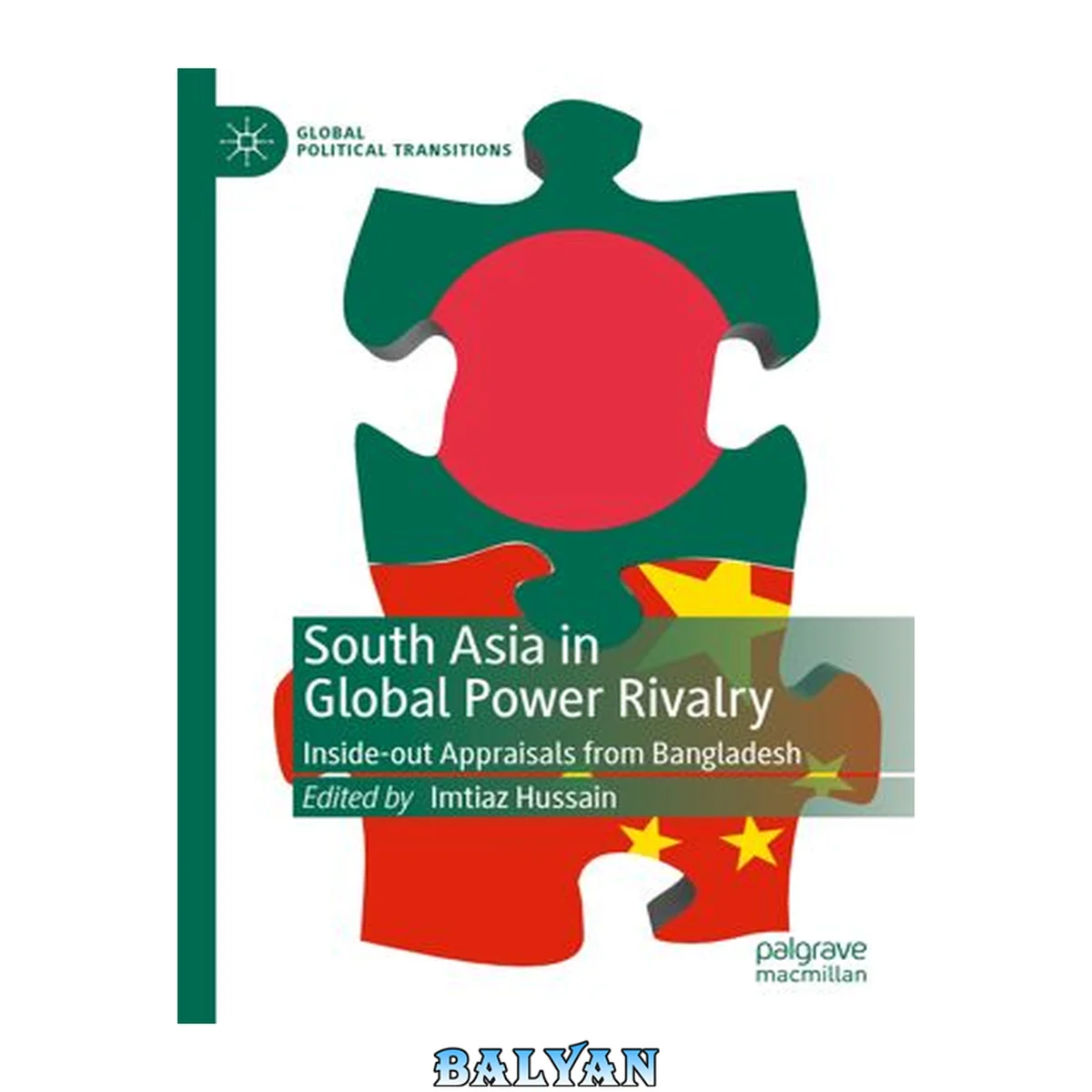
معرفی کتاب «South Asia in Global Power Rivalry: Inside-out Appraisals from Bangladesh (Global Political Transitions)» نوشتهٔ Imtiaz Hussain، منتشرشده توسط نشر Springer Singapore : Imprint: Palgrave Macmillan در سال 2019. این کتاب در فرمت pdf، زبان انگلیسی ارائه شده است.
This edited volume examines global power-rivalry in and around South Asia through Bangladeshi lenses using imperfect and overlapping interest concentric-circles as a template. Dynamics from three transitions --the United States exiting the Cold War, China emerging as a global-level power, and India's eastern interests squaring off with China's Belt Road Initiative, BRI--help place China, India, and the United States (in alphabetical order) in Bangladesh's "inner-most" circle, China, India, and the United States in a "mid-stream" circle, and the United States and Latin America, among other countries, in the "outer-most" circle, depending on the issue. In an atmosphere of short-term gains over-riding long-term considerations, the desperate, widespread search for infrastructural funding inside South Asia enhances China's value, raises local heat, releases new challenges, with costly default consequences looming, issue-specific analysis overtaking formal bilateral relations and a stubborn uncertainty riddling the Bangladeshi air as its policy preferences stubbornly show more certainty. Imtiaz Hussain is the Head of Global Studies & Governance, at Independent University, Bangladesh. Previously Professor of International Relations (Universidad Iberoamericana, Mexico City, 1995-2013) and International Political Economy (Philadelphia University, 1990-94), his publications include:Transatlantic Transitions: Back to a Global Future? (2018), North American Regionalism and Global Spread (2015); Evaluating NAFTA: Theory and Practice (2013); Border Governance and the 'Unruly' South (2013), North America's Soft Security Threat (2013), Afghanistan-Iraq and Post-conflict Governance (2010), The Impact of NAFTA on North America (2010), North American Homeland Security (2008); Running on Empty Across Central America (2006), and Globalization, Indigenous Groups, and Mexico's Plan Puebla Plan (2006); and articles in Handbook of Global Security and Intelligence (2008), South Asian Survey (2008), Politics & Policy (2008), Journal of the Asiatic Society of Bangladesh (2006), Norteamérica (2006), among others. A recipient of over 12 international fellowships and 8 teaching awards, he graduated from the University of Pennsylvania in 1989 Acknowledgments 6 Contents 7 Abbreviations 9 List of Tables 13 Chapter 1: Bangladesh and the Changing Global Rivalry: An Inside-out Appraisal 14 Introduction 14 Bangladesh: A Concentric-Circle View 19 Theoretical Interpretations 24 Corresponding Chapters 29 Conclusions 34 Bibliography 40 Chapter 2: Bangladesh-India Relations: Transitions at the Core 44 Introduction 44 Scope 45 History 45 Issues Between India and Bangladesh 47 Geo-strategic and Security Issues 48 Water Dispute 50 Trade Issue 51 Border Killings and Management 52 Transit 52 Land Boundary and Enclaves 53 Maritime Border 53 Visa Processing 54 Terrorism and Insurgency 54 Drug and Arms Trafficking 54 Plurilateral Coalescing/Alignment 55 Energy Dependence and Complementarity 56 Recent Developments 56 Conclusion 56 Recommendations 57 Bibliography 59 Chapter 3: “Shining” or “Suffering” South Asia? China’s South Asian Footprints 61 Introduction 61 China and Bangalee Muslims’ Imagination 62 Chattogram: Connector of Ancient and Modern Silk Roads 64 Old Silk Road 65 Modern Silk Road 67 Bangladesh-India Connectivity 67 Bangladesh-China Connectivity 67 Bangladesh-Myanmar Connectivity 68 Chindia and Bangladesh 68 Chindia Investment in Bangladesh 69 Modernization and “Suffering” Asia 70 Human Costs of Energy-Based Modernization 71 Old History and Inter-State Distrust Across Ethnic Lines 72 “Suffering” South Asia and Revolt 73 Locating India’s Rebel Hotspots 73 Bangladesh’s Internal Wars 74 State Collaboration and New Economic Geography 74 Regional Wars, Emerging Alliances, and Impending Revolution 76 Trans-Border Alliances 76 Parallel Market 77 Ecological Nationalism 78 Regional War 79 Old History and New Economic Geography: Narratives 79 Conclusions 80 Bibliography 87 Chapter 4: China, India, and Myanmar: Playing Rohingya Roulette? 93 Introduction 93 Chinese Strategic Interests and Stakes in Myanmar 94 Access to the Indian Ocean 94 Energy Security 95 Economic Development and Cooperation 96 Military Trade and Cooperation 97 India’s Strategic Interests and Stakes in Myanmar 97 Infrastructure 99 Obtaining Access to Gas and Oil 100 Military Cooperation 100 Can China and India Coexist in Rakhine? 101 Conclusions 103 Bibliography 108 Chapter 5: Encircling India: China Tightens South Asian Noose 112 Globalizing Local Tensions (or Localizing Global Tensions)? 112 Diverging South Asian Pathways 115 China’s Track 116 India’s Track 119 Conclusions: Globalized Spillovers 125 Bibliography 131 Chapter 6: Gender Benders in Off-Shore Production: Bangladesh-China Comparisons 135 Introduction 135 Women as an Issue: A Comparative Study 136 Why Chinese Women and Bangladesh Comparison? 137 China’s Off-Shore Production and the Role of Bangladesh 143 Things to Ponder 147 Health 147 Housing 147 Education 148 Gender Wage Equality 148 Why Relocate China RMGs to Bangladesh? 148 Aging Population 150 Higher Educated Bangladeshi Job Openings 151 Other Areas of Cooperation? 151 Tourism 152 Infrastructure 152 Agriculture 152 Industry 152 Conclusions 153 Bibliography 158 Chapter 7: Trading with China, India, and the United States: Bangladesh’s Track Record 162 Introduction 162 A Macroeconomic Overview 163 Bangladesh: Duty-Free Accesses to the Global Market 165 Bangladesh’s Trade Feasibility 173 Trade Connections with China, India, and United States 175 Why Bangladesh? 178 What Lies Ahead? 180 Conclusions 184 Bibliography 186 Chapter 8: Chinese and Indian Latin America Entry: Resurrecting Old-Model Relationships 188 The Latin American Debate: Academic Problems and Approaches 188 Asia’s Latin American Toolbox 190 Post-Trump Asia in Latin America during the Trump Era: Fatal Chinese Attraction Versus Indian Political Measure 190 The Chinese Discourse: A Comprehensive Latin American Approach 193 Institutions 196 Chinese Interests, Trade, and Investment 201 India and Latin America 202 Indian and Latin American Institutions: Discourse and Praxis 204 India’s Trade and Investment in Latin America and the Caribbean 207 Future Implications 209 Bibliography 217 Chapter 9: Asia, Latin America, and Globalization: Close Encounters of a Third Kind? 222 First Encounter 224 Second Encounter 225 Third Encounter 232 Bangladesh and Latin America 237 Conclusions 241 Bibliography 245 Chapter 10: South Asia in Strategic Competition: Tracing Chinese, Indian, and U.S. Footprints 250 Triangular Power-Politics in a Dynamic Landscape 250 South Asia in the Triangle: Insecurity, Deterrence, and Strategy 253 Bangladesh-China-India Dynamics 255 Recycled History 257 Sanguinary Linkages 263 History, Geography, and Geopolitics 269 Fragile Mountains 271 Tibet-Shaped Triangle 275 Bibliography 291 Chapter 11: Conclusions: Global Leadership of a Glocal Kind 302 Summaries 302 Bibliography 307 Index 308 This edited volume examines global power-rivalry in and around South Asia through Bangladeshi lenses using imperfect and overlapping interest concentric-circles as a template. Dynamics from three transitions --the United States exiting the Cold War, China emerging as a global-level power, and Indias eastern interests squaring off with Chinas Belt Road Initiative, BRI--help place China, India, and the United States (in alphabetical order) in Bangladeshs "inner-most" circle, China, India, and the United States in a "mid-stream" circle, and the United States and Latin America, among other countries, in the "outer-most" circle, depending on the issue. In an atmosphere of short-term gains over-riding long-term considerations, the desperate, widespread search for infrastructural funding inside South Asia enhances Chinas value, raises local heat, releases new challenges, with costly default consequences looming, issue-specific analysis overtaking formal bilateral relations and a stubborn uncertainty riddling the Bangladeshi air as its policy preferences stubbornly show more certainty. Imtiaz Hussain is the Head of Global Studies & Governance, at Independent University, Bangladesh. Previously Professor of International Relations (Universidad Iberoamericana, Mexico City, 1995-2013) and International Political Economy (Philadelphia University, 1990-94), his publications include:Transatlantic Transitions: Back to a Global Future? (2018), North American Regionalism and Global Spread (2015); Evaluating NAFTA: Theory and Practice (2013); Border Governance and the 'Unruly South (2013), North Americas Soft Security Threat (2013), Afghanistan-Iraq and Post-conflict Governance (2010), The Impact of NAFTA on North America (2010), North American Homeland Security (2008); Running on Empty Across Central America (2006), and Globalization, Indigenous Groups, and Mexicos Plan Puebla Plan (2006); and articles in Handbook of Global Security and Intelligen ce (2008), South Asian Survey (2008), Politics & Policy (2008), Journal of the Asiatic Society of Bangladesh (2006), Norteamérica (2006), among others. A recipient of over 12 international fellowships and 8 teaching awards, he graduated from the University of Pennsylvania in 1989 Front Matter ....Pages i-xiii Bangladesh and the Changing Global Rivalry: An Inside-out Appraisal (Imtiaz Hussain)....Pages 1-30 Bangladesh-India Relations: Transitions at the Core (M. Ashab Uddin)....Pages 31-47 “Shining” or “Suffering” South Asia? China’s South Asian Footprints (Manzurul Mannan)....Pages 49-80 China, India, and Myanmar: Playing Rohingya Roulette? (Hossain Ahmed Taufiq)....Pages 81-99 Encircling India: China Tightens South Asian Noose (Imtiaz Hussain)....Pages 101-123 Gender Benders in Off-Shore Production: Bangladesh-China Comparisons (Shamsun Nahar Ahmed)....Pages 125-151 Trading with China, India, and the United States: Bangladesh’s Track Record (A. N. M. Shibly Noman Khan)....Pages 153-178 Chinese and Indian Latin America Entry: Resurrecting Old-Model Relationships (Francisco Javier Haro-Navejas, Cristina Tapia-Muro)....Pages 179-212 Asia, Latin America, and Globalization: Close Encounters of a Third Kind? (Imtiaz Hussain)....Pages 213-240 South Asia in Strategic Competition: Tracing Chinese, Indian, and U.S. Footprints (Syed Mahmud Ali)....Pages 241-292 Conclusions: Global Leadership of a Glocal Kind (Imtiaz Hussain)....Pages 293-298 Back Matter ....Pages 299-320
دانلود کتاب South Asia in Global Power Rivalry: Inside-out Appraisals from Bangladesh (Global Political Transitions)