راهحلهایی برای احتمال و آمار با کاربردها: متنی برای حل مسئله
Solutions to PROBABILITY AND STATISTICS WITH APPLICATIONS. A Problem Solving Text.
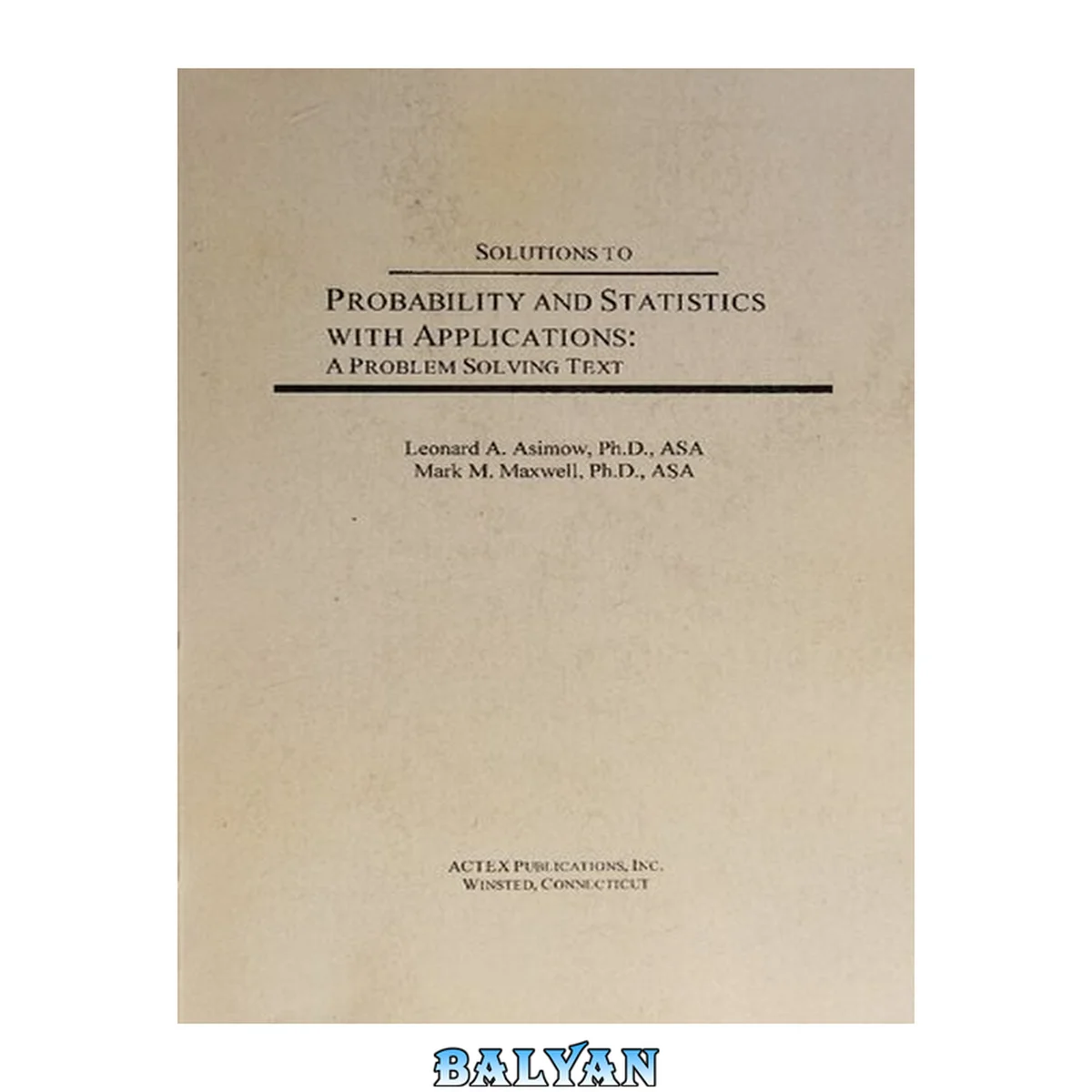
معرفی کتاب «راهحلهایی برای احتمال و آمار با کاربردها: متنی برای حل مسئله» (با عنوان لاتین Solutions to PROBABILITY AND STATISTICS WITH APPLICATIONS. A Problem Solving Text.) نوشتهٔ Russell C. Hibbeler و Leonard A. Asimow, Mark M. Maxwell، منتشرشده توسط نشر ACTEX Publications در سال 2010. این کتاب در فرمت pdf، زبان انگلیسی ارائه شده است.
For courses in Structural Analysis; also suitable for individuals planning a career as a structural engineer. Applying theory to structural modeling and analysisStructural Analysis, 10e in SI Units, presents the theory and applications of structural analysis as it applies to trusses, beams, and frames. Through its student-friendly, clear organization, the text emphasizes developing the ability to model and analyze a structure in preparation for professional practice. The text is designed to ensure students taking their first course in this subject understand some of the more important classical methods of structural analysis, in order to obtain a better understanding of how loads are transmitted through a structure, and how the structure will deform under load. The large number of problems covers realistic situations involving various levels of difficulty. The updated 10th SI edition features many new problems and an expanded discussion of structural modeling, specifically the importance of modeling a structure so it can be used in computer analysis. Newly added material includes a discussion of catenary cables and further clarification for drawing moment and deflection diagrams for beams and frames. MasteringTM Engineering is not included. Students, if Mastering Engineering is a recommended/mandatory component of the course, please ask your instructor for the correct ISBN. Mastering Engineering should only be purchased when required by an instructor. Instructors, contact your Pearson representative for more information. Reach every student by pairing this text with Mastering EngineeringMastering is the teaching and learning platform that empowers you to reach every student. By combining trusted author content with digital tools and a flexible platform, Mastering personalizes the learning experience and improves results for each student. Front Cover Title Page Copyright Page Preface Contents 1 Types of Structures and Loads 1.1 Introduction 1.2 Classification of Structures 1.3 Loads 1.4 Structural Design 2 Analysis of Statically Determinate Structures 2.1 Idealized Structure 2.2 Load Path 2.3 Principle of Superposition 2.4 Equations of Equilibrium 2.5 Determinacy and Stability 2.6 Application of the Equations of Equilibrium 3 Analysis of Statically Determinate Trusses 3.1 Common Types of Trusses 3.2 Classification of Coplanar Trusses 3.3 The Method of Joints 3.4 Zero-Force Members 3.5 The Method of Sections 3.6 Compound Trusses 3.7 Complex Trusses 3.8 Space Trusses 4 Internal Loadings Developed in Structural Members 4.1 Internal Loadings at a Specified Point 4.2 Shear and Moment Functions 4.3 Shear and Moment Diagrams for a Beam 4.4 Shear and Moment Diagrams for a Frame 4.5 Moment Diagrams Constructed by the Method of Superposition 5 Cables and Arches 5.1 Cables 5.2 Cable Subjected to Concentrated Loads 5.3 Cable Subjected to a Uniform Distributed Load 5.4 Cable Subjected to Its Own Weight 5.5 Arches 5.6 Three-Hinged Arch 6 Influence Lines for Statically Determinate Structures 6.1 Influence Lines 6.2 Influence Lines for Beams 6.3 Qualitative Influence Lines 6.4 Influence Lines for Floor Girders 6.5 Influence Lines for Trusses 6.6 Maximum Influence at a Point Due to a Series of Concentrated Loads 6.7 Absolute Maximum Shear and Moment 7 Deflections 7.1 Deflection Diagrams and the Elastic Curve 7.2 Elastic-Beam Theory 7.3 The Double Integration Method 7.4 Moment-Area Theorems 7.5 Conjugate-Beam Method 8 Deflections Using Energy Methods 8.1 External Work and Strain Energy 8.2 Principle of Work and Energy 8.3 Principle of Virtual Work 8.4 Method of Virtual Work: Trusses 8.5 Castigliano’s Theorem 8.6 Castigliano’s Theorem for Trusses 8.7 Method of Virtual Work: Beams and Frames 8.8 Virtual Strain Energy Caused by Axial Load, Shear, Torsion, and Temperature 8.9 Castigliano’s Theorem for Beams and Frames 9 Analysis of Statically Indeterminate Structures by the Force Method 9.1 Statically Indeterminate Structures 9.2 Force Method of Analysis: General Procedure 9.3 Maxwell’s Theorem of Reciprocal Displacements 9.4 Force Method of Analysis: Beams 9.5 Force Method of Analysis: Frames 9.6 Force Method of Analysis: Trusses 9.7 Composite Structures 9.8 Symmetric Structures 9.9 Influence Lines for Statically Indeterminate Beams 9.10 Qualitative Influence Lines for Frames 10 Displacement Method of Analysis: Slopedeflection Equations 10.1 Displacement Method of Analysis: General Procedures 10.2 Slope-Deflection Equations 10.3 Analysis of Beams 10.4 Analysis of Frames: No Sidesway 10.5 Analysis of Frames: Sidesway 11 Displacement Method of Analysis: Moment Distribution 11.1 General Principles and Definitions 11.2 Moment Distribution for Beams 11.3 Stiffness-Factor Modifications 11.4 Moment Distribution for Frames: No Sidesway 11.5 Moment Distribution for Frames: Sidesway 12 Approximate Analysis of Statically Indeterminate Structures 12.1 Use of Approximate Methods 12.2 Trusses 12.3 Vertical Loads on Building Frames 12.4 Portal Frames and Trusses 12.5 Lateral Loads on Building Frames: Portal Method 12.6 Lateral Loads on Building Frames: Cantilever Method 13 Beams and Frames Having Nonprismatic Members 13.1 Introduction 13.2 Loading Properties of Nonprismatic Members 13.3 Moment Distribution for Structures Having Nonprismatic Members 13.4 Slope-Deflection Equations for Nonprismatic Members 14 Truss Analysis Using the Stiffness Method 14.1 Fundamentals of the Stiffness Method 14.2 Member Stiffness Matrix 14.3 Displacement and Force Transformation Matrices 14.4 Member Global Stiffness Matrix 14.5 Truss Stiffness Matrix 14.6 Application of the Stiffness Method for Truss Analysis 14.7 Nodal Coordinates 14.8 Trusses Having Thermal Changes and Fabrication Errors 14.9 Space-Truss Analysis 15 Beam Analysis Using the Stiffness Method 15.1 Preliminary Remarks 15.2 Beam-Member Stiffness Matrix 15.3 Beam-Structure Stiffness Matrix 15.4 Application of the Stiffness Method for Beam Analysis 16 Plane Frame Analysis Using The Stiffness Method 16.1 Frame-Member Stiffness Matrix 16.2 Displacement and Force Transformation Matrices 16.3 Frame-Member Global Stiffness Matrix 16.4 Application of the Stiffness Method for Frame Analysis 17 Structural Modeling and Computer Analysis 17.1 General Structural Modeling 17.2 Modeling a Structure and Its Members 17.3 General Application of a Structural Analysis Computer Program Appendix A Matrix Algebra for Structural Analysis Preliminary and Fundamental Problem Solutions Answers to Selected Problems Index Back Cover For courses in Structural Analysis; also suitable for individuals planning a career as a structural engineer. Structural Analysis in SI Units, presents the theory and applications of structural analysis as it applies to trusses, beams, and frames. Through its student-friendly, clear organisation, the text emphasises developing the ability to model and analyse a structure in preparation for professional practice. The text is designed to ensure students taking their first course in this subject understand some of the more important classical methods of structural analysis, in order to obtain a better understanding of how loads are transmitted through a structure, and how the structure will deform under load. The large number of problems covers realistic situations involving various levels of difficulty. The updated 10th SI edition features many new problems and an expanded discussion of structural modeling, specifically the importance of modeling a structure so it can be used in computer analysis. Newly added material includes a discussion of catenary cables and further clarification for drawing moment and deflection diagrams for beams and frames. The full text downloaded to your computer With eBooks you can: search for key concepts, words and phrases make highlights and notes as you study share your notes with friends eBooks are downloaded to your computer and accessible either offline through the Bookshelf (available as a free download), available online and also via the iPad and Android apps. Upon purchase, you'll gain instant access to this eBook. Time limit The eBooks products do not have an expiry date. You will continue to access your digital ebook products whilst you have your Bookshelf installed. « Edward Allen and Joseph Iano's, Fundamentals of building construction, has been the go-to reference for thousands of professionals and students of architecture, engineering, and construction technology for over thirty years. The materials and methods described in this new seventh edition have been thoroughly updated to reflect the latest advancements in the industry. Carefully selected and logically arranged topics-ranging from basic building methods to the principles of structure and enclosure-help readers gain a working knowledge of the field in an enjoyable, easy-to-understand manner. All major construction systems, including light wood frame, mass timber, masonry, steel frame, light gauge steel, and reinforced concrete construction, are addressed. Now in its seventh edition, Fundamentals of building construction contains substantial revisions and updates. New illustrations and photographs reflect the latest practices and developments in the industry. Revised chapters address exterior wall systems and high-performance buildings, an updated and comprehensive discussion of building enclosure science, evolving tools for assessing environmental and health impacts of building materials, and more. New and exciting developments in mass timber construction are also included. »-- Résumé de l'éditeur Structural Analysis, 10th Edition, presents the theory and applications of structural analysis as it applies to trusses, beams, and frames. Through its student-friendly, clear organization, the text emphasizes developing the ability to model and analyze a structure in preparation for professional practice. The text is designed to ensure students taking their first course in this subject understand some of the more important classical methods of structural analysis, in order to obtain a better understanding of how loads are transmitted through a structure, and how the structure will deform under load. The large number of problems cover realistic situations involving various levels of difficulty. The updated 10th edition features 30% new problems and an expanded discussion of structural modeling, specifically the importance of modeling a structure so it can be used in computer analysis. Newly added material includes anupdate to the ASCE/SEI 2106 specifications, a discussion of catenary cables, and further clarification for drawing moment and deflection diagrams for beams and frames "The text is designed to ensure students taking their first course in this subject understand some of the more important classical methods of structural analysis, in order to obtain a better understanding of how loads are transmitted through a structure, and how the structure will deform under load. The large number of problems covers realistic situations involving various levels of difficulty. The updated 10th SI edition features many new problems and an expanded discussion of structural modeling, specifically the importance of modeling a structure so it can be used in computer analysis. Newly added material includes a discussion of catenary cables and further clarification for drawing moment and deflection diagrams for beams and frames." provided by publisher
دانلود کتاب راهحلهایی برای احتمال و آمار با کاربردها: متنی برای حل مسئله