Slingers and Sling Bullets in the Roman Civil Wars of the Late Republic, 90-31 BC
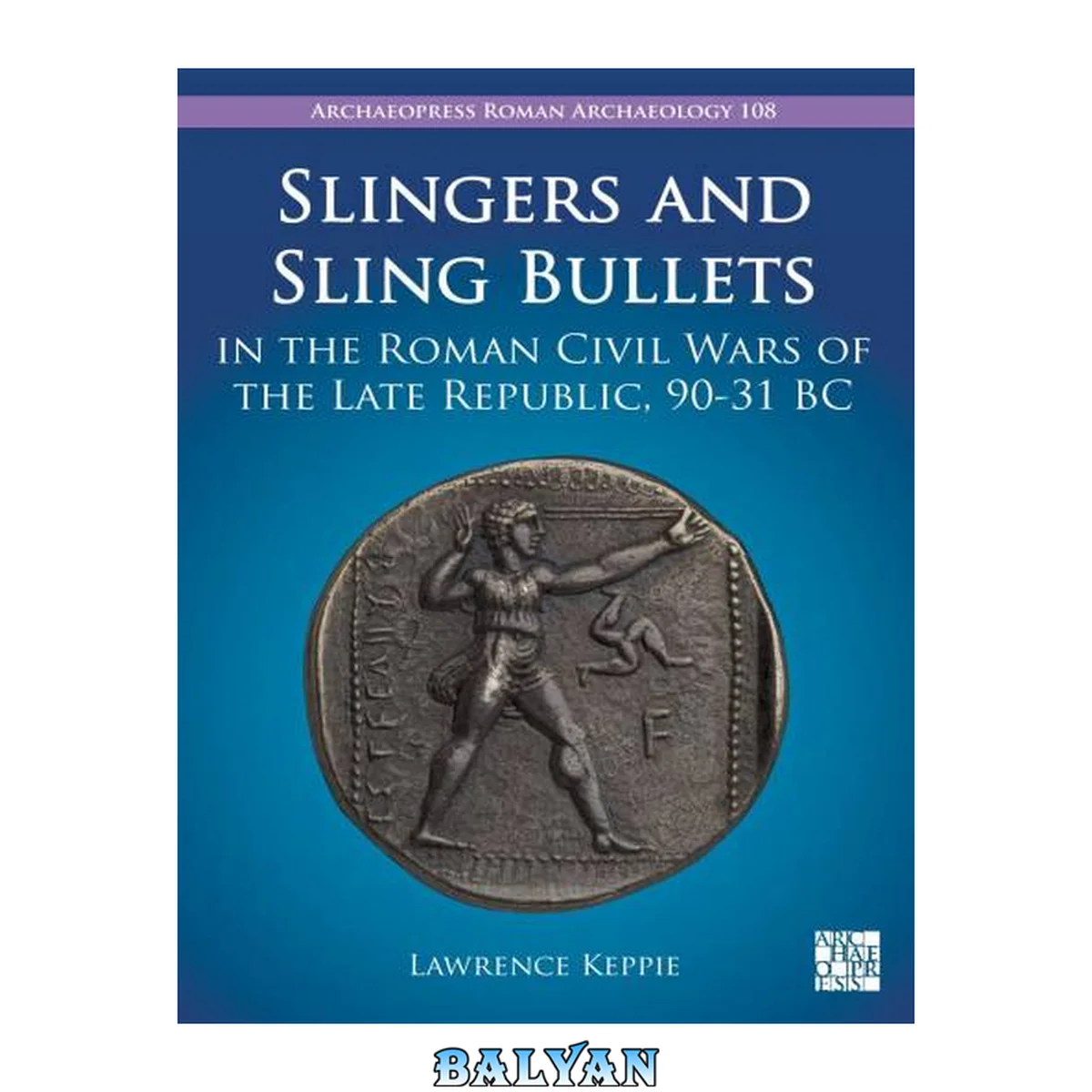
معرفی کتاب «Slingers and Sling Bullets in the Roman Civil Wars of the Late Republic, 90-31 BC» نوشتهٔ Varios Autores، Frederico Lourenço و Lawrence Keppie، منتشرشده توسط نشر Archaeopress Archaeology در سال 2023. این کتاب در فرمت pdf، زبان انگلیسی ارائه شده است.
Slingers were an element in the Roman army over many centuries. Their activities are frequently reported in literary accounts of battles and sieges during the civil wars of the Late Republic. Sling bullets, in stone, clay and lead, have been found at many scenes of conflict. Lead bullets often bear brief inscriptions addressed to the recipients, naming military units, their commanders and centurions; others carry sexual insults. This is an ever-expanding body of ancient evidence. Yet some books on the Roman army scarcely mention slingers. This monograph seeks to redress the balance and draws attention to their role and effectiveness. It covers the period between the Social War of 90-89 BC and the close of the civil wars at the battle of Actium in 31 BC, encompassing the campaigns of Julius Caesar in Gaul between 58 and 50 BC, including his expeditions to Britain, the wars between Caesar and Pompey the Great (and his sons) in 49-45 BC, and between Caesar’s heirs and successors in 44-31 BC, including Mark Antony and the future emperor Augustus. Professor Lawrence Keppie studied at the University of Glasgow, Balliol College Oxford, and The British School at Rome, where he was Scholar in Classical Studies. For 30 years he was a curator of archaeology at The Hunterian Museum, University of Glasgow, before retiring in 2003. He has excavated widely on Roman sites in Scotland, and in Italy. His many books include The Making of the Roman Army (1984, 1998), Understanding Roman Inscriptions (1991, 2001) and The Romans on the Bay of Naples (2009). He has held visiting appointments at The Institute for Advanced Study, Princeton, N.J., The British School at Rome and The University of British Columbia, Vancouver. Cover 1 Title Page 3 Copyright Page 4 Contents Page 5 List of Figures 6 Figure 1. Lead bullets naming Gnaeus Pompeius Magnus, son of Pompey the Great, 45 BC. Museo Arqueológico de Osuna, Spain. Photo: © Dr J.H. Reid. 12 Figure 2. Scene from the Altar of Domitius Ahenobarbus, Rome, showing two legionaries and a cavalryman. The date is disputed: perhaps the end of the 2nd century BC. Musée du Louvre, Paris. Photo: Jastrow (2007). Wikimedia Commons. 13 Figure 3. Numantia, Spain. Clay sling bullets from Adolf Schulten’s excavations of 1905-12. Photo: A. Schulten, Numantia II. Die Stadt Numantia, 1931, München: Tafel 38B. 15 Figure 4. Front and side of a clay mould for lead bullets found in the Rue Saint-Martin, Paris. After Poux and Guyard. Scale 1:1. 16 Figure 5. Numantia, Spain. Plan of the town and siegeworks of 134-133 BC. After L. Keppie, The Making of the Roman Army, 1984, London: figure 15. 21 Figure 6. Numantia, Spain. Stone ballista balls from Adolf Schulten’s excavations of 1905-12. Photo: A. Schulten, Numantia III. Die Lager des Scipio, 1927, München: Tafel 53. 23 Figure 7. Italy, showing places mentioned in the text. 24 Figure 8. Asculum (Ascoli Piceno, Italy). Course of the Castellano tributary at the Ponte di Cecco. The bridge, of Roman Republican or Augustan date, was reconstructed in the 1960s following wartime demolition. Photo: Pampuco. Wikimedia Commons. Licence: 26 Figure 9. Lead sling bullets from Asculum and vicinity, 90-89 BC. After Zangemeister. Scale 1:1 27 Figure 10. Row of five slingers on a stone relief at Asculum (Ascoli Piceno, Italy). Museo Archeologico Statale di Ascoli Piceno. Photo: Cast in the Museo della Civiltà Romana, Rome. © Roma, Sovrintendenza Capitolina ai Beni Culturali. 29 Figure 11. Silver denarius depicting L. Cornelius Sulla, issued in 54 BC by his grandson. The coin legend reads: SVLLAˑCOS (Sulla consul). Photo: © The Hunterian, University of Glasgow (GLAHM 22407). 32 Figure 12. Pompeii, The Anglo-American Project. Excavation in progress close to the Herculaneum Gate, 2004. Photo: © The late Margaret J. Robb. Courtesy of Dr R.F.J. Jones. 34 Figure 13. Lead sling bullets of the Late Republic, from Renieblas (near Numantia, Spain), naming Quintus Sertorius (no. 1); Volubilis (Morocco), naming Sosus, King of Mauretania; the other side shows what may be a stylised lightning-bolt (no. 2); Numanti 35 Figure 14. France, Belgium, Holland, Germany (Roman Gaul), showing places mentioned in the text. 37 Figure 15. Alesia (Alise-Sainte-Reine, France). 38 Figure 16. South of France, showing places mentioned in the text. Note: 1. Alts; 2. Saint-Affrique; 3. Saint-Pargoire; 4. Les Petites Caisses; 5. Saint-Blaise; 6. La Cloche. 39 Figure 17. North Africa, showing places mentioned in the text. 39 Figure 18. Lead sling bullets of the Late Republic, from Paris (no. 1), Alesia (nos 2-4), Le Mas d’Agenais (no. 5), Saint-Pargoire (no. 6), Sicily (no. 7), L’Ermitage d’Agen (no. 8). After Poux and Robin (no. 1), Sievers (nos 2-4), Feugère (nos 5-6), Cost 42 Figure 19. Spain and Portugal, showing places mentioned in the text 44 Figure 20. Lead sling bullets, Spain, 49-45 BC, from Ilerda (no. 1), Menorca (no. 2), Urso (no. 3), Cerro de las Balas (nos 4-5). After López Vilar (no. 1), De Nicolàs (no. 2); Díaz Ariňo (no. 3), Pina Polo and Zanier (nos 4-5). Scale 1:1. 46 Figure 21. North-Eastern Spain, to illustrate events in 133-49 BC. Note: 1. Prades; 2. Picamoixons. 47 Figure 22. Silver denarius, showing an elephant trampling a serpent, 49-48 BC. The coin legend reads: CAESAR. Photo: © The Hunterian, University of Glasgow (GLAHM 22426). 48 Figure 23. Greece, showing places mentioned in the text. 49 Figure 24. Siegelines constructed by Caesar and by Pompey at Dyrrhachium (Durrës, Albania), 48 BC. The siting of individual forts, marked here by dots, is largely hypothetical. After L. Keppie, The Making of the Roman Army, 1984, London: figure 31). 50 Figure 25. Southern Spain, to illustrate events in 49-45 BC. Note: 1. Alcalá de Guadaíra; 2. Lantejuela; 3. Puebla de Cazalla. 53 Figure 26. Silver denarius depicting Julius Caesar, 44 BC. The coin legend reads: CAESARˑDICTˑPERPETVO (Caesar, dictator for life). Photo: © The Hunterian, University of Glasgow (GLAHM 22531). 55 Figure 27. Northern Italy, showing location of Mutina (Modena). 58 Figure 28. Gold aureus depicting Octavian, 42 BC. The coin legend reads: CˑCAESARˑIIIˑVIRˑRˑ PˑC (Gaius Caesar, Triumvir for the ordering of the state). Photo: © The Hunterian, University of Glasgow (GLAHM 22579). 59 Figure 29. Silver denarius naming Q. Salvidienus Rufus and showing a lightning-bolt, 40 BC. The coin legend reads: QˑSALVIVSˑIMPˑCOSˑDESIG (Quintus Salvius, saluted as victorious commander, consul designate). Photo: © The Hunterian, University of Glasgow 60 Figure 30. Sicily and Calabria (Italy), to illustrate events in 42-36 BC. Note: 1. Mylae; 2. Naulochus; 3. Rhegium; 4. Leucopetra. 61 Figure 31. Perusia (Perugia, Italy). Panoramic view from the North-West, showing the Basilica of San Domenico (centre), with the bell-tower of the Abbazia of San Pietro further towards the right. Photo: trolvag. Wikimedia Commons. Licence: CC BY-SA 3.0 Un 64 Figure 32. Lead sling bullets from Perusia (Italy), 41-40 BC. After Keppie (nos 1-3, front, 5-8; Benedetti (nos 3 back, 4). Scale 1:1. 65 Figure 33. Lead sling bullets from Perusia (Italy), 41-40 BC. After Benedetti (nos 1, 3); Keppie nos 2, 4-6). Scale 1:1. 66 Figure 34. Silver denarius depicting Lucius Antonius, 41 BC. The coin legend reads: LˑANTONIVSˑCOS (Lucius Antonius, consul). Photo: Classical Numismatic Group. Inc. Wikimedia Commons. Licence: CC BY-SA 3.0 Unported. 69 Figure 35. Lead sling bullet from Perusia (Italy), 41-40 BC. After Benedetti. Scale 2:1. 70 Figure 36. Gold aureus depicting Sextus Pompeius, 42-40 BC. The coin legend reads: MAGˑPIVSˑIMPˑITER (Magnus Pius, twice saluted victorious commander). Photo: © The Hunterian, University of Glasgow (GLAHM 22653). 72 Figure 37. Silver denarius issued by Mark Antony, 32-31 BC. The obverse (above) shows a galley, the reverse (below) an eagle between two standards, celebrating his legion V. The coin legend reads (obverse): ANTˑAVGˑIIIVIRˑRˑPˑC (Antonius, augur, Triumvir 73 Figure 38. Tombstone from Rome, naming the slinger Epitynchanus, AD 100 or later. After De Minicis, Sulle antiche ghiande, 1844, Roma: tabula 1. 77 Figure 39. Trajan’s Column, Rome. A slinger and a stone-thrower. Photo: C. Cichorius, Die Reliefs der Traiansäule, 1896, Berlin: scene lxvi. Courtesy of Glasgow University Library. 78 Figure 40. Trajan’s Column, Rome. A stone-thrower poised to cast a stone. Photo: C. Cichorius, Die Reliefs der Traiansäule. 1896, Berlin: scene lxxii. Courtesy of Glasgow University Library. 79 Figure 41. Trajan’s Column, Rome. A slinger viewed from behind. Photo: C. Cichorius, Die Reliefs der Traiansäule, 1896, Berlin: scene cxiii. Courtesy of Glasgow University Library. 80 Figure 42. Column of Marcus Aurelius, Rome. A group of bearded slingers. Photo: E. Petersen, A. von Domaszewski and G. Calderini, Die Marcus-Säule auf Piazza Colonna in Rom, 1896, Munchenü: scene x. Courtesy of Glasgow University Library 82 Preface 9 Chapter 1 11 Slingers and slinging in the Roman world 11 Introduction 11 Slings, slingers and sling bullets 11 Inscriptions on lead bullets 19 Balearic slingers 20 A case study: the siege of Numantia 134-33 BC 22 Chapter 2 25 The Social War and the siege of Asculum, 90-89 BC 25 Chapter 3 33 Sulla, Sertorius and Caesar, 89-50 BC 33 Quintus Sertorius 33 Caesar in Gaul 58-50 BC 40 Sosus, King of Mauretania. 43 Chapter 4 45 Civil war 1: Caesar against Pompey and his sons, 49-45 BC 45 The battle of Ilerda, 49 BC 45 Dyrrhachium and Pharsalus, 48 BC 49 Campaigns in Africa and Spain, 46-45 BC 52 The battle of Munda, 45 BC 54 Chapter 5 57 Civil war 2: Caesar’s heirs and successors, 44-42 BC 57 The battle of Mutina, 43 BC 57 Events of 42 BC: Calabria, Sicily, Philippi 60 Chapter 6 63 The siege of Perusia, 41-40 BC 63 Chapter 7 72 From Perusia to Actium, 40-31 BC 72 Chapter 8 76 Slingers under the Roman Empire 76 Chapter 9 84 The role of slingers in battle and their effectiveness 84 Chapter 10 87 Conclusion 87 Reference 1 92 Glossary 92 Reference 2 93 Bibliography 93 Epigraphic corpora 93 References 93 Index 105 Roman,Late Republic,Roman Civil Wars,Sling,Slingers,Weaponry,Weapons
دانلود کتاب Slingers and Sling Bullets in the Roman Civil Wars of the Late Republic, 90-31 BC