کشتیها، قدیسین و دریا: میراث فرهنگی و مردمنگاری مدیترانه و دریای سرخ
Ships, Saints and Sealore : Cultural Heritage and Ethnography of the Mediterranean and the Red Sea
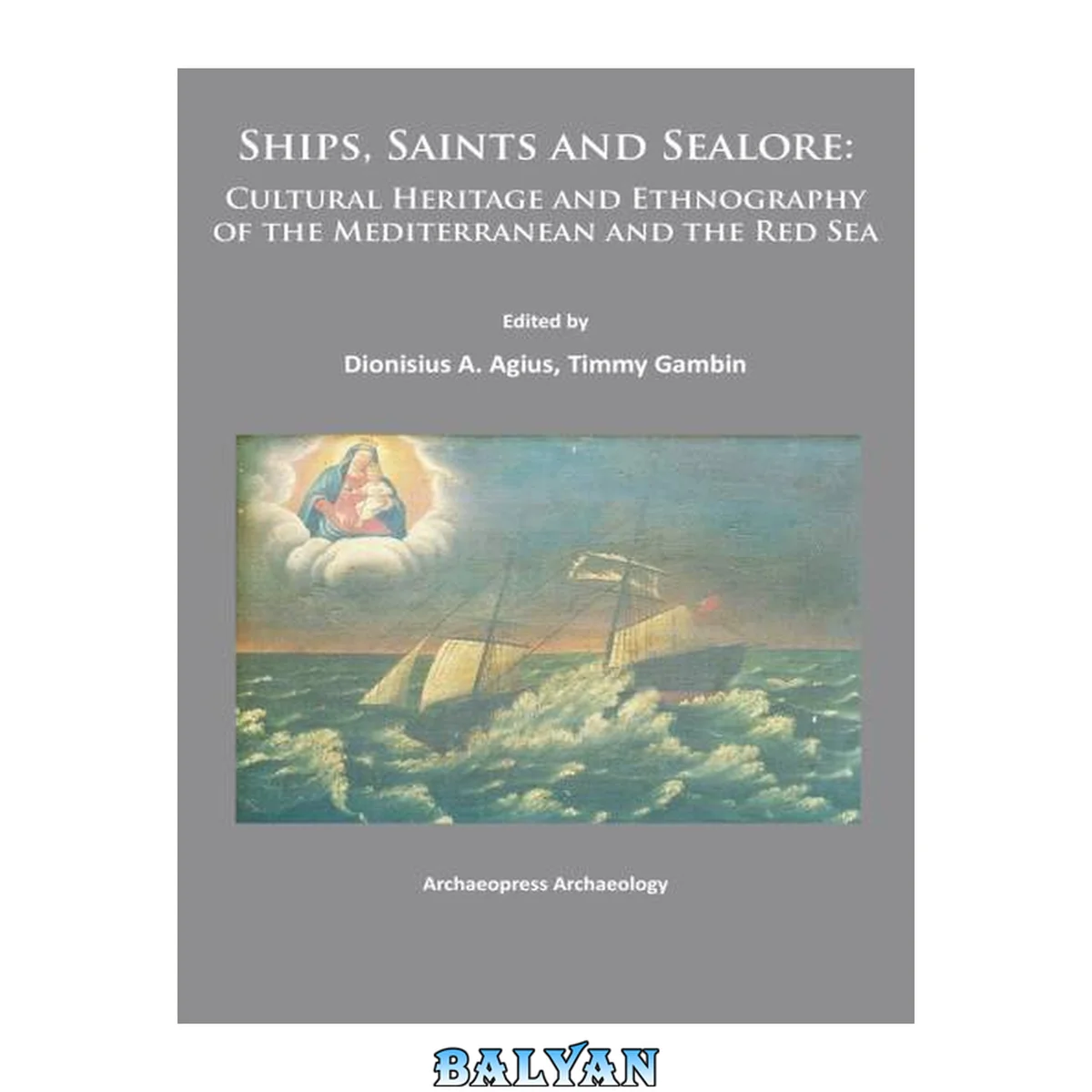
معرفی کتاب «کشتیها، قدیسین و دریا: میراث فرهنگی و مردمنگاری مدیترانه و دریای سرخ» (با عنوان لاتین Ships, Saints and Sealore : Cultural Heritage and Ethnography of the Mediterranean and the Red Sea) نوشتهٔ Dionisius A. Agius (editor), Timmy Gambin (editor), Athena Trakadas (editor), Harriet Nash (editor)، منتشرشده توسط نشر Archaeopress Access Archaeology در سال 2014. این کتاب در فرمت pdf، زبان انگلیسی ارائه شده است.
Just as the sea has played a pivotal role in the connectivity of people, economies and cultures, it has also provided a common platform for inter-disciplinary cooperation amongst academics. This book is a selection of conference papers and other contributions that has seen the coming-together of scholars and researchers from backgrounds as diverse as archaeology, history, ethnography, maritime and heritage studies of the Mediterranean and the Red Sea. Its strength lies in the way such diversity has been harnessed to provide an engaging and insightful study of the sea and its influences on various factors of life - both past and present. Table of Contents Foreword Introduction: A seaman’s view of the Mediterranean (Seán McGrail) I. Maritime Rituals, Superstitions and Ship Images: Maritime activity and the Divine – an overview of religious expression by Mediterranean seafarers, fishermen and travellers (Timmy Gambin) Hazards at sea: a case-study of two ex-voto paintings from the Church of the Karmelitani Skalzi in Bormla, Malta (Simon Mercieca) II. Confraternities in Maritime Culture: The Holy Vessel: the Vascelluzzo of Messina during the early modern period (Carmelina Gugliuzzo) Two maritime related confraternities established at Bormla (Cospicua) parish church, Malta (Emanuel Magro Conti) III. Maritime Heritage: Historical Narratives: Quatri partitu en cosmographia pratica i por otro nombre llamado Espejo de navegantes by Alonso de Chaves: a navigation manual for the instruction of Spanish pilots in the sixteenth century (Maravillas Aguiar) Images of pirates and slaves in traditional Greek popular songs (Efsevia Lasithiotaki) IV. Ethnography, Tourism and Maritime Heritage: Sun, sand and sea: tourism and the commodification of Malta’s maritime heritage (Jeremy Boissevain) Work, tourism and the sea: Bulgarian experiences in Malta (Irina Atanasova) Lateen sails versus fibreglass boats: the contradictions of a maritime heritage process – the Platja dels Pescadors on the Catalonian coast (Eliseu Carbonell) The Maritime Museum of Barcelona’s approach to maritime ethnology: research and communications (Enric Garcia Domingo) V. Maritime Archaeology: Traditions and Practices: Sailing the Red Sea: ships, infrastructure, seafarers and society (Cheryl Ward) The dgħajsa: a Phoenician survival (Alec Tilley) Maritime ethnography and archaeology (Seán McGrail) The maritime heritage of Yemen: a focus on traditional wooden ‘dhows’ (Dionisius A. Agius, John P. Cooper and Chiara Zazzaro) The hūrī of Socotra: cultural treasure or coastal trash? (Julian Jansen van Rensburg) Index Cover Title Page Copyright page Contents List of Figures Foreword A seaman’s view of the Mediterranean Seán McGrail Maritime activity and the Divine – an overview of religious expression by Mediterranean seafarers, fishermen and travellers Timmy Gambin Hazards at sea: a case-study of two ex-voto paintings from the Church of the Karmelitani Skalzi in Bormla, Malta Simon Mercieca The Holy Vessel: the Vascelluzzo of Messina during the early modern period Carmelina Gugliuzzo Two maritime related confraternities established at Bormla (Cospicua) parish church, Malta Emanuel Magro Conti Quatri partitu en cosmographia pratica i por otro nombre llamado Espejo de navegantes by Alonso de Chaves: a navigation manual for the instruction of Spanish pilots in the sixteenth century Maravillas Aguiar Images of pirates and slaves in traditional Greek popular songs Efsevia Lasithiotaki Sun, sand and sea: tourism and the commodification of Malta’s maritime heritage Jeremy Boissevain Work, tourism and the sea: Bulgarian experiences in Malta Irina Atanasova Lateen sails versus fibreglass boats: the contradictions of a maritime heritage process – the Platja dels Pescadors on the Catalonian coast Eliseu Carbonell The Maritime Museum of Barcelona’s approach to maritime ethnology: research and communications Enric Garcia Domingo Sailing the Red Sea: ships, infrastructure, seafarers and society Cheryl Ward The dgħajsa: a Phoenician survival Alec Tilley Maritime ethnography and archaeology Seán McGrail The maritime heritage of Yemen: a focus on traditional wooden “dhows” Dionisius A. Agius, John P. Cooper and Chiara Zazzaro The hūrī of Socotra: cultural treasure or coastal trash? Julian Jansen van Rensburg Index Back cover A seaman’s view of the Mediterranean Fig. 1: Visibility of land from a boat at sea level in the Mediterranean (A. Trakadas after X. Henkel, ‘Die sichtbarkeit im Mittelmeergerbier’, Petermann’s Geographische Mittelungen, 1901: fig.1). Maritime activity and the Divine – an overview of religious expression by Mediterranean seafarers, fishermen and travellers Fig. 1: A Roman mosaic from Tunisia portraying Neptune (photo T. Gambin). Fig. 2: A louterion from the third century CE Site III in Filicudi, Sicily (photo T. Gambin). Fig. 3: Various stages of the maritime procession held annually in Cartagena, Spain (photos T. Gambin). Fig. 4: Early nineteenth-century sketch showing the archaeological remains that provide good indicators for vessels entering the harbour (after William Smyth 1823; courtesy of the Wignacourt Museum, Rabat-Malta). Fig. 5: A typical Mediterranean ex-voto painting from a church in Malta Hazards at sea: Fig. 1: Il-Kunvent tal-Karmelitani Skalzi. The monastery which suffered extensive damage during the Second World War Fig. 2: The church today, lit up for the religious festivities of St. Teresa of Ávila (1515-1582), Doctor of the Church and co-founder of the Discalced Carmelites Fig. 3: The ex-voto brig-rigged steamer Posocchob. Saint Therese Church, Bormla Fig. 4: The ex-voto showing members of the crew of the pilot boat in peril The Holy Vessel: the Vascelluzzo of Messina Fig. 1: View of the Port of Messina from the Palazzo del Senato Fig. 2: The Vascelluzzo (photo by Giuseppe Martino, private collection). Fig. 3: Procession of the Vascelluzzo in front of the Church of Catalans Fig. 4: Madonna della Lettera Fig. 5: Ex-voto painting in the Church of the Sailors – the so-called Sacrarium, second half of the eighteenth century (artist unknown).* Fig. 6: Procession of the Vascelluzzo promoted by the Confraternity of Sailors with their banner (photographer unknown). Fig. 7: The banner of the confraternity (photo by G. Conti-Giordano Corsi, in Conti-Giordano Corsi, 1980). Two maritime related confraternities established at Bormla (Cospicua) parish church, Malta Fig. 1: Seventeenth-century silver encased wooden statue of the Madonna Tal-Kunċizzjoni Fig. 2: Bormla’s main church escapes destruction during the Second World War (photo collection of E. Magro Conti). Fig. 3: Some modern day Bormla barklori participating in the 8th of September 1565 Great Siege regatta (photo collection of E. Magro Conti). Fig. 4: A procession emanating from the main Bormla church showing some of the confraternities banners, crosses and lanterns in sequence of establishment. The very first banner is that of the Confraternity of Sant Andrija (St. Andrew) Fig. 5: View of the site of the disputed foreshore which eventually racked havoc of the lives of Bormla’a fisherman and also proved a death knell for their confraternity Fig. 6: Wooden carved processional statue of Sant Andrija (St. Andrew) which survives to this day unlike its masonry counterpart (photo E. Magro Conti). Fig. 7: St. Theresa’s (Santa Tereża’s) church interior Quatri partitu en cosmographia pratica i por otro nombre llamado Espejo de navegantes by Alonso de Chaves: a navigation manual for the instruction of Spanish pilots in the sixteenth century Fig. 1: Real provisión or Royal Mandate of the Catholic Monarchs ordered the Casa de Contratación (House of Trade) to be located in the city of Seville. 20th of January, 1503, Alcalá de Henares (Spain) (Archivo General de Indias, Patronato, 251, R.1.).* Fig. 2: Portrait of Amerigo Vespucci (1451-1512) in A. Montanus, De nieuwe en onbekende weereld of beschryving van America en’t zuid-land (‘The New and Unknown World or Description of America and the Southland’) (Amsterdam: J. Meurs, 1671). The Reyes Cató Fig. 3: First page of Alonso de Chaves’ manuscript Quatri partitu. Manuscript preserved in a single copy Fig. 4: Page from the index of Alonso de Chaves’ manuscript, Quatri partitu (courtesy of the Real Academia de la Historia, Madrid). Fig. 5: The wind rose in Alonso de Chaves’ manuscript, Quatri partitu. The Arabs used a 32-point wind rose (courtesy of the Real Academia de la Historia, Madrid). Fig. 6: The chapter on the astrolabe in Alonso de Chaves’ manuscript Quatri partitu (courtesy of Real Academia de la Historia, Madrid). Fig. 7: The shadow quadrant in Alonso de Chaves’ manuscript, Quatri partitu (courtesy of the Real Academia de la Historia, Madrid). Fig. 8: The cross-staff in Alonso de Chaves’ manuscript, Quatri partitu (courtesy of the Real Academia de la Historia, Madrid). Fig. 9: Frontispiece of Johannes de Sacrobosco’s Sphaera Mundi, Venice, 1490. Astronomy, placed in the middle, is flanked by Urania, the muse of astrology, and Ptolemy. Astronomy holds two instruments: an astrolabe and an armillary sphere. This is the ear Fig. 10: Waghenaer’s Mariner’s Mirror (1586), the first English Atlas Images of pirates and slaves in traditional Greek popular songs Fig. 1: The Bay of Gera, where Barbarossa grew up, Lesbos Island, Greece (photo E. Lasithiotaki). Fig. 2: Map of Crete, 1702-1773 (after Santorineu, 8-9). Fig. 3: Matthew, the Greek Patriarch of Alexandria (r. 1746-1767), who sent monks to assist to the Orthodox slaves in the prisons of Algiers and Tripoli. Fig. 4: A Muslim galley (courtesy of Joseph Muscat). Fig. 5: Contemporary view of Naxos port. This is the port where a man was abducted and taken to Libya, where as a slave he wrote the letter to his wife. Fig. 6: Byzantine plate with the depiction of Digenis Akritas fighting a snake, c. twelfth century (courtesy of The Museum of the Ancient Agora, Stoa of Attalos, Athens). Fig. 7: Miguel Cervantes, the author of Don Quixote. A portrait by his contemporary El-Greco Fig. 8: The castle of Lepanto, c. 1500 (Athens, Gennadios Library [Collective work 1972]). Fig. 9: A Christian slave (B) Sun, sand and sea: tourism and the commodification of Malta’s maritime heritage Fig. 1: The Maltese Islands with some of the sites discussed here indicated (map A. Trakadas). Fig. 2: Unspoiled countryside on northwest Gozo island (photo A. Trakadas). Fig. 3: Mdina from fields below (photo A. Trakadas). Fig. 4: A view of holiday apartments and hotel developments in Marsalforn, Gozo (photo A. Trakadas). Fig. 5: The speculative apartment developments on Tigné Point in the foreground stare across the entrance to Marsamxett Harbour at Valletta with Manoel Island in the background. Work, tourism and the sea: Bulgarian experiences in Malta Fig. 1: Location of Bulgaria and Malta. Fig. 2: Location of Bulgarians employed in Malta (December 2008; source: Google maps). Fig. 3: Gender distribution of Bulgarians employed in Malta (December 2008). Fig. 4: Occupation distribution of Bulgarians employed in Malta (December 2008). Lateen sails versus fibreglass boats: the contradictions of a maritime heritage process – the Platja dels Pescadors on the Catalonian coast Fig. 1: Fishermen’s Beach in 1911 (photo Arxiu Històric Fidel Fita). Fig. 2: Fishermen’s Beach in 2011 (photo E. Carbonell). Fig. 3: The last four trawlers operating in the Fishermen’s Beach, 1980 Fig. 4: The last trawler burning on the beach, 1989 (photo private collection P. Sauleda). Fig. 5: Restored wooden boat in the Fishermen’s Beach, 2011 (photo E. Carbonell). Fig. 6: Sant Pau, a replica of a sardine fishing boat from the nineteenth century (photo E. Carbonell). Fig. 7: The engine house (photo E. Carbonell). Fig. 8: Beach and engine house before restoration, winter 2007 (photo E. Carbonell). Fig. 9: Beach and engine house after restoration, summer 2011 (photo E. Carbonell). Fig. 10: View of the Fishermen’s Beach, summer 2010 (photo E. Carbonell). Fig. 11: The Fishermen’s Beach with the bar, 1970s (photo private collection N. Vergés). The Maritime Museum of Barcelona’s approach to maritime ethnology: research and communications Fig. 1: Drassanes Reials (Royal Shipyard), Museu Marítim de Barcelona Fig. 2: Brochure published by the Inventari del Patrimoni Etnologic de Catalunya. Fig. 3: Reference book published by the Inventari del Patrimoni Etnologic de Catalunya. Fig. 4: Traditional shipyard in Blanes, c. 1910 (Museu Marítim de Barcelona). Fig. 5: One of our first research programmes in maritime ethnology in Barcelona. Fig. 6: The Museu Maritim de Barcelona preserves a very interesting collection of maritime ex-votos. Fig. 7: Logo of the Observatori Permanent d’Història i Cultura Marítima de la Mediterránia. Fig. 8: Poster used to explain the policy of the Museu Marítim de Barcelona in a congress in 2008. Fig. 9: Publication of the Inventari del Patrimoni Etnologic de Catalunya – documentation project in the journal Camins. Fig. 10: The restored schooner Santa Eulalia (photo Museu Marítim de Barcelona). Sailing the Red Sea: ships, infrastructure, seafarers and society Fig. 1: Coastal settlements on the Red Sea shores depend on support from the mainland as well as contact with the wider world by sea. Active geological processes affect the area by shifting water sources, and settlement patterns reflect periods of abandon Fig. 2: Excavation of the Sadana Island shipwreck included more than a hundred volunteers including Egyptian archaeologists and students. The site, at a depth of about 30 m, was subject to frequent visits by sport divers until the Supreme Council of Antiq Fig. 3: Artefacts tell the story of a cargo drawn from distant ports to be laden on a ship operated by a crew whose diet and personal possessions illuminate the global interconnections of the mid-eighteenth century. Chinese export porcelain, much of it ‘I Fig. 4: The harbour at Mersa Gawasis marked an Egyptian frontier base camp, where thousands of men periodically arrived with supplies including ‘ship kits’ to launch voyages to the southern Red Sea; the crews then dismantled those ships upon their return Fig. 5: Cedar, probably harvested and obtained in coastal Lebanon, was the wood of choice for seagoing ships because of its resilience, resistance to attack by biological organisms, and timber characteristics. Once used on a voyage, ship planks could not Fig. 6: Min of the Desert successfully sailed the Red Sea in December and January 2008/9, demonstrating the seaworthiness and easy handling of this reconstructed ancient Egyptian ship (photo C. Ward). The dgħajsa: a Phoenician survival Fig. 1: Sargon palace relief (courtesy of the Louvre, Paris). Fig. 2: One-man Maltese dgħajsa (photo A. Tilley). Fig. 3: Four-men racing dgħajsa in Malta’s Grand Harbour (courtesy of the Maltese government). Fig. 4: Ontro, a fishing boat off Scilla, Sicily (courtesy of the Italian government). Fig. 5: Part of the Balawat Gates, now in the Paris Louvre (courtesy of the Louvre, Paris). Fig. 6: A reconstruction of the ninth-century CE Oseberg ship, found in Norway (after Landström 1961, 58). Fig. 7: Similarity between the dgħajsa (right) and gondola (left) (after de Cervin and courtesy of the Maltese government). Maritime ethnography and archaeology Fig. 1: Ferriby Boat 1, a Bronze-Age sewn-plank boat, emerging from the northern foreshore of the River Humber in 1946. The ruler is 2 feet (60cm) long (photo E.V. Wright). Fig. 2: An early-twentieth century masula sewn-plank boat on the foreshore, near Madras, Tamil Nadu (photo J. Hornell). Fig. 3: Measured drawing, compiled in early 1996, of a sailing pattia at Kasafal, Orissa, eastern India (diagram S. McGrail, L. Blue, E. Kentley and C. Palmer). Fig. 4: Measured drawing of a Romano-Celtic boat of 300 CE, excavated at Barland’s Farm on the northern foreshore of the Severn Estuary (drawing GGAT). Fig. 5: A vattai in frame in H.M. Darwood’s boatyard in Atirampattinam, Tamil Nadu, India Fig. 6: Diagram illustrating how the frames for a Tamil Nadu vattai fishing boat are designed using a single mould on a scrieve board: A. preparatory marking; B. mould positioned to give shape of one half of master frame; C. shape of master frame (and tha Fig. 7: Diagram, not to scale, showing two methods of fastening planking. Upper: European clinker; Lower: Reverse-clinker (drawing Institute of Archaeology, University of Oxford). Fig. 8: Late eighteenth-century drawing by F.B. Solvyns of a pettoa-a Fig. 9: Reverse-clinker boats engaged in the extraction and transport of stone on the River Piyain at Bolla Ghat, Sylhet District, Bangladesh in December 1997. Graded piles of boulders, stones and shingle are in the foreground (photo S. McGrail). Fig. 10: Town seal of New Shoreham on the south coast of England, dated around 1295. The vessel depicted has hulc planking that appears to be laid in reverse-clinker (photo National Maritime Museum, Greenwich). The maritime heritage of Yemen: a focus on traditional wooden ‘dhows’ Fig. 1: Map of sites visited during the 2009 MARES fieldwork (J.P. Cooper). Fig. 2: Vessels moored or abandoned in the creek of Khawr al-Ghurayra (photo C. Zazzaro). Fig. 3: A large ‘winged’ hūrī in the sea at al-Khawkha (photo J. P. Cooper). Fig. 4: An cobrī propped at Dakkat al-Ghaz, Ma’alla, Aden (photo J.P. Cooper). Fig. 5: An abandoned zarūq at Khor al-Ghureira (photo J. P. Cooper). Fig. 6: A zacīma at Khor al-Ghureira (photo J.P. Cooper). Fig. 7: A bōt at Hudeida (photo J.P. Cooper). Fig. 8: An artisanal boatyard at Khokha, comprising a small carpenter’s hut and open shelter, alongside an open-air boatbuilding area with an almost-complete, but abandoned,cobrī (photo J.P. Cooper). Fig. 9: An cobrī at Khokha in its early stages of construction. The keel has been laid and rabbeted. The stem-post, stern-post and the L-shaped timber through which the propeller shaft will ultimately pass, also rabbeted, have been fixed in place. The fou Fig. 10: cObrī construction: adjacent strakes are held flush together using temporary battens and chocks (photo J.P. Cooper). Fig. 11: cObrī construction: as the hull strakes are built up and the hull shape established, additional framing timbers are installed, here starting from the bow (right in picture). Upper futtocks may be added to secure the highest strakes (photo J.P. Co Fig. 12: The first stage of construction of the hūrī: the garboard strakes have been heat-shaped, and are fastened at their ends to internal stern and stem knees (photo J.P. Cooper). Fig. 14: The space between the garboard strakes of the hūrī into which the keel will ultimately fit is sometimes kept uniform using string to prevent the strakes from parting (photo J.P. Cooper). Fig. 13: The hull of a hūrī in its early stages of construction: the planks have been heat-shaped and built up from the garboard strakes around five guide-futtock pairs. Note the absent keel (photo J.P. Cooper). Fig. 15: A wooden spacer between a pair of futtocks amidships helps maintain the space between the garboard strakes while the hull of the hūrī is under construction. The space will ultimately accommodate the keel (photo J.P. Cooper). Fig. 16: A zacīma hull covered with white shaḥam, a mixture of animal lard and gypsum (nūra) (left). The traditional coating for inside the vessel is called sīfa, a mix of shark oil, charcoal, and incense (right) The hūrī of Socotra: cultural treasure or coastal trash? Fig. 1: Location of Socotra Fig. 2: Location of fishing villages mentioned (map J. Jansen van Rensburg). Fig. 3: A line drawing of a typical hūrī imported directly from India (J. Jansen van Rensburg). Fig. 4: A hūrī showing the two parallel gaps where planking has been inserted to increase the vessel’s beam (photo J. Jansen van Rensburg). Fig. 5: Repairs to the hull of a hūrī showing the sewn and planked repair techniques Fig. 7: A carved mast step with recess for the mast (photo J. Jansen van Rensburg). Fig. 6: A hūrī showing the carved transverse ridges and carved sheer strake Fig. 8: A hūrī showing the various framing elements and a sewn repair (photo J. Jansen van Rensburg).
دانلود کتاب کشتیها، قدیسین و دریا: میراث فرهنگی و مردمنگاری مدیترانه و دریای سرخ