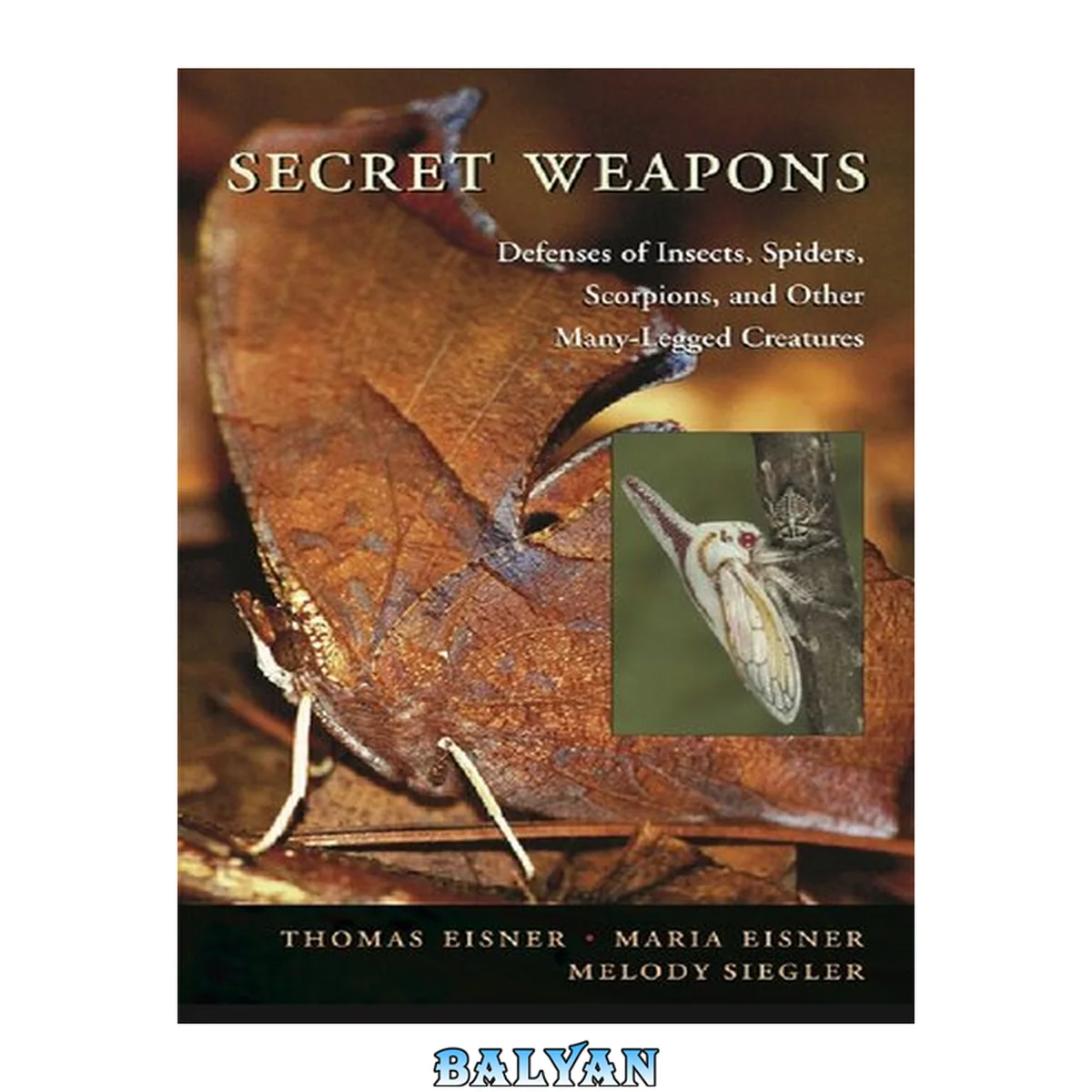
Secret Weapons : Defenses of Insects, Spiders, Scorpions, and Other Many-Legged Creatures
معرفی کتاب «سلاحهای پنهان: دفاعهای حشرات، عنکبوتها، عقربها و دیگر موجودات چندپای» (با عنوان لاتین Secret Weapons : Defenses of Insects, Spiders, Scorpions, and Other Many-Legged Creatures) نوشتهٔ Thomas Eisner, Maria Eisner, Melody Siegler, Thomas Eisner، منتشرشده توسط نشر Belknap Press: An Imprint of Harvard University Press در سال 2007. این کتاب در فرمت pdf، زبان انگلیسی ارائه شده است.
mostly Tiny, Infinitely Delicate, And Short-lived, Insects And Their Relatives—arthropods—nonetheless Outnumber All Their Fellow Creatures On Earth. How Lowly Arthropods Achieved This Unlikely Preeminence Is A Story Deftly And Colorfully Told In This Follow-up To The Award-winning for Love Of Insects . Part Handbook, Part Field Guide, Part Photo Album, secret Weapons Chronicles The Diverse And Often Astonishing Defensive Strategies That Have Allowed Insects, Spiders, Scorpions, And Other Many-legged Creatures Not Just To Survive, But To Thrive. in Sixty-nine Chapters, Each Brilliantly Illustrated With Photographs Culled From Thomas Eisner's Legendary Collection, We Meet A Largely North American Cast Of Arthropods—as Well As A Few Of Their Kin From Australia, Europe, And Asia—and Observe At Firsthand The Nature And Extent Of The Defenses That Lie At The Root Of Their Evolutionary Success. Here Are The Cockroaches And Termites, The Carpenter Ants And Honeybees, And All The Miniature Creatures In Between, Deploying Their Sprays And Venom, Froth And Feces, Camouflage And Sticky Coatings. And Along With A Marvelous Bug's-eye View Of How These Secret Weapons Actually Work, Here Is A Close-up Look At The Science Behind Them, From Taxonomy To Chemical Formulas, As Well As An Appendix With Instructions For Studying Chemical Defenses At Home. Whether Dipped Into Here And There Or Read Cover To Cover, secret Weapons Will Prove Invaluable To Hands-on Researchers And Amateur Naturalists Alike, And Will Captivate Any Reader For Whom Nature Is A Source Of Wonder. library Journal close On The Heels Of Eisner's (chemical Ecology, Cornell Univ.) Jewel Of A Book, For Love Of Insects, An Account Of His Own Extraordinary Research, The Present Volume Is A Beautifully Illustrated Guide To The Defense Systems Of Mainly North American Arthropods, Especially Insects. Written With Maria Eisner (biology, Cornell Univ.) And Melody V.s. Siegler (biology, Emory Univ.), It Draws On Examples Not Only From Eisner's Own Investigations But Also From Various Works Of Entomological Literature. Each Of The 69 Chapters Is Devoted To An Arthropod Or Arthropod Group And Provides A Clear, Concise (on Average Four To Five Pages Long) Introduction To Its General Features And Special Characteristics. Included Are Classification; Scientific Name; Common Name; Description Of Defense System, Whether Behavioral, Morphological, Or Chemical; Defensive Chemical Formula(e) When Applicable; And Key References. An Epilog Speculating On Future Directions, A Final Chapter On How To Study Insects, A General Index, And A Chemical Index Round Out This Remarkable Volume. The First Of Its Kind, This Primer Will Prove Indispensable To A Broad Audience, From Lay Naturalists To Students, Teachers, Specialists-even Medical Doctors.-annette Aiello, Smithsonian Tropical Research Inst., Panama Copyright 2005 Reed Business Information. Part Handbook, Part Field Guide, Part Photo Album, Secret Weapons Chronicles The Diverse And Often Astonishing Defensive Strategies That Have Allowed Insects, Spiders, Scorpions, And Other Many-legged Creatures Not Just To Survive, But To Thrive. In Sixty-nine Chapters, Each Illustrated With Photographs Culled From Thomas Eisner's Legendary Collection, We Meet A Largely North American Cast Of Anthropods - As Well As A Few Of Their Kin From Australia, Europe, And Asia - And Observe At Firsthand The Nature And Extent Of The Defenses That Lie At The Root Of Their Evolutionary Success. Here Are The Cockroaches And Termites, The Carpenter Ants And Honeybees, And All The Miniature Creatures In Between, Deploying Their Sprays And Venom, Froth And Feces, Camouflage And Sticky Coatings. And Along With A Marvelous Bug's-eye View Of How These Secret Weapons Actually Work, Here Is A Close-up Look At The Science Behind Them, From Taxonomy To Chemical Formulas, As Well As An Appendix With Instructions For Studying Chemical Defenses At Home. Whether Dipped Into Here And There Or Read Cover To Cover, Secret Weapons Will Prove Invaluable To Hands-on-researchers And Amateur Naturalists Alike, And Will Captivate Any Reader For Whom Nature Is A Source Of Wonder.--book Jacket. Prologue -- Class Arachnida -- Order Uropygi -- Family Theliphonidae -- 1. Mastigoproctus Giganteus (the Vinegaroon) -- Order Opiliones -- Family Cosmetidae -- 2. Vonones Sayi (a Harvestman) -- Family Sclerosomatidae -- 3. Leiobunum Nigripalpi (a Daddylonglegs) -- Order Scorpiones -- Family Vejovidae -- 4. Vejovis Spinigerus (the Striped Tail Scorpion) -- Order Araneida -- Family Oxyopidae -- 5. Peucetia Viridans (the Green Lynx Spider) -- Class Chilopoda -- Order Scolopendrida -- Family Scholopendiridae -- 6. Scolopendra Heros (the Giant Sonoran Centipede) -- Order Geophilida -- Family Oryidae -- 7. Orphnaeus Brasilianus (a Geophilid Centipede) -- Class Diplopoda -- Order Spirobolida -- 8. Floridobolus Penneri (the Florida Scrub Millipede) -- Order Polydesmida -- Family Polydesmidae -- 9. Apheloria Kleinpeteri (a Polydesmid Millipede) -- Order Polyzoniida -- Family Polyzoniidae -- 10. Polyzonium Rosalbum (a Polyzoniid Millipede) -- Order Glomerida -- Family Glomeridae -- 11. Glomeris Marginata (a Pill Millipede) -- Order Polyxenida -- Family Polyxenidae -- 12. Polyxenus Fasciculatus (a Bristle Millipede) -- Class Insecta -- Order Dyctioptera -- Family Blattidae -- 13. Eurycotis Floridana (the Florida Woods Cockroach) -- 14. Periplaneta Australasiae (the Australian Cockroach) -- 15. Deropeltis Wahlbergi (a Blattid Cockroach) -- Family Blaberidae -- 16. Diploptera Punctata (the Pacific Beetle Cockroach) -- Order Dermaptera -- Family Forficulidae -- 17. Doru Taeniatum (an Earwig) -- Order Isoptera -- Family Termitidae -- 18. Nasutitermes Exitiosus (a Termite) -- Order Phasmatodea -- Family Diapheromeridae -- 19. Oreophoetes Perusana (a Walkingstick) -- Family Pseudophasmatidae -- 20. Anisomorpha Buprestoides (the Two-striped Walkingstick) -- Order Orthoptera -- Family Romaleidae -- 21. Romalea Guttata (the Eastern Lubber Grasshopper) -- Order Hemiptera -- Family Coreidae -- 22. Chelinidea Vittiger (a Leaf-footed Bug) -- Family Reduviidae -- 23. Apiomerus Flaviventris (a Reduviid Bug) -- Family Belostomatidae -- 24. Abedus Herberti (a Giant Water Bug) -- Family Aphididae -- 25. Aphis Nerii (the Oleander Aphid) -- 26. Prociphilus Tessellatus (the Woolly Alder Aphid) -- Family Flatidae -- 27. Ormenaria Rufifascia (a Flatid Planthopper) -- Family Cercopidae -- 28. Prosapia Bicincta (the Two-lined Spittlebug) -- Family Dactylopiidae -- 29. Dactylopius Confusus (a Cochineal Bug) -- Family Aleyrodidae -- 30. Metaleurodicus Griseus (a Whitefly) -- Order Neuroptera -- Family Chrysopidae -- 31. Ceraeochrysa Cubana (a Green Lacewing) -- 32. Ceraeochrysa Smithi (a Green Lacewing) -- 33. Chrysopa Slossonae (a Green Lacewing) -- Order Coleoptera -- Family Carabidae -- 34. Galerita Lecontei (a Ground Beetle) -- 35. Brachinus (many Species) (bombardier Beetles) -- Family Gyrinidae -- 36. Dineutus Hornii (a Whirligig Beetle) -- Family Dytiscidae -- 37. Thermonectus Marmoratus (a Predaceous Diving Beetle) -- Family Silphidae -- 38. Necrodes Surinamensis (the Red-lined Carrion Beetle) -- Family Staphylinidae -- 39. Creophilus Maxillosus (the Hairy Rove Beetle) -- Family Cantharidae -- 40. Chauliognathus Lecontei (a Soldier Beetle) -- Family Lampyridae -- 41. Photinus Ignitus And Photuris Versicolor (fireflies) -- Family Lycidae -- 42. Calopteron Reticulatum (the Banded Net-winged Beetle) -- Family Elateridae -- 43. Alaus Myops (the Eyed Elater) -- Family Buprestidae -- 44. Acmaeodera Pulchella (the Flat-headed Baldcypress Sapwood Borer) -- Family Coccinellidae -- 45. Cycloneda Sanguinea (a Ladybird Beetle) -- 46. Epilachna Varivestis (the Mexican Bean Beetle) -- Family Meloidae -- 47. Epicauta (an Unidentified Species) (a Blister Beetle) -- Family Pyrochroidae -- 48. Neopyrochroa Flabellata (a Fire-colored Beetle) -- Family Tenebrionidae -- 49. Adelium Percatum (a Darkling Beetle) -- 50. Bolitotherus Cornutus (the Forked Fungus Beetle) -- 51. Eleodes Longicollis (a Darkling Beetle) -- Family Scarabaeidae -- 52. Trichiotinus Rufobrunneus (a Scarab Beetle) -- Family Chrysomelidae -- 53. Hemisphaerota Cyanea (a Tortoise Beetle) -- 54. Gratiana Pallidula (a Tortoise Beetle) -- 55. Plagiodera Versicolora (the Imported Willow Leaf Beetle) -- Order Lepidoptera -- Family Dalceridae -- 56. Dalcerides Ingenita (a Dalcerid Moth) -- Family Noctuidae -- 57. Litoprosopus Futilis (the Palmetto Borer Moth) -- Family Notodontidae -- 58. Schizura Unicornis (the Unicorn Caterpillar Moth) -- Family Thyrididae -- 59. Calindoea Trifascialis (a Thyridid Moth) -- Family Yponomeutidae -- 60. Ypsolopha Dentella (the European Honeysuckle Leaf Roller) -- Family Geometridae -- 61. Nemoria Outina (a Geometrid Moth) -- Family Arctiidae -- 62. Utetheisa Ornatrix (the Rattlebox Moth) -- Family Saturniidae -- 63. Automeris Io (the Io Moth) -- Family Papilionidae -- 64. Eurytides Marcellus (the Zebra Swallowtail Butterfly) -- Family Pieridae -- 65. Pieris Rapae (the Cabbage Butterfly) -- Family Nymphalidae -- 66. Danaus Plexippus (the Monarch Butterfly) -- Order Hymenoptera -- Family Pergidae -- 67. Perga Affinis (a Pergine Sawfly) -- Family Formicidae -- 68. Camponotus Floridanus (a Carpenter Ant) -- Family Apidae -- 69. Apis Mellifera (the Honey Bee) -- Epilogue -- How To Study Insects And Their Kin -- Acknowledgments -- Illustration Credits -- Index. Thomas Eisner, Maria Eisner, Melody Siegler. Includes Bibliographical References And Index.
Mostly tiny, infinitely delicate, and short-lived, insects and their relatives—arthropods—nonetheless outnumber all their fellow creatures on earth. How lowly arthropods achieved this unlikely preeminence is a story deftly and colorfully told in this follow-up to the award-winning For Love of Insects. Part handbook, part field guide, part photo album, Secret Weapons chronicles the diverse and often astonishing defensive strategies that have allowed insects, spiders, scorpions, and other many-legged creatures not just to survive, but to thrive.In 69 chapters, each brilliantly illustrated with photographs culled from Thomas Eisner's legendary collection, we meet a largely North American cast of arthropods—as well as a few of their kin from Australia, Europe, and Asia—and observe at firsthand the nature and extent of the defenses that lie at the root of their evolutionary success. Here are the cockroaches and termites, the carpenter ants and honeybees, and all the miniature creatures in between, deploying their sprays and venom, froth and feces, camouflage and sticky coatings. And along with a marvelous bug's-eye view of how these secret weapons actually work, here is a close-up look at the science behind them, from taxonomy to chemical formulas, as well as an appendix with instructions for studying chemical defenses at home.Whether dipped into here and there or read cover-to-cover, Secret Weapons will prove invaluable to hands-on researchers and amateur naturalists alike, and will captivate any reader for whom nature is a source of wonder.
Contents 6 Prologue 14 Class arachnida 17 Order uropygi 17 Order opiliones 20 Order scorpiones 28 Order araneida 35 Class chilopoda 42 Order scolopendrida 42 Order geophilida 46 Class diplopoda 50 Order spirobolida 50 Order polydesmida 56 Order polyzoniida 61 Order glomerida 64 Order polyxenida 68 Class insecta 72 Order dyctioptera 72 Order dermaptera 90 Order isoptera 95 Order phasmatodea 102 Order orthoptera 110 Order hemiptera 115 Order neuroptera 154 Order coleoptera 164 Order lepidoptera 274 Order hymenoptera 327 Epilogue 351 How to Study Insects and Their Kin 356 Acknowledgments 368 Illustration Credits 370 Index 374