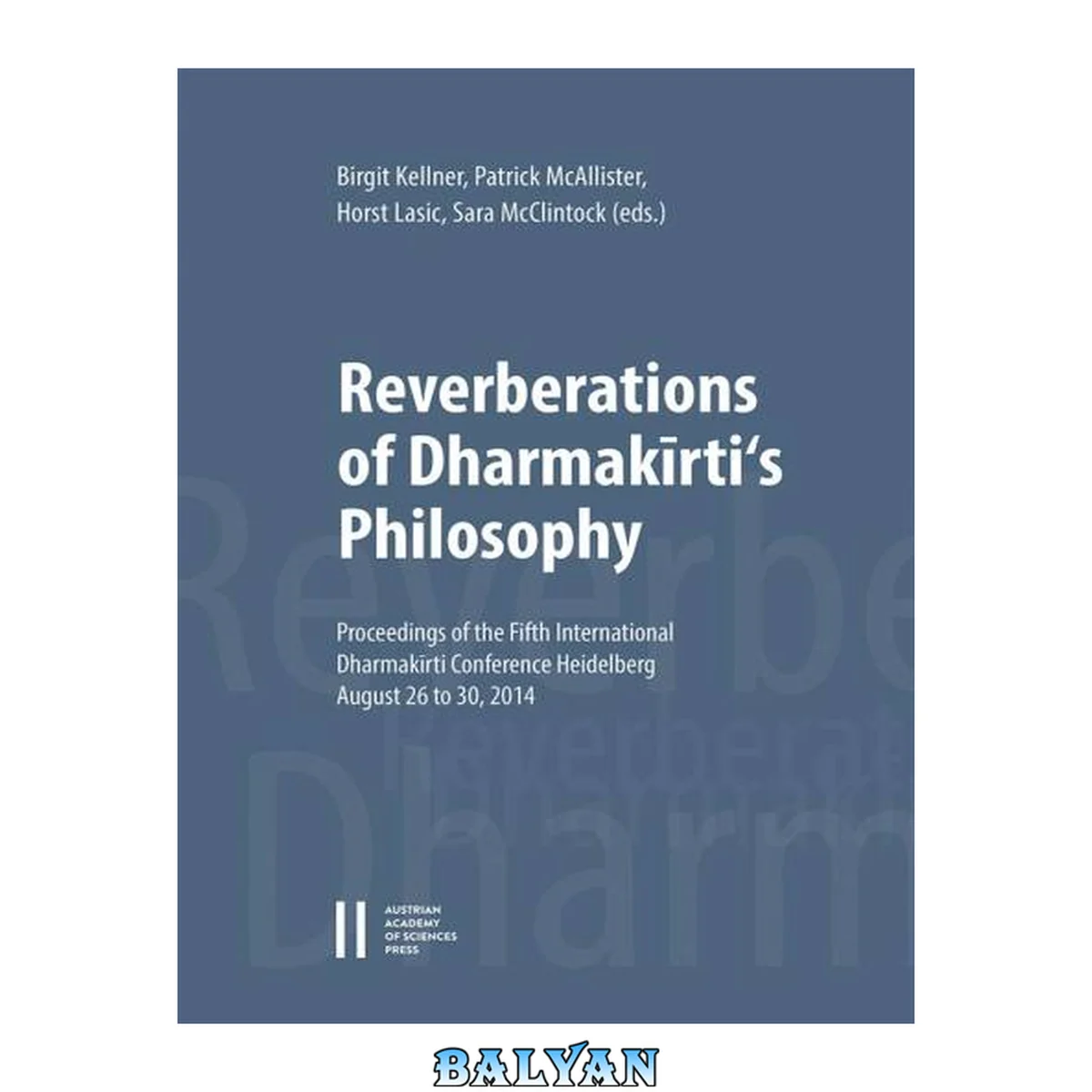
تأثیرات فلسفهٔ دارماکیردی: مجموعه مقالات پنجمین کنفرانس بینالمللی دارماکیردی، هایدلبرگ، ۲۶ تا ۳۰ اوت ۲۰۱۴ (گزارشهای نشست کلاس فلسفی-تاریخی، ۹۰۴)
Reverberations of Dharmakirti's Philosophy: Proceedings of the Fifth International Dharmakirti Conference Heidelberg, August 26 to 30, 2014 (Philosophisch-Historische Klasse Sitzungsberichte, 904)
معرفی کتاب «تأثیرات فلسفهٔ دارماکیردی: مجموعه مقالات پنجمین کنفرانس بینالمللی دارماکیردی، هایدلبرگ، ۲۶ تا ۳۰ اوت ۲۰۱۴ (گزارشهای نشست کلاس فلسفی-تاریخی، ۹۰۴)» (با عنوان لاتین Reverberations of Dharmakirti's Philosophy: Proceedings of the Fifth International Dharmakirti Conference Heidelberg, August 26 to 30, 2014 (Philosophisch-Historische Klasse Sitzungsberichte, 904)) نوشتهٔ Birgit Kellner, Horst Lasic, Patrick McAllister, Sara McClintock، منتشرشده توسط نشر Austrian Academy of Sciences Press در سال 2020. این کتاب در فرمت pdf، زبان انگلیسی ارائه شده است.
Die "Proceedings of the Fifth International Dharmakirti Conference" (Heidelberg, August 2014) beschaftigen sich mit der erkenntnistheoretisch-logischen Schule des Buddhismus - einer lange wahrenden Tradition, die innerhalb des heilstheoretischen Rahmens des Buddhismus die Analyse von Erkenntnis, Schlussfolgerung und Beweis in das Zentrum ihrer theoretischen Bemuhungen stellte und dabei das Werk des indisch-buddhistischen Erkenntnistheoretikers und Logikers Dharmakirti (6.-7. Jhd. u. Z.) zugrundelegte. Methoden und Ansatze dieser Schule wurden durch das intellektuelle Umfeld des mittelalterlichen Indien mit seiner Wechselwirkung unterschiedlicher religios-philosophischer Stromungen gepragt und beeinflussten die Geistesgeschichte des tibetischen Buddhismus nachhaltig; sie wurden auch in China und Japan rezipiert. Die 30 Beitrage zu diesem Band stellen eine Momentaufnahme einer internationalen Forschungslandschaft mit Zentren in Wien und Japan dar. Sie befassen sich mit historischen und philologischen Problemen, die durch wichtige rezente Manuskriptfunde aufgeworfen werden, verfolgen Forschungsfragen aus der Geschichte der Philosophie und unternehmen philosophische Rekonstruktion und kritische Uberprufung einzelner Theorien und Argumente. Indem der Band den Schwerpunkt auf Stromungen aus Asien richtet, die rigorose philosophische Methoden entwickelten und systematisch zur Anwendung brachten, leistet er einen Beitrag zur Ausbildung eines besser fundierten globalen Geschichtsbewusstseins im Bereich der Philosophie. The proceedings volume of the Fifth International Dharmakirti Conference (Heidelberg, August 2014) is concerned with the logico-epistemological school of Buddhism ? a long-lasting tradition that pursued the analysis of knowledge, inference and proof within a Buddhist soteriological framework, based on the works of the Indian epistemologist and logician Dharmakirti (6th-7th c. CE). Having been shaped in the environment of medieval India, with its multiple mutually interacting and partly competing religio-philosophical schools, the methods and approaches of Buddhist logic and epistemology had lasting impact on the intellectual history of Tibetan Buddhism and were also received in China and Japan. The 30 papers in this volume offer a snapshot of an international research landscape with centers in Vienna and Japan. They address historical and philological problems raised by important recent manuscript discoveries, pursue specific research questions in the history of philosophy, and undertake philosophical reconstructions and critical examinations relating to individual theories and arguments. By focusing on currents in Asia that developed and applied rigorous philosophical methods, the volume aims to contribute to the formation of a better-founded global historical awareness in the field of philosophy. Cover 1 8781-3-reverberations of dharma_kern 2 Preface 12 Opening Speech 18 Account of the Fifth International Dharmakīrti Conference 24 Junjie Chu: Jitāri’s Vijñaptimātratāsiddhi 32 Christian Coseru: Consciousness and Causality: Dharmakīrti Against Physicalism 52 Hugo David: Action Theory and Scriptural Exegesis in Early Advaita-Vedānta (2): Maṇḍana Miśra’s Excursus on the Buddha’s Omniscience 72 Eli Franco: On the Determination of Causation by Dharmakīrti 108 Yoichi Fukuda: Reinterpretation of the Compound svabhāva-pratibandha in Dharmakīrti’s Logical Theory 122 Marie-Hélène Gorisse: Jain Conceptions of Non-Cognition: A Dialogue with Dharmakīrti on Inferential Evidence 142 Pascale Hugon: Universals, Demons’ Pots, and Demons’ Permanent Pots: Phya pa Chos kyi seng ge on Unestablished Subjects in Arguments by Consequence 160 Masahiro Inami: Two Kinds of Causal Capacity: sāmānyā śaktiḥ and pratiniyatā śaktiḥ 186 Kyo Kano: Jñānaśrīmitra on viparyayabādhakapramāṇa 208 Kei Kataoka: How Does One Cognize a Cow? A Dialogue between Mādhava and Dignāga 222 Hiroko Matsuoka: Śāntarakṣita on Two Kinds of Arguments for Self-Awareness: sahopalambhaniyama and saṃvedana 234 Patrick McAllister: Prajñākaragupta's Argument for Two Means of Valid Cognition 252 Lawrence McCrea: Balancing the Scales: Dharmakīrti Inside and Out 282 Mai Miyo: The Concept of vyava√sthā in Dharmottara’s and Prajñākaragupta’s Explanation of pramāṇa and pramāṇaphala 298 Miyuki Nakasuka: Dharmakīrti’s Apoha Theory: Perceptual Judgment and the Lack of Superimposition (samāropaviveka) 314 Hiroshi Nemoto: Dharmakīrti’s Notion of Permanence and Its Impact on the Tibetan Buddhist Doctrine of Buddhahood 332 Hideyo Ogawa: Dignāga on the View of a Generic Term as Denoting a Relation 344 Kensho Okada: Communication between a Speaker and a Listener as the Seeing of a Double Moon — In Light of the Apoha Theory of Śāntarakṣita and Kamalaśīla 362 Motoi Ono: On pramāṇabhūta — The Change of Its Meaning from Dignāga to Prajñākaragupta 374 Cristina Pecchia: Dharmakīrti on the Role of Salvific Initiation and the Reception of His Critique in the Later Śaiva Tradition 394 Masamichi Sakai: Dharmottara on the viparyaye bādhakapramāṇa and trairūpya in Dharmakīrti’s sattvānumāna 406 Ryo Sasaki: Dharmakīrti’s Vādanyāya and the History of Conceptions of Debate in Indian Logic 422 Kiyokuni Shiga: The Meaning of bāhyārtha in Dignāga’s and Jinendrabuddhi’s Theories of Inference 442 Ernst Steinkellner: Closing a Gap in the Interpretation of Dharmakīrti’s Logic 460 John Taber: Philosophical Reflections on the sahopalambhaniyama Argument 472 Masaki Tamura: The Truth, the Buddha’s Words, and Inference: Bhāviveka’s Theory of Two Truths 494 Mingjun Tang: The Concept of sādhana in Chinese Buddhist Logic 504 Somadeva Vasudeva: A Causeless Liberation? Kṣemarāja’s Response to Dharmakīrti’s Critique of Initiation 528 Toshikazu Watanabe: Dharmakīrti and His Successors on āśrayāsiddha and prasaṅgaviparyaya 544 Kiyotaka Yoshimizu: Another Look at avinābhāva and niyama in Kumārila’s Exegetical Works 560 BC 588 This proceedings volume contains 30 papers dealing with the history, literature and ideas of the logico-epistemological school of Indian Buddhism initiated by Dignaga and Dharmakirti, and related currents in South Asia (India), Tibet and East Asia (China). The papers address historical and philological problems raised by important recent manuscript discoveries, pursue specific research questions in the history of philosophy, and undertake philosophical reconstructions and critical examinations relating to individual theories and arguments. By focusing on philosophical currents in Asia that developed and applied rigorous philosophical methods, the volume also aims to contribute to the formation of a better-founded global historical awareness in the field of philosophy