بازتعریف دموکراسی و عاملیت در هند: بررسی جامعه سیاسی
Re-framing Democracy and Agency in India : Interrogating Political Society
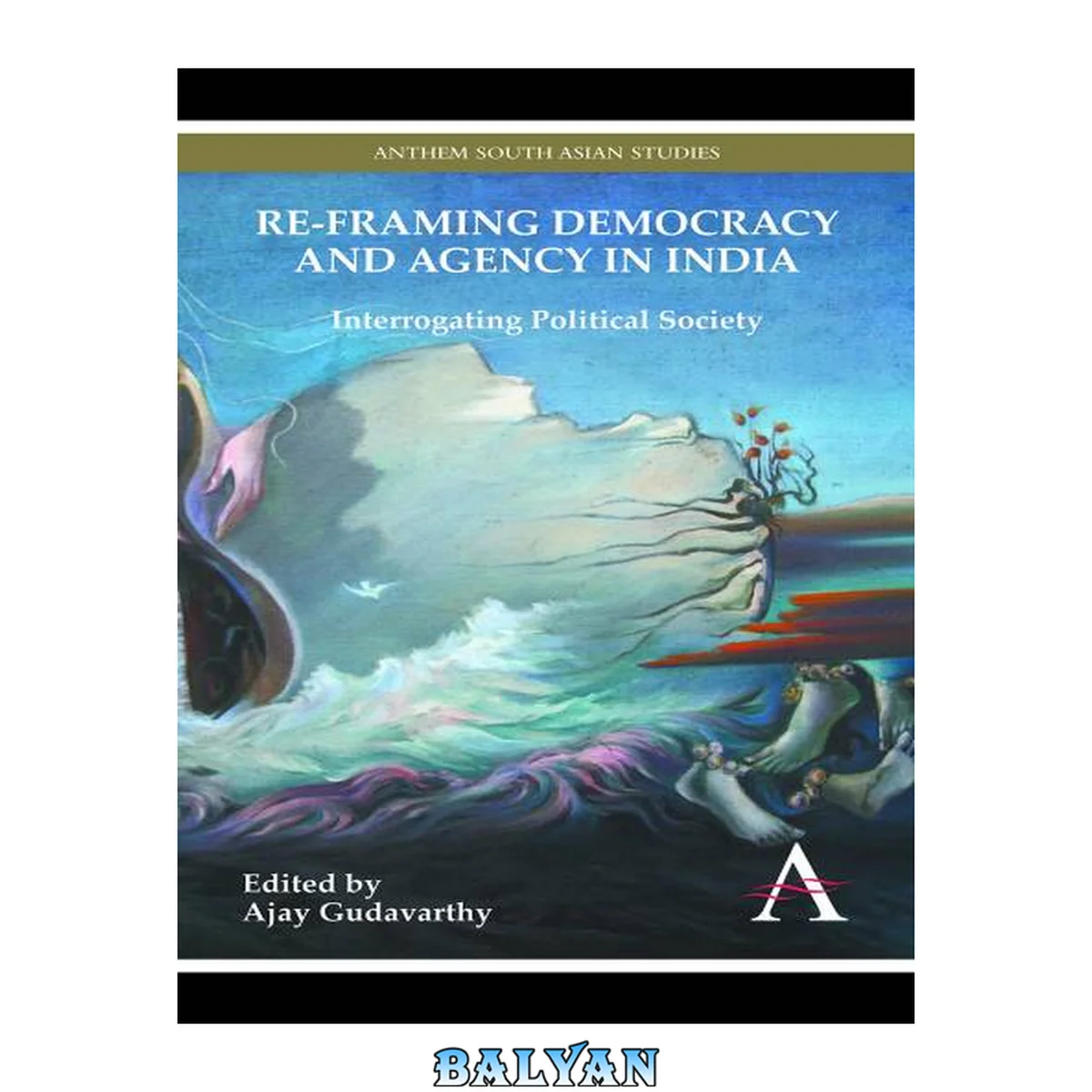
معرفی کتاب «بازتعریف دموکراسی و عاملیت در هند: بررسی جامعه سیاسی» (با عنوان لاتین Re-framing Democracy and Agency in India : Interrogating Political Society) نوشتهٔ Ajay Gudavarthy (editor)، منتشرشده توسط نشر Anthem Press در سال 2012. این کتاب در فرمت pdf، زبان انگلیسی ارائه شده است.
‘Re-framing Democracy and Agency in India: Interrogating Political Society’ critically unpacks the concept of ‘political society’, which was formulated as a response to the idea of civil society in the postcolonial context. The volume’s case studies, drawn from across India and combined with a sharp focus on the concept of political society, provide those interested in Indian democracy and its changing patterns with an indispensable collection of works, brought together in their common pursuit of highlighting the limitations of different core concepts as formulated by Chatterjee. Centred around five themes – the relation between the civil and the political; the role of middlemen and their impact on the mobility of subaltern groups; elites and leadership; the fragmentation and intra-subaltern conflicts and their implications for subaltern agency; and the idea of moral claims and moral community – this volume re-frames issues of democracy and agency in India within a wider scope than has ever been published before, and gathers ideas from some of the foremost scholars in the field. The volume concludes with a rejoinder from Partha Chatterjee. Front Matter Title Page Half Title Copyright Dedication Contents Preface and Acknowledgements List of Tables Main Matter Chapter 1 INTRODUCTION: WHY INTERROGATE POLITICAL SOCIETY? - Ajay Gudavarthy Political Society and Resistance as Radical Politics Politics of Pyraveekar and the Question of Subaltern Agency Civil Society and Political Society References Part I POLITICAL SOCIETY AND PROTEST POLITICS Chapter 2 POLITICAL SOCIETY IN A CAPITALIST WORLD - Swagato Sarkar Chatterjee’s Critique of Civil Society Chatterjee on Political Society A Critical Appraisal of Political Society Political Society as a Critique Conclusion References Chapter 3 ANTINOMIES OF POLITICAL SOCIETY – IMPLICATIONS OF UNCIVIL DEVELOPMENT - Ajay Gudavarthy and G. Vijay Understanding the Context Nature of Industrialization and Capital Political Society – Collective or Interest Based? ‘Political Society’ and the Decaying Community References Chapter 4 CIVIL SOCIETY AND THE URBAN POOR - Supriya RoyChowdhury Introduction Urban Deprivation and Civil Society in Bengaluru Slums, Urban Land and Civil Society Activism Organizing Women Workers in the Readymade Garments Exports Industry Urban Activism: Shared Discourse and Politics Theorizing Urban Activism References Chapter 5 CONTENTIOUS POLITICS AND CIVIL SOCIETY IN VARANASI - Jolie M. F. Wood Civil Society and Political Society in India The ‘Concept of Civil Society’ Who Agitates and Who Operates? The Research Tentative Conclusions References Chapter 6 THE POLITICS OF A POLITICAL SOCIETY - Ranabir Samaddar References Part II POLITICAL SOCIETY, MIDDLEMEN AND MOBILITY Chapter 7 THE PYRAVEEKAR: THE ‘FIXER’ IN RURAL INDIA - G. Ram Reddy and G. Haragopal Who Is the Pyraveekar? How Pyraveekars Work Impact on the Development Process References Chapter 8 POLITICS OF MIDDLEMEN AND POLITICAL SOCIETY - Stuart Corbridge, Glyn Williams, Manoj Srivastava and Rene Veron Introduction The Constitution of Political Society: Fixers and Leaders Engaging the State: Networks of Power The Price of Rule Conclusion References Chapter 9 WIDOWS’ ORGANIZATIONS IN KERALA STATE, INDIA: SEEKING CITIZENSHIP AMIDST THE DECLINE OF POLITICAL SOCIETY - J. Devika and A. K. Rajasree Introduction Emergent Conditions ‘We Have No Politics’ Beyond a Governmental Category An Emergent Political Subject? Conclusion References Part III CIVIL SOCIETY AND/OR POLITICAL SOCIETY Chapter 10 CLUBBING TOGETHER: VILLAGE CLUBS, LOCAL NGOs AND THE MEDIATIONS OF POLITICAL SOCIETY - Tom Harrison Chatterjee’s Two Lines of Interaction The Activities of Political Society: Conflating Diverse Activities Forming Associations: Formal Procedures, Informal Practices Personal Associations: The Practices of Political Society In Conclusion References Chapter 11 CIVIC ANXIETIES AND DALIT DEMOCRATIC CULTURE: BALMIKIS IN DELHI - Omar Kutty Introduction Part I: A Different Democracy Part II: Fetishizing and Defetishizing Civil Society Conclusion: Democracy in the Context of Heterogeneous Sovereignty References Chapter 12 THE HABITS OF THE POLITICAL HEART: RECOVERING POLITICS FROM GOVERNMENTALITY - Aparna Sundar and Nandini Sundar Defining Civil Society Associational Life and Politics in Two Marginal Spaces Conclusion References Chapter 13 CIVIL SOCIETY IN THE EAST AND SOME DARK THOUGHTS ABOUT THE PROSPECTS OF POLITICAL SOCIETY - Sanjeeb Mukherjee The Idea of Civil Society Rethinking the Idea of Civil Society Political Society vs. Civil Society In Search of a Civil Society and Its Philosophers References Part IV REJOINDER Chapter 14 THE DEBATE OVER POLITICAL SOCIETY - Partha Chatterjee Political Society as Resistance Political Society as the Field of Exception The Contrast with Civil Society Political Society in Practice References Back Matter LIST OF CONTRIBUTORS Civil Society as a conceptual category across different disciplines and ideological and theoretical frameworks has enjoyed an acceptability that no other concept has in the recent past. In response to what could, perhaps, be referred to as the post-euphoric versions of the civil society, scholars across theoretical dispositions began to look for the critical limits of posturing core issues of democracy through the prism of civil society. It is in this context that Partha Chatterjee has made one of the most important interventions by opposing the idea of civil society to that of political society. ‘Re-framing Democracy and Agency in India: Interrogating Political Society'critically unpacks the concept of ‘political society', which was formulated as a response to the idea of civil society in a postcolonial context. The volume addresses the theoretical issues of political society through a number of detailed case studies from across India: Kerala, Andhra Pradesh, Karnataka, West Bengal, Chattisgarh, Delhi and Maharashtra. These case studies, combined with a sharp focus on the concept of political society, provide those interested in democracy and its changing patterns in India with an indispensable collection of works, brought together in their common pursuit to highlight the limitations with different core concepts that Chatterjee has formulated. Centred around five themes – the relation between the civil and the political; the role of middlemen and their impact on mobility of the subaltern groups; elites and leadership; the fragmentation and intra-subaltern conflicts and its implications for subaltern agency; and finally the idea of moral claims and moral community – this volume re-frames issues of democracy and agency in India within a wider scope than has ever before been published, and gathers ideas from some of the foremost scholars in the field. The volume concludes with a rejoinder from Partha Chatterjee.
دانلود کتاب بازتعریف دموکراسی و عاملیت در هند: بررسی جامعه سیاسی