Practical AI for Healthcare Professionals : Machine Learning with Numpy, Scikit-learn, and TensorFlow
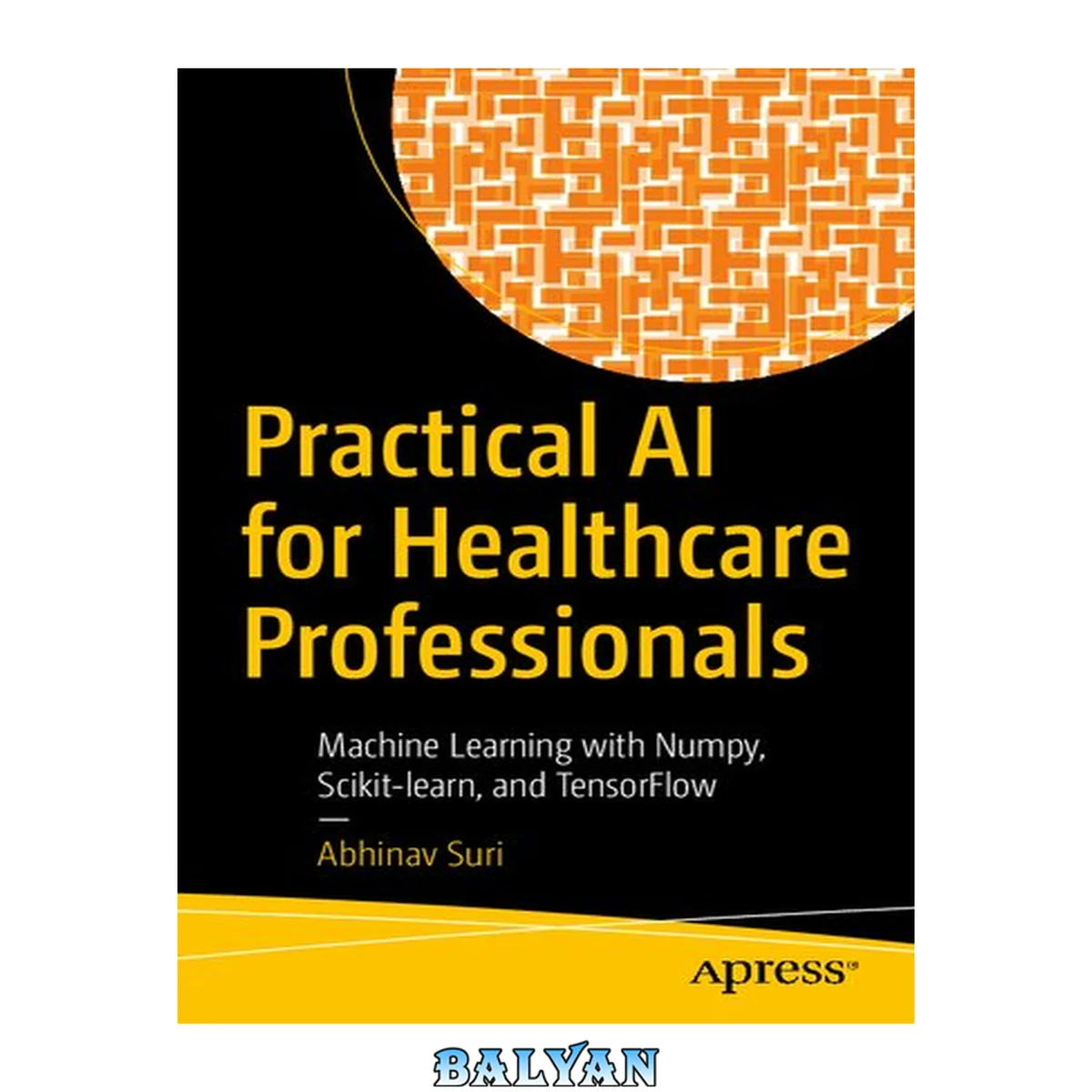
معرفی کتاب «Practical AI for Healthcare Professionals : Machine Learning with Numpy, Scikit-learn, and TensorFlow» نوشتهٔ Abhinav Suri; O'Reilly for Higher Education (Firm),; Safari, an O'Reilly Media Company، منتشرشده توسط نشر Apress : Imprint: Apress در سال 2021. این کتاب در فرمت pdf، زبان انگلیسی ارائه شده است.
Use Artificial Intelligence (AI) to analyze and diagnose what previously could only be handled by trained medical professionals. This book gives an introduction to practical AI, focusing on real-life medical problems, how to solve them with actual code, and how to evaluate the efficacy of these solutions. You’ll start by learning how to diagnose problems as ones that can and cannot be solved with AI or computer science algorithms. If you’re not familiar with those algorithms, that’s not a problem. You’ll learn the basics of algorithms and neural networks and when each should be applied. Then you’ll tackle the essential parts of basic Python programming relevant to data processing and making AI programs. The TensorFlow library alogn with Numpy and Scikit-Learn are covered, too. Once you’ve mastered those basic computer science concepts, you can dive into three projects with code, implementation details and explanation, and diagnostic utility analysis. These projects give you the change to explore using machine learning algorithms for diagnosing diabetes from patient data, using basic neural networks for heart disease prediction from cardiac data, and using convolutional networks for brain tumor segmentation from MRI scans The topics and projects covered not only encompass areas of the medical field where AI is already playing a major role but also are engineered to cover as much as possible of AI that is relevant to medical diagnostics. Along the way, readers can expect to learn data processing, how to conceptualize problems that can be solved by AI, and how to program solutions to problems using modern libraries, such as TensorFlow. Physicians and other healthcare professionals who can master these skills will be able to lead AI-based research and diagnostic tool development, ultimately benefiting countless patients. What You'll Learn Distinguish between problems that currently can and cannot be solved with AI Master programming concepts not familiar to physicians, such as libraries, coding, and creating and training ML models Perform dataset analysis with decision trees, SVMs, and neural networks. Who This Book Is For Physicians and other healthcare professionals curious about AI and interested in leading medical innovation initiatives. Additionally, software engineers working on healthcare related projects involving AI. Table of Contents 5 About the Author 9 About the Technical Reviewer 10 Foreword to Practical AI for Healthcare Professionals 11 Chapter 1: Introduction to AI and Its Use Cases 13 The Healthcare Information Paradox 14 AI, ML, Deep Learning, Big Data: What Do the Buzzwords Mean? 15 AI Considerations 23 Summary 26 The Rest of the Book... 26 Chapter 2: Computational Thinking 29 How Computers “Think” 30 What “Can” and “Cannot” Be Solved 32 Algorithmic Alternatives 37 Stable Matching 38 Activity Selection 41 Analysis of Algorithms and Other Algorithms 46 Conclusion 52 Chapter 3: Overview of Programming 53 But First, What Are Programs? 53 Getting Started with Python 55 What Just Happened? 57 Stepping It Up a Bit 57 Variables, Methods/Functions, String Operations, Print String Interpolation Applied 59 Minor Improvements: If Statements 66 More Improvements: File Input and For Loops/Iteration 71 File Output, Dictionaries, List Operations 78 Cutting This Down with Pandas 86 Summary 89 Chapter 4: A Brief Tour of Machine Learning Algorithms 91 ML Algorithm Fundamentals 91 Regression 94 Linear Regression (for Classification Tasks) 95 Logistic Regression 97 LASSO, Ridge, and Elastic Net for Regression, the Bias-Variance Trade-Off 101 Instance Learning 105 k-Nearest Neighbors (and Scaling in ML) 105 Support Vector Machines 107 Decision Trees and Tree-Based Ensemble Algorithms 110 Classification and Regression Trees 112 Tree-Based Ensemble Methods: Bagging, Random Forest, and XGBoost 113 Clustering/Dimensionality Reduction 115 k-Means Clustering 116 Principal Component Analysis 120 Artificial Neural Networks and Deep Learning 122 Fundamentals (Perceptron, Multilayer Perceptron) 122 Convolutional Neural Networks 128 Other Networks (RCNNs, LSTMs/RNNs, GANs) and Tasks (Image Segmentation, Key Point Detection, Image Generation) 132 Other Topics 133 Evaluation Metrics 133 k-Fold Cross Validation 136 Next Steps 137 Chapter 5: Project #1 Machine Learning for Predicting Hospital Admission 139 Data Processing and Cleaning 140 Installing + Importing Libraries 141 Reading in Data and Isolating Columns 142 Data Visualization 145 Cleaning Data 148 Dealing with Categorical Data/One-Hot Encoding 150 Starting the ML Pipeline 152 Training a Decision Tree Classifier 156 Grid Searching 158 Evaluation 159 Visualizing the Tree 163 This Seems Like a Lot to Do 164 Moving to PyCaret 164 Extra: Exporting/Loading a Model 173 Summary and What’s Next 173 Chapter 6: Project #2 CNNs and Pneumonia Detection from Chest X-Rays 175 Project Setup 175 Colab Setup 176 Downloading Data 177 Splitting Data 180 Creating Data Generators and Augmenting Images 184 Your First Convolutional Neural Network: SmallNet 194 Callbacks: TensorBoard, Early Stopping, Model Checkpointing, and Reduce Learning Rates 205 Defining the Fit Method and Fitting Smallnet 209 Your Second Convolutional Neural Network: Transfer Learning with VGG16 216 Visualizing Outputs with Grad-CAM 225 Evaluating Performance of SmallNet vs. VGG16 230 Evaluating on “External” Images 235 Things to Improve 237 Recap 239 Chapter 7: The Future of Healthcare and AI 241 Starting Your Own Projects 242 Debugging 243 Considerations 250 Patient Privacy 250 Algorithmic Bias 251 Snake Oil + Creating Trust in the Real World 253 How to Talk About AI 255 Wrap Up 258 Index 259 Practical AI for Healthcare Professionals Artificial Intelligence (AI) is a buzzword in the healthcare sphere today. However, notions of what AI actually is and how it works are often not discussed. Furthermore, information on AI implementation is often tailored towards seasoned programmers rather than the healthcare professional/beginner coder. This book gives an introduction to practical AI in the medical sphere, focusing on real-life clinical problems, how to solve them with actual code, and how to evaluate the efficacy of those solutions. You’ll start by learning how to diagnose problems as ones that can and cannot be solved with AI. You’ll then learn the basics of computer science algorithms, neural networks, and when each should be applied. Then you’ll tackle the essential parts of basic Python programming relevant to data processing and making AI programs. The Tensorflow/Keras library along with Numpy and Scikit-Learn are covered as well. Once you’ve mastered those basic computer science and programming concepts, you can dive into projects with code, implementation details, and explanations. These projects give you the chance to explore using machine learning algorithms for issues such as predicting the probability of hospital admission from emergency room triage and patient demographic data. We will then use deep learning to determine whether patients have pneumonia using chest X-Ray images. The topics covered in this book not only encompass areas of the medical field where AI is already playing a major role, but also are engineered to cover as much as possible of AI that is relevant to medical diagnostics. Along the way, readers can expect to learn data processing, how to conceptualize problems that can be solved by AI, and how to program solutions to those problems. Physicians and other healthcare professionals who can master these skills will be able to lead AI-based research and diagnostic tool development, ultimately benefiting countless patients.
دانلود کتاب Practical AI for Healthcare Professionals : Machine Learning with Numpy, Scikit-learn, and TensorFlow