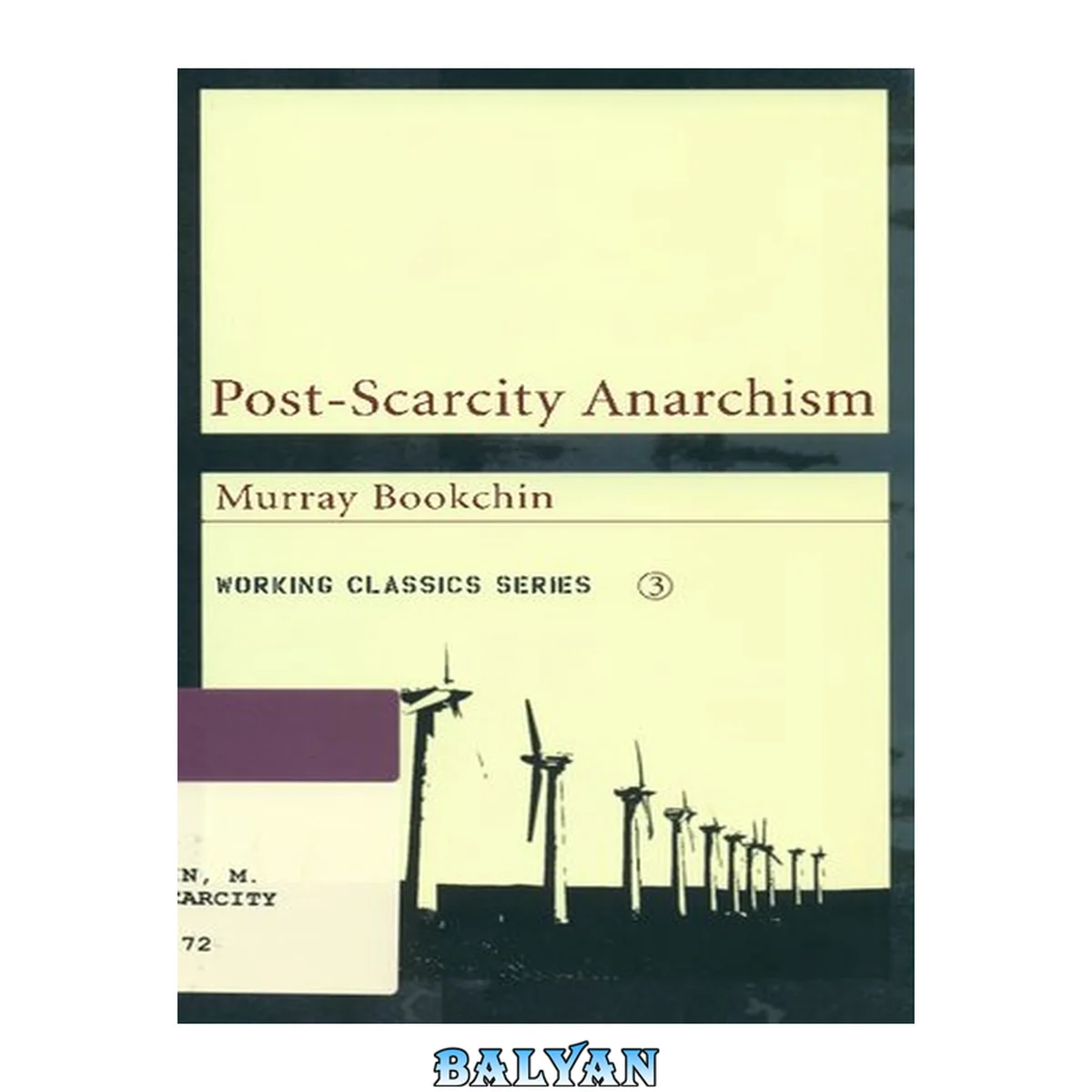
معرفی کتاب «Post-Scarcity Anarchism (Working Classics)» نوشتهٔ Andrew Carnie و Bookchin, Murray، منتشرشده توسط نشر AK Press در سال 2018. این کتاب در فرمت pdf، زبان انگلیسی ارائه شده است.
In a series of related essays, Murray Bookchin balances his ecological and anarchist vision with the promising opportunities of a “post-scarcity” era. Surpassing the constraints of Marxist political economy—which was rooted in an era of material scarcity and could not foresee the sweeping changes ahead—Bookchin argues that the tools necessary for the self-administration of a complex, industrial society have already been developed and have greatly altered our revolutionary landscape. Technological advances were made during the twentieth century which expanded production greatly, but in the pursuit of corporate profit and at the expense of human need, workers’ control and ecological sustainability. Through direct control of industry, and by incorporating an ecological and utopian vision for society, the working class can now dispel the myth that the state, hierarchical social relations, and political parties (vanguards) are necessary to their struggle for freedom. Bookchin’s analysis, rooted in the realities of contemporary society, remains refreshingly pragmatic. Perhaps his most influential collection of essays (including the legendary “Listen Marxist!” and “Ecology and Revolutionary Thought”), this third edition contains a new preface from the author. "In this series of related essays, Murray Bookchin balances his ecological and anarchist vision with the promising opportunities of a 'post-scarcity' era. Surpassing the constraints of Marxist political economy--which was rooted in an era of material scarcity and could not forsee the sweeping changes ahead--Bookchin argues that the tools necessary for the self-administration of a complex, industrial societyhave already been developed and have greatly altered our revolutionary landscape. Technological advances were made during the 20th century which expanded production greatly, but in the pursuit of corporate profit and at the expense of human need, workers' control and ecological sustainability. Through direct control on industry, and by incorporating an ecological and utopian vision for society, the working class can now dispell the myth that the state, hierarchical social relations and political parties (vanguards) are necessary to their struggle for freedom. Bookchin's analysis, rooted in the realities of contemporary society, remains refreshingly pragmatic."--Jacket. In this series of essays, Murray Bookchin balances his ecological and anarchist vision with the promising opportunities of a post-scarcity era. Technological advances during the 20th century have expanded production in the pursuit of corporate profit at the expense of human need and ecological sustainability. New possibilities for human freedom must combine an ecological outlook with the dissolution of hierarchical social relations, capitalism and canonical political orientation. Bookchins utopian vision, rooted in the realities of contemporary society, remains refreshingly pragmatic. Book-chin makes a trenchant analysis of modern society and offers a pointed, provocative discussion of the ecological crisis. Library Journal Murray Bookchin has been an active voice in the ecology and anarchist movements for more than 40 years. In Oakland, California on March 24, 2015 a fire destroyed the AK Press warehouse along with several other businesses. Please consider visiting the AK Press website to learn more about the fundraiser to help them and their neighbors.
In this series of essays, Murray Bookchin balances his ecological and anarchist vision with the promising opportunities of a “post-scarcity” era. Technological advances during the 20th century have expanded production in the pursuit of corporate profit at the expense of human need and ecological sustainability. New possibilities for human freedom must combine an ecological outlook with the dissolution of hierarchical social relations, capitalism and canonical political orientation. Bookchin’s utopian vision, rooted in the realities of contemporary society, remains refreshingly pragmatic. “Book-chin makes a trenchant analysis of modern society and offers a pointed, provocative discussion of the ecological crisis.”—Library Journal
Murray Bookchin has been an active voice in the ecology and anarchist movements for more than 40 years.
Introduction to the First Edition iii Introduction to the Second Edition xx Introduction to the Third Edition xxxvi Post-Scarcity Anarchism 1 Ecology and Revolutionary Thought 19 Towards a Liberatory Technology 41 The Forms of Freedom 85 Listen, Marxist! 107 :: Note on Affinity Groups 145 Discussion on “Listen, Marxist!" 147 The May-June Events in France: 1 France: A Movement for Life 165 The May-June Events in France: 2 Excerpts from a Letter 175 Desire and Need 185 References 197 From the Working Classics Series ' comes this modern anarchist classic, bringing an inspiring vision of how a non-hierarchical, ecologically minded and non-capitalist society can equitably meet human needs. Bookchin argues that material scarcity need no longer plague human history. Through the dissolution of hierarchical relations, social and cultural potentials can now be fulfilled in our 'post-scarcity' era.' Post-scarcity anarchism Ecology and revolutionary thought Towards a liberatory technology The forms of freedom Listen, Marxist! A note on affinity groups Discussion on "Listen, Marxist!" The May-June events in France: 1. France: a movement for life The May-June events in France: 2. Excerpts from a letter Desire and need. We normally live completely immersed in the present -- to such a degree, in fact, that we often fail to see how much our own social period differs from the past -- indeed from a mere generation ago.