Poincare and the Three Body Problem (History of Mathematics, V. 11)
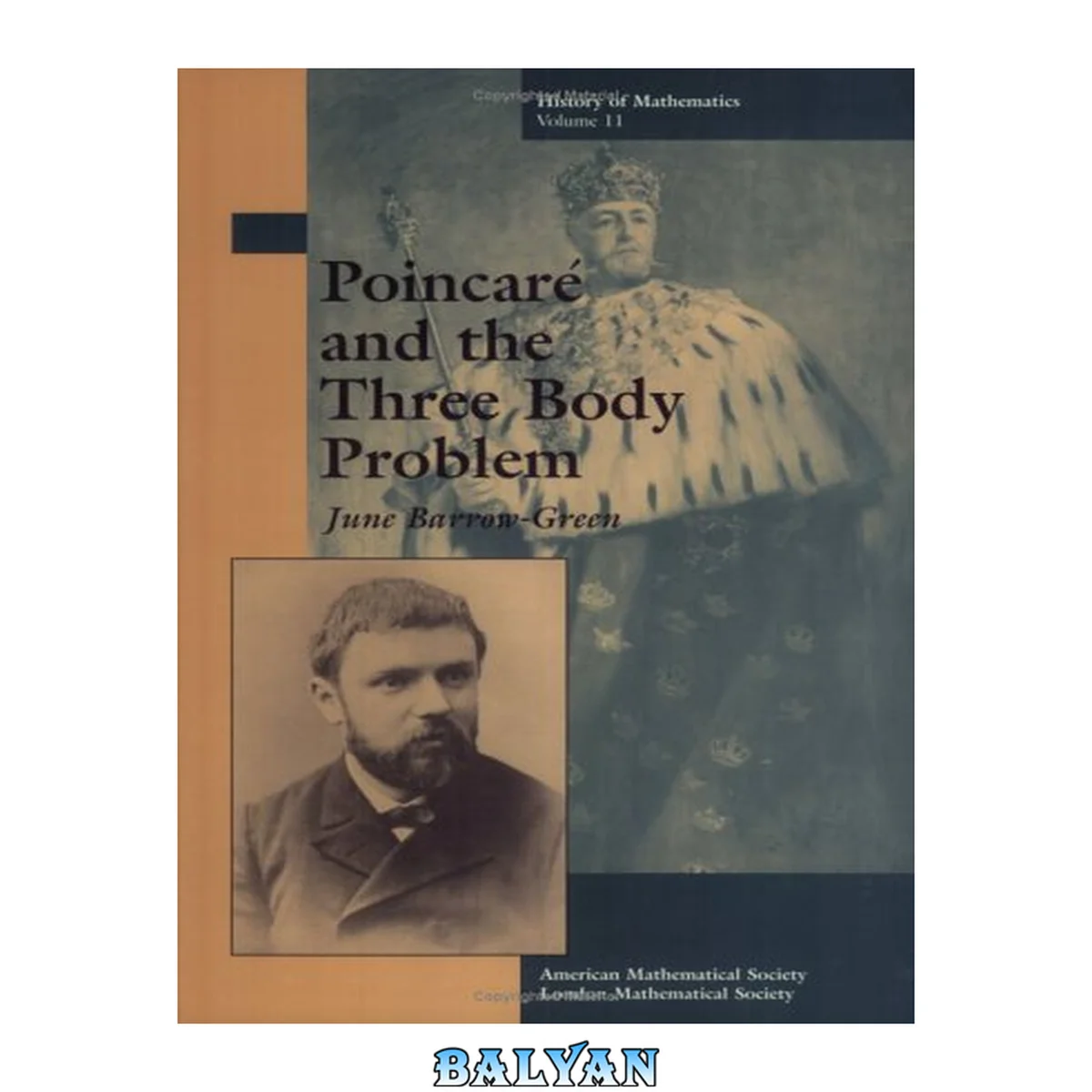
معرفی کتاب «Poincare and the Three Body Problem (History of Mathematics, V. 11)» نوشتهٔ Haidt، Jonathan و June Barrow-Green، منتشرشده توسط نشر American Mathematical Society ; London Mathematical Society در سال 1996. این کتاب در فرمت pdf، زبان انگلیسی ارائه شده است.
The idea of chaos figures prominently in mathematics today. It arose in the work of one of the greatest mathematicians of the late 19th century, Henri Poincare, on a problem in celestial mechanics: the three body problem. This ancient problem—to describe the paths of three bodies in mutual gravitational interaction—is one of those which is simple to pose but impossible to solve precisely. Poincare's famous memoir on the three body problem arose from his entry in the competition celebrating the 60th birthday of King Oscar of Sweden and Norway. His essay won the prize and was set up in print as a paper in Acta Mathematica when it was found to contain a deep and critical error. In correcting this error Poincare discovered mathematical chaos, as is now clear from Barrow-Green's pioneering study of a copy of the original memoir annotated by Poincare himself, recently discovered in the Institut Mittag-Leffler in Stockholm. Poincare and the Three Body Problem opens with a discussion of the development of the three body problem itself and Poincare's related earlier work. The book also contains intriguing insights into the contemporary European mathematical community revealed by the workings of the competition. After an account of the discovery of the error and a detailed comparative study of both the original memoir and its rewritten version, the book concludes with an account of the final memoir's reception, influence and impact, and an examination of Poincare's subsequent highly influential work in celestial mechanics.
Poincare's famous memoir on the three body problem arose from his entry in the competition celebrating the 60th birthday of King Oscar of Sweden and Norway. His essay won the prize and was set up in print as a paper in Acta Mathematica when it was found to contain a deep and critical error. In correcting this error Poincare discovered mathematical chaos, as is now clear from June Barrow-Green's pioneering study of a copy of the original memoir annotated by Poincare himself, recently discovered in the Institut Mittag-Leffler in Stockholm. Poincare and the Three Body Problem opens with a discussion of the development of the three body problem itself and Poincare's related earlier work. The book also contains intriguing insights into the contemporary European mathematical community revealed by the workings of the competition. After an account of the discovery of the error and a detailed comparative study of both the original memoir and its rewritten version, the book concludes with an account of the final memoir's reception, influence and impact, and an examination of Poincare's subsequent highly influential work in celestial mechanics. The idea of chaos figures prominently in mathematics today. It arose in the work of one of the greatest mathematicians of the late 19th century, Henri Poincare, on a problem in celestial mechanics: the three body problem. This ancient problem - to describe the paths of three bodies in mutual gravitational interaction - is one of those which is simple to pose but impossible to solve precisely. Poincare's famous memoir on the three body problem arose from his entry in King Oscar of Sweden's 60th birthday competition. His essay won the prize and was set up in print as a paper in Acta Mathematica when it was found to contain a deep and critical error. In correcting this error Poincare discovered mathematical chaos, as is now clear from the author's study of a copy of the original memoir annotated by Poincare himself, recently discovered in the Institut Mittag-Leffler in Stockholm. Poincare and the Three Body Problem opens with a discussion of the development of the three body problem itself and Poincare's related earlier work. Cover Title page Dedication Contents Acknowledgements Photograph and figure credits Chapter 1. Introduction Chapter 2. Historical background Chapter 3. Poincare’s work before 1889 Chapter 4. Oscar II’s 60th birthday competition Chapter 5. Poincare’s Memoirs on the three body problem Chapter 6. Reception of Poincare’s memoir Chapter 7. Poincare’s related work after 1889 Chapter 8. Associated mathematical activity Chapter 9. Hadamard and Birkoff Chapter 10. Epilogue Appendix 1. A letter from Gosta Mittag-Leffler to Sonya Appendix 2. Announcement of the Oscar competition Appendix 3. Entries recieved in the Oscar competition Appendix 4. Report of the Prize commission Appendix 5. Title pages and tables of contents Appendix 6. Theorems in [P1] not included in [P2] Index Back Cover