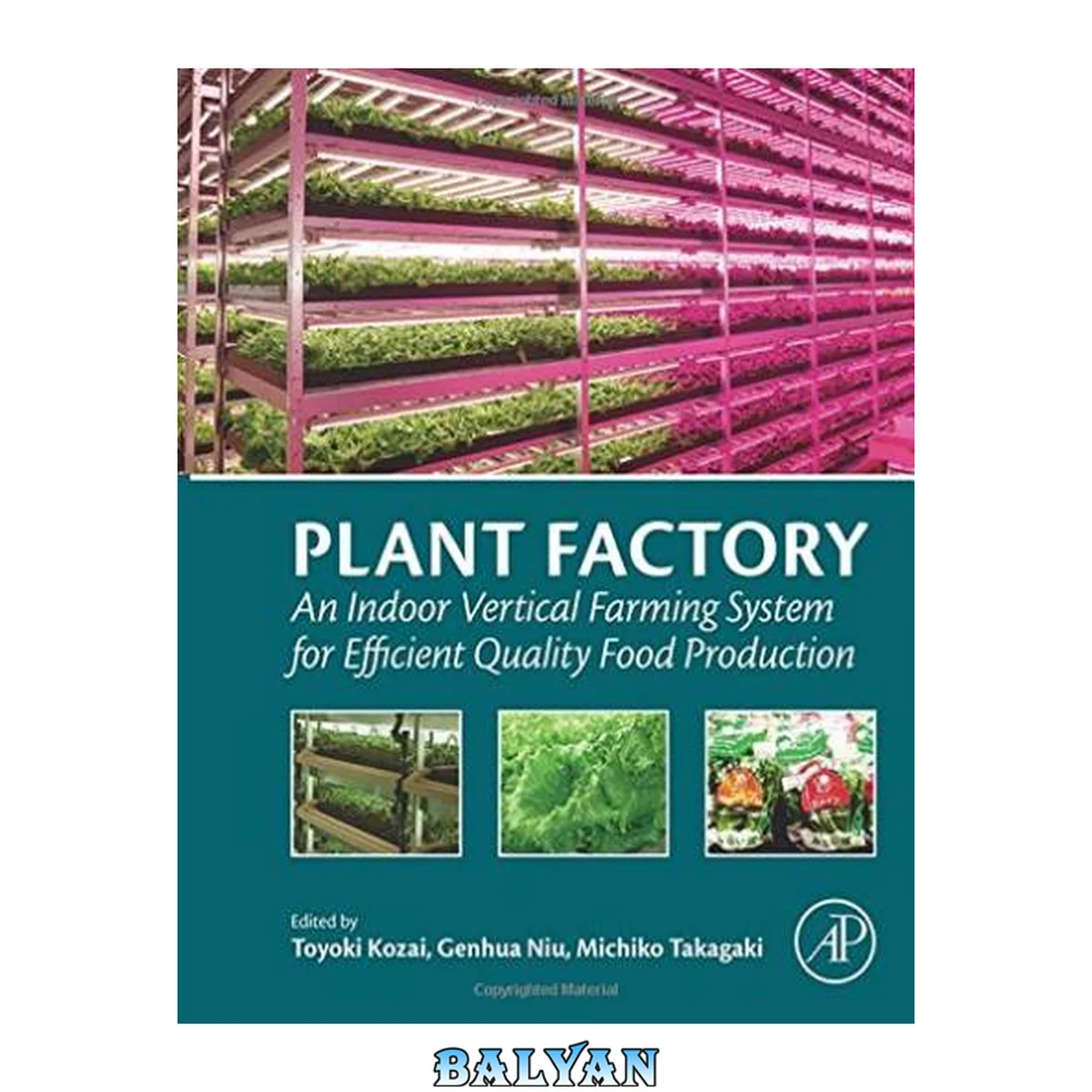
معرفی کتاب «Plant factory : an indoor vertical farming system for efficient quality food production» نوشتهٔ 1952-، Peter S Baker، (Peter Stuart) و Kozai, Toyoki; Niu, Genhua; Takagaki, Michiko، منتشرشده توسط نشر Academic Press is an imprint of Elsevier در سال 2016. این کتاب در 64 صفحه، فرمت pdf، زبان انگلیسی ارائه شده است.
Plant Factory: An Indoor Vertical Farming System for Efficient Quality Food Production provides information on a field that is helping to offset the threats that unusual weather and shortages of land and natural resources bring to the food supply. As alternative options are needed to ensure adequate and efficient production of food, this book represents the only available resource to take a practical approach to the planning, design, and implementation of plant factory (PF) practices to yield food crops. The PF systems described in this book are based on a plant production system with artificial (electric) lights and include case studies providing lessons learned and best practices from both industrial and crop specific programs. With insights into the economics as well as the science of PF programs, this book is ideal for those in academic as well as industrial settings. Provides full-scope insight on plant farm, from economics and planning to life-cycle assessment Presents state-of-the-art plant farm science, written by global leaders in plant farm advancements Includes case-study examples to provide real-world insights Content: Front Cover Plant Factory: An Indoor Vertical Farming System for Efficient Quality Food Production Copyright Contents Contributors Preface Acknowledgments Chapter 5, Kozai Chapter 19.2, Shibuya Chapter 19.3, He Part 1: Overview and Concept of Closed Plant Production System (CPPS) Chapter 1: Introduction Introduction References Chapter 2: Role of the Plant Factory with Artificial Lighting (PFAL) in Urban Areas Introduction Interrelated Global Issues to be Solved Concurrently Resource Inflow and Waste Outflow in Urban Areas Energy and Material Balance in Urban Ecosystems Photoautotrophs (Plants) and Heterotrophs (Animals and Microorganisms)Waste Produced in Urban Areas as an Essential Resource for Growing Plants Plant Production Systems Integrated With Other Biological Systems Role of Organic Fertilizers and Microorganisms in the Soil Stability and Controllability of the Environment in Plant Production Systems Key Indices for Sustainable Food Production What is ""PFAL""? Plants Suited and Unsuited to PFALs Growing Social Needs and Interest in PFALs Criticisms of PFALs and Responses to Them Initial Cost is Too High Production Cost is Too High Electricity Cost is Too High, Whereas Solar Light is FreeLabor Cost is Too High PFAL-Grown Vegetables Are Neither Tasty Nor Nutritious Most PFALs Are Not Making a Profit Land Price is Too High Water Consumption for Irrigation Is too High PFALs Can Only Produce Leafy Greens-Minor Vegetables-Economically Towards a Sustainable PFAL Requirements for a Sustainable PFAL Factors Affecting the Sustainability of PFALs Positive aspects affecting environmental, resource, social, and economic sustainability Factors to be solved to improve sustainability Similarities Between the Earth, Space Farms, Autonomous Cities, and PFALsConclusion References Chapter 3: PFAL Business and R&D in the World: Current Status and Perspectives Introduction Japan Brief History and Current Status of PFAL Business Research and Development Public Service Taiwan Status of PFAL in Taiwan PFAL Expo in Taiwan PFAL Research Cost comparison of PFALs Spectra of LEDs used in PFALs Wireless sensor networks in PFALs Ion-selective sensors for nutrient detection Nondestructive plant growth measurement system Business Models of PFALs in Taiwan Conclusions KoreaPFAL Industry, a Commitment to the Future Research and Technical Development Private Companies and Farms in the PFAL Business Achievements and Challenges China Development of PFAL in China Case Study of Typical PFALs PFALs in the Chinese Academy of Agricultural Sciences PFAL of Beijing Kingpeng International Hi-Tech Corporation Plant factory of Zhejiang University PFAL with LED in Shouguang Research Projects on Plant Factories in China North America History Contribution of Space Science Current Status and Future Prospective Europe (England, The Netherlands, and Others) Part 1: Overview and concept of closed plant production system (CPPS). Introduction / Toyoki Kozai, Genhua Niu Role of the plant factory with artificial lighting (PFAL) in urban areas / Toyoki Kozai, Genhua Niu PFAL business and R & D in the world: current status and perspectives Plant factory as a resource-efficient closed plant production system / Toyoki Kozai, Genhua Niu Micro- and mini-PFALs for improving the quality of life in urban areas / Michiko Takagaki, Hiromichi Hara, Toyoki Kozai Rooftop plant production systems in urban areas / Nadia Sabeh Part 2: Basics of physics and physiology- environments and their effects. Light Physical environmental factors and their properties / Genhua Niu, Toyoki Kozai, Nadia Sabeh Photosynthesis and respiration / Wataru Yamori Growth, development, transpiration and translocation as affected by abiotic environmental factors / Chieri Kubota Nutrition and nutrient uptake in soilless culture systems / Satoru Tsukagoshi, Yutaka Shinohara Tipburn / Toru Maruo, Masahumi Johkan Functional components in leafy vegetables / Keiko Ohashi-Kaneko Medicinal components / Sma Zobayed Production of pharmaceuticals in a specially designed plant factory / Eiji goto Part 3: System design, construction, cultivation and management. Plant producion process, floor plan, and layout of PFAL / Toyoki Kozai Hydroponic systems / Jung Eek Son, Hak Jin Kim, Tae In Ahn Seeding, seedling production and transplanting / Osamu Nunomura, Toyoki Kozai, Kimiko Shinozaki, Takahiro Oshio Transplant production in closed systems Photoautotrophic micropropagation / Quynh Thi Nguyen, Yulan Xiao, Toyoki Kozai Biological factor management Design and management of PFAL / Toyoki Kozai, Shunsuke Sakaguchi, Takuji Akiyama, Kosuke Yamada, Kazutaka Ohshima Automated technology in plant factories with artificial lighting / Hiroshi Shimizu, Kazuhiro Fukuda, Yoshikazu Nishida, Toichi Ogura Life cycle assessment / Yasunori Kikuchi Education, training, and intensive business forums on plant factories / Toshitaka Yamaguchi, Michiko Takagaki, Satoru Tsukagoshi Part 4: PFALs in operation and its perspectives. Selected commercial PFALs in Japan and Taiwan Challenges for the next-generation PFAL / Toyoki Kozai, Genhua Niu Conclusions: Resource-saving and resource-consuming characteristics of PFALs / Toyoki Kozai, Genhua Niu.
Plant Factory: An Indoor Vertical Farming System for Efficient Quality Food Production provides information on a field that is helping to offset the threats that unusual weather and shortages of land and natural resources bring to the food supply.
As alternative options are needed to ensure adequate and efficient production of food, this book represents the only available resource to take a practical approach to the planning, design, and implementation of plant factory (PF) practices to yield food crops. The PF systems described in this book are based on a plant production system with artificial (electric) lights and include case studies providing lessons learned and best practices from both industrial and crop specific programs.
With insights into the economics as well as the science of PF programs, this book is ideal for those in academic as well as industrial settings.
- Provides full-scope insight on plant farm, from economics and planning to life-cycle assessment
- Presents state-of-the-art plant farm science, written by global leaders in plant farm advancements
- Includes case-study examples to provide real-world insights
__Plant Factory: An Indoor Vertical Farming System for Efficient Quality Food Production__As alternative options are needed to ensure adequate and efficient production of food, this book represents the only available resource to take a practical approach to the planning, design, and implementation of plant factory (PF) practices to yield food crops. The PF systems described in this book are based on a plant production system with artificial (electric) lights and include case studies providing lessons learned and best practices from both industrial and crop specific programs. With insights into the economics as well as the science of PF programs, this book is ideal for those in academic as well as industrial settings.