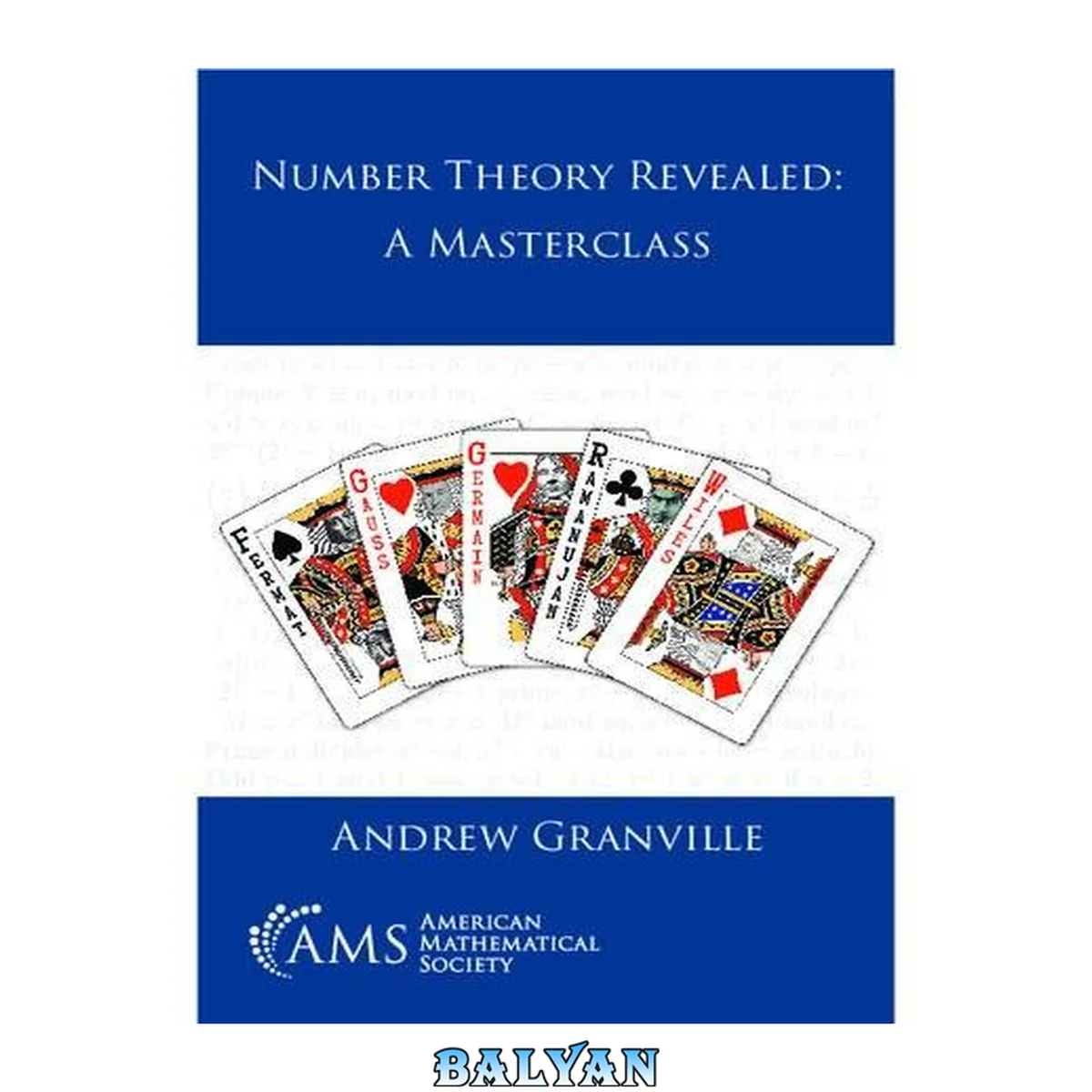
معرفی کتاب «Number Theory Revealed: A Masterclass» نوشتهٔ Diaz Hazel و Andrew Granville، منتشرشده توسط نشر American Mathematical Society ProQuest در سال 2019. این کتاب در فرمت pdf، زبان انگلیسی ارائه شده است.
Number Theory Revealed: A Masterclass acquaints enthusiastic students with the “Queen of Mathematics”. The text offers a fresh take on congruences, power residues, quadratic residues, primes, and Diophantine equations and presents hot topics like cryptography, factoring, and primality testing. Students are also introduced to beautiful enlightening questions like the structure of Pascal's triangle mod $p$ and modern twists on traditional questions like the values represented by binary quadratic forms, the anatomy of integers, and elliptic curves. This Masterclass edition contains many additional chapters and appendices not found in Number Theory Revealed: An Introduction, highlighting beautiful developments and inspiring other subjects in mathematics (like algebra). This allows instructors to tailor a course suited to their own (and their students') interests. There are new yet accessible topics like the curvature of circles in a tiling of a circle by circles, the latest discoveries on gaps between primes, a new proof of Mordell's Theorem for congruent elliptic curves, and a discussion of the $abc$-conjecture including its proof for polynomials. About the Author: Andrew Granville is the Canada Research Chair in Number Theory at the University of Montreal and professor of mathematics at University College London. He has won several international writing prizes for exposition in mathematics, including the 2008 Chauvenet Prize and the 2019 Halmos-Ford Prize, and is the author of Prime Suspects (Princeton University Press, 2019), a beautifully illustrated graphic novel murder mystery that explores surprising connections between the anatomies of integers and of permutations. Contents Preface Gauss’s Notation Prerequisites Preliminary Chapter on Induction 0.1. Fibonacci numbers and other recurrence sequences 0.2. Formulas for sums of powers of integers 0.3. The binomial theorem, Pascal’s triangle, and the binomial coefficients Appendices for Preliminary Chapter on Induction Appendix 0A. A closed formula for sums of powers Appendix 0B. Generating functions Appendix 0C. Finding roots of polynomials Appendix 0D. What is a group? Appendix 0E. Rings and fields Appendix 0F. Symmetric polynomials Appendix 0G. Constructibility Chapter 1. The Euclidean algorithm Appendices for Chapter 1: Appendix 1A. Reformulating the Euclidean algorithm Appendix 1B. Computational aspects of the Euclidean algorithm Appendix 1C. Magic squares Appendix 1D. The Frobenius postage stamp problem Appendix 1E. Egyptian fractions Chapter 2. Congruences Appendices for Chapter 2 Appendix 2A. Congruences in the language of groups Appendix 2B. The Euclidean algorithm for polynomials Chapter 3. The basic algebra of number theory Appendices for Chapter 3 Appendix 3A. Factoring binomial coefficients and Pascal’s triangle modulo Appendix 3B. Solving linear congruences Appendix 3C. Groups and rings Appendix 3D. Unique factorization revisited Appendix 3E. Gauss’s approach Appendix 3F. Fundamental theorems and factoring polynomials Appendix 3G. Open problems Chapter 4. Multiplicative functions Appendices for Chapter 4 Appendix 4A. More multiplicative functions Appendix 4B. Dirichlet series and multiplicative functions Appendix 4C. Irreducible polynomials modulo Appendix 4D. The harmonic sum and the divisor function Appendix 4E. Cyclotomic polynomials Chapter 5. The distribution of prime numbers Appendices for Chapter 5 Appendix 5A. Bertrand’s postulate and beyond Appendix 5B. An important proof of infinitely many primes Appendix 5C. What should be true about primes? Appendix 5D. Working with Riemann’s zeta-function Appendix 5E. Prime patterns: Consequences of the Green-Tao Theorem Appendix 5F. A panoply of prime proofs Appendix 5G. Searching for primes and prime formulas Appendix 5H. Dynamical systems and infinitely many primes Chapter 6. Diophantine problems Appendices for Chapter 6 Appendix 6A. Polynomial solutions of Diophantine equations Appendix 6B. No Pythagorean triangle of square area via Euclidean geometry Appendix 6C. Can a binomial coefficient be a square? Chapter 7. Power residues Appendices for Chapter 7 Appendix 7A. Card shuffling and Fermat’s Little Theorem Appendix 7B. Orders and primitive roots Appendix 7C. Finding Appendix 7D. Orders for finite groups Appendix 7E. Constructing finite fields Appendix 7F. Sophie Germain and Fermat’s Last Theorem Appendix 7G. Primes of the form Appendix 7H. Further congruences Appendix 7I. Primitive prime factors of recurrence sequences Chapter 8. Quadratic residues Appendices for Chapter 8 Appendix 8A. Eisenstein’s proof of quadratic reciprocity Appendix 8B. Small quadratic non-residues Appendix 8C. The first proof of quadratic reciprocity Appendix 8D. Dirichlet characters and primes in arithmetic progressions Appendix 8E. Quadratic reciprocity and recurrence sequences Chapter 9. Quadratic equations Appendices for Chapter 9 Appendix 9A. Proof of the local-global principle for quadratic equations Appendix 9B. Reformulation of the local-global principle Appendix 9C. The number of representations Appendix 9D. Descent and the quadratics Chapter 10. Square roots and factoring Appendices for Chapter 10 Appendix 10A. Pseudoprime tests using square roots of Appendix 10B. Factoring with squares Appendix 10C. Identifying primes of a given size Appendix 10D. Carmichael numbers Appendix 10E. Cryptosystems based on discrete logarithms Appendix 10F. Running times of algorithms Appendix 10G. The AKS test Appendix 10H. Factoring algorithms for polynomials Chapter 11 Rational approximations to real numbers Appendices for Chapter 11 Appendix 11A. Uniform distribution Appendix 11B. Continued fractions Appendix 11C. Two-variable quadratic equations Appendix 11D. Transcendental numbers Chapter 12. Binary quadratic forms Appendices for Chapter 12 Appendix 12A. Composition rules: Gauss, Dirichlet, and Bhargava Appendix 12B. The class group Appendix 12C. Binary quadratic forms of positive discriminant Appendix 12D. Sums of three squares Appendix 12E. Sums of four squares Appendix 12F. Universality Appendix 12G. Integers represented in Apollonian circle packings Chapter 13. The anatomy of integers Appendices for Chapter 13 Appendix 13A. Other anatomies Appendix 13B. Dirichlet L-functions Chapter 14. Counting integral and rational points on curves, modulo p Appendix 14A. Gauss sums Chapter 15. Combinatorial number theory Appendices for Chapter 15 Appendix 15A. Summing sets modulo Appendix 15B. Summing sets of integers Chapter 16. The p-adic numbers Chapter 17. Rational points on elliptic curves Appendices for Chapter 17 Appendix 17A. General Mordell’s Theorem Appendix 17B. Pythagorean triangles of area Appendix 17C. 2-parts of abelian groups Appendix 17D. Waring’s problem Hints for exercises Recommended further reading Index
Number Theory Revealed: A Masterclass acquaints enthusiastic students with the "Queen of Mathematics". The text offers a fresh take on congruences, power residues, quadratic residues, primes, and Diophantine equations and presents hot topics like cryptography, factoring, and primality testing. Students are also introduced to beautiful enlightening questions like the structure of Pascal's triangle mod $p$ and modern twists on traditional questions like the values represented by binary quadratic forms, the anatomy of integers, and elliptic curves.This Masterclass edition contains many additional chapters and appendices not found in Number Theory Revealed: An Introduction, highlighting beautiful developments and inspiring other subjects in mathematics (like algebra). This allows instructors to tailor a course suited to their own (and their students') interests. There are new yet accessible topics like the curvature of circles in a tiling of a circle by circles, the latest discoveries on gaps between primes, a new proof of Mordell's Theorem for congruent elliptic curves, and a discussion of the $abc$-conjecture including its proof for polynomials.About the Author:Andrew Granville is the Canada Research Chair in Number Theory at the University of Montreal and professor of mathematics at University College London. He has won several international writing prizes for exposition in mathematics, including the 2008 Chauvenet Prize and the 2019 Halmos-Ford Prize, and is the author of Prime Suspects (Princeton University Press, 2019), a beautifully illustrated graphic novel murder mystery that explores surprising connections between the anatomies of integers and of permutations.