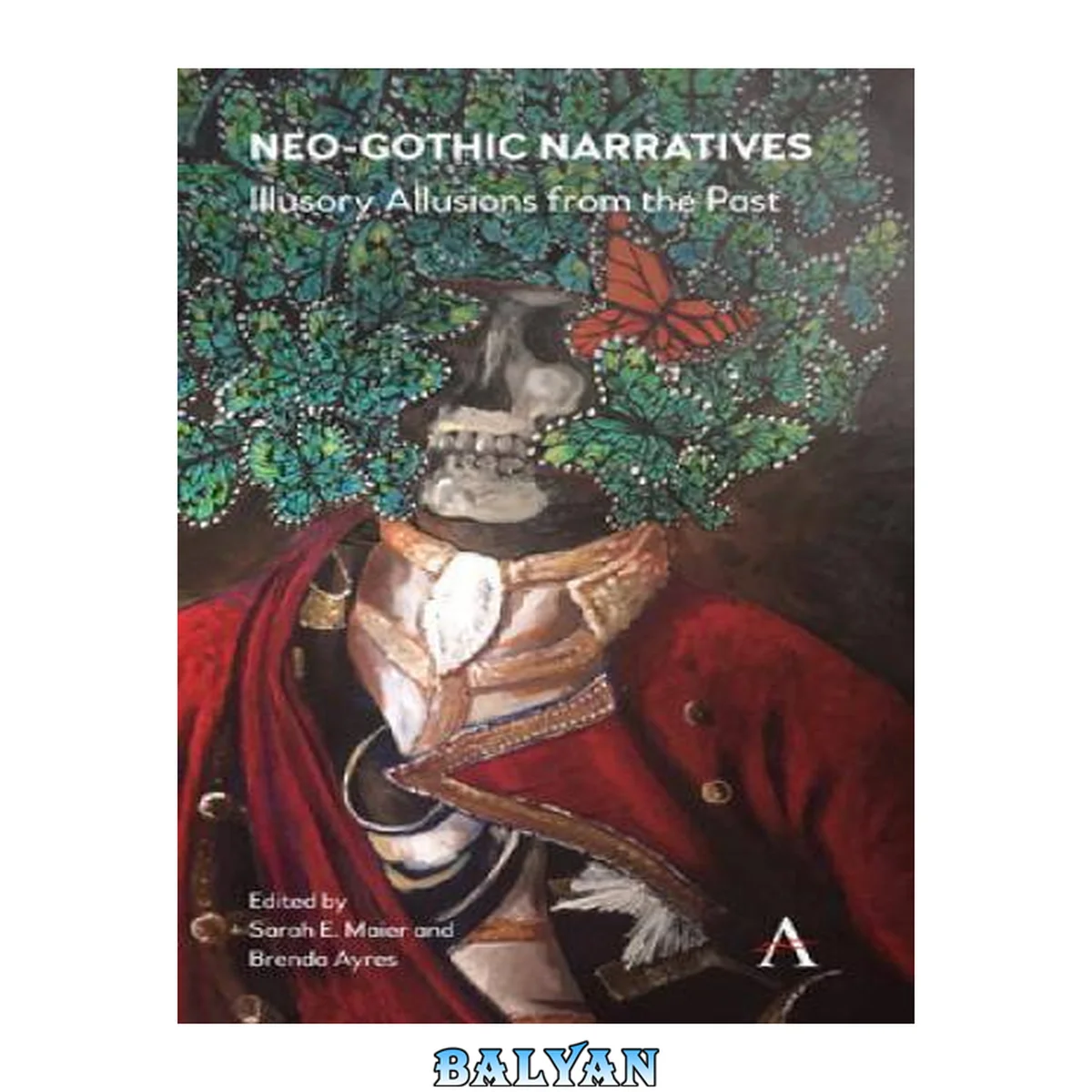
معرفی کتاب «Neo-Gothic Narratives: Illusory Allusions from the Past (Anthem Studies in Gothic Literature)» نوشتهٔ Stephanie Amaral و Sarah E. Maier (editor), Brenda Ayres (editor)، منتشرشده توسط نشر Anthem Press در سال 2020. این کتاب در فرمت pdf، زبان انگلیسی ارائه شده است.
__Neo-Gothic Narratives__ defines and theorises what, exactly, qualifies as such a text, what mobilises the employment of the Gothic to speak to our own times, whether nostalgia plays a role and whether there is room for humour besides the sobriety and horror in these narratives across various media. What attracts us to the Gothic that makes us want to resurrect, reinvent, echo it? Why do we let the Gothic redefine us? Why do we let it haunt us? Does it speak to us through intertexuality, self-reflectivity, metafiction, immersion, affect? Are we reclaiming the history of women and other subalterns in the Gothic that had been denied in other forms of history? Are we revisiting the trauma of English colonisation and seeking national identity? Or are we simply tourists who enjoy cruising through the otherworld? The essays in this volume investigate both the readerly experience of Neo-Gothic narratives as well as their writerly pastiche. Neo-Gothic Narratives defines and theorises what, exactly, qualifies as such a text, what mobilises the employment of the Gothic to speak to our own times, whether nostalgia plays a role and whether there is room for humour besides the sobriety and horror in these narratives across various media. What attracts us to the Gothic that makes us want to resurrect, reinvent, echo it? Why do we let the Gothic redefine us? Why do we let it haunt us? Does it speak to us through intertexuality, self-reflectivity, metafiction, immersion, affect? Are we reclaiming the history of women and other subalterns in the Gothic that had been denied in other forms of history? Are we revisiting the trauma of English colonisation and seeking national identity? Or are we simply tourists who enjoy cruising through the otherworld? The essays in this volume investigate both the readerly experience of Neo-Gothic narratives as well as their writerly pastiche. | Recent years have seen the strong development of Neo-Victorian studies, including its theorisation by such scholars as Cora Kaplan, Sally Shuttleworth, Ann Heilmann, Christian Gutleben, Marie-Louise Kohlke, Mark Llewellyn and others. It is a focus that has engaged literary critics from around the globe like Carmen Veronica Borbély (Romania), Susanne Gruß (Germany), Tiffany Gagliardi Trotman (Spain), Hitomi Nakatani (Japan), Agnieszka Matysiak (Poland), Max Duperray (France), Jeanne Ellis (South Africa) and Van Leavenworth (Sweden) to name just a few. [NP] 'Neo-Gothic Narratives' defines and theorizes what, exactly, qualifies as such a text, what mobilises the employment of the Gothic to speak to our own times, whether nostalgia plays a role and whether there is room for humour besides the sobriety and horror in these narratives across various media. What attracts us to the Gothic that makes us want to resurrect, reinvent, echo it? Why do we let the Gothic redefine us? Why do we let it haunt us? Does it speak to us through intertexuality, self-reflectivity, metafiction, immersion, affect? Are we reclaiming the history of women and other subalterns in the Gothic that had been denied in other forms of history? Are we revisiting the trauma of English colonisation and seeking national identity? Or are we simply tourists who enjoy cruising through the otherworld? The essays in this volume investigate both the readerly experience of Neo-Gothic narratives as well as their writerly pastiche.
Neo-Gothic Narratives defines and theorises what, exactly, qualifies as such a text, what mobilises the employment of the Gothic to speak to our own times, whether nostalgia plays a role and whether there is room for humour besides the sobriety and horror in these narratives across various media. What attracts us to the Gothic that makes us want to resurrect, reinvent, echo it? Why do we let the Gothic redefine us? Why do we let it haunt us? Does it speak to us through intertexuality, self-reflectivity, metafiction, immersion, affect? Are we reclaiming the history of women and other subalterns in the Gothic that had been denied in other forms of history? Are we revisiting the trauma of English colonisation and seeking national identity? Or are we simply tourists who enjoy cruising through the otherworld? The essays in this volume investigate both the readerly experience of Neo-Gothic narratives as well as their writerly pastiche.
Cover Front Matter Half-title Title page Copyright information Dedication Table of Contents Acknowledgements Chapters Int-11 Introduction Notes Bibliography Chapter One “Through A Glass Darkly”: the Gothic trace Notes Bibliography Chapter Two Dark Descen(den)ts: Neo-Gothic Monstrosity and the Women of Frankenstein Notes Bibliography Chapter Three Theorising Race, Slavery and the New Imperial Gothic in Neo-Victorian Returns to Wuthering Heights Notes Bibliography Chapter Four Toxic Neo-Gothic Masculinity: Mr. Hyde, Tyler Durden and Donald J. Trump as Angry White Men Dr. Jekyll’s failure as a gentleman Fight Club: Violence as male bonding Snowflakes and white male supremacy Neo-Gothic toxic American masculinity Conclusion Notes Bibliography Chapter Five Shadows of the Vampire: Neo-Gothicism in Dracula, Ripper Street and What we do in the Shadows Notes Bibliography Chapter Six “Here we are, Again!”: Neo-Gothic Narratives of Textual Haunting, from Peter Ackroyd’s Dan Leno and the Limehouse Golem Notes Bibliography Chapter Seven Spectral Females, Spectral Males: Coloniality and Gender in Neo-Gothic Australian Novels The return of the repressed (ideology) Haunted houses Spectral femininity Spectral males Notes Bibliography Chapter Eight “We Are All Humans”: Self-Aware Zombies and Neo-Gothic Posthumanism Notes Bibliography Chapter Nine Neo-Gothic Dinosaurs and the Haunting of History Notes Bibliography Chapter Ten Doctor Who’s Shaken Faith in Science: Mistrusting Science from the Gothic to the Neo-Gothic Notes Bibliography Chapter Eleven The Devil’s in it: The Bible as Gothic Notes Bibliography NOTES ON Contributors End Matter Index