More Effective C++ : 35 New Ways to Improve Your Programs and Designs
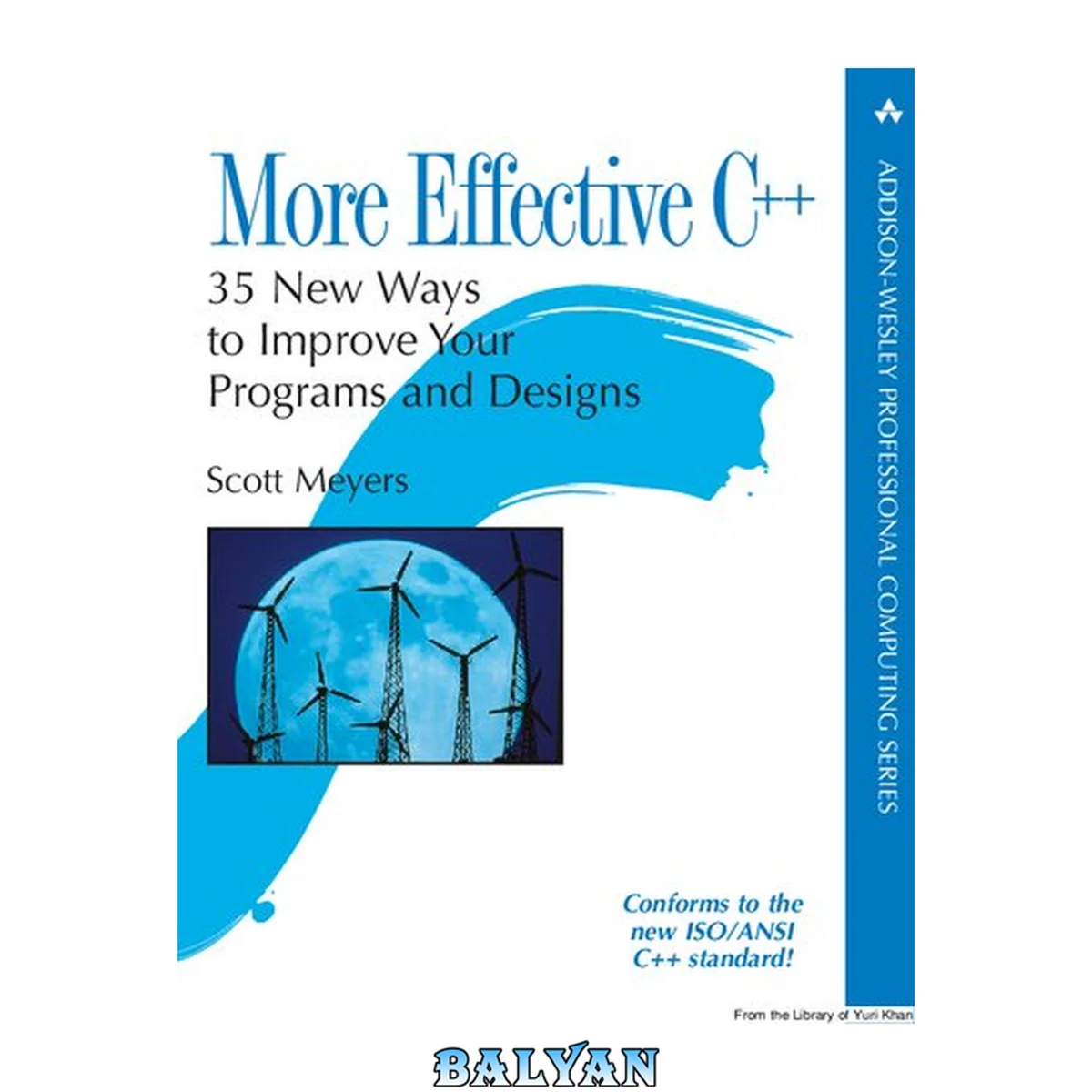
معرفی کتاب «More Effective C++ : 35 New Ways to Improve Your Programs and Designs» نوشتهٔ Scott Meyers، منتشرشده توسط نشر Addison-Wesley Professional در سال 1995. این کتاب در فرمت pdf، زبان انگلیسی ارائه شده است.
More than 150,000 copies in print! Praise for Scott Meyers' first book, Effective C++ : "I heartily recommend Effective C++ to anyone who aspires to mastery of C++ at the intermediate level or above." – The C/C++ User's Journal From the author of the indispensable Effective C++ , here are 35 new ways to improve your programs and designs. Drawing on years of experience, Meyers explains how to write software that is more effective : more efficient, more robust, more consistent, more portable, and more reusable. In short, how to write C++ software that's just plain better. More Effective C++ includes: Proven methods for improving program efficiency, including incisive examinations of the time/space costs of C++ language features Comprehensive descriptions of advanced techniques used by C++ experts, including placement new, virtual constructors, smart pointers, reference counting, proxy classes, and double-dispatching Examples of the profound impact of exception handling on the structure and behavior of C++ classes and functions Practical treatments of new language features, including bool, mutable, explicit, namespaces, member templates, the Standard Template Library, and more. If your compilers don't yet support these features, Meyers shows you how to get the job done without them. More Effective C++ is filled with pragmatic, down-to-earth advice you'll use every day. Like Effective C++ before it, More Effective C++ is essential reading for anyone working with C++. Contents Acknowledgments Introduction Basics Item 1: Distinguish between pointers and references. Item 2: Prefer C++-style casts. Item 3: Never treat arrays polymorphically. Item 4: Avoid gratuitous default constructors. Operators Item 5: Be wary of user-defined conversion functions. Item 6: Distinguish between prefix and postfix forms of increment and decrement operators. Item 7: Never overload &&, ||, or ,. Item 8: Understand the different meanings of new and delete. Exceptions Item 9: Use destructors to prevent resource leaks. Item 10: Prevent resource leaks in constructors. Item 11: Prevent exceptions from leaving destructors. Item 12: Understand how throwing an exception differs from passing a parameter or calling a virtual function. Item 13: Catch exceptions by reference. Item 14: Use exception specifications judiciously. Item 15: Understand the costs of exception handling. Efficiency Item 16: Remember the 80-20 rule. Item 17: Consider using lazy evaluation. Item 18: Amortize the cost of expected computations. Item 19: Understand the origin of temporary objects. Item 20: Facilitate the return value optimization. Item 21: Overload to avoid implicit type conversions. Item 22: Consider using op= instead of stand-alone op. Item 23: Consider alternative libraries. Item 24: Understand the costs of virtual functions, multiple inheritance, virtual base classes, and RTTI. Techniques Item 25: Virtualizing constructors and non-member functions. Item 26: Limiting the number of objects of a class. Item 27: Requiring or prohibiting heap-based objects. Item 28: Smart pointers. Item 29: Reference counting. Item 30: Proxy classes. Item 31: Making functions virtual with respect to more than one object. Miscellany Item 32: Program in the future tense. Item 33: Make non-leaf classes abstract. Item 34: Understand how to combine C++ and C in the same program. Item 35: Familiarize yourself with the language standard. Recommended Reading An auto_ptr Implementation General Index Index of Example Classes, Functions, and Templates This is the eBook version of the printed book. From the author of the indispensable Effective C++ , here are 35 new ways to improve your programs and designs. Drawing on years of experience, Meyers explains how to write software that is more effective : more efficient, more robust, more consistent, more portable, and more reusable. In short, how to write C++ software that’s just plain better. More Effective C++ includes: Proven methods for improving program efficiency, including incisive examinations of the time/space costs of C++ language features Comprehensive descriptions of advanced techniques used by C++ experts, including placement new, virtual constructors, smart pointers, reference counting, proxy classes, and double-dispatching Examples of the profound impact of exception handling on the structure and behavior of C++ classes and functions Practical treatments of new language features, including bool, mutable, explicit, namespaces, member templates, the Standard Template Library, and more. If your compilers don’t yet support these features, Meyers shows you how to get the job done without them. More Effective C++ is filled with pragmatic, down-to-earth advice you’ll use every day. Like Effective C++ before it, More Effective C++ is essential reading for anyone working with C++.
دانلود کتاب More Effective C++ : 35 New Ways to Improve Your Programs and Designs