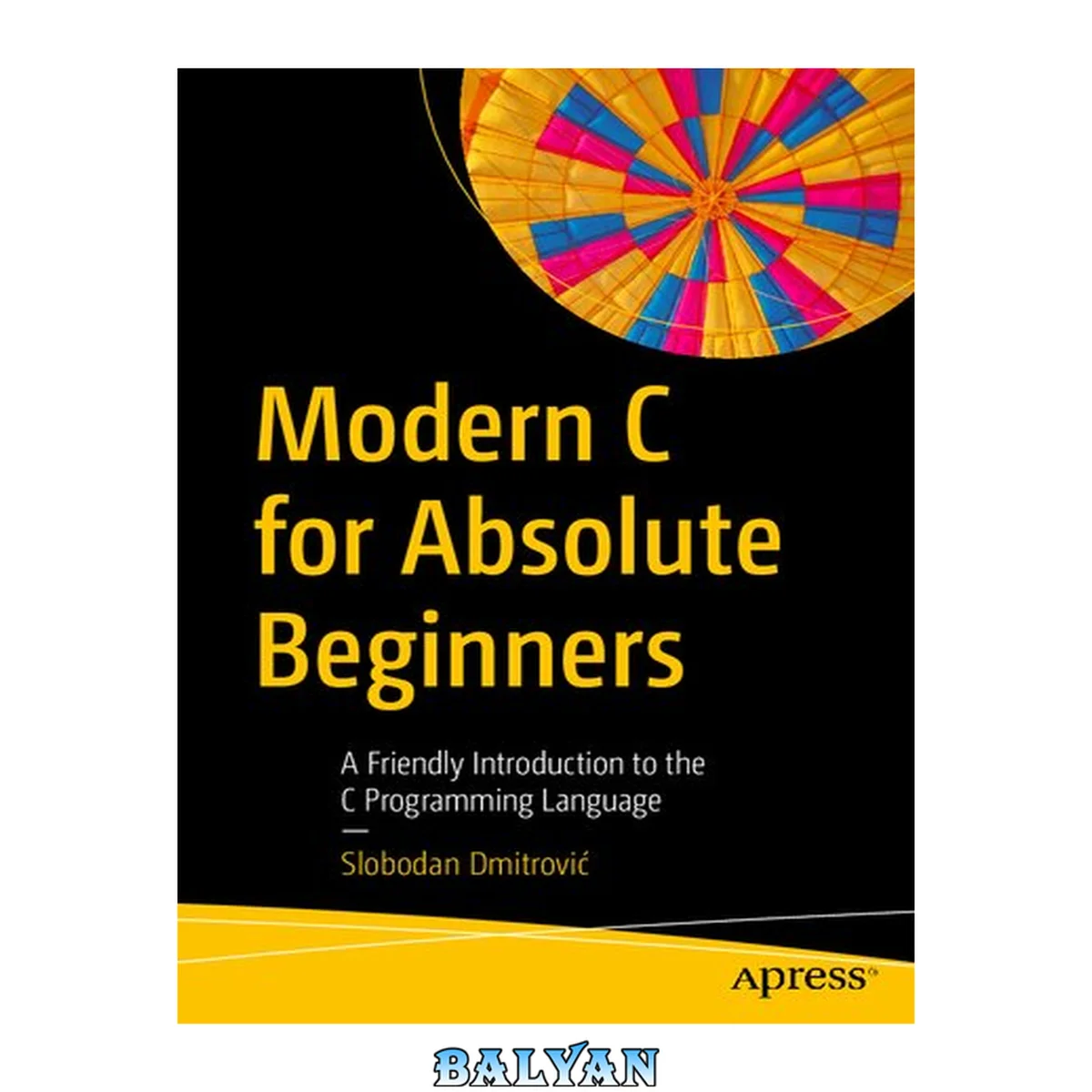
معرفی کتاب «Modern C for Absolute Beginners : A Friendly Introduction to the C Programming Language» نوشتهٔ Slobodan Dmitrović، منتشرشده توسط نشر Apress : Imprint: Apress در سال 2021. این کتاب در 365 صفحه، فرمت pdf، زبان انگلیسی ارائه شده است. «Modern C for Absolute Beginners : A Friendly Introduction to the C Programming Language» در دستهٔ برنامهنویسی قرار دارد.
زبان برنامهنویسی سی (C) با وجود قدمت، همچنان به عنوان یکی از پایهایترین و پرکاربردترین زبانها در دنیای فناوری اطلاعات شناخته میشود. کتاب «Modern C for Absolute Beginners» نوشتهٔ اسلوبودان دیمیتروویچ، اثری است که با زبانی ساده و ساختاری گامبهگام، این زبانِ کلاسیک را به شیوهای نوین و بهروز به تازهکاران عرصهٔ برنامهنویسی آموزش میدهد. این مقاله، شما را با محتوا و ارزشهای این کتاب راهنما آشنا میسازد و نشان میدهد چرا مطالعهٔ آن میتواند نقطهشروعی ایدهآل برای ورود به دنیای کدنویسی باشد.
دربارهٔ کتاب «Modern C for Absolute Beginners» —
کتاب «Modern C for Absolute Beginners» که توسط انتشارات معتبر آپرس (Apress) منتشر شده است، یک راهنمای دوستداشتنی و مختصر برای فراگیری زبان برنامهنویسی سی از صفر تا سطحی قابلقبول است. نویسنده با تکیه بر استانداردهای مدرن این زبان، از جمله نسخههای جدیدتر مانند سی۲۳ (C23)، مبانی اولیه را به زبانی روان و به دور از پیچیدگیهای غیرضروری توضیح میدهد. رویکرد کتاب به شکلی است که هر فصل تعادلی مناسب میان توضیحات نظری و مثالهای کدنویسی عملی برقرار میکند و این امر، فرایند یادگیری را برای مخاطب، لذتبخش و مؤثر میسازد. محتوای کتاب با مفاهیم پایهای مانند انواع داده، عملگرها، و حلقهها آغاز شده و به تدریج به مباحث پیچیدهتر اما ضروری مانند آرایهها، توابع، و به ویژه اشارهگرها (Pointers) و مدیریت حافظه میپردازد. همچنین، بخشهایی از کتاب به کتابخانهٔ استاندارد سی (Standard Library) اختصاص دارد که آشنایی با آن برای هر برنامهنویسی حیاتی است. در نهایت، خواننده با مطالعهٔ این کتاب، دانش و مهارت لازم برای شروع برنامهنویسی به زبان سی را به دست میآورد و درک درستی از جایگاه و کاربرد گستردهٔ آن در حوزههای مختلف، از برنامهنویسی میکروکنترلرها تا توسعهٔ سیستمعاملها، پیدا میکند.
دربارهٔ نویسنده
اسلوبودان دیمیتروویچ (Slobodan Dmitrović) یک مشاور نرمافزار، مدرس و کارآفرین با تجربه است که به عنوان مدیرعامل و بنیانگذار شرکت «Clear Programming Paradigm» فعالیت میکند و خدمات آموزشی و برونسپاری در حوزهٔ برنامهنویسی ارائه میدهد. توانایی او در خلاصهسازی موضوعات پیچیده و ارائهٔ آموزشهای کاربردی، او را به مشاوری محبوب در صنایع گوناگونی چون خودروسازی و فناوری مالی (فینتک) تبدیل کرده است. دیمیتروویچ علاقهٔ عمیقی به زبانهای سی و سیپلاسپلاس، معماری نرمافزار، و تحقیق و توسعه دارد و پیش از این نیز کتابی مشابه با عنوان «Modern C++ for Absolute Beginners» برای آموزش زبان سیپلاسپلاس تألیف کرده است.
چرا باید «Modern C for Absolute Beginners» را بخوانید؟
مطالعهٔ این کتاب، مزایای ارزشمندی برای علاقهمندان به برنامهنویسی به همراه دارد. در ادامه به برخی از مهمترین دستاوردهای آن اشاره میشود:
- آموزش اصولی از پایه و بدون پیشنیاز: این کتاب دقیقاً برای افراد مبتدی و بدون هیچ سابقهٔ برنامهنویسی نوشته شده است و مبانی را از صفر و به زبانی بسیار ساده توضیح میدهد.
- پوشش استانداردهای مدرن زبان سی: برخلاف بسیاری از منابع قدیمی، این کتاب بر اساس جدیدترین استانداردهای زبان سی (از جمله سی۲۳) نگاشته شده و شما را با بهترین شیوههای روز کدنویسی آشنا میسازد.
- ساختار گامبهگام و تمرینمحور: کتاب با مثالهای عملی و فصلهای تمرینی همراه است که به تثبیت یادگیری کمک شایانی میکند و به شما امکان میدهد مفاهیم را در عمل نیز تجربه کنید.
- پوشش مفاهیم کلیدی و حیاتی: مباحثی مانند اشارهگرها و مدیریت حافظه که از مهمترین و در عین حال چالشبرانگیزترین مفاهیم در زبان سی هستند، به طور کامل و قابلفهمی در این کتاب پوشش داده شدهاند.
- آشنایی با کاربردهای گستردهٔ زبان سی: کتاب به خوبی نشان میدهد که چرا یادگیری سی هنوز هم اهمیت دارد و چگونه از آن در حوزههای مختلفی از جمله برنامهنویسی میکروکنترلرها و سیستمعاملها استفاده میشود.
این کتاب برای چه کسانی مناسب است؟
این کتاب به طور خاص برای افراد مبتدی و تازهکاری طراحی شده است که هیچ گونه پیشزمینهای در زمینهٔ برنامهنویسی ندارند و قصد دارند اولین گامهای خود را با یکی از قدرتمندترین و بنیادینترین زبانهای دنیا بردارند. همچنین، برای کسانی که ممکن است با زبانهای سطحبالاتر آشنایی داشته باشند اما میخواهند درک عمیقتری از مفاهیم پایهای مانند مدیریت حافظه و معماری کامپیوتر به دست آورند، این کتاب منبعی بسیار مفید و روشنگر محسوب میشود.
سوالات متداول
آیا برای استفاده از این کتاب باید با مفاهیم برنامهنویسی آشنایی داشته باشم؟
خیر، این کتاب دقیقاً برای افرادی نوشته شده است که هیچ گونه آشنایی قبلی با برنامهنویسی ندارند و از ابتداییترین مفاهیم شروع به آموزش میکند.
آیا مباحث این کتاب بر اساس نسخههای قدیمی زبان سی است یا بهروز میباشد؟
این کتاب بر اساس جدیدترین استانداردهای زبان سی، از جمله استاندارد سی۲۳ (C23) نوشته شده و بر شیوههای مدرن کدنویسی تأکید دارد.
آیا کتاب صرفاً به مبانی تئوری میپردازد یا مثالهای عملی هم دارد؟
کتاب با رویکردی عملی و متعادل نوشته شده و هر فصل شامل مثالهای کدنویسی متعددی است که به درک بهتر و کاربردیتر مفاهیم کمک میکند.
Learn the C programming language easily and in a straightforward way. This book teaches the basics of C, the C Standard Library, and modern C standards. No previous programming experience is required. C is a language that is as popular today as it was decades ago. C covers a wide variety of domains. It can be used to program a microcontroller, or to develop an entire operating system. This book is an effort to introduce the reader to the C programming language in a concise and easy to follow manner. The author takes you through the C programming language, the Standard Library, and the C standards basics. Each chapter is the right balance of theory and code examples. After reading and using this book, you'll have the essentials to start programming in modern C. What You Will Learn The C programming language fundamentals The C Standard Library fundamentals New C Standards features The basics of types, operators, statements, arrays, functions, and structs The basics of pointers, memory allocation, and memory manipulation Take advantage of best practices in C Who This Book Is For Beginner or novice programmers who wish to learn the C programming language. No prior programming experience is required. Table of Contents About the Author About the Technical Reviewer Acknowledgments Part I: The C Programming Language Chapter 1: Introduction 1.1 What Is C? 1.2 What Is C Used For? 1.3 C Compilers 1.3.1 Installing Compilers 1.3.1.1 On Linux 1.3.1.2 On Windows 1.4 C Standards Chapter 2: Our First Program 2.1 Function main() 2.2 Comments 2.3 Hello World Chapter 3: Types and Declarations 3.1 Declarations 3.2 Introduction 3.3 Character Type 3.4 Integer Type 3.5 Floating-Point Types 3.5.1 float 3.5.2 double 3.5.3 long double Chapter 4: Exercises 4.1 Hello World with Comments 4.1.1 Declaration 4.1.2 Definition 4.1.3 Outputting Values Chapter 5: Operators 5.1 Introduction 5.2 Arithmetic Operators 5.3 Assignment Operator 5.4 Compound Assignment Operators 5.5 Relational Operators 5.6 Equality Operators 5.7 Logical Operators 5.8 Increment and Decrement Operators 5.9 Operator Precedence Chapter 6: Expressions 6.1 Initialization 6.2 Type Conversion Chapter 7: Statements 7.1 Introduction 7.2 Selection Statements 7.2.1 if 7.2.2 if-else 7.2.3 switch 7.3 Iteration Statements 7.3.1 while 7.3.2 do-while 7.3.3 for Chapter 8: Exercises 8.1 Arithmetic Operations 8.2 Integral Division 8.3 Floating-Point Division and Casting 8.4 Equality Operator 8.5 Relational and Logical Operators 8.6 The switch Statement 8.7 Iteration Statements Chapter 9: Arrays 9.1 Declaration 9.2 Subscript Operator 9.3 Array Initialization 9.4 Character Arrays 9.5 Multidimensional Arrays 9.6 Array Size and Count Chapter 10: Pointers 10.1 Introduction 10.2 Declaration and Initialization 10.3 Pointers and Arrays 10.4 Pointer Arithmetics 10.5 Void Pointers 10.6 Pointer to Character Arrays 10.7 Arrays of Pointers Chapter 11: Command-Line Arguments Chapter 12: Exercises 12.1 Character Array 12.2 Array Elements 12.3 Pointer to an Existing Object 12.4 Pointers and Arrays 12.5 Pointer to a Character Array 12.6 Pointer Arithmetics 12.7 Array of Pointers Chapter 13: Functions 13.1 Introduction 13.2 Function Declaration 13.3 Function Definition 13.4 Parameters and Arguments 13.4.1 Passing Arguments 13.4.1.1 Passing by Value 13.4.1.2 Passing by Pointer/Address 13.5 Return Statement Chapter 14: Exercises 14.1 A Simple Function 14.2 Function Declaration and Definition 14.3 Passing Arguments by Value 14.4 Passing Arguments by Pointer/Address 14.5 Function – Multiple Parameters Chapter 15: Structures 15.1 Introduction 15.2 Initialization 15.3 Member Access Operator 15.4 Copying Structures 15.5 Pointers to Structures 15.6 Self-Referencing Structures 15.7 Structures as Function Arguments Chapter 16: Unions Chapter 17: Conditional Expression Chapter 18: Typedef Chapter 19: Const Qualifier Chapter 20: Enumerations Chapter 21: Function Pointers Chapter 22: Exercises 22.1 Structure Definition 22.2 Structure Typedef Alias 22.3 Structure Initialization 22.4 Pointers to Structures 22.5 Unions 22.6 Const Variables and Pointers 22.7 Constant Function Parameters 22.8 Enums 22.9 Pointers to Functions Chapter 23: Preprocessor 23.1 #include 23.2 #define 23.3 #undef 23.4 Conditional Compilation 23.4.1 #if 23.4.2 #ifdef 23.4.3 #ifndef 23.5 Built-in Macros 23.6 Function-Like Macros Chapter 24: Exercises 24.1 Define and Undefine a Macro 24.2 Conditional Compilation 24.3 Built-in Macros 24.4 Function Macros Chapter 25: Dynamic Memory Allocation 25.1 malloc 25.2 calloc 25.3 realloc Chapter 26: Storage and Scope 26.1 Scope 26.1.1 Local Scope 26.1.2 Global Scope 26.2 Storage 26.2.1 Automatic Storage Duration 26.2.2 Static Storage Duration 26.2.3 Allocated Storage Duration Chapter 27: Exercises 27.1 Dynamic Memory Allocation 27.2 Dynamic Memory Allocation: Arrays 27.3 Dynamic Memory Resizing 27.4 Automatic and Allocated Storage Chapter 28: Standard Input and Output 28.1 Standard Input 28.1.1 scanf 28.1.2 sscanf 28.1.3 fgets 28.2 Standard Output 28.2.1 printf 28.2.2 puts 28.2.3 fputs 28.2.4 putchar Chapter 29: File Input and Output 29.1 File Input 29.2 File Output Chapter 30: Exercises 30.1 Standard Input 30.2 Standard Output Chapter 31: Header and Source Files Part II: The C Standard Library Chapter 32: Introduction to C Standard Library 32.1 String Manipulation 32.1.1 strlen 32.1.2 strcmp 32.1.3 strcat 32.1.4 strcpy 32.1.5 strstr 32.2 Memory Manipulation Functions 32.2.1 memset 32.2.2 memcpy 32.2.3 memcmp 32.2.4 memchr 32.3 Mathematical Functions 32.3.1 abs 32.3.2 fabs 32.3.3 pow 32.3.4 round 32.3.5 sqrt 32.4 String Conversion Functions 32.4.1 strtol 32.4.2 snprintf Part III: Modern C Standards Chapter 33: Introduction to C11 Standard 33.1 _Static_assert 33.2 The _Noreturn Function Specifier 33.3 Type Generic Macros Using _Generic 33.4 The _Alignof Operator 33.5 The _Alignas Specifier 33.6 Anonymous Structures and Unions 33.7 Aligned Memory Allocation: aligned_alloc 33.8 Unicode Support for UTF-16 and UTF-32 33.9 Bounds Checking and Threads Overview 33.9.1 Bounds-Checking Functions 33.9.2 Threads Support Chapter 34: The C17 Standard Chapter 35: The Upcoming C2X Standard 35.1 _Static_assert Without a Message 35.2 Attributes 35.3 No Parameters Function Declaration 35.4 The strdup Function 35.5 The memccpy Function Part IV: Dos and Don’ts Chapter 36: Do Not Use the gets Function Chapter 37: Initialize Variables Before Using Them Chapter 38: Do Not Read Out of Bounds Chapter 39: Do Not Free the Allocated Memory Twice Chapter 40: Do Not Cast the Result of malloc Chapter 41: Do Not Overflow a Signed Integer Chapter 42: Cast a Pointer to void* When Printing Through printf Chapter 43: Do Not Divide by Zero Chapter 44: Where to Use Pointers? 44.1 Pointers to Existing Objects 44.2 Pointers to Arrays 44.3 Pointers to String Constants 44.4 Pointers to Dynamically Allocated Memory 44.5 Pointers as Function Arguments Chapter 45: Prefer Functions to Function-Like Macros Chapter 46: static Global Names Chapter 47: What to Put in Header Files? 47.1 Shared Macros 47.2 Function Declarations 47.3 Shared extern Variables and Constants 47.4 Other Header Files Part V: Appendices Appendix A: Linkage Appendix B: Time and Date Appendix C: Bitwise Operators C.1 The Bitwise NOT Operator ~ C.2 Bitwise Shift Operators < > C.3 The Bitwise AND Operator & Appendix D: Numeric Limits D.1 Integer Types Limits D.2 Floating-Point Types Limits Appendix E: Summary and Advice E.1 What to Learn Next? E.2 Online References E.3 Other C Books E.4 Advice Index