Megaliths of the World Volume 1 / Volume 1
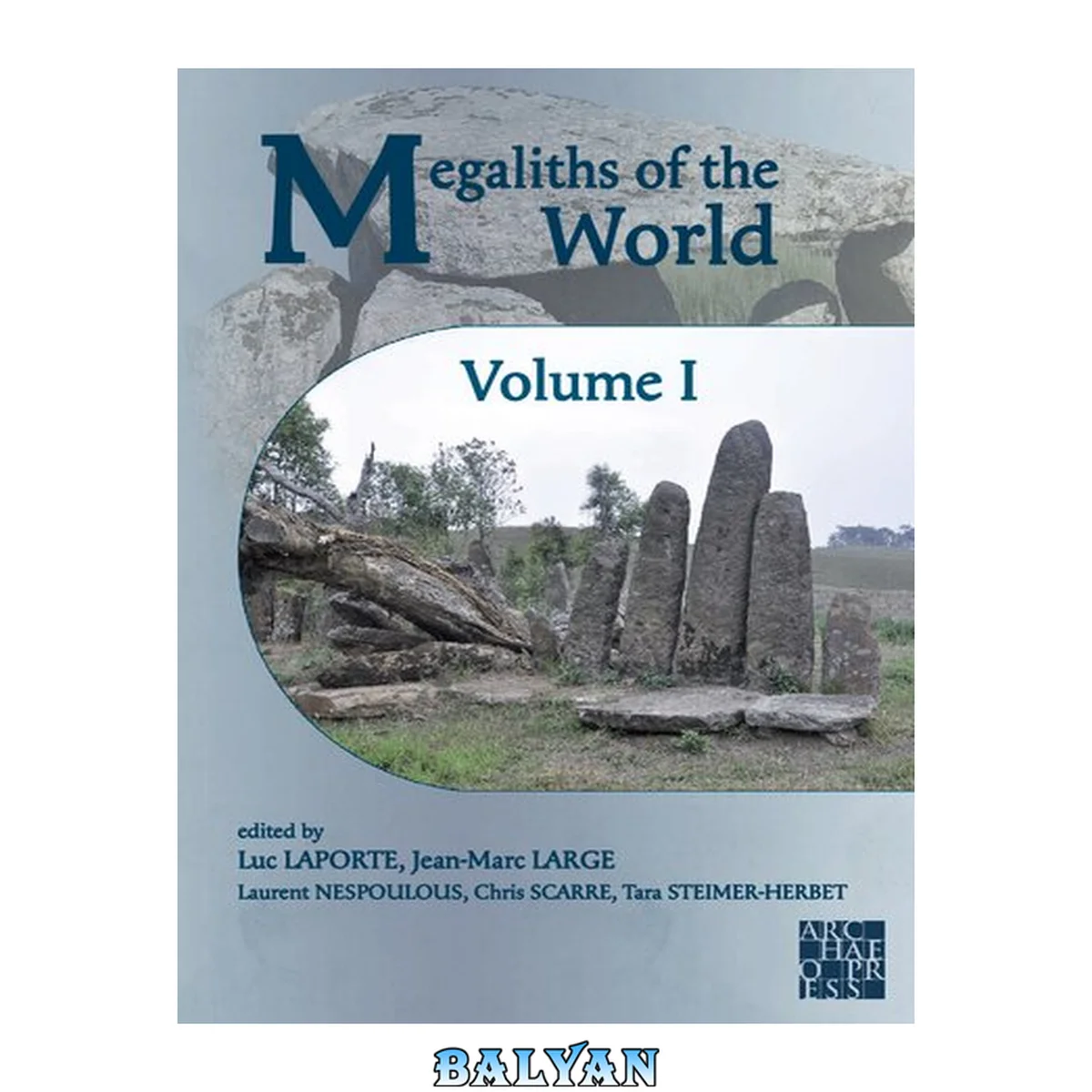
معرفی کتاب «Megaliths of the World Volume 1 / Volume 1» نوشتهٔ Steven E. Shreve و Edited by Luc Laporte, Jean-Marc Large, Laurent Nespoulous, Chris Scarre, Tara Steimer-Herbet، منتشرشده توسط نشر Archaeopress Archaeology در سال 2022. این کتاب در فرمت pdf، زبان انگلیسی ارائه شده است.
Bringing together the latest research on megalithic monuments throughout the world, 150 researchers offer 72 articles, providing a region-by region account in their specialist areas, and a summary of the current state of knowledge. Highlighting salient themes, the book is vital to anyone interested in the phenomenon of megalithic monumentality. READ MORE Megaliths of the World brings together the latest research on megalithic monuments throughout the world. Many of these sites are well known, others less familiar, yet equally deserving of close attention. Megalithic monuments in different regions of the world are far from being a single unified phenomenon, having varied chronologies, and diverse origins, but they all share a certain family resemblance through their common characteristic: the deployment of large stones. No fewer than 150 researchers have contributed 72 articles and inserts, providing a vital region-by region account of the megalithic monuments in their specialist areas, and the current state of knowledge. The insights offered in these volumes emphasize the particular character and significance of these apparently inanimate stones. The use of such large blocks must surely have been an expression of power or prestige, yet the size and materiality of the stones themselves opens up new perspectives into the meaning and symbolism of these monuments, the places from which the blocks were derived, and the way they were manipulated and shaped. Megaliths of the World takes the reader on a fascinating journey, offering new insights through encounters with megaliths and megalithic traditions that will often be new and unfamiliar. Highlighting salient themes, it provides a compendium of detailed information that will be vital to anyone interested in the phenomenon of megalithic monumentality. Title Page Copyright Page Table of contents Preface Roger JOUSSAUME Fig. 1 – Poster of the International Meeting on Megalithisms in the World (RIMM). The logo was created by © Florent Large. Introduction Jean-Paul CROS, Sophie CORSON,Jean-Marc LARGE, Luc LAPORTE Fig. 2 – Members of the Steering Committee together on the stage during the International Meeting,Megaliths of the World at the Historial de Vendée (France), September 9 to 4, 9 (Photo: J. Oliver). Fig. 3 – All the participants the International Meeting, Megaliths of the World, on the steps of Historial de Vendée (Photo: Historialde Vendée). Fig. 4 – Visit to one of the menhirs from Le Plessis (a) and the dolmenof La Frébouchère (b), Vendée (Photos: S. Labroche). Part I Megaliths 1 From the architectural project to megalithic ruins:a dynamic vision of ‘petrified’ remains Luc LAPORTE 2 Megalithism and monumentalism:a plea for broadening the debate Alain GALLAY (†) 3 From the rock throne to the burial chamber.History, myths and megaliths in Japan François MACÉ, Laurent NESPOULOUS 4 Megalithic genesis:construction of a cultural identityfor better goods circulation Tara STEIMER-HERBET 5 Stones in the landscape: Megalithic monumentsin their wider setting Chris SCARRE Authors Bibliography Part II Megaliths in America Introduction José R. OLIVER, Luc LAPORTE 6 Pre-Colombian megalithsof the Caribbean: bateyes and plazasof the Greater Antilles José R. OLIVER 7 Megaliths of the Colombian Andes:Boyacá, Sierra Nevada del Cocuy andSan Agustín José R. OLIVER 8 The Late Holocene Megalithic Structuresat Easternmost Amazonia João DARCY DE MOURA SALDANHA From stone to dust: ceramics and megalithism in Amapá (Brazil) Marina DA SILVA COSTA 9 Non-funerary megalithism among mobilehunter-gatherers and shepherds:Tulán-52 and Tulán-54(Atacama Desert, Chile) Catherine PERLÈS, Lautaro NÚÑEZ Authors Bibliography Part III Megaliths from Easter Island to Indonesia Fig. 1 – Huahine (Society Islands, French Polynesia), marae (altars and terraces) of Maeva, partially built on the lagoon, which isitself part of the monumental structure Introduction Nicolas CAUWE, Tara STEIMER-HERBET 10 Aboriginal monumental stone-workingin Northern Australiaduring the Pleistocene Chris URWIN, Bruno DAVID, Jean-Jacques DELANNOY,Joshua A. BELL, Jean-Michel GENESTE 11 Megalithismin Eastern Polynesia Nicolas CAUWE 12 Megalithic architecturesin a world of oceanic‘little islands (Micro-nesia)’ Christophe SAND 13 Mechanisms of appearance anddisappearance of Indonesian megaliths Tara STEIMER-HERBET 14 Menhirs of Tana Toraja (Indonesia) :a preliminary ethnoarchaeologicalassessment Ron ADAMS, Guillaume ROBIN 15 Megaliths on Sumatra andNias (Indonesia): Concepts of ‘value’behind the making of stone monuments Dominik BONATZ 16 The social context of megalithic practice:an ethnoarchaeological approach.What the case of the Indonesian islandof Sumba teaches us Christian JEUNESSE Megalithic techniques at Sumba Island (Indonesia):from quarries to abandonment Noisette BEC DRELON, Christian JEUNESSE 17 Setting the wider frame. A comparison of recent megalith buildingtraditions in Sumba (Indonesia) and Nagaland (India) Maria WUNDERLICH Authors Bibliography Part IV Megaliths from India and Southeastern Asia Introduction Rabindra Kumar MOHANTY, Johannes MÜLLER 18 Megalithic culturesin Southern Asia Rabindra Kumar MOHANTY 19 Megalithic architecturesin India Rabindra Kumar MOHANTY 20 Northeast Indian megaliths: Monuments and social structures Tiatoshi JAMIR, Johannes MÜLLER 21 Megalithic monuments of Jharkhand:Archaeology and ethnography Himanshu SHEKHAR, Rabindra Kumar MOHANTY 22 The stone jarsof Southeast Asia and Northeast India:Problems and prospects Tilok THAKURIA 23 The dolmens of Karachi, Sindh (Pakistan Zulfiqar Ali KALHORO 24 Megaliths in Vidarbha region(India) Rabindra Kumar MOHANTY Mahurjhari Megalithic Site(India) Rabindra Kumar MOHANTY BhagimohariMegalithic Site (India) Rabindra Kumar MOHANTY 25 Distributions and disparities in the megalithic burials of Vidarbha (India): a scrutiny Virag SONTAKKE Fig. 1 – Zone based classification of Vidarbha Megaliths Fig. 2 – Cartographic distribution of burial sites in Zone A Fig. 3 – Stone circle at Nipani-Thugaon, Nagpur Fig. 4 – Cairn at Dharti-Murti, Nagpur Fig. 5 – Cartographic distribution of burial sites in Zone B Fig. 6 – Malli, Gondia Fig. 7 – Zone-based variations in typology Fig. 8 – Characteristic features of megaliths in Zone A and Zone B. 26 Social organisationof the megalithic people in Vidarbha,Maharashtra (India) Shantanu VAIDYA, Rabindra Kumar MOHANTY 27 Situating megalithic monumentsin Tamil Nadu: Content and context K. RAJAN Authors Bibliography Volume I Résumés Part V Megalithsfrom Central andEast Asia Introduction Laurent NESPOULOUS, Anke HEIN Fig. 1 – The crescent-shaped cultural-communication belt Fig. 2– Megaliths of the Peinan culture, Taiwan Fig. 3 – Natural stone blocks arranged in the garden of the Suwa residence’s archaeological site in the medieval town of Ichijodani 28 Monuments in the mountains:The megalithic gravesof western China Anke HEIN Fig. 1 – Overview mapof the research area andits location withinChina Fig. 2 – Graves in the Anning River Valley by type Fig. 3 – Megalithic grave at Daba Hongmiao Fig. 5 – a. Megalithic grave Wanao M ;b. Detail of wall construction of megalithicgrave at Huangshui Fig. 6 – External additions Fig. 7 – Xide Lake Sihe M Fig. 8 – Megalithic graveat Dayangdui Fig. 9 – Xichang Xijiao Gongshe M Fig. 10 – Megalithic grave Guadi M Fig. 11 – Type 1 megalithic grave Dechang Arong M4 Fig. 12 – Type 2 megalithic grave Dechang Arong M3 Fig. 13 – Type 3 megalithic grave Xichang Dayangdui DM1 Fig. 14 – Type 4 megalithic grave Tianwangshan M10 ( Fig. 15 – The interred by number Fig. 16 – Skeleton positions Fig.17 – Interment types Fig. 18 – Number of objects per grave Fig. 19 – Frequency of different object types Fig. 20 – Ceramic vessel types from megalithic graves Fig. 21 – Metal objects from megalithic graves 29 Prehistoric cairns and dolmens in Manchuria (China) Kazuo MIYAMOTO Fig. 1 – Regional divisions based on subsistence activities in East Asia Fig. 2 – Location ofNiuheliang site(Hongshan culture) andSipingshan site in theLiaodong Peninsula Fig. 3 – Grave Cluster , Nieuheliang Fig. 4 – Cairn 1 of Grave Cluster 2, Niuheliang Fig. 5 – Cairn 2 of Grave Cluster 2, Niuheliang Fig. 6 – Cairn 4 of Grave Cluster 2, Niuheliang Fig. 7 – Burial 5 in Cairn 4 of Grave Cluster 2, Niuheliang Fig. 8 – Distribution of cairns at Sipingshan Fig. 9 – Stone structure of Cairn 35 at Sipingshan Fig. 10 – Grave goods in Cairn 36, Burial P, Sipingshan Fig. 11 – Chronology of red pottery at Sipingshan Fig. 12 – Combination of grave pottery in burial pitsat Sipingshan Fig. 13 – Jade found in burial pits at Sipingshan Fig. 14 – Social ranking indicated by the combination of grave goods in burial pits at Sipingshan Fig. 15 – Location of cairns at Sipingshan. The colour keyrelates to social ranking Fig. 16 – Process of development of cairns at Sipingshan. The colour key relates to social ranking Fig. 17 – Bronze Age cultural groups and their genealogical relationships in East Asia Fig. 18 – Distribution map of dolmens in the Liaodong district Fig. 19 – Type A table-typedolmens in the LiaodongPeninsula Fig. 20 – Type B table-type dolmens in the LiaodongPeninsula Fig. 21 – Type C table-type dolmens in the Liaodong Peninsula Fig. 22 – Ratio of length and width of inner stone cists of table-type dolmens in the Liaodong Peninsula Fig. 23 – Type A table-type dolmens in the inner Liaodong district Fig. 24 – Ratio of length and width of inner stone cists of table-type dolmens in the inner Liaodong district 30 Dolmens and societiesin the Korean Peninsula Daisuke NAKAMURA Fig. 1 – Distribution of a) dolmens and b) placenames Fig. 2 – The number of dolmens inthe Korean Peninsula Fig. 3 – Main variations in dolmen architecture in the Korean Peninsula Fig. 4 – Dolmens in North Korea: Fig. 5 – Dolmens in the Yeongdong and Yeongseo regions Fig. 6 – Capstone size in Ganghwa and Gochang dolmens Fig. 7 –Dolmens in the Gyeonggi and Honam regions Fig. 8 – Dolmens in the Yeosu Peninsula Fig. 9 – Dolmens in the Yeongnam region Fig. 10 – Burials and artefacts of Songgukri culture and clay band-rim pottery culture 31 Dolmens of the Korean Peninsula: Conservation and utilizationin Hoseo (South Korea) Joon-ho SON Fig. 1 – Distribution of excavated dolmens in Hoseo Fig. 2 – The conservation statusof dolmens non-designated ascultural properties in Hoseo Fig. 3 – The conservation state of non-designated dolmens either relocated or in situ in Hoseo Fig. 4 – The conservation statusof dolmens designated ascultural properties in Hoseo Fig. 5 – The conservation statusof dolmens designated ascultural properties in Hoseo Fig. 6 – The conservation state of designated dolmens in Hoseo 32 The development of stone art culturein ancient Korea Takafumi YAMAMOTO 33 From megalithic contexts in the Japanesearchipelago, to megalithism as a context: Reflections for consideration,from the first sedentary societiesto the first State societies Laurent NESPOULOUS 34 Prehistoric and protohistoric megalithsof the Japanese archipelago Yoshio KIKUCHI 35 Bronze Age and Iron Age decoratedmegaliths and funerary complexes inMongolia and Southern Siberia Jérôme MAGAIL, Yuri ESIN,Jamiyan-Ombo GANTULGA, Fabrice MONNA,Tanguy ROLLAND, Anne-Caroline ALLARD Digital 3D documentationof the Tamchinsky deer stone Vladislav KAZAKOV, Vasily KOVALEV,Kair ZHUMADILOV, Lyudmila LBOVA,Aleksandr SIMUKHIN 36 Megalithic traditions in the Early BronzeAge of the Mongolian Altai:the Chemurchek (Qie’muerqieke)cultural phenomenon Alexey KOVALEV Authors Bibliography Part VI Megaliths from Caucasus to the Arabic Peninsula Introduction Tara STEIMER-HERBET, Viktor TRIFONOV 37 In the shadow of monoliths. Göbekli Tepe and the monumental traditionof the Pre-Pottery Levant Rémi HADAD 38 The Bronze Age megaliths in the Caucasus:development trajectory of the architectureand the funeral practice Viktor TRIFONOV 39 The dolmens of the Balkans Georgi NEKHRIZOV, Stanislav ILIEV 40 At the intersection of continents: Megalithism in Turkey Bakiye YÜKMEN EDENS 41 Untangling megalith typologies andchronologies in the Levant James FRASER 42 Protohistoric cairns andtower tombs in South-Eastern Arabia(end of the 4th - beginningof the 3rd millennium BCE) Olivia MUNOZ 43 Megalithismin the Middle East Tara STEIMER-HERBET Authors Bibliography Part VII African Megaliths Introduction Jean-Paul CROS, Luc LAPORTE 44 Megaliths of Africa:an overview Alain GALLAY (†) 45 The Horn of Africa:five millennia of megalithism Jean-Paul CROS 46 Pastoral Neolithic ‘pillar sites’of northwestern Kenya Elisabeth HILDEBRAND, Katherine M. GRILLO 47 Megalithsin Madagascar Mike PARKER PEARSON 48 Megaliths of Nigeria: the footprints of ancient civilization Abu Solomon EDET, Abubakar SULE SANI 49 Megaliths from Senegal and The Gambiain their regional context Luc LAPORTE, Hamady BOCOUM,Adrien DELVOYE, Jean-Paul CROS,Selim DJOUAD, Matar NDIAYE,Aziz BALLOUCHE, Pierre LAMOTTE,Mathilde STERN, Abdoulaye NDIAYE,Laurent QUESNEL Earthern architectures and megalithism:the Soto monument (Senegal) Adrien DELVOYE, Khady THIAW, Marylise ONFRAY,Matar NDIAYE, Philippe GOUÉZIN, Abdoulaye NDIAYE,Vivien MATHÉ, Tioro BA, Christian CAMERLYNCK,Sire NDIAYE, Adrien CAMUS, Philippe BOULINGUIEZ,Leonor ROCHA, Pierre LAMOTTE, Aziz BALLOUCHE,Hamady BOCOUM, Luc LAPORTE 50 Types of monumentalism and burial ritesof the central and eastern Sahara Alain GALLAY (†) 51 Neolithic monuments with standing stonesin the northwestern Sahara Robert VERNET 52 The megalithic necropolisesof the eastern Maghreb Joan SANMARTÍ Authors Bibliography Part VIII European Megaliths Introduction Chris SCARRE Larger than life: monumentality of the landscape andnon-human imagery at Lepenski(Serbia) Dušan BORIĆ 54 On the Atlantic shores. The origin of megaliths in Europe? Luc LAPORTE, Primitiva BUENO RAMÍREZ Standing stones and sepulchral stone assemblies. Towards a convergence in thinking. The example of the megaliths in the Morbihandepartment, France Philippe GOUÉZIN 55 First monumentalities in Western Europe:the necropolis of Fleury-sur-Orne, ‘Les Hauts de l’Orne’(Normandy, France) Emmanuel GHESQUIÈRE, Philippe CHAMBON,David GIAZZON, Corinne THÉVENET,Aline THOMAS 56 Early monumentality in northern Europe Johannes MÜLLER, Karl-Göran SJÖGREN Old bones or early graves? A brief summary of megalithic burial sequencesin southern Sweden based on radiocarbon dating Malou BLANK 57 Beyond comparison: the diversity of megalith building Richard BRADLEY 58 Megaliths from north and northwestFrance, Britain and Ireland Chris SCARRE, Luc LAPORTE The clay binder: a link between megalithic funerary architecture and monumental non-megalithic architecture based onexamples from Champagne (France) Vincent DESBROSSE, Julia WATTEZ aDNA and kinship in French Atlantic façademegalithic monuments Olivia CHERONET, Daniel FERNANDES, Iñigo OLALDE,Nadin ROHLAND, Ludovic SOLER, Jean-Paul CROS,Jean-Marc LARGE, Chris SCARRE, Roger JOUSSAUME,David REICH, Luc LAPORTE, Ron PINHASI Secrets in the stones: examining the presenceof stones with inclusions in the passage tombsof Atlantic Europe Patricia KENNY A study of 26 Irish prehistoric stone circlesand their inbuilt sunrise calendars Terence MEADEN 59 Mediterranean megalithism: a long-term history Jean GUILAINE The megalithic monument of Uzès(Gard, south of France) Marie BOUCHET, Philippe CAYN, Christian SERVELLE 60 Megalithism versus cyclopeism: the case of prehistoric Menorca(Balearic Islands, Spain) Cristina BRAVO ASENSIO, Irene RIUDAVETS GONZÁLEZ 61 Small is Beautiful: Early megalithism and the first funeraryarchitectures in south-central Portugal(southwestern Iberia) Marco António ANDRADE, Rui MATALOTO,André PEREIRA 62 Megalithic art: Funeral scenariosin western Neolithic Europe Primitiva BUENO RAMÍREZ, Rosa BARROSO BERMEJO,Rodrigo de BALBÍN BEHRMANN Don Bosco: a new Final Neolithic megalithiccemetery at Sion (Valais-Switzerland) Manuel MOTTET Authors Bibliography Conclusion Luc LAPORTE Volume II Résumés __Megaliths of the World__ brings together the latest research on megalithic monuments throughout the world. Many of these sites are well known, others less familiar, yet equally deserving of close attention. Megalithic monuments in different regions of the world are far from being a single unified phenomenon, having varied chronologies, and diverse origins, but they all share a certain family resemblance through their common characteristic: the deployment of large stones. No fewer than 150 researchers have contributed 72 articles and inserts, providing a vital region-by region account of the megalithic monuments in their specialist areas, and the current state of knowledge. The insights offered in these volumes emphasize the particular character and significance of these apparently inanimate stones. The use of such large blocks must surely have been an expression of power or prestige, yet the size and materiality of the stones themselves opens up new perspectives into the meaning and symbolism of these monuments, the places from which the blocks were derived, and the way they were manipulated and shaped. __Megaliths of the World__ takes the reader on a fascinating journey, offering new insights through encounters with megaliths and megalithic traditions that will often be new and unfamiliar. Highlighting salient themes, it provides a compendium of detailed information that will be vital to anyone interested in the phenomenon of megalithic monumentality. Megaliths of the World brings together the latest research on megalithic monuments throughout the world. Many of these sites are well known, others less familiar, yet equally deserving of close attention. Megalithic monuments in different regions of the world are far from being a single unified phenomenon, having varied chronologies, and diverse origins, but they all share a certain family resemblance through their common characteristic: the deployment of large stones. No fewer than 150 researchers have contributed 72 articles and inserts, providing a vital region-by region account of the megalithic monuments in their specialist areas, and the current state of knowledge.0The insights offered in these volumes emphasize the particular character and significance of these apparently inanimate stones. The use of such large blocks must surely have been an expression of power or prestige, yet the size and materiality of the stones themselves opens up new perspectives into the meaning and symbolism of these monuments, the places from which the blocks were derived, and the way they were manipulated and shaped.0Megaliths of the World takes the reader on a fascinating journey, offering new insights through encounters with megaliths and megalithic traditions that will often be new and unfamiliar. Highlighting salient themes, it provides a compendium of detailed information that will be vital to anyone interested in the phenomenon of megalithic monumentality
دانلود کتاب Megaliths of the World Volume 1 / Volume 1