Mathematics for Social Justice: Resources for the College Classroom (Classroom Resource Materials) (Classroom Resource Materials, 60)
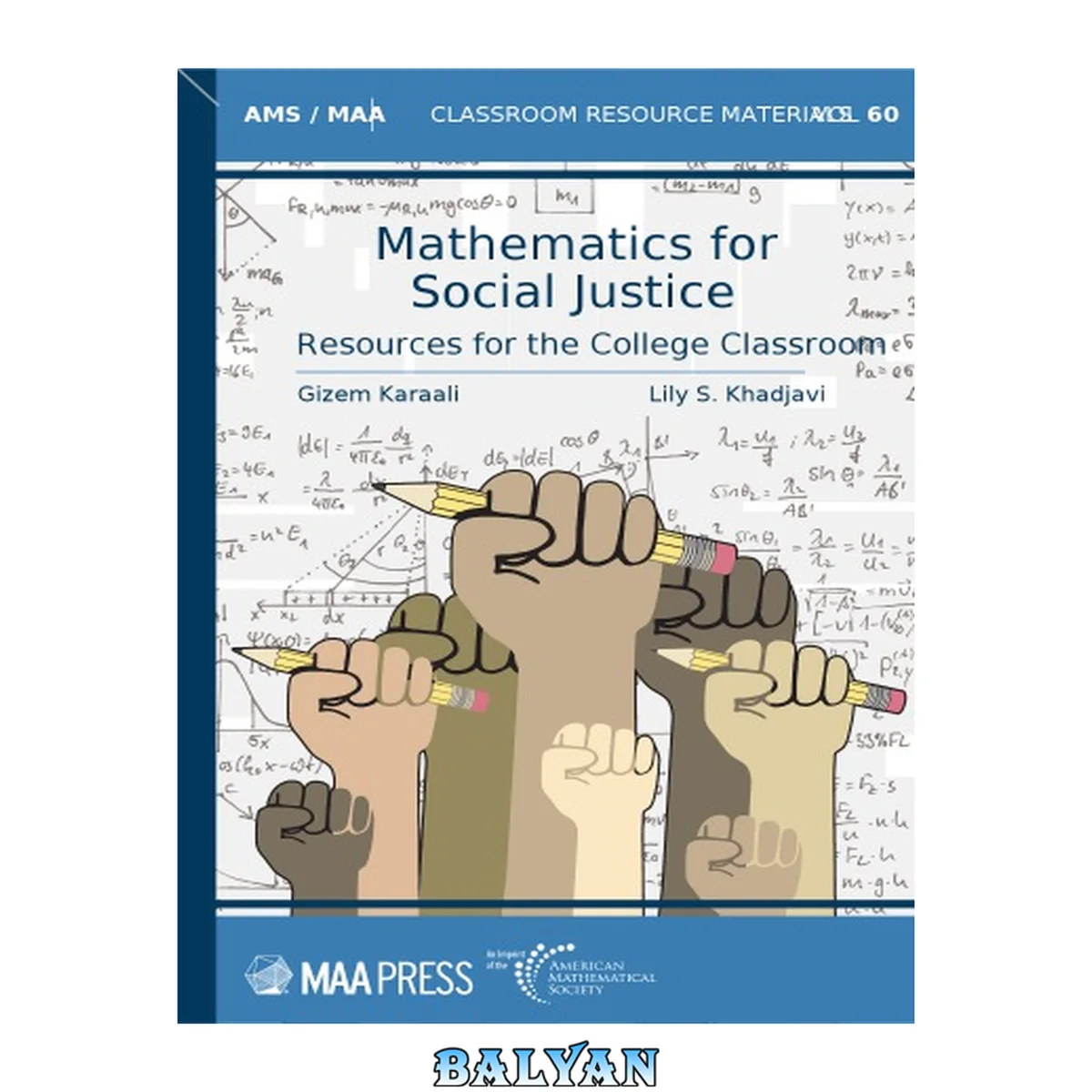
معرفی کتاب «Mathematics for Social Justice: Resources for the College Classroom (Classroom Resource Materials) (Classroom Resource Materials, 60)» نوشتهٔ Gizem Karaali, Lily S. Khadjavi، منتشرشده توسط نشر AMS/MAA Press در سال 2019. این کتاب در فرمت pdf، زبان انگلیسی ارائه شده است.
"Mathematics for Social Justice offers a collection of resources for mathematics faculty interested in incorporating questions of social justice into their classrooms. The book begins with a series of essays from instructors experienced in integrating social justice themes into their pedagogy; these essays contain political and pedagogical motivations as well as nuts-and-bolts teaching advice. The heart of the book is a collection of fourteen classroom-tested modules featuring ready-to-use activities and investigations for the college mathematics classroom. The mathematical tools and techniques used are relevant to a wide variety of courses including college algebra, math for the liberal arts, calculus, differential equations, discrete mathematics, geometry, financial mathematics, and combinatorics. The social justice themes include human trafficking, income inequality, environmental justice, gerrymandering, voting methods, and access to education. The volume editors are leaders of the national movement to include social justice material into mathematics teaching. Gizem Karaali is Associate Professor of Mathematics at Pomona College. She is one of the founding editors of The Journal of Humanistic Mathematics, and an associate editor for The Mathematical Intelligencer and Numeracy ; she also serves on the editorial board of the MAA's Carus Mathematical Monographs. Lily Khadjavi is Associate Professor of Mathematics at Loyola Marymount University and is a past co-chair of the Infinite Possibilities Conference. She has served on the boards of Building Diversity in Science, the Barbara Jordan-Bayard Rustin Coalition, and the Harvard Gender and Sexuality Caucus."-- Page 4 de la couverture Cover1 Title page5 Copyright6 Contents7 Preface9 Part A Getting Started11 Chapter 1. An Invitation to Mathematics for Social Justice (Gizem Karaali and Lily S. Khadjavi)13 Part B Essays27 Chapter 2. Mathematics in Service to Democracy (Kira Hamman)29 Chapter 3. Preparing for Student Resistance: Rules of Engagement for Sensitive Topics (Lisa Marano)33 Chapter 4. Social Justice and Sustainability: Two Perspectives on the Same System (Jason Hamilton and Thomas J. Pfaff)43 Chapter 5. Quantitative Ethics (Victor Piercey)53 Chapter 6. Math for Social Justice: A Last Math Class for Responsible Citizens (Dave Kung)61 Part C Modules67 Chapter 7. Sea Level Change and Function Composition (Dawn Archey)69 Chapter 8. Exploring the Problem of Human Trafficking (Julie Beier)83 Chapter 9. Evaluating Fairness in Electoral Districting (Geoffrey Buhl and Sean Q Kelly)101 Chapter 10. Modeling the 2010 Gulf of Mexico Oil Spill (Steve Cohen and Melanie Pivarski)115 Chapter 11. Voting with Partially-Ordered Preferences (John Cullinan and Samuel Hsiao)133 Chapter 12. Implementing Social Security: A Historical Role-Playing Game (John Curran and Andrew Ross)149 Chapter 13. Matching Kids to Schools: The School Choice Problem (Julie Glass and Gizem Karaali)165 Chapter 14. Modeling the 2008 Subprime Mortgage Crisis in the United States (Bárbara González-Arévalo and Wanwan Huang)181 Chapter 15. Using Calculus to Model Income Inequality (Bárbara González-Arévalo and Wilfredo Urbina-Romero)193 Chapter 16. What Does Fair Mean? (Kira Hamman)203 Chapter 17. Social and Environmental Justice Impacts of Industrial Agriculture (Amy Henderson and Emek Köse)217 Chapter 18. Student Loans: Fulfilling the American Dream or Surviving a Financial Nightmare? (Reem Jaafar)231 Chapter 19. Modeling Social Change: The Rise in Acceptance of Same-Sex Relationships (Angela Vierling-Claassen)247 Chapter 20. Sustainability Analysis of a Rural Nicaraguan Coffee Cooperative (John Zobitz, Tracy Bibelnieks, and Mark Lester)259 Postscript283 Back Cover "Mathematics for Social Justice offers a collection of resources for mathematics faculty interested in incorporating questions of social justice into their classrooms. The book begins with a series of essays from instructors experienced in integrating social justice themes into their pedagogy; these essays contain political and pedagogical motivations as well as nuts-and-bolts teaching advice. The heart of the book is a collection of fourteen classroom-tested modules featuring ready-to-use activities and investigations for the college mathematics classroom. The mathematical tools and techniques used are relevant to a wide variety of courses including college algebra, math for the liberal arts, calculus, differential equations, discrete mathematics, geometry, financial mathematics, and combinatorics. The social justice themes include human trafficking, income inequality, environmental justice, gerrymandering, voting methods, and access to education. The volume editors are leaders of the national movement to include social justice material into mathematics teaching. Gizem Karaali is Associate Professor of Mathematics at Pomona College. She is one of the founding editors of The Journal of Humanistic Mathematics, and an associate editor for The Mathematical Intelligencer and Numeracy ; she also serves on the editorial board of the MAA's Carus Mathematical Monographs. Lily Khadjavi is Associate Professor of Mathematics at Loyola Marymount University and is a past co-chair of the Infinite Possibilities Conference. She has served on the boards of Building Diversity in Science, the Barbara Jordan-Bayard Rustin Coalition, and the Harvard Gender and Sexuality Caucus."--Amazon.com
دانلود کتاب Mathematics for Social Justice: Resources for the College Classroom (Classroom Resource Materials) (Classroom Resource Materials, 60)