Mathematical Methods in Quantum Mechanics: With Applications to Schrödinger Operators
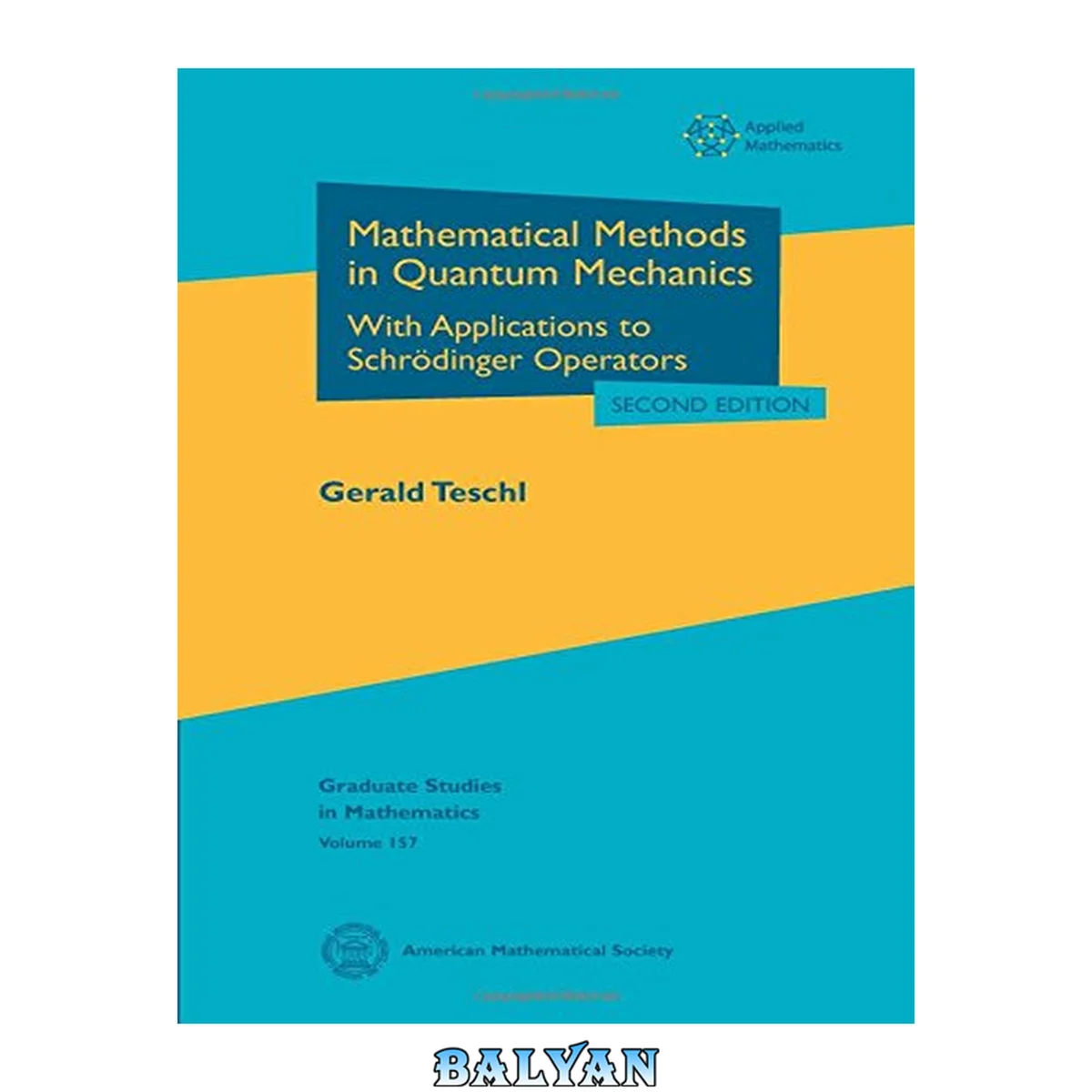
معرفی کتاب «Mathematical Methods in Quantum Mechanics: With Applications to Schrödinger Operators» نوشتهٔ Catharina Maura و Gerald Teschl، منتشرشده توسط نشر American Mathematical Society در سال 2014. این کتاب در فرمت pdf، زبان انگلیسی ارائه شده است.
Quantum mechanics and the theory of operators on Hilbert space have been deeply linked since their beginnings in the early twentieth century. States of a quantum system correspond to certain elements of the configuration space and observables correspond to certain operators on the space. This book is a brief, but self-contained, introduction to the mathematical methods of quantum mechanics, with a view towards applications to Schrodinger operators. Part 1 of the book is a concise introduction to the spectral theory of unbounded operators. Only those topics that will be needed for later applications are covered. The spectral theorem is a central topic in this approach and is introduced at an early stage. Part 2 starts with the free Schrodinger equation and computes the free resolvent and time evolution. Position, momentum, and angular momentum are discussed via algebraic methods. Various mathematical methods are developed, which are then used to compute the spectrum of the hydrogen atom. Further topics include the nondegeneracy of the ground state, spectra of atoms, and scattering theory. This book serves as a self-contained introduction to spectral theory of unbounded operators in Hilbert space with full proofs and minimal prerequisites: Only a solid knowledge of advanced calculus and a one-semester introduction to complex analysis are required. In particular, no functional analysis and no Lebesgue integration theory are assumed. It develops the mathematical tools necessary to prove some key results in nonrelativistic quantum mechanics. Mathematical Methods in Quantum Mechanics is intended for beginning graduate students in both mathematics and physics and provides a solid foundation for reading more advanced books and current research literature. This new edition has additions and improvements throughout the book to make the presentation more student friendly. Contents 5 Preface 9 Part 0. Preliminaries 13 Chapter 0. A first look at Banach and Hilbert spaces 15 0.1. Warm up: Metric and topological spaces 15 0.2. The Banach space of continuous functions 26 0.3. The geometry of Hilbert spaces 33 0.4. Completeness 38 0.5. Bounded operators 39 0.6. Lebesgue Lp spaces 42 0.7. Appendix: The uniform boundedness principle 50 Part 1. Mathematical Foundations of Quantum Mechanics 53 Chapter 1. Hilbert spaces 55 1.1. Hilbert spaces 55 1.2. Orthonormal bases 57 1.3. The projection theorem and the Riesz lemma 61 1.4. Orthogonal sums and tensor products 64 1.5. The C* algebra of bounded linear operators 66 1.6. Weak and strong convergence 67 1.7. Appendix: The Stone–Weierstraß theorem 71 Chapter 2. Self-adjointness and spectrum 75 2.1. Some quantum mechanics 75 2.2. Self-adjoint operators 78 2.3. Quadratic forms and the Friedrichs extension 88 2.4. Resolvents and spectra 95 2.5. Orthogonal sums of operators 101 2.6. Self-adjoint extensions 103 2.7. Appendix: Absolutely continuous functions 107 Chapter 3. The spectral theorem 111 3.1. The spectral theorem 111 3.2. More on Borel measures 123 3.3. Spectral types 129 3.4. Appendix: Herglotz–Nevanlinna functions 131 Chapter 4. Applications of the spectral theorem 143 4.1. Integral formulas 143 4.2. Commuting operators 147 4.3. Polar decomposition 150 4.4. The min-max theorem 151 4.5. Estimating eigenspaces 153 4.6. Tensor products of operators 155 Chapter 5. Quantum dynamics 157 5.1. The time evolution and Stone's theorem 157 5.2. The RAGE theorem 162 5.3. The Trotter product formula 167 Chapter 6. Perturbation theory for self-adjoint operators 169 6.1. Relatively bounded operators and the Kato–Rellich theorem 169 6.2. More on compact operators 172 6.3. Hilbert–Schmidt and trace class operators 175 6.4. Relatively compact operators and Weyl's theorem 182 6.5. Relatively form-bounded operators and the KLMN theorem 186 6.6. Strong and norm resolvent convergence 191 Part 2. Schrödinger Operators 197 Chapter 7. The free Schrödinger operator 199 7.1. The Fourier transform 199 7.2. Sobolev spaces 206 7.3. The free Schrödinger operator 209 7.4. The time evolution in the free case 211 7.5. The resolvent and Green's function 213 Chapter 8. Algebraic methods 219 8.1. Position and momentum 219 8.2. Angular momentum 221 8.3. The harmonic oscillator 224 8.4. Abstract commutation 226 Chapter 9. One-dimensional Schrödinger operators 229 9.1. Sturm–Liouville operators 229 9.2. Weyl's limit circle, limit point alternative 235 9.3. Spectral transformations I 243 9.4. Inverse spectral theory 250 9.5. Absolutely continuous spectrum 253 9.6. Spectral transformations II 256 9.7. The spectra of one-dimensional Schrödinger operators 262 Chapter 10. One-particle Schrödinger operators 269 10.1. Self-adjointness and spectrum 269 10.2. The hydrogen atom 270 10.3. Angular momentum 273 10.4. The eigenvalues of the hydrogen atom 277 10.5. Nondegeneracy of the ground state 284 Chapter 11. Atomic Schrödinger operators 287 11.1. Self-adjointness 287 11.2. The HVZ theorem 290 Chapter 12. Scattering theory 295 12.1. Abstract theory 295 12.2. Incoming and outgoing states 298 12.3. Schrödinger operators with short range potentials 301 Part 3. Appendix 305 Appendix A. Almost everything about Lebesgue integration 307 A.1. Borel measures in a nutshell 307 A.2. Extending a premeasure to a measure 315 A.3. Measurable functions 319 A.4. How wild are measurable objects? 321 A.5. Integration — Sum me up, Henri 324 A.6. Product measures 331 A.7. Transformation of measures and integrals 334 A.8. Vague convergence of measures 340 A.9. Decomposition of measures 343 A.10. Derivatives of measures 346 Bibliographical notes 353 Bibliography 357 Glossary of notation 361 Index 365 Quantum mechanics,Spectral Theory,Schroedinger Operators Quantum mechanics and the theory of operators on Hilbert space have been deeply linked since their beginnings in the early twentieth century. States of a quantum system correspond to certain elements of the configuration space and observables correspond to certain operators on the space. This book is a brief, but self-contained, introduction to the mathematical methods of quantum mechanics, with a view towards applications to Schrödinger operators. Part 1 of the book is a concise introduction to the spectral theory of unbounded operators. Only those topics that will be needed for later applications are covered. The spectral theorem is a central topic in this approach and is introduced at an early stage. Part 2 starts with the free Schrödinger equation and computes the free resolvent and time evolution. Position, momentum, and angular momentum are discussed via algebraic methods. Various mathematical methods are developed, which are then used to compute the spectrum of the hydrogen atom. Further topics include the nondegeneracy of the ground state, spectra of atoms, and scattering theory. This book serves as a self-contained introduction to spectral theory of unbounded operators in Hilbert space with full proofs and minimal prerequisites: Only a solid knowledge of advanced calculus and a one-semester introduction to complex analysis are required. In particular, no functional analysis and no Lebesgue integration theory are assumed. It develops the mathematical tools necessary to prove some key results in nonrelativistic quantum mechanics. Mathematical Methods in Quantum Mechanics is intended for beginning graduate students in both mathematics and physics and provides a solid foundation for reading more advanced books and current research literature. This new edition has additions and improvements throughout the book to make the presentation more student friendly. The book is written in a very clear and compact style. It is well suited for self-study and includes numerous exercises (many with hints). —Zentralblatt MATH The author presents this material in a very clear and detailed way and supplements it by numerous exercises. This makes the book a nice introduction to this exciting field of mathematics. —Mathematical Reviews
دانلود کتاب Mathematical Methods in Quantum Mechanics: With Applications to Schrödinger Operators