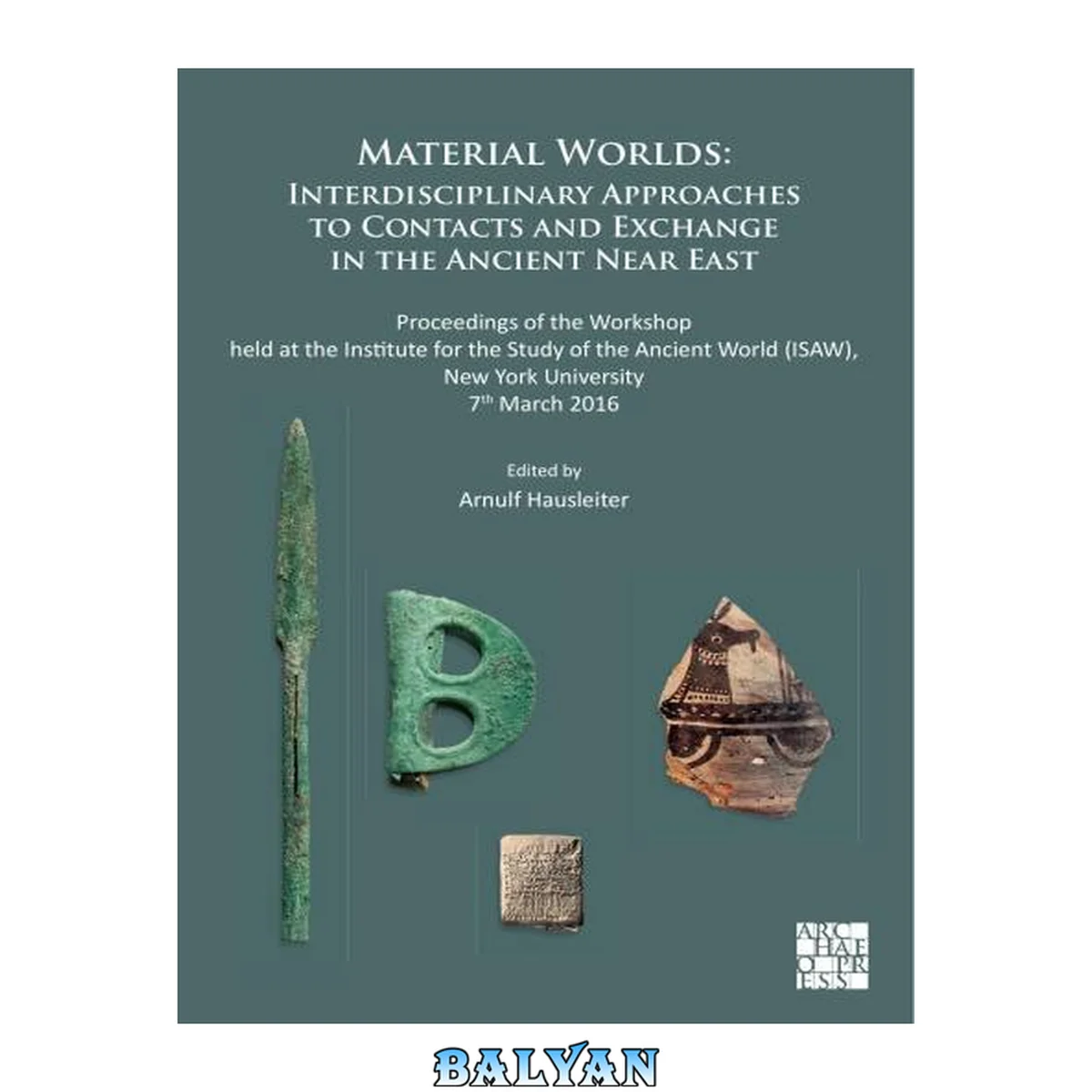
جهانهای مادی: رویکردهای بینرشتهای به تماسها و تبادلها در خاور نزدیک باستان: Proceedings of the Workshop held at the Institute for the Study of the Ancient World (ISAW), New York University, 7th March 2016
Material Worlds: Interdisciplinary Approaches to Contacts and Exchange in the Ancient Near East: Proceedings of the Workshop held at the Institute for the Study of the Ancient World (ISAW), New York University, 7th March 2016
معرفی کتاب «جهانهای مادی: رویکردهای بینرشتهای به تماسها و تبادلها در خاور نزدیک باستان: Proceedings of the Workshop held at the Institute for the Study of the Ancient World (ISAW), New York University, 7th March 2016» (با عنوان لاتین Material Worlds: Interdisciplinary Approaches to Contacts and Exchange in the Ancient Near East: Proceedings of the Workshop held at the Institute for the Study of the Ancient World (ISAW), New York University, 7th March 2016) نوشتهٔ Edited by Arnulf Hausleiter، منتشرشده توسط نشر Archaeopress Archaeology در سال 2023. این کتاب در فرمت pdf، زبان انگلیسی ارائه شده است.
Cultural contacts and exchange are constituents of human behavior – ancient and modern. Within archaeology, particularly in that of Western Asia, the topic and related phenomena have been intensively studied during the last decades, leading to a re-evaluation of the cultural and economic, as well as physical landscapes throughout the ancient Near East. The eleven contributions in this book were delivered at a workshop held in 2016 at NYU’s Institute for the Study of the Ancient World by renowned experts in their fields. They address the history of contacts and exchanges in the Bronze and Iron Ages using case studies from different regions and based on different types of sources. The contributions illustrate that the geographical dimension of cultural contacts and exchange networks within West Asia extends far beyond the boundaries of the previously defined contact zone of the ‘Ancient Near East’ and that other systems existed in adjacent regions (Egypt, Arabia as well as Iran, Central Asia, Africa, India, and South Asia), suggesting that the West Asian networks were also part of larger ones. At the same time, it has become clear that a closer look at single case studies of specific material culture datasets is important to better understand the dynamics, scale(s), and extent of contacts and exchanges. Contributing authors: Gojko Barjamovic (Harvard University), Celia J. Bergoffen (Fashion Institute of Technology, New York), Lorenzo D’Alfonso (NYU, New York), Nancy A. Highcock (The British Museum, London), Robert W. Homsher (San Francisco), Alice M. W. Hunt (University of Georgia, Athens), Marta Luciani (University of Vienna), Maria Grazia Masetti-Rouault (École Pratique des Hautes Études, Paris), Beate Pongratz-Leisten (NYU, New York), Lisa Saladino Haney (Carnegie Museum of Natural History, Pittsburgh), Jonathan Valk (University of Helsinki). Arnulf Hausleiter, MA 1992, PhD 1996 (University of Munich), Habilitation 2012 (Freie Universität Berlin), is scientific officer for the archaeology of the Arabian Peninsula at the German Archaeological Institute’s (DAI) Orient Department. His research interests focus on different aspects of material culture, urban and oasis settlements in their environmental contexts, and cultural contacts. He has been co-directing field projects in Syria, Iraq, Jordan, and Saudi Arabia. Cover 1 Title Page 3 Copyright Page 4 Table of Content 5 Acknowledgements 7 Material Worlds Program 8 Introductory Remarks 9 Arnulf Hausleiter 9 I. Old Assyrian Trade 15 Introduction to the Old Assyrian Trade Session 17 Nancy A. Highcock 17 States, Markets and Overland Trade in the Early And Middle Bronze Age 21 Gojko Barjamovic 21 Dynamism and Scale in Western Asian Bronze Age Trade Networks 29 Lorenzo D’Alfonso and Nancy A. Highcock 29 II. Cuneiform Knowledge Productionin Contact ZonesII. Cuneiform Knowledge Productionin Contact Zones 35 Reflections on the Dynamics of Cuneiform Knowledge Production in the Ancient Near East 37 Jonathan Valk 37 Production of Knowledge in Contact Zones: Mari and Tigunānum in the Old Babylonian Period 41 Beate Pongratz-Leisten 41 III. Transitions and Transformations in the Levant and Northern Arabia 51 The Middle to Late Bronze Age Transition at Tell el-ʿAjjul in the light of exchanges between Cyprus and the Eastern Mediterranean 53 Celia J. Bergoffen 53 Transitions in Material Culture of the 2nd Millennium BCE: The Middle Bronze to Late Bronze Age Shift Seen from Northwest Arabia 61 Marta Luciani 61 Connections and Transformations in the Southern Levant during the 2nd Millennium with a View from Megiddo 87 Robert Homsher 87 IV. Egyptian Red Sea Trade 103 Power and Prestige: Egyptian Red Sea Trade during the Old and Middle Kingdoms and its Place within the Royal Redistributive Network 105 Lisa Saladino Haney 105 V. Middle Grounds, Contact Areas and Social Identity in the Iron Age 121 Middle Grounds, Contact Areas, and the Assyrian Empire: the Case of the Syrian Lower Euphrates Valley, Iron II Period 123 Maria Grazia Masetti-Rouault 123 Tell Jemmeh: Social Identity at a Cultural Crossroads 133 Alice M. W. Hunt 133 Ancient,Near,East;,Bronze,Age;,Iron,Age;,Contacts;,Trade;,Exchange Ancient Near East,Bronze Age,Iron Age,Contacts,Trade,Exchange Cultural contacts and exchange are constituents of human behavior - ancient and modern. Within archaeology, particularly in that of Western Asia, the topic and related phenomena have been intensively studied during the last decades, leading to a re-evaluation of the cultural and economic, as well as physical landscapes throughout the ancient Near East. The eleven contributions in this book were delivered at a workshop held in 2016 at NYU's Institute for the Study of the Ancient World by renowned experts in their fields. They address the history of contacts and exchanges in the Bronze and Iron Ages using case studies from different regions and based on different types of sources. The contributions illustrate that the geographical dimension of cultural contacts and exchange networks within West Asia extends far beyond the boundaries of the previously defined contact zone of the 'Ancient Near East' and that other systems existed in adjacent regions (Egypt, Arabia as well as Iran, Central Asia, Africa, India, and South Asia), suggesting that the West Asian networks were also part of larger ones. At the same time, it has become clear that a closer look at single case studies of specific material culture datasets is important to better understand the dynamics, scale(s), and extent of contacts and exchanges. Contributing authors: Gojko Barjamovic (Harvard University), Celia J. Bergoffen (Fashion Institute of Technology, New York), Lorenzo D'Alfonso (NYU, New York), Nancy A. Highcock (The British Museum, London), Robert W. Homsher (San Francisco), Alice M. W. Hunt (University of Georgia, Athens), Marta Luciani (University of Vienna), Maria Grazia Masetti-Rouault (Ecole Pratique des Hautes Etudes, Paris), Beate Pongratz-Leisten (NYU, New York), Lisa Saladino Haney (Carnegie Museum of Natural History, Pittsburgh), Jonathan Valk (University of Helsinki).