Marx and Engels Collected Works, Volume 35 : Karl Marx - Capital, Volume I
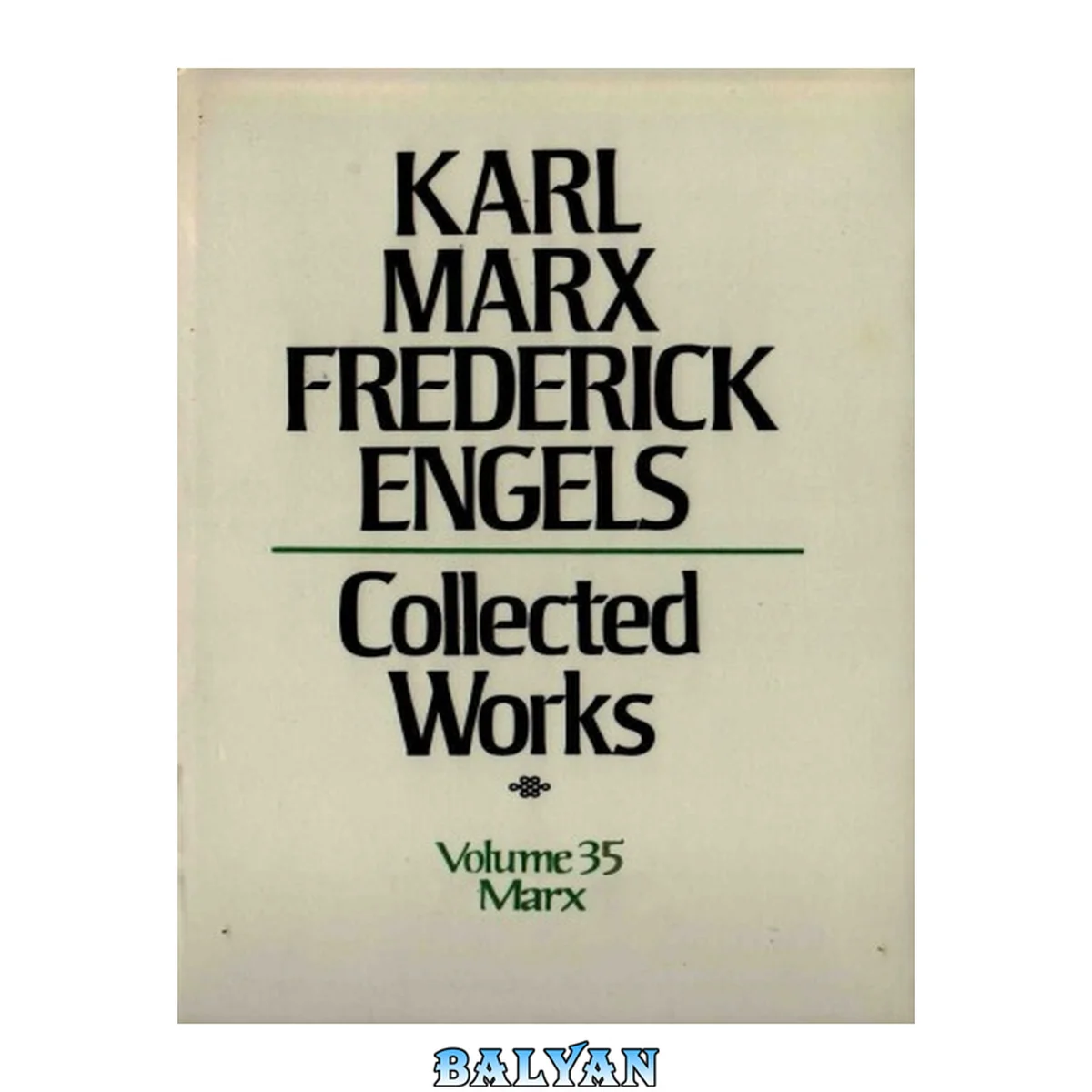
معرفی کتاب «Marx and Engels Collected Works, Volume 35 : Karl Marx - Capital, Volume I» نوشتهٔ Karl Marx و Friedrich Engels، منتشرشده توسط نشر 1996 در سال 1996. این کتاب در 862 صفحه، فرمت pdf، زبان انگلیسی ارائه شده است.
Marx/Engels Collected Works (MECW) is the largest collection of translations into English of the works of Karl Marx and Friedrich Engels. It contains all works published by Marx and Engels in their lifetimes and numerous unpublished manuscripts and letters. The Collected Works, which was translated by Richard Dixon and others, consists of 50 volumes. It was compiled and issued between 1975 and 2005 by Progress Publishers (Moscow) in collaboration with Lawrence and Wishart (London) and International Publishers (New York City). Politics,Marxism Contents 2 Preface to this edition 10 CAPITAL A Critique of Political Economy Volume I 13 Prefaces to editions 17 K. Marx. Preface to the First German Edition 17 K. Marx. Afterword to the Second German Edition 22 K. Marx. Preface to the French Edition 33 K. Marx. Afterword to the French Edition 34 F. Engels. Preface to the Third German Edition 37 F. Engels. Preface to the English Edition 40 F. Engels. Preface to the Fourth German Edition 47 BOOK I THE PROCESS OF PRODUCTION OF CAPITAL 53 PART I COMMODITIES AND MONEY 55 Chapter I.- Commodities 55 Section 1.- The Two Factors of a Commodity: Use Value and Value ( the Substance of Value and the Magnitude of Value) 55 Section 2. - The Twofold Character of the Labour Embodied in Commodities 61 Section 3.- The Form of Value or Exchange Value 67 A. Elementary or Accidental Form of Value 68 1. The Two Poles of the Expression of Value: Relative Form and Equivalent Form 68 2. The Relative Form of Value 69 ( a.) The Nature and Import of This Form 69 ( b.) Quantitative Determination of Relative Value 73 3. The Equivalent Form of Value 75 4. The Elementary Form of Value Considered as a Whole 80 B. Total or Expanded Form of Value 83 1. The Expanded Relative Form of Value 83 2. The Particular Equivalent Form 84 3. Defects of the Total or Expanded Form of Value 84 C. The General Form of Value 85 1. The Altered Character of the Form of Value 86 2. The Interdependent Development of the Relative Form of Value, and of the Equivalent Form 88 3. Transition from the General Form of Value to the Money Form 90 D. The Money Form 90 Section 4.- The Fetishism of Commodities and the Secret Thereof 91 Chapter II.- Exchange 104 Chapter III.- Money, or the Circulation of Commodities 113 Section 1.- The Measure of Values 113 Section 2.- The Medium of Circulation 123 a. The Metamorphosis of Commodities 123 b. The Currency of Money 134 c. Coin and Symbols of Value 145 Section 3.- Money 150 a. Hoarding 150 b. Means of Payment 155 c. Universal Money 163 PART II THE TRANSFORMATION OF MONEY INTO CAPITAL 167 Chapter IV.- The General Formula for Capital 167 Chapter V.- Contradictions in the General Formula of Capital . 176 Chapter VI.- The Buying and Selling of Labour Power 187 PART III THE PRODUCTION OF ABSOLUTE SURPLUS VALUE 197 Chapter VII.- The Labour Process and the Process of Producing Surplus Value 197 Section 1.- The Labour Process or the Production of Use Values 197 Section 2.- The Production of Surplus Value 206 Chapter VIII.- Constant Capital and Variable Capital 219 Chapter IX.- The Rate of Surplus Value 231 Section 1.- The Degree of Exploitation of Labour Power 231 Section 2.- The Representation of the Components of the Value of the Product by Corresponding Proportional Parts of the Product Itself 240 Section 3.- Senior's " Last Hour" 243 Section 4.- Surplus Produce 248 Chapter X.- The Working Day 249 Section 1.- The Limits of the Working Day 249 Section 2.- The Greed for Surplus Labour. Manufacturer and Boyard 24 13 Section 3.- Branches of English Industry Without Legal Limits to Exploitation 261 Section 4.- Day and Night Work. The Relay System 273 Section 5.- The Struggle for a Normal Working Day. Compulsory Laws for the Extension of- the Working Day from the Middle of the 14th to the End of the 17th Century 280 Section 6.- The Struggle for the Normal Working Day. Compulsory Limitation by Law of the Working Time. The English Factory Acts, 1833 to 1864 293 Section 7.- The Struggle for the Normal Working Day. Reaction of the English Factory Acts on Other Countries 312 Chapter XL- Rate and Mass of Surplus Value -. 317 PART IV PRODUCTION OF RELATIVE SURPLUS VALUE 327 Chapter XII.- The Concept of Relative Surplus Value 327 Chapter XIII.- Co- operation 336 Chapter XIV.- Division of Labour and Manufacture 351 Section 1.- Twofold Origin of Manufacture 351 Section 2.- The Detail Labourer and his Implements 354 Section 3. - The Two Fundamental Forms of Manufacture: Heter ogeneous Manufacture, Serial Manufacture 357 Section 4.- Division of Labour in Manufacture, and Division of Labour in Society 366 Section 5.- The Capitalistic Character of Manufacture 374 Chapter XV.- Machinery and Modern Industry 384 Section 1.- The Development of Machinery 384 Section 2.- The Value Transferred by Machinery to the Product 399 Section 3.- The Proximate Effects of Machinery on the Workman 407 a. Appropriation of Supplementary Labour Power by Capital. The Employment of Women and Children 408 b. Prolongation of the Working Day 416 c. Intensification of Labour 422 Section 4.- The Factory 430 Section 5.- The Strife Between Workman and Machine 440 Section 6.- The Theory of Compensation as Regards the Workpeople Displaced by Machinery 450 Section 7.- Repulsion and Attraction of Workpeople by the Factory System. Crises in the Cotton Trade 460 Section 8.- Revolution Effected in Manufacture, Handicrafts, and Domestic Industry by Modern Industry 472 a. Overthrow of Co- operation Based on Handicraft and on the Division of Labour 472 b. Reaction of the Factory System on Manufacture and Domestic Industries 474 c. Modern Manufacture 476 d. Modern Domestic Industry 478 e. Passage of Modern Manufacture, and Domestic Industry into Modern Mechanical Industry. The Hastening of This Revolution by the Application of the Factory Acts to Those Industries 483 Section 9.- The Factory Acts. Sanitary and Educational Clauses of the Same. Their General Extension in England 493 Section 10.- Modern Industry and Agriculture 515 PART V THE PRODUCTION OF ABSOLUTE AND OF RELATIVE SURPLUS VALUE 519 Chapter XVI.- Absolute and Relative Surplus Value 519 Chapter XVII.- Changes of Magnitude in the Price of Labour Power and in Surplus Value 529 I. Length of the Working Day and Intensity of Labour Constant Productiveness of Labour Variable 530 II. Working Day Constant. Productiveness of Labour Constant. Intensity of Labour Variable 534 III. Productiveness and Intensity of Labour Constant. Length of the Working Day Variable 536 IV. Simultaneous Variations in the Duration, Productiveness, and Intensity of Labour 537 ( 1.) Diminishing Productiveness of Labour with a Simultaneous Lengthening of the Working Day 538 ( 2.) Increasing Intensity and Productiveness of Labour with Simultaneous Shortening of the Working Day 540 Chapter XVIII.- Various Formulae for the Rate of Surplus Value 541 PART VI WAGES 545 Chapter XIX.- The Transformation of the Value (and Respectively the Price) of Labour Power into Wages 545 Chapter XX.- Time Wages 552 Chapter XXL- Piece Wages 560 Chapter XXII.- National Differences of Wages 568 PART VII THE ACCUMULATION OF CAPITAL 575 Chapter XXIII.- Simple Reproduction 575 Chapter XXIV.- Conversion of Surplus Value into Capital 588 Section 1.- Capitalist Production on a Progressively Increasing Scale. Transition of the Laws of Property that Characterise Production of Commodities into Laws of Capitalist Appropriation 588 Section 2.- Erroneous Conception, by Political Economy, of Reproduction on a Progressively Increasing Scale 594 Section 3.- Separation of Surplus Value into Capital and Revenue. The Abstinence Theory 597 Section 4.— Circumstances that, Independently of the Proportional Division of Surplus Value into Capital and Revenue,Determine the Amount of Accumulation. Degree of Exploita tion of Labour Power. Productivity of Labour. Growing Dif ference in Amount Between Capital Employed and Capital Consumed. Magnitude of Capital Advanced 605 Section 5.- The So- Called Labour Fund 614 Chapter XXV.- The General Law of Capitalist Accumulation 617 Section 1.- The Increased Demand for Labour Power that Accompanies Accumulation, the Composition of Capital Remaining the Same 617 Section 2.- Relative Diminution of the Variable Part of Capital Simultaneously with the Progress of Accumulation and of the Concentration that Accompanies it 626 Section 3.- Progressive Production of a Relative Surplus Population or Industrial Reserve Army 633 Section 4.- Different Forms of the Relative Surplus Population. The General Law of Capitalistic Accumulation 644 Section 5.- Illustrations of the General Law of Capitalist Accumulation 652 ( a.) England from 1846- 1866 652 ( b.) The Badly Paid Strata of the British Industrial Class 658 ( c.) The Nomad Population 667 ( d.) Effect of Crises on the Best Paid Part of the Working Class 670 ( e.) The British Agricultural Proletariat 675 ( f.) Ireland 698 PART VIII THE SO- CALLED PRIMITIVE ACCUMULATION 714 Chapter XXVI.- The Secret of Primitive Accumulation 714 Chapter XXVII.- Expropriation of the Agricultural Population from the Land 717 Chapter XXVIII.- Bloody Legislation Against the Expropriated, from the End of the 15th Century. Forcing down of Wages by Acts of Parliament 733 Chapter XXIX.- Genesis of the Capitalist Farmer 741 Chapter XXX.- Reaction of the Agricultural Revolution on Industry. Creation of the Home Market for Industrial Capital 743 Chapter XXXI.- Genesis of the Industrial Capitalist 748 Chapter XXXII.- Historical Tendency of Capitalist Accumulation . . 758 Chapter XXXIII.- The Modern Theory of Colonisation 761 NOTES AND INDEXES 775 Notes 775 Name Index 818 Index of Quoted and Mentioned Literature 826 Index of Periodicals 862 Illustrations 775 Title page of the first German edition of Volume 1 of Capital 14 Marx's letter to Lachâtre of March 18, 1872, the facsimile of which is given in the French edition of Volume I of Capital 31 Cover of the first issue of the French edition of Volume I of Capital 35 Title page of the first English edition of Volume I of Capital 41
دانلود کتاب Marx and Engels Collected Works, Volume 35 : Karl Marx - Capital, Volume I