Martin Luther, Volume 3: The Preservation of the Church, 15321546
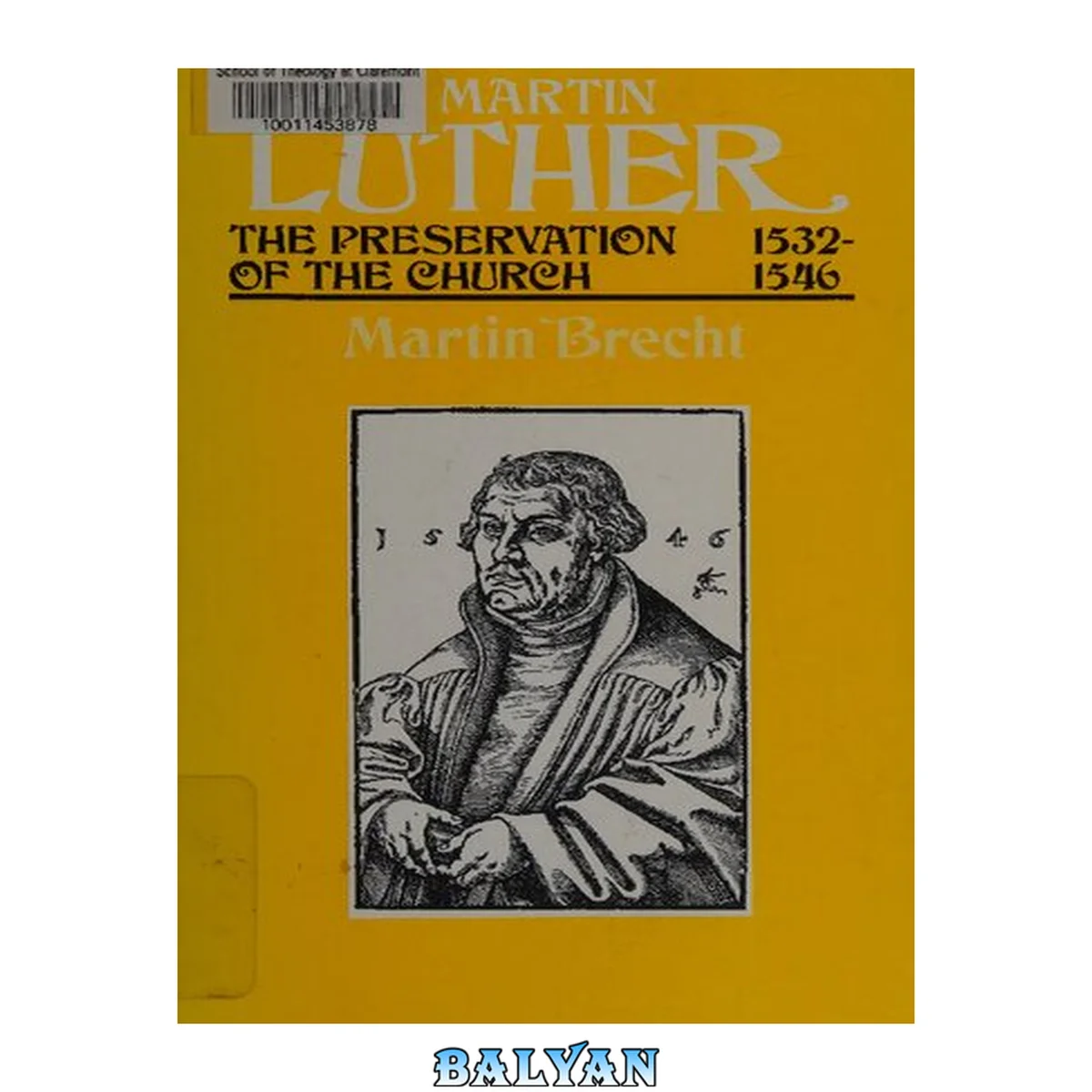
معرفی کتاب «Martin Luther, Volume 3: The Preservation of the Church, 15321546» نوشتهٔ Martin Brecht; translated by James L. Schaaf، منتشرشده توسط نشر Augsburg Fortress Publishing در سال 1999. این کتاب در فرمت pdf، زبان انگلیسی ارائه شده است.
The third volume of Brecht's magnificent biography describes the final fourteen years of Luther's life, beginning with the accession of Elector John Frederick in 1532. The period is often treated briefly because some Reformation developments continued without him, his Catholic opponents paid only partial attention to him, his personality displayed great tensions, and his judgment, errors. Yet the preservation of the churchthose confessing the Reformation gospel being identical, according to Luther, with the truechurchdominated Luther's concerns. A work of immense and engaging scholarship, gracefully translated by James Schaaf, this volume offers comprehensive and original interpretations of Luther's private life, his congregation and the church in Saxony, his professorial lectures and theological controversies, Bible translation, Luther and the council of Trent, and his later writings about the Jews and Turks. With 34 illustrations. Cover Praise Title Copyright Contents Translator’s Preface Foreword SUPPLEMENTARY FOREWORDTO THE ENGLISH EDITION Sources of Illustrations I. Peaceful Beginnings under Elector John Frederick— But with Most of the Old Problems (1532-36) 1. ELECTOR JOHN FREDERICK 2. ELECTORAL SAXONY ANDITS CHURCH 3. WITTENBERG 4. HOME, FAMILY, AND PERSONAL HEALTH II. Luther’s Role in the Reformation’s Progress in Other German Territories, the Agreement onthe Lord’s Supper, and the Relationships with France and England(1532-36) 1. THE REFORMATION IN THE PRINCIPALITY OF ANHALT 2. RELATIONSHIPS WITH OTHER TERRITORIES AND THEIR REFORMATION 3. DEFENSE AGAINST THE MÜNSTER ANABAPTISTS 4. THE AGREEMENT BETWEEN THE SOUTHERN GERMANS AND LUTHER ON THE LORD’S SUPPER IN THE WITTENBERG CONCORD Irritations and Perspectives New Impulses for a Concord The Negotiations in Wittenberg and the Establishment of the Concord Efforts at Getting the Concord Accepted 5. FRANCE AND ENGLAND IlI. Renewed Strife with Old Opponents 1. DUKE GEORGE AND THE REPRESSION OF THE REFORMATION IN DUCAL SAXONY (1532-39) Comfort and Protest in the Face of Persecution Duke George’s Defeat in the Fight against the Reformation 2. THE PRIVATE MASS AND THE CONSECRATION OF PRIESTS 3. ERASMUS AND WITZEL 4. THE INJUSTICE OF ARCHBISHOP ALBRECHT OF MAINZ The Schönitz Affair The Scandal over Simon Lemnius’s Epigrams A Letter Carrier for the High Judge IV. Completing the Translation of the Bible 1. TRANSLATING THE PROPHETS AND THE APOCRYPHA 2. REVISIONS 3. ARGUING WITH THE CRITICS 4. PRAISING AND RECOMMENDING THE BIBLE V. The Professor 1. THE UNIVERSITY: ITS ORGANIZATION AND CONSTITUTION 2. THE ORDINATIONS 3. GRADUATIONS AND DISPUTATIONS 4. THE FINAL LECTURES 5. THE COLLECTED WORKS VI. Theological Controversies in Wittenberg 1. ON THE SIGNIFICANCE OF REPENTANCE IN JUSTIFICATION— THE “CORDATUS CONTROVERSY” 2. THE REPUDIATION OF JACOB SCHENK 3. JOHN AGRICOLA AND THE ANTINOMIAN CONTROVERSY The Onset of the Conflict Disputations and Reconciliations Against the Antinomians The Final Split VII. Luther and the Council (1533-39) 1. INITIAL CATHOLIC PROBES AND EVANGELICAL REACTIONS 2. SUMMONING THE COUNCIL TO MANTUA, LUTHER’S ARTICLES, AND THE SMALCALD ASSEMBLY IN 1537 3. THE ILLNESS 4. CRITICAL PUBLICATIONS AGAINST THE POPE 5. THE FINAL POSITION: ON THE COUNCILS AND THE CHURCHES VIll. The Right of Resistance, Attempts at Peace, the Defection of the Landgrave, and Religious Colloquies (1538-41) 1. NEW DISCUSSIONS ON THE RIGHT OF RESISTANCE 2. THE PEACE NEGOTIATIONS IN FRANKFURT, 1539 3. THE CALAMITOUS BIGAMY OF LANDGRAVE PHILIP The Confessional Advice Melanchthon’s Illness Successfully Preventing Publication of the Confessional Advice 4. THE RELIGIOUS COLLOQUIES AND THEIR EXPECTED FAILURE The Futile Meeting in Hagenau Worms—A Deceptive Hope Against Hanswurst Regensburg—Chance or Patchwork? IX. Personal Affairs (1537-46) 1. ILL, OLD, AND TIRED OF LIVING 2. MARRIAGE, CHILDREN, FAMILY, AND GUESTS 3. HOME, HOUSEHOLD, GARDEN, AND PROPERTY 4. SOCIAL LIFE, FESTIVALS, AND MUSIC X. Luther’s Congregation— Wittenberg (1537-46) 1. THE PREACHER AND PASTOR 2. THE CONGREGATION General Criticism of Morality and Moral Discipline The Chief Evil: Greed and Usury The Crisis XI. Luther’s Church—Electoral Saxony (1537-46) 1. THE RELATIONSHIP TO ELECTORAL SAXON SOCIETY 2. PASTORS AND CONGREGATIONS 3. CHURCH ADMINISTRATION AND CHURCH ORDER Xll. The Progress of the Lutheran Reformation in the German Empire and in Europe 1. THE REFORMATION IN DUCAL SAXONY 2. THE REFORMATION IN THE ELECTORATE OF BRANDENBURG 3. HALLE—BETWEEN ALBRECHT OF MAINZ AND ELECTORAL SAXONY 4. THE REFORMATION EXPERIMENT IN THE DIOCESES OF NAUMBURG AND MERSEBURG 5. RELATIONSHIPS WITH SMALLER NEIGHBORING TERRITORIES 6. THE OTHER GERMAN TERRITORIES AND ADJACENT LANDS 7. THE REFORMATION IN EUROPEAN LANDS 8. THE ACTION AGAINST DUKE HENRY O F BRUNSWICK-WOLFENBÜTTEL AND THE REFORMATION IN BRUNSWICK- WOLFENBÜTTEL 9. RENEWED CONTROVERSY ABOUT THE LORD’S SUPPER Xll. The Enemies of Christ and of His Church: Jews, Turks, and the Pope 1. THE JEWS (1525-46) Exegetical Differences and Occasional Disappointments Rejecting the Judaizing Sabbatarians: An Attitude Fundamentally Unchanged Advocating Expulsion of the Jews Because of a Violated Faith 2. THE TURKS 3. THE POPE (1542-46) XIV. The Final Journey 1. THE UNITY NEGOTIATIONS IN EISLEBEN 2. “NOW LETTEST THOU THY SERVANT .. .” 3. “DEAD IS THE CHARIOTEER OF ISRAEL”— BURIAL AND REMEMBRANCE Abbreviations Notes I. PEACEFUL BEGINNINGS UND ERELECTOR JOHN FREDERICK—BUT WITH MOST OF THE OLD PROBLEMS (1532-36) 1. Elector John Frederick 2. Electoral Saxony and Its Church 3. Wittenberg 4. Home, Family, and Personal Health Il. LUTHER’S ROLE IN THE REFORMATION’S PROGRESS IN OTHER GERMAN TERRITORIES, THE AGREEMENT ON THE LORD’S SUPPER, AND THE RELATIONSHIPS WITH FRANCE AND ENGLAND (1532-36) 1. The Reformation in the Principality of Anhalt 2. Relationships with Other Territories and Their Reformation 3. Defense against the Miinster Anabaptists 4. The Agreement between the Southern Germans and Luther on the Lord’s Supper in the Wittenberg Concord 5. France and England III. RENEWED STRIFE WITH OLD OPPONENTS 1. Duke George and the Repression of the Reformation in Ducal Saxony (1532-39) 2. The Private Mass and the Consecration of Priests 3. Erasmus and Witzel 4. The Injustice of Archbishop Albrecht of Mainz IV. COMPLETING THE TRANSLATION OF THE BIBLE 1. Translating the Prophets and the Apocrypha 2. Revisions 3. Arguing with the Critics 4. Praising and Recommending the Bible V. THE PROFESSOR 1. The University: Its Organization and Constitution 2. The Ordinations 3. Graduations and Disputations 4. The Final Lectures 5. The Collected Works VI. THEOLOGICAL CONTROVERSIES IN WITTENBERG 1. On the Significance of Repentance in Justification— The “Cordatus Controversy” 2. The Repudiation of Jacob Schenk 3. John Agricola and the Antinomian Controversy VII. LUTHER AND THE COUNCIL (1533-39) 1. Initial Catholic Probes and Evangelical Reactions 2. Summoning the Council to Mantua, Luther’s Articles, and the Smalcald Assembly in 1537 3. The Illness 4. Critical Publications against the Pope 5. The Final Position: On the Councils and the Churches VIII. THE RIGHT OF RESISTANCE, ATTEMPTS AT PEACE, THE DEFECTION OF THE LANDGRAVE, ANDRELIGIOUS COLLOQUIES (1538-41) 1. New Discussions on the Right of Resistance 2. The Peace Negotiations in Frankfurt, 1539 3. The Calamitous Bigamy of Landgrave Philip 4. The Religious Colloquies and Their Expected Failure IX. PERSONAL AFFAIRS (1537-46) 1. Ill, Old, and Tired of Living 2. Marriage, Children, Family, and Guests 3. Home, Household, Garden, and Property 4. Social Life, Festivals, and Music X. LUTHER’S CONGREGATION— WITTENBERG (1537-46) 1. The Preacher and Pastor 2. The Congregation XI. LUTHER’S CHURCH— ELECTORAL SAXONY (1537-46) 1. The Relationship to Electoral Saxon Society 2. Pastors and Congregations 3. Church Administration and Church Order XII. THE PROGRESS OF THE LUTHERAN REFORMATION IN THE GERMAN EMPIRE AND IN EUROPE 1. The Reformation in Ducal Saxony 2..The Reformation in the Electorate of Brandenburg 3. Halle—Between Albrecht of Mainz and Electoral Saxony 4. The Reformation Experiment in the Dioceses of Naumburg and Merseburg 5. Relationships with Smaller Neighboring Territories 6. The Other German Territories and Adjacent Lands 7. The Reformation in European Lands 8. The Action against Duke Henry of Brunswick—Wolfenbüttel and the Reformation in Brunswick—Wolfenbüttel 9. Renewed Controversy about the Lord’s Supper XIII. THE ENEMIES OF CHRIST AND OF HIS CHURCH: JEWS, TURKS, AND THE POPE 1. The Jews (1525-46) 2. The Turks 3. The Pope (1542-46) XIV. THE FINAL JOURNEY 1. The Unity Negotiations in Eisleben 2. “Now Lettest Thou Thy Servant .. .” 3. “Dead Is the Charioteer of Israel”— Burial and Remembrance Index Subject Index to Volumes 1-3 Back Cover Vol. 2. Describes the years in which the distinctive aspects of the Reformation took shape. During this time four difficult conflicts--the Peasants' War, the interchange between Luther and Erasmus, debates on the Lord's Supper, and the rise of Anabaptist groups--strengthened the need to fashion new orders for governing the church and the need to develop new patterns for worship and the instruction of youth. Luther the theologian was occupied with problems of politics, economy, law, and education. In addition, his own life was altered by his marriage Vol. 3. Describes the final 14 years of Luther's life, beginning with the accession of Elector John Frederick in 1532. Some Reformation developments continued without him, his Catholic opponents paid only partial attention to him, his personality displayed great tensions, and his judgment, errors. "Yet the preservation of the church--those confessing the Reformation gospel being identical, according to Luther, with the true church--dominated Luther's concerns."
دانلود کتاب Martin Luther, Volume 3: The Preservation of the Church, 15321546