یادگیری ماشین برای اقتصاد و امور مالی در TensorFlow 2: مدلهای یادگیری عمیق برای تحقیق و صنعت
Machine Learning for Economics and Finance in TensorFlow 2 : Deep Learning Models for Research and Industry
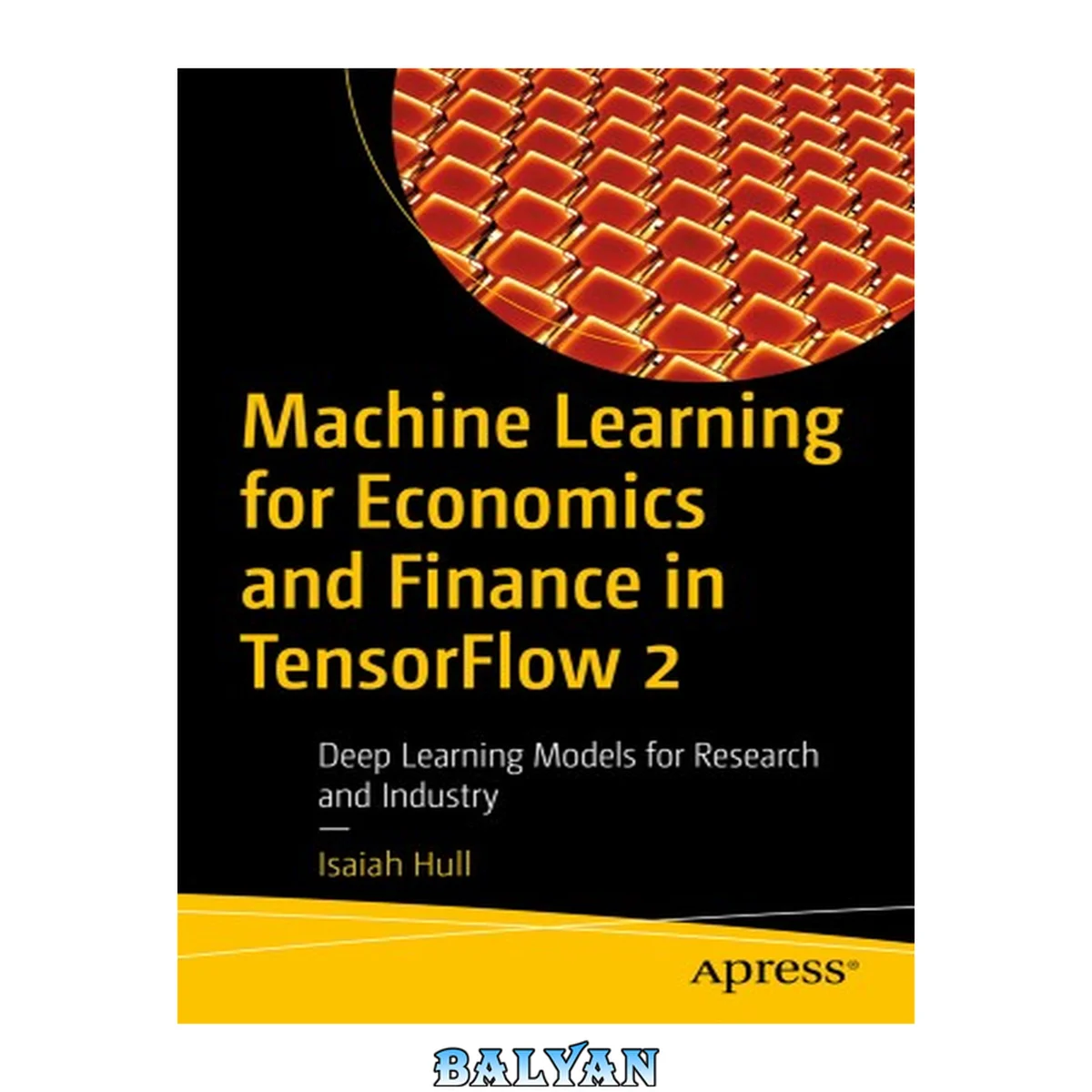
معرفی کتاب «یادگیری ماشین برای اقتصاد و امور مالی در TensorFlow 2: مدلهای یادگیری عمیق برای تحقیق و صنعت» (با عنوان لاتین Machine Learning for Economics and Finance in TensorFlow 2 : Deep Learning Models for Research and Industry) نوشتهٔ S.J. Tilly و Isaiah Hull; Safari, an O'Reilly Media Company، منتشرشده توسط نشر Apress : Imprint: Apress در سال 2021. این کتاب در فرمت pdf، زبان انگلیسی ارائه شده است.
Machine learning has taken time to move into the space of academic economics. This is because empirical research in economics is concentrated on the identification of causal relationships in parsimonious statistical models; whereas machine learning is oriented towards prediction and is generally uninterested in either causality or parsimony. That leaves a gap for students, academics, and professionals who lack a standard reference on machine learning for economics and finance.This book focuses on economic and financial problems with an empirical dimension, where machine learning methods may offer something of value. This includes coverage of a variety of discriminative deep learning models (DNNs, CNNs, LSTMs, and DQNs), generative machine learning models (GANs and VAEs), and tree-based models. It also covers the intersection of empirical methods in economics and machine learning, including regression analysis, natural language processing, and dimensionality reduction.TensorFlow offers a toolset that can be used to define and solve any graph-based model, including those commonly used in economics. This book is structured to teach through a sequence of complete examples, each framed in terms of a specific economic problem of interest or topic. This simplifies otherwise complicated concepts, enabling the reader to solve workhorse theoretical models in economics and finance using TensorFlow.**What You'll Learn**• Define, train, and evaluate machine learning models in TensorFlow 2• Apply fundamental concepts in machine learning, such as deep learning and natural language processing, to economic and financial problems • Solve theoretical models in economics**Who This Book Is For**Students, data scientists working in economics and finance, public and private sector economists, and academic social scientists Machine learning has taken time to move into the space of academic economics. This is because empirical research in economics is concentrated on the identification of causal relationships in parsimonious statistical models; whereas machine learning is oriented towards prediction and is generally uninterested in either causality or parsimony. That leaves a gap for students, academics, and professionals who lack a standard reference on machine learning for economics and finance. This book focuses on economic and financial problems with an empirical dimension, where machine learning methods may offer something of value. This includes coverage of a variety of discriminative deep learning models (DNNs, CNNs, LSTMs, and DQNs), generative machine learning models (GANs and VAEs), and tree-based models. It also covers the intersection of empirical methods in economics and machine learning, including regression analysis, natural language processing, and dimensionality reduction. TensorFlow offers a toolset that can be used to define and solve any graph-based model, including those commonly used in economics. This book is structured to teach through a sequence of complete examples, each framed in terms of a specific economic problem of interest or topic. This simplifies otherwise complicated concepts, enabling the reader to solve workhorse theoretical models in economics and finance using TensorFlow. What You'll Learn • Define, train, and evaluate machine learning models in TensorFlow 2 • Apply fundamental concepts in machine learning, such as deep learning and natural language processing, to economic and financial problems • Solve theoretical models in economics Who This Book Is For Students, data scientists working in economics and finance, public and private sector economists, and academic social scientists Find solutions to problems in economics and finance using tools from machine learning. ML has taken time to move into the space of academic economics. This is because empirical work in economics is concentrated on the identification of causal relationships in parsimonious statistical models; whereas machine learning is oriented towards prediction and is generally uninterested in either causality or parsimony. That leaves a gap for both students and professionals in the economics industry without a standard reference. This book focuses on economic problems with an empirical dimension, where machine learning methods may offer something of value. This includes coverage of a variety of discriminative deep learning models (DNNs, CNNs, RNNs, LSTMs, and DQNs), generative machine learning models, random forests, gradient boosting, clustering, and feature extraction. You'll also learn about the intersection of empirical methods in economics and machine learning, including regression analysis, text analysis, and dimensionality reduction methods, such as principal component analysis. TensorFlow offers a toolset that can be used to set up and solve any mathematical model, including those commonly used in economics. This book is structured to teach through a sequence of complete examples, each framed in terms of a specific economic problem of interest or topic. Otherwise complicated content is then distilled into accessible examples, so you can use TensorFlow to solve workhorse models in economics and finance. You will: Define, train, and evaluate machine learning models in TensorFlow 2 Apply fundamental concepts in machine learning, such as deep learning and natural language processing, to economic and financial problems Solve workhorse models in economics and finance Machine learning has taken time to move into the space of academic economics. This is because empirical research in economics is concentrated on the identification of causal relationships in parsimonious statistical models; whereas machine learning is oriented towards prediction and is generally uninterested in either causality or parsimony. That leaves a gap for students, academics, and professionals who lack a standard reference on machine learning for economics and finance. This book focuses on economic and financial problems with an empirical dimension, where machine learning methods may offer something of value. This includes coverage of a variety of discriminative deep learning models (DNNs, CNNs, LSTMs, and DQNs), generative machine learning models (GANs and VAEs), and tree-based models. It also covers the intersection of empirical methods in economics and machine learning, including regression analysis, natural language processing, and dimensionality reduction. TensorFlow offers a toolset that can be used to define and solve any graph-based model, including those commonly used in economics. This book is structured to teach through a sequence of complete examples, each framed in terms of a specific economic problem of interest or topic. This simplifies otherwise complicated concepts, enabling the reader to solve workhorse theoretical models in economics and finance using TensorFlow. You will: " Define, train, and evaluate machine learning models in TensorFlow 2 " Apply fundamental concepts in machine learning, such as deep learning and natural language processing, to economic and financial problems " Solve theoretical models in economics Front Matter ....Pages i-xiii TensorFlow 2 (Isaiah Hull)....Pages 1-59 Machine Learning and Economics (Isaiah Hull)....Pages 61-86 Regression (Isaiah Hull)....Pages 87-125 Trees (Isaiah Hull)....Pages 127-147 Image Classification (Isaiah Hull)....Pages 149-187 Text Data (Isaiah Hull)....Pages 189-248 Time Series (Isaiah Hull)....Pages 249-279 Dimensionality Reduction (Isaiah Hull)....Pages 281-306 Generative Models (Isaiah Hull)....Pages 307-330 Theoretical Models (Isaiah Hull)....Pages 331-356 Back Matter ....Pages 357-368
دانلود کتاب یادگیری ماشین برای اقتصاد و امور مالی در TensorFlow 2: مدلهای یادگیری عمیق برای تحقیق و صنعت