Lying About Hitler: History, Holocaust Holocaust And The David Irving Trial
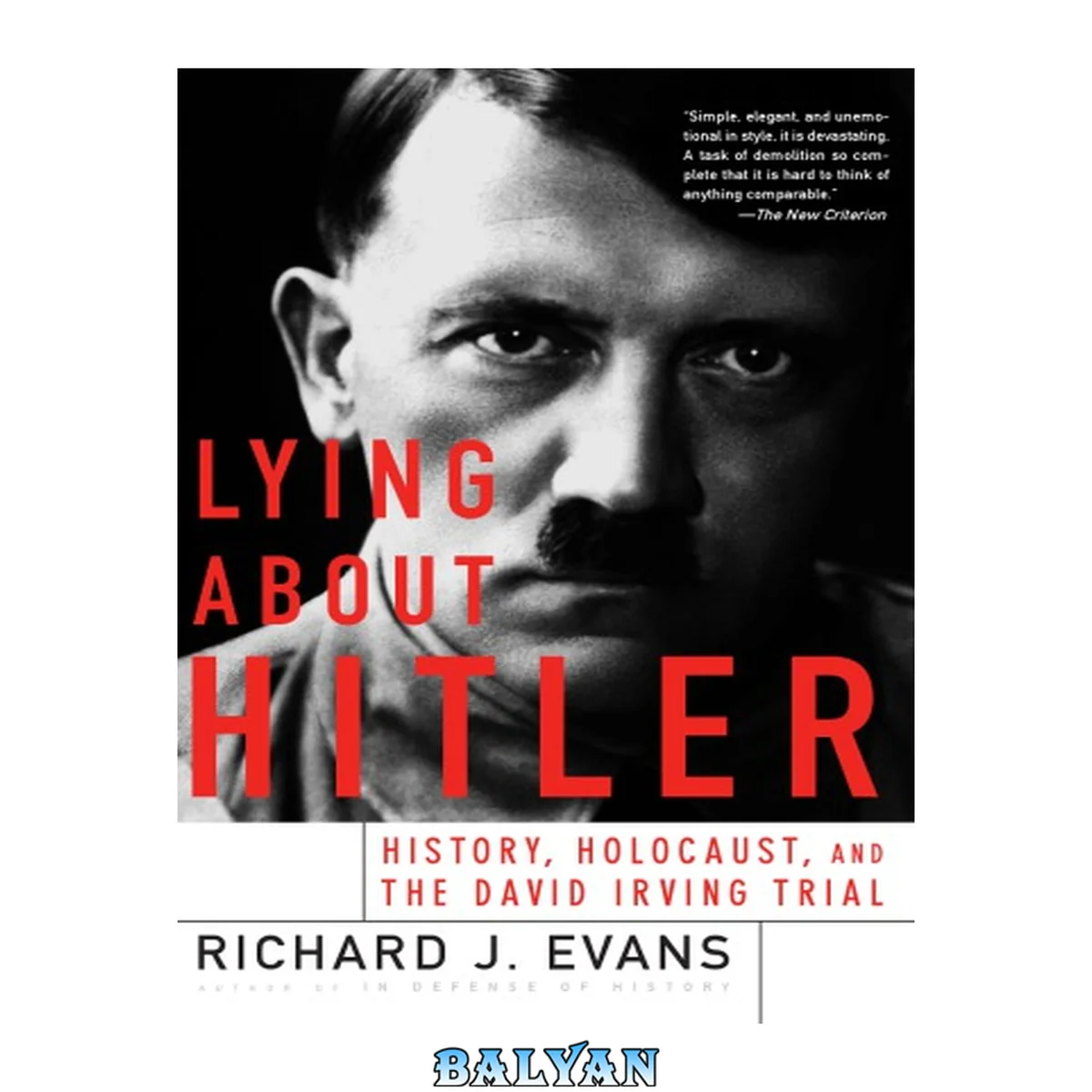
معرفی کتاب «Lying About Hitler: History, Holocaust Holocaust And The David Irving Trial» نوشتهٔ David John Cawdell Irving، Richard J Evans و Deborah E. Lipstadt، منتشرشده توسط نشر Basic Civitas Books در سال 2002. این کتاب در فرمت pdf، زبان انگلیسی ارائه شده است. «Lying About Hitler: History, Holocaust Holocaust And The David Irving Trial» در دستهٔ تاریخ جهان قرار دارد.
In ruling against the controversial historian David Irving in his libel suit against the American historian Deborah Lipstadt, last April 2000, the High Court in London labeled him a falsifier of history. No objective historian, declared the judge, would manipulate the documentary record in the way that Irving did. Richard J. Evans, a Cambridge historian and the chief advisor for the defense, uses this pivotal trial as a lens for exploring a range of difficult questions about the nature of the historian's enterprise. For instance, don't all historians in the end bring a subjective agenda to bear on their reading of the evidence? Is it possible that Irving lost his case not because of his biased history but because his agenda was unacceptable? The central issue in the trial -- as for Evans in this book -- was not the past itself, but the way in which historians study the past. In a series of short, sharp chapters, Richard Evans sets David Irving's methods alongside the historical record in order to illuminate the difference between responsible and irresponsible history. The result is a cogent and deeply informed study in the nature of historical interpretation. LYING ABOUT HITLERHistory, Holocaust, and the David Irving TrialBy RICHARD J. EVANSBASIC BOOKSA MEMBER OF THE PERSEUS BOOK GROUPCopyright © 2001 Richard J. Evans. All rights reserved.ISBN: 0-465-02152-2Chapter One History on TrialIWhat is historical objectivity? How do we know when a historian is tellingthe truth? Aren't all historians, in the end, only giving their own opinionsabout the past? Don't they just select whatever facts they need to supporttheir own interpretations and leave the rest in the archives? Aren'tthe archives full of preselected material anyway? Can we really say thatanything historians present to us about the past is true? Aren't there,rather, many different truths, according to your political beliefs and personalperspectives? Questions such as these have been preoccupying historiansfor a long time. In recent years, they have become, if anything,more urgent and more perplexing than ever. Debate about them hasrepeatedly gravitated toward the Nazi extermination of the Jews duringthe Second World War. If we could not know for sure about anything thathappened in the past, then how could we know about this most painfulof all topics in modern history? Just such a question has been posed, and answered in the negative,by a group of individuals, based mainly in the United States, who are certainlyfar removed in intellectual terms from postmodernist hyper-relativism,but who have asserted in a variety of publications that indeedthere is no real evidence to support the conventional picture of the Nazipersecution of the Jews. There is a thin but seemingly continuous line ofwriting since the Second World War that has sought to deny the existenceof the gas chambers at Auschwitz and other extermination camps, to minimizethe number of Jews killed by the Nazis until it becomes equivalentto that of the Germans killed by the Allies, to explain away the killings asincidental by-products of a vicious war rather than the result of centralplanning in Berlin, and to claim that the evidence for the extermination,the gas chambers, and all the rest of it had mostly been concocted afterthe war. A number of scholars have devoted some attention to this strange anddisturbing stream of thought. The most important of their works is Denyingthe Holocaust: The Growing Assault on Truth and Memory, by theAmerican historian Deborah Lipstadt. Published in 1993, this book gavean extended factual account of the deniers' publications and activitiessince the Second World War and identified them as closely connectedwith neo-fascist, far-right, and antisemitic political extremists in Europeand the United States. Whether or not Lipstadt was correct to claim thatthese people posed a serious threat to historical knowledge and memorywas debatable. But the evidence she presented for the existence of thephenomenon and for its far-right connections seemed convincingenough. Lipstadt argued that denial of the Holocaust was in most casesantisemitic and tied to an anti-Jewish political agenda in the present. Thedenial of history was the product of political bias and political extremism,which had no place in the world of serious historical scholarship. Yet how unbiased was Lipstadt herself? There was no doubt abouther commitment to Jewish causes. Born in 1947 in New York of a German-Jewishimmigrant father who was descended from a prominent familyof rabbis, she had been brought up in what she described as a "traditionalJewish home," she had studied at the Hebrew University ofJerusalem for two years, and been present in Israel during the 1967 Arab-Israeliwar. She had studied modern Jewish history, the Third Reich, andthe Holocaust at university, and taught courses on the history of theHolocaust at a variety of institutions, including the University of Washingtonand the University of California at Los Angeles, before joining thestaff of Emory University in Atlanta, Georgia, in 1993, where she held anendowed chair and was setting up a new Institute for Jewish Studies. Shewas also a member of the United States Holocaust Memorial Councilapresidential appointmentand had acted as a consultant to the UnitedStates Holocaust Memorial Museum while it was being built. Aside from these academic credentials and activities, Lipstadt wasalso a member of the United States Department of State Advisory Committeeon Religious Freedom Abroad. In 1972 she had visited the SovietUnion and inspected sites of major Nazi killings of Jews such as Babi Yar.This was a period when controversy was being aroused by the Sovietauthorities' refusal to allow Soviet Jews to emigrate to Israel, and therewas a good deal of subtle and sometimes not so subtle antisemitism onthe part of the authorities. Lending her Jewish prayerbook to an elderlyJewish woman in a synagogue in Czernowitz, Lipstadt was denounced tothe authorities and arrested by the KGB for distributing religious items,strip-searched, held in prison for a day, questioned, and deported. Afterthis, she had continued for some years to work hard for Soviet Jews whilethey were being persecuted. Combined with her many discussions with camp survivors in Israel,she reported, this experience had led her to study the history of antisemitismand, in particular, the Holocaust. Remembering the Holocaustwas crucial in the perpetuation of Jewish tradition, but also in teachinglessons about the need to fight prejudice and persecution of many kindsin the world today. However, Lipstadt insisted, whatever her political andreligious beliefs, she was convinced that the history of the Holocaust hadto be researched to the highest possible scholarly standards and taughtin a straightforwardly factual manner. She denied any wish to impose herviews about the lessons of the Holocaust on her students. After the publicationof her book, Lipstadt left no doubt that her work on Holocaustdenial had led some of the deniers to engage in "a highly personal and,at times, almost vile campaign against me." She had been vilified on theInternet, accused of fascist behavior, and phoned up by deniers anddepicted by them in "an ugly and sometimes demeaning fashion." Theyhad also left notes in her home mailbox. This had not stopped her fromworking in the field. Her book Denying the Holocaust was an academicproject, but it had also taken on a broader significance. Lipstadt's book, when taken together with her previous work, madeit clear that her main interest was in reactions to the extermination ofEurope's Jews by the Nazis rather than in the extermination itself. Aftercompleting her work on Holocaust denial, she planned a book calledAmerica Remembers the Holocaust: From the Newsreels to Schindler'sList. She had never written about German history and had never been ina German archive. Indeed, as far as I could tell, she did not even readGerman. She was really a specialist in the history of the United Statessince the Second World War. Yet it was easy enough for her to include inDenying the Holocaust refutations of some of the principal arguments ofthe deniers on the basis of well-known secondary literature about theextermination. Given the main focus of her work, which was on denial asa political and intellectual phenomenon, that was surely all that wasrequired. Nevertheless, her book did not pull its punches when it came to convictingdeniers of massive falsification of historical evidence, manipulationof facts, and denial of the truth. One of those whom she discussed inthis context was the British writer David Irving, who certainly did readGerman, had spent years in the archives researching the German side inthe Second World War, and was the author of some thirty books on historicalsubjects. Some of them had gone through many reprints and anumber of different editions. The great majority of them were about theSecond World War, and in particular about Nazi Germany and its leaders.Before he was thirty, he had already begun researching and writingon twentieth-century history, publishing his first book, The Destructionof Dresden, in 1963, when he was only twenty-five. Irving had also written The Mare's Nest, a study of German secretweapons in the Second World War, published in 1964, and a book aboutthe German atomic bomb, The Virus House, published in 1967. In thesame year, Irving published two more books, The Destruction of ConvoyPQ17, and AccidentThe Death of General Sikorski. Despite theirsomewhat specialized titles, these books in many cases aroused widespreadcontroversy and made Irving into a well-known figure. TheDestruction of Dresden created a storm by alleging that the bombing ofDresden by Allied airplanes early in 1945 caused many more deaths thanhad previously been thought. The Destruction of Convoy PQ 17 arousedserious objections on the part of a British naval officer criticized by Irvingin his book. Accident generated considerable outrage by its suggestionthat the Polish exile leader in the Second World War, General Sikorski,had been assassinated on the orders of Winston Churchill. By the endof the 1960s, Irving had already made a name for himself as an extremelycontroversial writer about the Second World War. With the publication of his massive study of Hitler's War in 1977, Irvingstirred up fresh debate. In this book, he argued that far from orderingit himself, Hitler had not known about the extermination of the Jewsuntil late in 1943, and both before and after that had done his best to mitigatethe worst antisemitic excesses of his subordinates. Irving heightenedthe controversy by publicly offering a financial reward to anyonewho could come up with a document proving him wrong. The furor completelyovershadowed his publication of a biography of the German generalErwin Rommel in the same year, under the title The Trail of the Fox.The following year, Irving brought out a `prequel' to his book on Hitlerand the Second World War, entitled The War Path. In 1981 he publishedtwo more booksThe War Between the Generals, devoted to exposingdifferences of opinion among the commanders of Hitler's army duringthe Second World War; and Uprising!, arguing, to quote Irving himself,"that the Uprising of 1956 in Hungary was primarily an anti-Jewish uprising,"because the communist regime was run by Jews. The stream of books continued with Churchill's War in 1987, RudolfHess: The Missing Years published in the same year, a biography of HermannGöring (1989), and most recently a book on Goebbels: Mastermindof the `Third Reich' (1996). And while he was producing new work, healso published revised and amended editions of some of his earlier books,most notably, in 1991, Hitler's War, which also incorporated a newversion of The War Path, and in 1996 Nuremberg: The Last Battle, anupdated version of a previously published book, reissued to mark the fiftiethanniversary of the Nuremberg War Crimes Trials. Despite all this, Irving had never held a post in a university historydepartment or any other academic institution. He did not even have adegree. He had started a science degree at London University but neverfinished it. "I am an untrained historian," he had confessed in 1986. "Historywas the only subject I flunked when I was at school." Severaldecades on from his self-confessedly disastrous schoolboy encounterwith the subject, however, Irving clearly laid great stress on the fact thatthe catalogue of his work demonstrated that he had now become a `reputablehistorian': As an independent historian, I am proud that I cannot be threatened with the loss of my job, or my pension, or my future. Other historians around the world sneer and write letters to the newspapers about `David Irving, the so-called historian', and they demand, "Why does he call himself a Historian anyway? Where did he study History? Where did he get his Degree? What, No Degree in History, then why does he call himself a Historian?" My answer to them, Was Pliny a historian or not? Was Tacitus? Did he get a degree in some university? Thucydides? Did he get a degree? And yet we unashamedly call them historianswe call them historians because they wrote history which has done (recte: gone) down the ages as accepted true history.This was true. Irving could not be dismissed just because he lacked formalqualifications. Irving was clearly incensed by a reference to him on page 180 of Lipstadt'sbook as "discredited." Lipstadt also alleged in her book that Irvingwas "one of the most dangerous spokespersons for Holocaust denial.Familiar with historical evidence," she wrote, "he bends it until it conformswith his ideological leanings and political agenda." According toLipstadt, Irving had "neofascist" and "denial connections," for example,with the so-called Institute for Historical Review in California. Moreimportant, Lipstadt charged that Holocaust deniers like Irving "misstate,misquote, falsify statistics, and falsely attribute conclusions to reliablesources. They rely on books that directly contradict their arguments,quoting in a manner that completely distorts the authors' objectives." Irvinghimself, she claimed, was "an ardent admirer of the Nazi leader," who"declared that Hitler repeatedly reached out to help the Jews" (p. 161).Scholars had "accused him of distorting evidence and manipulating documentsto serve his own purposes ... of skewing documents and misrepresentingdata in order to reach historically untenable conclusions,particularly those that exonerate Hitler." "On some level," Lipstadt concluded,"Irving seems to conceive himself as carrying on Hitler's legacy." These were serious charges. Historians do not usually answer suchcriticisms by firing off writs. Instead, they normally rebut them in print.Irving, however, was no stranger to the courts. He wrote to Lipstadt'sEnglish publisher Penguin Books in November 1995 demanding thewithdrawal of Lipstadt's book from circulation, alleging defamation andthreatening to sue. Lipstadt responded, pointing out that her book mentionedIrving only on six out of more than three hundred pages. The publisherrefused to withdraw; and Irving issued his defamation writ in September1996. By December 1997, the legal process of mounting adefense against the writ was well under way, and a date for the proceedingsto be held before the High Court in London was due to be fixed.IIIt was at this point that I became involved in the case on the initiative ofAnthony Julius, of the London firm of solicitors Mishcon de Reya. I hadnever met him in person, but of course I knew of him through his highmedia profile as the solicitor who had won a record settlement forPrincess Diana in her divorce from the Prince of Wales. Julius was notjust a fashionable and successful lawyer. He was also well known as awriter and intellectual, although in the field of English literature ratherthan history. He was the author of a scholarly if controversial study ofT. S. Eliot and antisemitism, and he wrote frequent book reviews for theSunday papers. Julius was representing Deborah Lipstadt. When hephoned me toward the end of 1997, it was to ask if I would be willing toact as an expert witness for the defense. Later, in his cramped and book-lined Holborn office, Julius explainedto me in more detail what would be involved. The first duty of an expertwitness, he said, was to the court. That is, the evidence had to be as truthfuland objective as possible. Expert witnesses were not there to plead acase. They were there to help the court in technical and specialized matters.They had to give their own opinion, irrespective of which side hadengaged them. They had to swear a solemn oath to tell the truth andcould be prosecuted for perjury if they did not. On the other hand, theywere usually commissioned by one side or the other in the belief thatwhat they said would support the case being put rather than undermineit. At the end of the day, it was up to the lawyers whether or not they usedthe reports they had commissioned. I would be paid by the hour, not byresults. So the money would have no influence on what I wrote or said.If I did agree to write an expert report, however, and it was accepted bythe lawyers, then I could expect it to be presented to the court and Iwould have to attend the trial to be cross-examined on it by the plaintiff. Why me? I asked. There were a number of reasons, Julius said. First,I was a specialist in modern German history. A copy of my most recentbook in this field, Rituals of Retribution, was on his bookshelf. It was alarge-scale study of capital punishment in Germany from the seventeenthcentury to the abolition of the death penalty in East Germany in1987. Like much of my other work, it rested on unpublished manuscriptdocuments in a range of German archives. So it was clear that I had agood command of the German language. I could read the obsolete Germanscript in which many documents were written until the end of theSecond World War. And I was familiar with the documentary basis onwhich a lot of modern German history was written. I had also for manyyears taught a document-based undergraduate course on Nazi Germanyfor the history degree at Birkbeck College in London University andbefore that in my previous post at the University of East Anglia. Clearly,the trial was going to turn to a considerable extent on the interpretationof Nazi documents, so expertise of this kind was crucial; and it was expertisethat the court itself could not be expected to possess. Second, a coupleof months earlier, I had published a short book entitled In Defense ofHistory, which had dealt with such vexed questions as objectivity and biasin historical writing, the nature of historical research, the differencebetween truth and fiction, and the possibility of obtaining accurateknowledge about the past. These in a way, Anthony Julius explained, werethe central issues in the case that Irving was bringing against Lipstadt. What Anthony Julius wanted me to do was to advise the court onwhether Lipstadt's charges were justified. I was in a good position to doso not only because of my previous writings, but also because I had nopersonal connection with either of the two main protagonists in the case.Indeed, I had never actually seen either of them in the flesh. Irving wasa famously combative figure, but he had never had occasion to crossswords with me. As I left Anthony Julius's office, I tried to put togetherwhat was known about Irving's reputation. Irving insisted that his workson the Second World War had a high standing and claimed in his libelsuit that Lipstadt's allegations had caused "damage to his reputation" inhis "calling as an historian." Yet as I began to plow through the reviewsof Irving's books written by a wide range of historians and journalists overthe years, the case he made for his high reputation among academicreviewers began to crumble. Academic historians with a general knowledgeof modern history had indeed mostly been quite generous to Irving,even where they had found reason to criticize him or disagree withhis views. Paul Addison, for example, an expert on British history in theSecond World War, had concluded that while Irving was "usually a Colossusof research, he is often a schoolboy in judgment." Reviewing TheWar Path in 1978, R. Hinton Thomas, professor of German at BirminghamUniversity, whose knowledge of the social and political context oftwentieth-century German literature was both deep and broad, dismissedthe book as "unoriginal" and its "claims to novelty" as "ill-based.""Much of Irving's argument," wrote Sir Martin Gilbert, official biographerof Churchill, about Hitler's War in 1977, "is based on speculation."But he also praised the book as "a scholarly work, the fruit of a decade ofwide researches." The military historian Sir Michael Howard, subsequentlyRegius Professor of Modern History at Oxford, praised on theother hand the "very considerable merits" of The War Path, and declaredthat Irving was "at his best as a professional historian demanding documentaryproof for popularly-held beliefs." In similar fashion, the eminent American specialist on modern Germany,Gordon A. Craig, reviewing Irving's Goebbels in the New YorkReview of Books in 1996, seemed at first glance full of praise for Irving'swork: Silencing Mr Irving would be a high price to pay for freedom from the annoyance that he causes us. The fact is that he knows more about National Socialism than most professional scholars in his field, and students of the years 1933-1945 owe more than they are always willing to admit to his energy as a researcher.... Hitler's War ... remains the best study we have of the German side of the Second World War, and, as such, indispensable for all students of that conflict .... It is always difficult for the non-historian to remember that there is nothing absolute about historical truth. What we consider as such is only an estimation, based upon what the best available evidence tells us. It must constantly be tested against new information and new interpretations that appear, however implausible they may be, or it will lose its vitality and degenerate into dogma or shibboleth. Such people as David Irving, then, have a indispensable part in the historical enterprise, and we dare not disregard their views. Yet even reviewers who had praised "the depth of Irving's researchand his intelligence" found "too many avoidable mistakes ... passagesquoted without attribution and important statements not tagged to thelisted sources." John Charmley, a right-wing historian at the Universityof East Anglia, wrote that he "admires Mr. Irving's assiduity, energy, andcourage." He continued: "Mr. Irving's sources, unlike the conclusionswhich he draws from them, are usually sound." But he also noted: "Mr. Irvingis cited only when his sources have been checked and found reliable." Historians with firsthand research experience and expertise in Irving'sfield were more critical still. An early, prominent instance of criticismfrom such a quarter came with Hugh Trevor-Roper's review ofHitler's War in 1977. Trevor-Roper had worked in British Intelligenceduring the war and had been charged with heading an official mission tofind out the true facts about the death of Hitler. The result of hisresearches, published in 1947 as The Last Days of Hitler, immediatelyestablished him as a leading authority on Nazi Germany and especiallyon Irving's home territory of Hitler and his immediate personal entourage.Reviewing Hitler's War, Trevor-Roper paid the by now customarytribute to Irving's ingenuity and persistence as a researcher. "Nopraise," he wrote, "can be too high for his indefatigable scholarly industry."But this was immediately followed by devastating criticism of Irving'smethod. Trevor-Roper continued: When a historian relies mainly on primary sources, which we cannot easily cheek, he challenges our confidence and forces us to ask critical questions. How reliable is his historical method? How sound is his judgment? We ask these questions particularly of any man who, like Mr. Irving, makes a virtuealmost a professionof using arcane sources to affront established opinions.Trevor-Roper made it clear he found Irving's method and judgmentdefective: "He may read his manuscript diaries correctly. But we cannever be quite sure, and when he is most original, we are likely to be leastsure." Irving's work, he concluded, had a "consistent bias." The same view was taken by Martin Broszat, director of the Institutfür Zeitgeschichte (Institute for Contemporary History) in Munich whenIrving published Hitler's War. One of the world's leading historians ofNazi Germany, Broszat began his critique of Hitler's War by casting scornon Irving's much-vaunted list of archival discoveries. The evidence Irvinghad gathered from the reminiscences of Hitler's entourage might providemore exact detail of what went on at Hitler's wartime headquarters,he wrote, and it might convey something of the atmosphere of the place,but it did little to enlarge our knowledge of the important military and politicaldecisions that Hitler took, and so did not live up to the claims Irvingmade for it. Broszat went much further, however, and included the allegation,backed up by detailed examples, that Irving had manipulated and misinterpretedoriginal documents in order to prove his arguments. Equallycritical was the American Charles W. Sydnor Jr., who at the time of writinghis review had just completed a lengthy study, Soldiers of Destruction: TheSS Death's Head Division, 1933-1945, published by Princeton UniversityPress. Sydnor's thirty-page demolition of Irving's book was one of the fewreviews of any of Irving's books for which the reviewer had manifestlyundertaken a substantial amount of original research. Sydnor consideredIrving's boast to have outdone all other Hitler scholars in the depth and thoroughnessof his research to be "pretentious twaddle." He accused Irving ofinnumerable inaccuracies, distortions, manipulations, and mistranslationsin his treatment of the documents. Peter Hoffmann, the world's leading authority on the conservativeresistance to Hitler and the individuals and groups behind the bomb plotof 20 July 1944, and a profound student of the German archival recordof the wartime years, was equally critical of Irving's biography of HermannGöring, published in 1988: Mr. Irving's constant references to archives, diaries and letters, and the overwhelming amount of detail in his work, suggest objectivity. In fact they put up a screen behind which a very different agenda is transacted.... Mr Irving is a great obfuscator.... Distortions affect every important aspect of this book to the point of obfuscation.... It is unfortunate that Mr. Irving wastes his extraordinary talents as a researcher and writer on trivializing the greatest crimes in German history, on manipulating historical sources and on highlighting the theatrics of the Nazi era.Hoffmann commented that while the 1977 edition of Hitler's War had"usefully provoked historians by raising the question of the smoking gun"(whether an order could be found from Hitler to perpetrate a holocaustagainst the Jews), twenty-two years on, so much research had been carriedout in this area by historians that although he repeated it in Göring, "it isno longer possible to regard Mr. Irving's thesis as a useful provocation." John Lukács, an American historian who had written extensively onthe Second World War, declared in a review of one of Irving's books in1981 that "Mr Irving's factual errors are beyond belief." He renewed hiscriticisms of Irving years later in a general survey of historical writings onHitler." "Few reviewers and critics of Irving's books," Lukács complained,not without some justification, "have bothered to examine themcarefully enough." Hitler's War contained "many errors in names anddates; more important, unverifiable and unconvincing assertions abound."There were references to archives "without dates, places, or file or pagenumbers." "Many of the archival references in Irving's footnotes ... wereinaccurate and did not prove or even refer to the pertinent statements inIrving's text." Lukács found many instances of Irving's "manipulations,attributing at least false meanings to some documents or, in otherinstances, printing references to irrelevant ones." Often "a single document,or fragment of a document, was enough for Irving to build a veryquestionable thesis on its contents or on the lack of such." "While some ofIrving's `finds' cannot be disregarded," Lukács went on, "their interpretation ...is, more often than not, compromised and even badly flawed." Heconvicted Irving of "frequent `twisting' of documentary sources" and urged"considerable caution" in their use by other historians. Similar conclusions were reached by Professor David Cannadine,currently director of the Institute of Historical Research at London University,when he came to consider the first volume of Irving's biographyof Sir Winston Churchill. Cannadine noted that the publishers to whomthe book had originally been contracted (Michael Joseph in London andDoubleday in New York) had turned the manuscript down and it hadbeen published by an unknown Australian company. "It has receivedalmost no attention from historians or reviewers," and, Cannadine added,"It is easy to see why." Irving's method was full of "excesses, inconsistenciesand omissions." Irving, he charged, "seems completely unaware ofrecent work done on the subject." "It is not merely," he observed, "thatthe arguments in this book are so perversely tendentious and irresponsiblysensationalist. It is also that it is written in a tone which is at best casuallyjournalistic and at worst quite exceptionally offensive. The text is litteredwith errors from beginning to end." In Cannadine's judgment,too, therefore, Irving's work was deeply flawed. "Perversely tendentious,'" "`twisting' of documentary sources," "manipulatinghistorical sources," "pretentious twaddle": these were unusuallyharsh criticisms emerging from the wider chorus of praise for Irving'senergy and persistence as a researcher. Clearly, Lipstadt was far frombeing the first critic of Irving's work to accuse him of bending the documentaryrecord to suit his arguments. For many years, professional historianshad seemed to regard him as an assiduous collector of originaldocumentation, although there was some dispute over quite how importantall of it was. But when it came to Irving's interpretation of the documents,several eminent specialists were harsh, even savage, in their criticisms.Nor was this all. Irving's writings had repeatedly landed him introuble with the law. He had been sued for libel by a retired naval officerwho considered Irving's charge of cowardice against him in TheDestruction of Convoy PQ 17 to be defamatory, and had been "Last Year, in the most famous Holocaust court case since the Adolf Eichmann trial, controversial author David Irving brought a libel suit against Penguin Books UK and author Deborah Lipstadt, who had denounced Irving in print as one of the most dangerous Holocaust deniers at work today. As the chief historical adviser to Penguin Books in its successful defense of Lipstadt, Richard J. Evans spent two years of research in preparation for this case. In Lying About Hitler, Evans uses the trial as a lens for exploring a range of vital questions such as who was responsible for violence and genocide against the Jews in Nazi Germany, what Hitler knew and when, and how far his henchmen Himmler and Goebbels and Nazi officials in the SS acted on their own initiative in organizing the violence and mass murder perpetrated by the Nazi regime against the Jews.". "In ruling against David Irving in April 2000, the High Court in London labeled him a falsifier of history. No objective historian, declared the Judge, would manipulate the documentary record in the way that Irving did. Yet, one could ask, is a court of law the appropriate place to debate history? Can it really settle issues of objectivity and bias in the study of the past? Don't all historians in the end bring a subjective agenda to bear on their reading of the evidence? The judgment branded Irving a racist, an anti-Semite and an active supporter of neo-fascism. Is it possible, though, that he lost his case not because of his biased history but because his agenda was unaceptable? Evans answers these questions and more in ways that may surprise many of the commentators and pundits on the trial. While most people would share the court's views of Irving's work, some commentators have feared that the verdict will make it all but impossible to question the accepted version of the Holocaust."--BOOK JACKET. In April 2000 a High Court judge branded the writer David Irving a racist, an antisemite, a Holocaust denier, and a falsifier of history. The key expert witness against Irving was the Cambridge historian Richard J. Evans who describes here, in a book which several publishers have been intimidated to withdrawing, his involvement in the case. Recounting his discovery of Irving’s connections with far right Holocaust deniers in the United States and of how Irving falsified the documentary evidence on the Second World War, Evans reflects generally and eloquently on the interaction of historical and legal rules of evidence. Evans argues that the Irving trial does for the twenty-first century what the Eichmann trial did for the second half of the twentieth. It vindicates history’s ability to come to reasoned conclusions on the basis of a careful examination of the evidence, even when eyewitnesses and survivors are no longer around to tell the tale. (Source: [Verso Books](https://www.versobooks.com/en-gb/products/1781-telling-lies-about-hitler)) The Author Examines The Libel Suit And Ensuing Trial Of Penguin Books Uk And Deborah Lipstadt Against Holocaust Denier David Irving. The Author Uses The Trial To Explore The Question Of Nazi Genocide Against The Jews And The Roles Of Hitler, Himmler And Goebbels In The Holocaust. Preface -- History On Trial -- Hitler And The Jews, 1924-1939 -- Hitler And The Final Solution -- Irving And Holocaust Denial -- Bombing Of Dresden -- In The Witness Box -- Judgment Day. Richard Evans. Includes Bibliographical References (p. [267]-309) And Index. Includes Bibliographical References (pages 267-309) And Index. Annotation In ruling against the controversial historian David Irving, whose libel suit against the American historian Deborah Lipstadt was tried in April 2000, the High Court in London labeled Irving a falsifier of history. No objective historian, declared the judge, would manipulate the documentary record in the way that Irving did. Richard J. Evans, a Cambridge historian and the chief adviser for the defense, uses this famous trial as a lens for exploring a range of difficult questions about the nature of the historian's enterprise CONTENTS 8 ABBREVIATIONS 10 PREFACE 12 CHAPTER ONE History on Trial 16 CHAPTER TWO Hitler and the Jews, 1924–1939 55 CHAPTER THREE Hitler and the “Final Solution” 86 CHAPTER FOUR Irving and Holocaust Denial 119 CHAPTER FIVE The Bombing of Dresden 164 CHAPTER SIX In the Witness Box 200 CHAPTER SEVEN Judgment Day 240 NOTES 282 INDEX 326
دانلود کتاب Lying About Hitler: History, Holocaust Holocaust And The David Irving Trial