Integrating Differentiated Instruction and Understanding by Design : Connecting Content and Kids
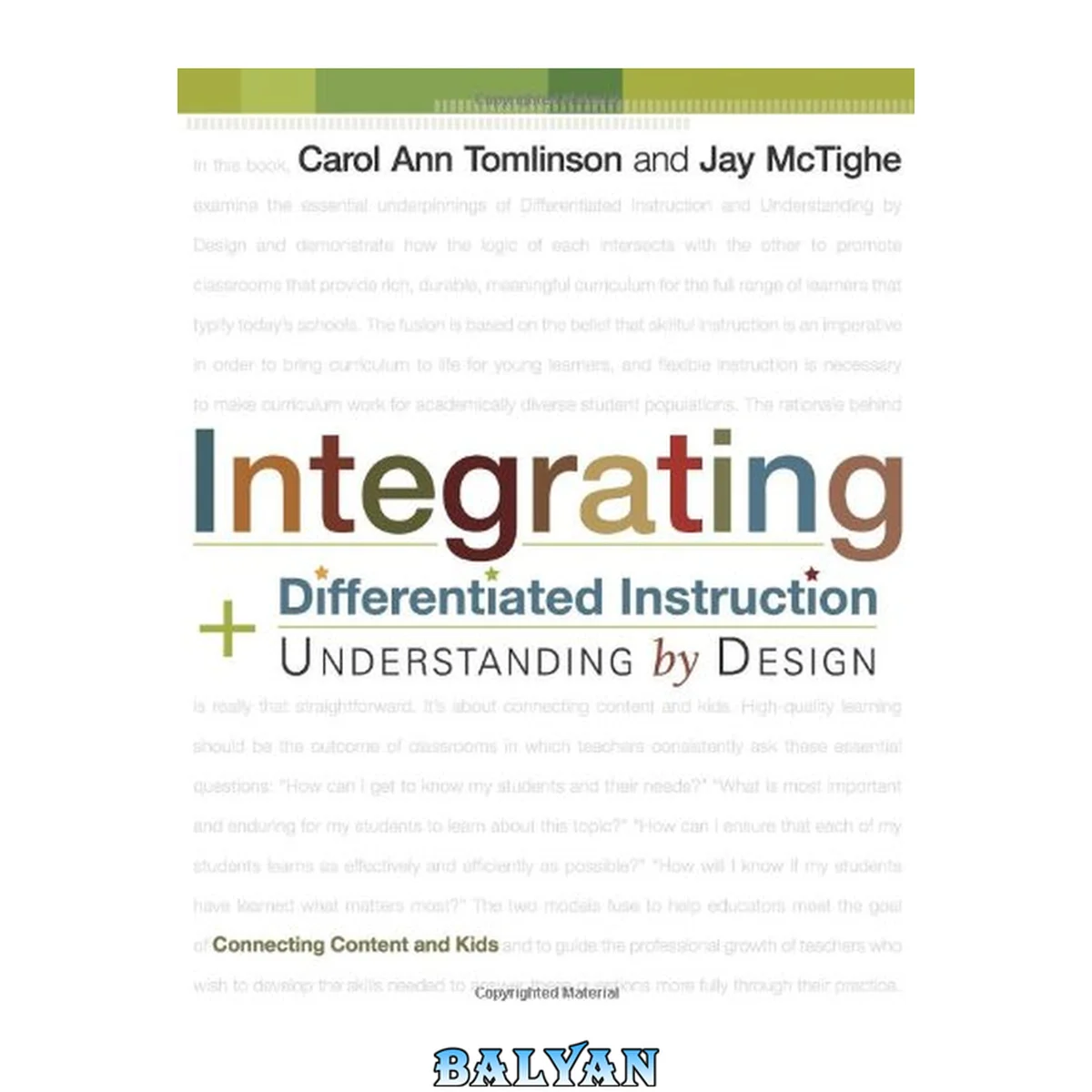
معرفی کتاب «Integrating Differentiated Instruction and Understanding by Design : Connecting Content and Kids» نوشتهٔ David M. Killoran و Carol A Tomlinson; Carol Ann Tomlinson; Jay McTighe، منتشرشده توسط نشر Association for Supervision and Curriculum Development. 1703 North Beauregard Street در سال 1703. این کتاب در فرمت pdf، زبان انگلیسی ارائه شده است.
Teachers struggle every day to bring quality instruction to their students. Beset by lists of content standards and accompanying "high-stakes" accountability tests, many educators sense that both teaching and learning have been redirected in ways that are potentially impoverishing for those who teach and those who learn. Educators need a model that acknowledges the centrality of standards but also ensures that students truly understand content and can apply it in meaningful ways. For many educators, Understanding by Design addresses that need.
Simultaneously, teachers find it increasingly difficult to ignore the diversity of the learners who populate the classrooms. Few teachers find their work effective or satisfying when they simply "serve up" a curriculum - even an elegant one - to students with no regard for their varied learning needs. For many educators, Differentiated Instruction offers a framework for addressing learner variance as a critical component of instructional planning.
In this book the two models converge, providing readers fresh perspectives on two of the greatest contemporary challenges for educators: crafting powerful curriculum in a standards-dominated era and ensuring academic success for the full spectrum of learners. Each model strengthens the other. Understanding by Design is predominantly a curriculum design model that focuses on what we teach, and how we teach. Carol Ann Tomlinson and Jay McTighe show you how to use the principles of backward design and differentiation together to craft lesson plans that will teach essential knowledge and skills for the full spectrum of learners.
Connecting content and kids in meaningful ways is what teachers strive to do every day. In tandem, UbD and DI help educators meet that goal by providing structures, tools, and guidance for developing curriculum and instruction that bring to students the best of what we know about effective teaching and learning.
Discover how two of education's most powerful frameworks can team up to provide your school with a comprehensive and in-depth approach to ensure all students are learning at maximum levels. The leading experts on Differentiated Instruction and Understanding by Design explain how to connect these two approaches and use their combined power to: (1) Meet content standards and prepare for high-stakes tests while providing students with multiple learning pathways; (2) Use the backward design approach to develop curriculum units and lessons that can be differentiated in response to students' different readiness levels, abilities, and learning styles; (3) Combine drill and practice with differentiated performance tasks to inspire understanding of content; and (4) Create a fair, criterion-referenced assessment approach that supports standards and differentiation. Find out how a curriculum built on the goal of student understanding, integrated with instructional approaches that emphasize reaching every learner, can provide teachers with more specific teaching targets and more flexible ways to reach them Preface......Page 5 Acknowledgments......Page 8 UbD and DI: An Essential Partnership......Page 10 What Really Matters in Teaching? (The Students)......Page 21 What Really Matters in Learning? (Content)......Page 33 What Really Matters in Planning for Student Success?......Page 47 Considering Evidence of Learning in Diverse Classrooms......Page 68 Responsive Teaching with UbD in Academically Diverse Classrooms......Page 92 Teaching for Understanding in Academically Diverse Classrooms......Page 117 Grading and Reporting Achievement......Page 137 Bringing It All Together: Curriculum and Instruction Through the Lens of UbD and DI......Page 150 Moving Forward to Integrate UbD and DI......Page 175 Appendix......Page 182 References......Page 196 Index......Page 201 About the Authors......Page 205 Explains how the combination of the Differentiated Instruction and Understanding by Design frameworks can ensure all students are learning at maximum levels. Describes how a curriculum built on the goal of student understanding, integrated with instructional approaches that emphasize reaching every learner, can provide teachers with more specific teaching targets and more flexible ways to reach them Explains how the curriculum planning model Understanding by Design (UbD) and the teaching model Differentiated Instruction (DI) fit together and can be integrated for student success, discussing such topics as responsive teaching with UbD and assessment in academically diverse classrooms Discover how the integration of two of education's most powerful frameworks will help teachers impart essential knowledge and skills to the full spectrum of learners.