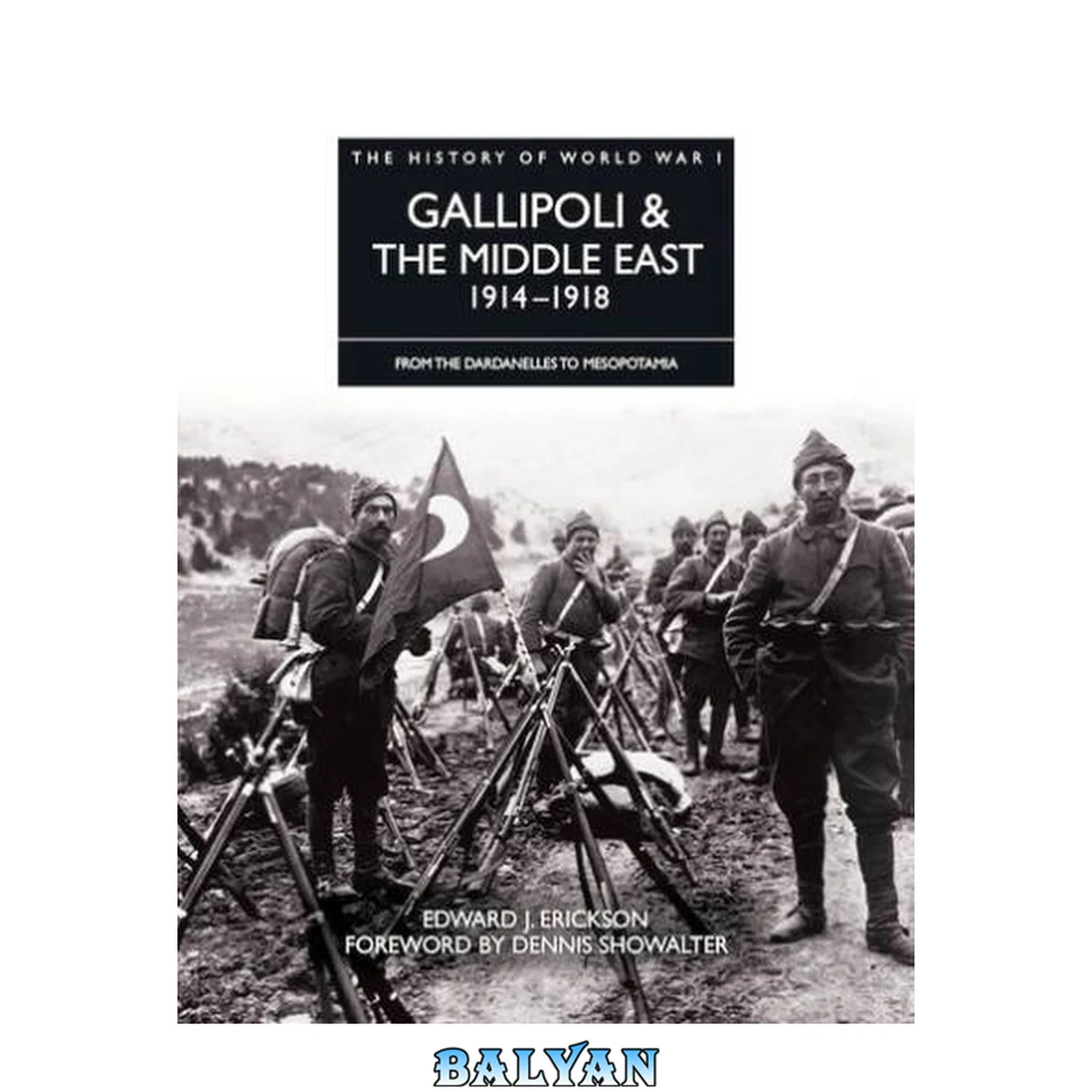
History of World War I: Gallipoli & the Middle East 1914–1918: From the Dardanelles to Mesopotamia
معرفی کتاب «تاریخ جنگ جهانی اول: گالیپولی و خاورمیانه ۱۹۱۴–۱۹۱۸: از داردانل تا بینالنهرین» (با عنوان لاتین History of World War I: Gallipoli & the Middle East 1914–1918: From the Dardanelles to Mesopotamia) نوشتهٔ Edward J Erickson، منتشرشده توسط نشر Amber Books Ltd در سال 2021. این کتاب در فرمت epub، زبان انگلیسی ارائه شده است.
The History of World War I series recounts the battles and campaigns that took place during the 'Great War'. From the Falkland Islands to the lakes of Africa, across the Eastern and Western Fronts, to the former German colonies in the Pacific, the World War I series provides a six-volume history of the battles and campaigns that raged on land, at sea and in the air. The war in the Middle East was a struggle between the Ottoman Turks, British, French and Russians for control of the lands and peoples held by the Ottoman Empire since the 1400s. Although known as the 'Sick Man of Europe', the empire still controlled significant parts of the Middle East. The Ottoman Empire initially declared its neutrality when the war broke out, but intense diplomatic pressure from Germany culminated in the decision to join the Central Powers in October 1914. Russia had long held ambitions for Ottoman territory, and the two empires clashed in the Caucasus, where the Ottoman Minister of War, Enver Pasha, hoped to regain the land lost in the Russo-Turkish war of 1877. The Turks suffered a major defeat at Sarakamis, and their lack of success continued into 1916. However the Russian revolutions of 1917 led to the Russian forces in the area dissipating, and the following year the new Muslim-only 'Army of Islam' was sent to claim oil-rich Baku for the Turks, ousting the British-led defenders. In Mesopotamia (modern Iraq) the Ottoman defenders were at first defeated by the British, but General Townshend's decision to stay in Kut-al-Amara resulted in his force's eventual surrender in April 1916, a huge blow to Allied morale. The loss prompted the despatch of a much larger British force, and the subsequent capture of Baghdad and Mosul by the war's end. The persistent Ottoman threat to the Suez Canal led to the British offensive in Palestine. The capture of Jerusalem by General Allenby in 1917 was a welcome Christmas present for the Allies, while his subsequent victory at Megiddo, combined with the Arab Revolt inspired by Lawrence of Arabia, resulted in Ottoman defeat and the capture of Damascus. However the defining struggle in this theatre was Gallipoli, the first time in over 200 years that Ottoman forces stood toe-to-toe with European troops and prevailed. The Gallipoli campaign had a profound effect not only on the Turks, but on the British, Australian and New Zealand troops who fought there, and marked the beginning of the end of European military supremacy in the region. With the aid of over 300 black and white and colour photographs, complemented by full-colour maps, Gallipoli and the Middle East provides a detailed guide to the background and conduct of World War I in all the theatres in which Ottoman forces were engaged.
The war in the Middle East was a struggle between the Ottoman Turks, British, French and Russians for control of the lands and peoples held by the Ottoman Empire since the 1400s. Although known as the 'Sick Man of Europe', the empire still controlled significant parts of the Middle East. Intense diplomatic pressure from Germany culminated in a decision to join the Central Powers in October 1914. Russia had long coveted Ottoman territory, and the two empires clashed in the Caucasus. The Turks suffered a major defeat at Sarakamis, and their lack of success continued into 1916. However the Russian revolutions of 1917 led to the Russian forces in the area dissipating, and the following year the new Muslim-only 'Army of Islam' was sent to claim oil-rich Baku for the Turks, ousting the British-led defenders. In Mesopotamia (modern Iraq) the Ottoman defenders were at first defeated by the British, but General Townshend's decision to stay in Kut-al-Amara resulted in his eventual surrender in April 1916, a huge blow to Allied morale. The loss prompted the despatch of a much larger British force, and the subsequent capture of Baghdad and Mosul by the war's end. The persistent Ottoman threat to the Suez Canal led to the British offensive in Palestine. The capture of Jerusalem by General Allenby in 1917 was a welcome Christmas present for the Allies, while his subsequent victory at Megiddo, combined with the Arab Revolt inspired by Lawrence of Arabia, resulted in the capture of Damascus. However the defining struggle in this theatre was Gallipoli, the first time in over 200 years that Ottoman forces stood toe-to-toe with European troops and prevailed. The Gallipoli campaign had a profound effect not only on the Turks, but on the British, Australian and New Zealand troops who fought there, and marked the beginning of the end of European military supremacy in the region. With the aid of over 300 photographs, complemented by full-colour maps, Gallipoli and the Middle East provides a detailed guide to the background and conduct of World War I in all the theatres in which Ottoman forces were engaged.
The Allied landing and subsequent campaign on the peninsula during World War I is usually known in Britain as the Dardanelles Campaign and in Turkey as the Battle of Canakkale. In Australia, New Zealand, South Africa and Newfoundland, the term Gallipoli alone is used to describe the 8 month campaign. In early 1915 Russia was fighting a multi front war against Germany, Austria/Hungary, and Turkey. While it had a sizable army it struggled to deliver sufficient supplies to the troops. The landings at Gallipoli were an Allied attempt to clear a supply path through the Dardanelles to Russia Gallipoli & the Middle East describes the conflict between Turkey, known as the Ottoman Empire, and Russian and British Empires for control of the Middle East, most notably the failed assault on the Dardanelles in 1915. It includes such battles and campaigns as Kut, Suvla Bay, Jerusalem, Baghdad, and Sarikamish. Detailed maps accompany boxes explaining key events, personalities, and weapons.