Handbook of Research on Food Processing and Preservation Technologies : Volume 5: Emerging Techniques for Food Processing, Quality, and Safety Assurance
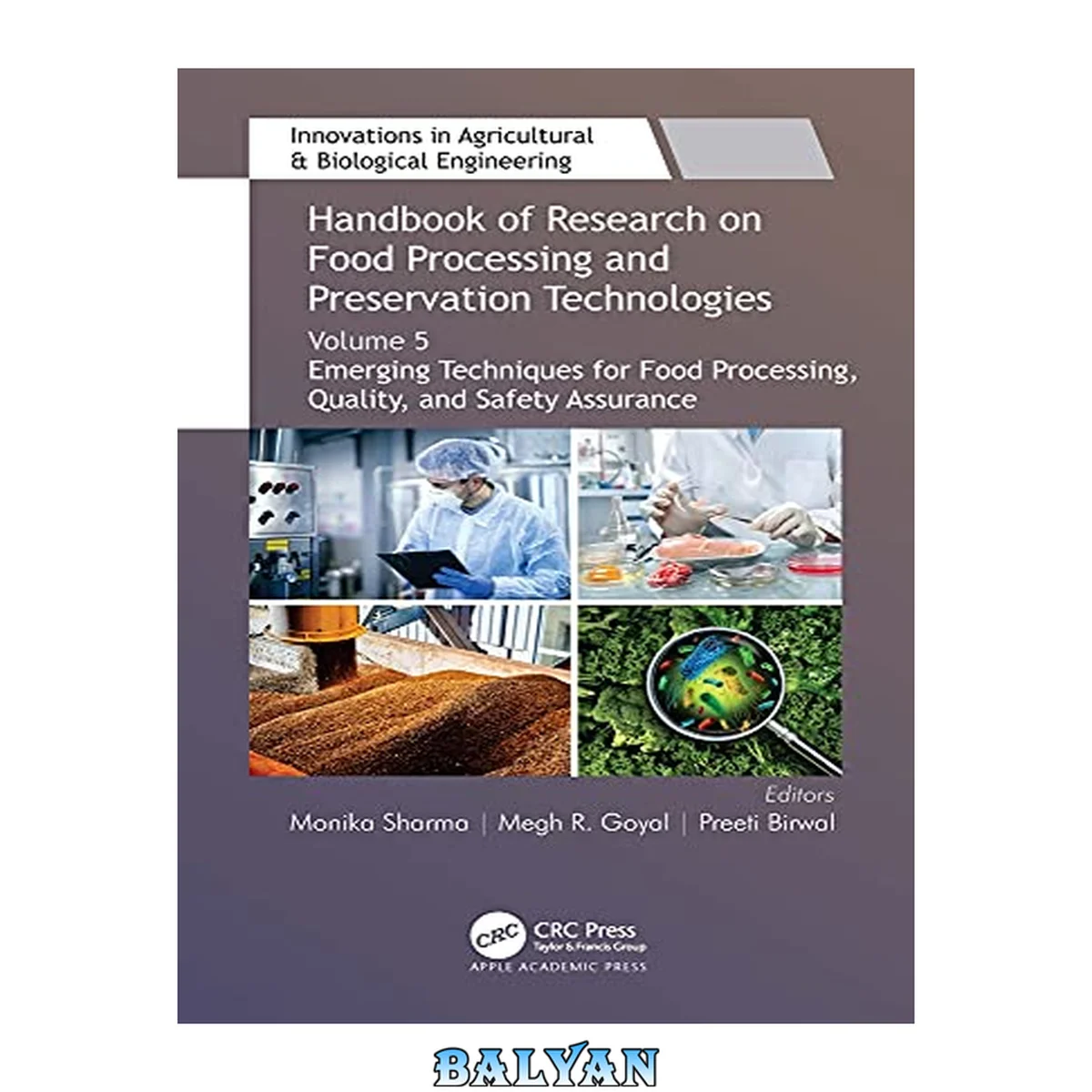
معرفی کتاب «Handbook of Research on Food Processing and Preservation Technologies : Volume 5: Emerging Techniques for Food Processing, Quality, and Safety Assurance» نوشتهٔ [法] 费尔南·布罗代尔 و Monika Sharma (editor), Megh R. Goyal (editor), Preeti Birwal (editor)، منتشرشده توسط نشر Apple Academic Press ; CRC Press در سال 2021. این کتاب در فرمت pdf، زبان انگلیسی ارائه شده است.
"The Handbook of Research on Food Processing and Preservation Technologies covers a vast abundance of information on various design, development, and applications of novel and innovative strategies for food processing and preservation. The roles and applications of minimal processing techniques (such as ozone treatment, vacuum drying, osmotic dehydration, dense phase carbon dioxide treatment, pulsed electric field, and high-pressure assisted freezing) are discussed, along with a wide range of applications. The handbook also explores some exciting computer-aided techniques emerging in the food processing sector, such as robotics, radio frequency identification (RFID), three-dimensional food printing, artificial intelligence, etc. Some emphasis has also been given on nondestructive quality evaluation techniques (such as image processing, terahertz spectroscopy imaging technique, near infrared, Fourier transform infrared spectroscopy technique, etc.) for food quality and safety evaluation. The significant roles of food properties in the design of specific foods and edible films have been elucidated as well. Volume 5: Emerging Techniques for Food Processing, Quality, and Safety Assurance discusses various emerging techniques for food preservation, formulation, and nondestructive quality evaluation techniques. Each chapter covers major aspects pertaining to principles, design, and applications of various food processing methods, such as low temperature-based-ultrasonic drying of foods, hypobaric processing of foods, viability of high-pressure technology, application of pulsed electric fields in food preservation, green nanotechnology for food processing and preservation, advanced methods of encapsulation, basics and methods of food authentication, imaging techniques for quality inspection of spices and nuts, FTIR coupled with chemometrics for food quality and safety, and the use of robotic engineering for quality and safety"-- Provided by publisher The Handbook of Research on Food Processing and Preservation Technologies covers a vast abundance of information on various design, development, and applications of novel and innovative strategies for food processing and preservation. The roles and applications of minimal processing techniques (such as ozone treatment, vacuum drying, osmotic dehydration, dense phase carbon dioxide treatment, pulsed electric field, and high-pressure assisted freezing) are discussed, along with a wide range of applications. The handbook also explores some exciting computer-aided techniques emerging in the food processing sector, such as robotics, radio frequency identification (RFID), three-dimensional food printing, artificial intelligence, etc. Some emphasis has also been given on nondestructive quality evaluation techniques (such as image processing, terahertz spectroscopy imaging technique, near infrared, Fourier transform infrared spectroscopy technique, etc.) for food quality and safety evaluation. The significant roles of food properties in the design of specific foods and edible films have been elucidated as well.Volume 5: Emerging Techniques for Food Processing, Quality, and Safety Assurance discusses various emerging techniques for food preservation, formulation, and nondestructive quality evaluation techniques. Each chapter covers major aspects pertaining to principles, design, and applications of various food processing methods, such as low temperature-based-ultrasonic drying of foods, hypobaric processing of foods, viability of high-pressure technology, application of pulsed electric fields in food preservation, green nanotechnology for food processing and preservation, advanced methods of encapsulation, basics and methods of food authentication, imaging techniques for quality inspection of spices and nuts, FTIR coupled with chemometrics for food quality and safety, and the use of robotic engineering for quality and safety.Other volumes in the 5-volume set include:Volume 1: Nonthermal and Innovative Food Processing MethodsVolume 2: Nonthermal Food Preservation and Novel Processing StrategiesVolume 3: Computer-Aided Food Processing and Quality Evaluation TechniquesVolume 4: Design and Development of Specific Foods, Packaging Systems, and Food SafetyTogether with the other volumes in the set, the Handbook of Research on Food Processing and Preservation Technologies will be a valuable resource for researchers, scientists, students, growers, traders, processors, industries, and others. About the Book Series: Innovations in Agricultural and Biological Engineering Other Books on Agricultural and Biological Engineering from Apple Academic Press, Inc. About the Editors Contents Contributors Abbreviations Symbols Preface PART I: EMERGING TECHNOLOGIES FOR PRESERVATION AND FORMULATION OF FOODS 1. Low Temperature Based Ultrasonic Drying of Foods • Pavan M. Gundu, Preeti Birwal, Chaitradeepa G. Mestri, and Abila Krishna 2. Hypobaric Processing of Food • Sharanabasava Kumbar and Menon Rekha Ravindra 3. Viability of High‐Pressure Technology in the Food Industry • Mohona Munshi, Madhusudan Sharma, and Saptashish Deb 4. Potential of Pulsed Electric Fields in Food Preservation • Pranali Nikam, Suvartan Ranvir, John David, Thejus Jacob, and Raman Seth 5. Pulsed Light Technology in Food Processing and Preservation • Mahendra Gunjal, Humeera Tazeen, Pavan M. Gundu, Preeti Birwal, and Abila Krishna 6. Potential of Green Nanotechnology in Food Processing and Preservation • ............................................. 135Shikha Pandhi, Arvind Kumar, Sadhna Mishra, and Dinesh Chandra Rai 7. Food Encapsulation: Principles, Novel Methods, and Applications • Nikunj Sharma, Syed Mansha Rafiq, and Syed Insha Rafiq PART II: NON‐DESTRUCTIVE TECHNIQUES FOR FOOD QUALITY AND SAFETY 8. Food Authentication: Basics and Detection Methods • Sangita Bansal, Kanika Sharma, and Era V. Malhotra 9. Imaging Techniques for Quality Assessment of Spices and Nuts • Leena Kumari, Monika Sharma, and Gajanan Deshmukh 10. Fourier Transform Infrared (FTIR) Spectroscopy with Chemometrics: Evaluation of Food Quality and Safety • Neelam Upadhyay, C. G. Harshitha, Nilesh Kumar Pathak, and Rajan Sharma 11. Robotic Engineering: A Tool for Quality and Safety of Foods • Ravi Prakash and Menon Rekha Ravindra Index "Handbook of Research on Food Processing and Preservation Technologies will be a 5-volume collection that attempts to illustrate various design, development, and applications of novel and innovative strategies for food processing and preservation. The role and applications of minimal processing techniques (such as ozone treatment, vacuum drying, osmotic dehydration, dense phase carbon dioxide treatment, pulsed electric field, and high-pressure assisted freezing) are also discussed, along with a wide range of applications. The handbook also explores some exciting computer-aided techniques emerging in the food processing sector, such as robotics, radio frequency identification (RFID), three-dimensional food printing, artificial intelligence, etc. Some emphasis has also been given on nondestructive quality evaluation techniques (such as image processing, terahertz spectroscopy imaging technique, near infrared, Fourier transform infrared spectroscopy technique, etc.) for food quality and safety evaluation. The significant roles of food properties in the design of specific foods and edible films have been elucidated as well. The first volume in this set, Nonthermal and Innovative Food Processing Methods, provides a detailed discussion of many nonthermal food process techniques. These include high-pressure processing, ultraviolet light technology, microwave-assisted extraction, high pressure assisted freezing, microencapsulation, dense phase carbon dioxide aided preservation, to name a few. The volume is a treasure house of valuable information and will be an excellent reference for researchers, scientists, students, growers, traders, processors, industries, and others."-- Provided by publisher
دانلود کتاب Handbook of Research on Food Processing and Preservation Technologies : Volume 5: Emerging Techniques for Food Processing, Quality, and Safety Assurance