Handbook of International Trade Agreements: Country, regional and global approaches (Routledge International Handbooks)
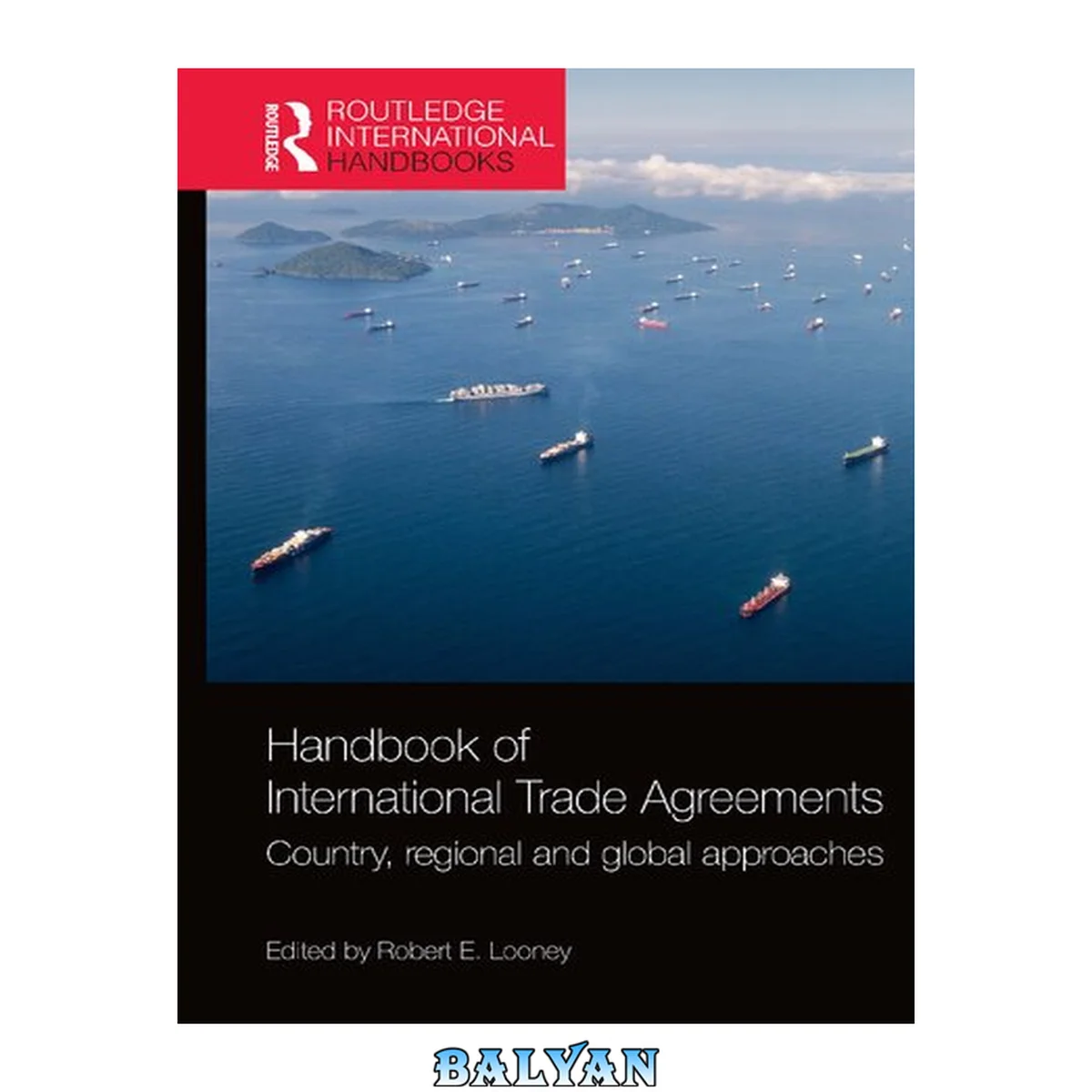
معرفی کتاب «Handbook of International Trade Agreements: Country, regional and global approaches (Routledge International Handbooks)» نوشتهٔ Robert E. Looney, (editor)، منتشرشده توسط نشر Routledge در سال 2018. این کتاب در فرمت pdf، زبان انگلیسی ارائه شده است.
International trade has, for decades, been central to economic growth and improved standards of living for nations and regions worldwide. For most of the advanced countries, trade has raised standards of living, while for most emerging economies, growth did not begin until their integration into the global economy. The economic explanation is simple: international trade facilitates specialization, increased efficiency and improved productivity to an extent impossible in closed economies. However, recent years have seen a significant slowdown in global trade, and the global system has increasingly come under attack from politicians on the right and on the left. The benefits of open markets, the continuation of international co-operation, and the usefulness of multilateral institutions such as the World Trade Organization (WTO), the International Monetary Fund and the World Bank have all been called into question. While globalization has had a broadly positive effect on overall global welfare, it has also been perceived by the public as damaging communities and social classes in the industrialized world, spawning, for example, Brexit and the US exit from the Trans-Pacific Partnership. The purpose of this volume is to examine international and regional preferential trade agreements (PTAs), which offer like-minded countries a possible means to continue receiving the benefits of economic liberalization and expanded trade. What are the strengths and weaknesses of such agreements, and how can they sustain growth and prosperity for their members in an ever-challenging global economic environment? The Handbook is divided into two parts. The first, Global Themes, offers analysis of issues including the WTO, trade agreements and economic development, intellectual property rights, security and environmental issues, and PTAs and developing countries. The second part examines regional and country-specific agreements and issues, including NAFTA, CARICOM, CETA, the Pacific Alliance, the European Union, EFTA, ECOWAS, SADC, TTIP, RCEP and the TPP (now the CPTPP), as well as the policies of countries such as Japan and Australia. Cover Half Title Title Page Copyright Page Dedication Table of Contents List of illustrations The Editor and Contributors Preface Acknowledgements Acronyms and Abbreviations PART I:Global Themes 1. Introduction 2. Regional trade agreements: Myths and misconceptions Myth 1: RTAs are formed owing to lack of progress at the WTO Myth 2: RTAs are bad for the WTO Myth 3: RTAs divert trade Myth 4: RTAs hurt jobs Myth 5: RTAs create an unmanageable ‘spaghetti bowl’ Myth 6: RTAs will forever Balkanize the global trading system Myth 7: RTAs should not be renegotiated Conclusion Notes 3. The WTO and regional/bilateral trade agreements Non-discrimination and multilateralism in the post-war trading system Trends in regionalism WTO responses to the proliferation in RTAs Implications of regionalism Whither trade policy? Notes 4. International agreements on intellectual property rights: TRIPS and beyond Introduction TRIPS and the WTO The Role of preferential trade agreements and the TRIPS-Plus agenda Conclusion Notes 5. The spread of international trade agreements: A dynamics towards the ‘spaghetti bowl’ phenomenon? Introduction Political economy of ITAs Evidence of the ‘spaghetti bowl’ phenomenon Conclusion Notes 6. The economic effects of FTAs Introduction Effects on trade Effects on firms and labour markets Effects on economic welfare Conclusion Notes 7. Trade agreements and economic development Introduction The anticipated effects of trade agreements Why they may not happen Problems with assessing impact Effects of trade agreements on government revenue Applying the lessons – the case of Brexit Conclusion Notes 8. The investment component of trade agreements Introduction Overview: investment rules in trade agreements Context: regulating investment protection through trade agreements Norms: legal issues raised by PTIA’s investment chapters Conclusion Notes 9. Trade agreements and national security: An economic approach International trade, alliances and conflict A classical economic analysis of trade agreements A neoclassical economic analysis of trade agreements A ‘new trade’ theory analysis of trade agreements Conclusion Notes 10. Economic reform and service liberalization in developing countries: Can preferential trade agreements help? Introduction The problem of reforming Trade agreements and economic reform Reforming services: evidence from US PTAs Conclusion Notes 11. Gender rights and trade agreements Introduction The gender-trade nexus The codification of gender rights in trade agreements Future directions in gender-aware trade policies Conclusion Notes 12. Trade agreements and the environment Introduction Precautionary principle Regional trade agreements and the environment Conclusion Notes 13. Neoliberal globalization and its opponents Resisting neoliberal globalization: from Heiligendamm to crisis to Trump Neoliberal globalization: a brief critical history Resisting neoliberal globalization: three critiques Conclusion: three critiques of 21st-century globalization in action Notes PART II:Regional/Country Analysis 14. NAFTA Introduction Origins, negotiation, debate and enactment Content of the agreement Economic impact of NAFTA The future of NAFTA post-Trump Notes 15. CAFTA-DR: diverging trajectories and uneven development Introduction Background and motivations Regional integration The US relationship with the five Central American countries Negotiations Opposition and ratification The first decade of consequences Diverging national trajectories The USA Costa Rica Dominican Republic Nicaragua Northern Triangle Prospects for deeper integration Securitization Infrastructure expansion Environmental oversight Conclusion Notes 16. CARICOM Introduction The CARICOM region: a brief description CARICOM’s involvements in trade agreements Assessing CARICOM’s involvement in trade agreements Summary and conclusion Notes 17. Mexico’s approach to preferential agreements Introduction Mexico’s FTA network The North American Free Trade Agreement Europe: the EU and the EFTA Asia-Pacific Challenges to Mexico’s open regionalism Conclusion Notes 18. CETA Introduction Pre-history What is CETA all about? Canadian interests in CETA Motivation of the EU Cracks in the European trade coalition Conclusion 19. Mercosur The foundation of Mercosur and the economic-commercial phase (1991–2002) The social, political, participatory and distributive phase (2003–10) The uncertainty phase (2011–) Conclusion Notes 20. The Pacific Alliance Nature, functioning and achievements of the Pacific Alliance Regional integration as a national strategy Challenges and new initiatives Conclusion Notes 21. ALBA Introduction The emergence of ALBA From Alternative to Alliance, contestation to content Implementing innovative ideas The People’s Trade Treaty The Unified Regional Compensation System Petrocaribe The impact of irregular implementation ALBA’s prospects for future integration Notes 22. The European Union Introduction The challenges to the EU’s global trade position The challenge of coordinating trade policy in the diverse European single market The impact of the global financial crisis Perspectives for the EU after Brexit Notes 23. TTIP Introduction TTIP: long in the making The EU negotiation mandate Areas of consent and dissent between the EU and the USA Academic and societal critique of TTIP Notes 24. EFTA Introduction The establishment of EFTA Development of relations with the EU The EEA Agreement: EFTA-EU relations beyond free trade The creation of EFTA’s third-country policy Development of intra-EFTA relations The functioning of the EEA EFTA’s third-country policy: developing relations beyond the EU Future challenges for the EEA Future challenges for EFTA’s third-country policy Notes 25. Eastern Partnership countries Introduction Trade negotiations between the EU and the EaP countries Quality of institutions in the EaP countries Actual trade patterns The effects on trade of the DCFTAs Conclusion Notes 26. Trade agreements and regional integration: The European Union after Brexit EU trade dynamics: towards comprehensive FTAs and unaffected by Brexit Brexit is a peculiar case in an international trade context Brexit and the EU Prospective arrangements for a post-Brexit EU-UK trade relationship Challenges facing the UK as an EU outsider The position of the EU Deep FTAs prompt a qualitative change in EU trade The issue of regulation in internal and external trade Notes 27. The GCC trade agreements: regional integration challenges and opportunities Introduction GCC economic integration goals Bilateral FTAs The case of Bahrain The case of Oman The case for free trade in the GCC GCC FTA accords with three partners The case of Singapore The case of EFTA Negotiations with India Conclusion Notes 28. Liberalization without integration: Egypt and PTAs (1990–2010) The curious case of liberalization-cum-PTAs Where does Egypt stand? A review of the literature Egypt’s many PTAs Conclusion: PTAs and feigned reorientation Notes 29. The African Union and the European Union: Trade reciprocity and/or economic development? The moral economy of EU trade reciprocity as embodied within the EPA agenda DCFTAS and the moral economy of trade reciprocity in the Maghreb The AU-EU partnership and agency for progressive action to contest ‘trade reciprocity’ Conclusion Notes 30. ECOWAS: An economic commitment that needs political strengthening Introduction Highlights of the ECOWAS treaty (1975 and 1993) Summary of trade and common sectoral polices Conceptual markers for understanding the problem of coordination and cooperation11 Conclusion Notes 31. SADC: Towards a deeper and wider union? Introduction History SADC’s mission Organizational structure SADC’s Common Agenda: increased regional integration Other SADC initiatives Appendix A: SADC Protocols (dates signed) Notes 32. COMESA: A case study Introduction The background to COMESA Objectives of COMESA Share of value added to GDP, 2016 Continental FTA: implications Conclusion Notes 33. RCEP and Asian economic integration Introduction The framework for negotiations Contribution to economic integration Quantifying economic impacts and risks Case studies of India and Sri Lanka Pathways to multilateralization Conclusion Appendix Notes 34. The TPP: Origins and outcomes The TPP: origins The TPP: like-minded but diverse participants The TPP: broad objectives The TPP: scope and coverage Postscript: moving the TPP forwards without the USA Notes 35. Japan’s approach to preferential trade agreements The political and social context of Japan’s PTA policy Japan’s bilateral and regional PTAs A shifting focus to mega-regional agreements Conclusion Notes 36. Australia’s approach to PTAs Preferential trade agreements with developing countries Regional integration with New Zealand Bilateral trade agreements Negotiating mega-regionals The Australia-Europe-Asia Triangle Conclusion Notes Index International trade has, for decades, been central to economic growth and improved standards of living for nations and regions worldwide. For most of the advanced countries, trade has raised standards of living, while for most emerging economies, growth did not begin until their integration into the global economy. The economic explanation is simple: international trade facilitates specialization, increased efficiency and improved productivity to an extent impossible in closed economies. However, recent years have seen a significant slowdown in global trade, and the global system has increasingly come under attack from politicians on the right and on the left. The benefits of open markets, the continuation of international co-operation, and the usefulness of multilateral institutions such as the World Trade Organization (WTO), the International Monetary Fund and the World Bank have all been called into question. While globalization has had a broadly positive effect on overall global welfare, it has also been perceived by the public as damaging communities and social classes in the industrialized world, spawning, for example, Brexit and the US exit from the Trans-Pacific Partnership. The purpose of this volume is to examine international and regional preferential trade agreements (PTAs), which offer like-minded countries a possible means to continue receiving the benefits of economic liberalization and expanded trade. What are the strengths and weaknesses of such agreements, and how can they sustain growth and prosperity for their members in an ever-challenging global economic environment? (4e de couverture)
دانلود کتاب Handbook of International Trade Agreements: Country, regional and global approaches (Routledge International Handbooks)