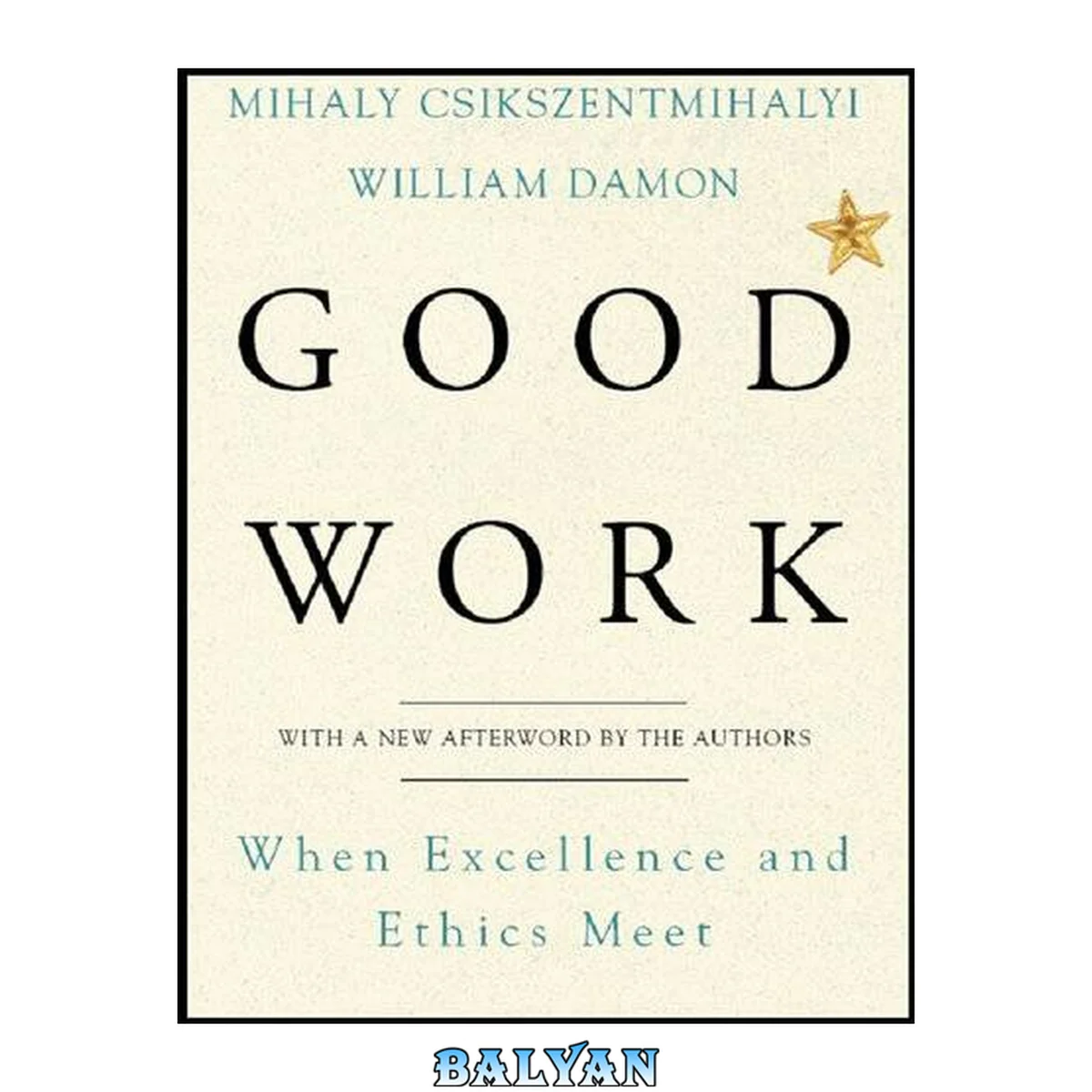
معرفی کتاب «Good Work : When Excellence and Ethics Meet» نوشتهٔ Chastity Foelds و Howard E Gardner, Mihaly Csikszentmihalhi, William Damon، منتشرشده توسط نشر Basic Books : Perseus Books در سال 2008. این کتاب در فرمت epub، زبان انگلیسی ارائه شده است.
What does it mean to carry out "good work"? What strategies allow people to maintain moral and ethical standards at a time when market forces have unprecedented power and work life is being radically altered by technological innovation? These questions lie at the heart of this eagerly awaited new book. Focusing on genetics and journalism-two fields that generate and manipulate information and thus affect our lives in myriad ways-the authors show how in their quest to build meaningful careers successful professionals exhibit "humane creativity," high-level performance coupled with social responsibility. Over the last five years the authors have interviewed over 100 people in each field who are engaged in cutting-edge work, probing their goals and visions, their obstacles and fears, and how they pass on their most cherished practices and values. They found sharp contrasts between the two fields. Until now, geneticists' values have not been seriously challenged by the demands of their work world, while journalists are deeply disillusioned by the conflict between commerce and ethics. The dilemmas these professionals face and the strategies they choose in their search for a moral compass offer valuable guidance on how all persons can transform their professions and their lives. Enlivened with stories of real people facing hard decisions, Good Work offers powerful insight into one of the most important issues of our time and, indeed, into the future course of science, technology, and communication. GOOD WORKWhen Excellence and Ethics MeetBy Howard Gardner, Mihaly Csikszentmihalyi and William DamonBASIC BOOKSCopyright © 2001 Howard Gardner, Mihaly Csikszentmihalyi and William Damon.All rights reserved.ISBN: 0-465-02607-9Chapter One Good Work in Difficult TimesIn every historical era, many people have sought to carry outgood work. It has always been true that some people do their work expertlybut not very responsibly. People who do good work, in our sense ofthe term, are clearly skilled in one or more professional realms. At thesame time, rather than merely following money or fame alone, or choosingthe path of least resistance when in conflict, they are thoughtful abouttheir responsibilities and the implications of their work. At best, they areconcerned to act in a responsible fashion with respect toward their personalgoals; their family, friends, peers and colleagues; their mission orsense of calling; the institutions with which they are affiliated; and, lastly,the wider worldpeople they do not know, those who will come afterwards,and, in the grandest sense, to the planet or to God. To be sure, no one can continually monitor each of these responsibilities.Like the proverbial centipede asked to explain how it walks, a workerwould find this impractical and probably counterproductive. Still, a goodprofessional maintains these concerns implicitly and returns to themexplicitly from time to time. Good Work in Uncertain TimesTo do good work is a laudable goal, one difficult to achieve even under favorablecircumstances. In the modern world scarcely anyone is sealed offfrom rampant and rapid innovations or from intrusive market forces. Indeed,even in professions that might seem immune, these forces are dramaticallyevident. In education, charter schools and voucher programsare sprouting up in different corners of the globe. For-profit institutionslike the University of Phoenix are roiling traditional liberal arts collegesand universities. In the museum world, where competition rages for bigger-than-everblockbuster shows, exhibitions are sponsored by corporationsthat demand an increasing say over what is displayed and how.Churches are competing for larger congregations, more lavish buildings,and more charismatic religious leaders. And even traditionally secretivephilanthropic foundations are hiring publicists to make sure that their"good works" are well known: they are contemplating "strategic alliances"with neighboring institutions and fretting about the challenges posed bynew-style venture philanthropy or charitable accounts offered by investmenthouses. Similarly, there are physicians who cannot prescribe acourse of treatment because it will not be underwritten by the HMO,corporate lawyers whose employers engage in shady practices, teacherswho believe they should hug unhappy children but are forbidden even totouch them on the shoulder, and museum curators who need money tomount shows but like neither the artists, the policies, nor the restrictionsimposed by the most generous arts funders. Of course, ethical and professional dilemmas are not new. And manywould argue, with some justification, that the ways to deal with themhave long been known. They would say that the solutions can be foundin the great religions, in the Bible and other sacred texts, in long-standingmodels of behavior contained in the very traditions of the professions,and in the behaviors of well-known exemplarsfor instance, physicianssuch as Albert Schweitzer and Jonas Salk, and journalists such as EdwardR. Murrow and I. F. Stone. But religious and professional traditions arenot always available to young people, and they are not always credible.Much evil has been carried out in the name of religion, and many once-idolizedfigures (ranging from politicians such as John F. Kennedy tobusiness titans such as Henry Ford or Walt Disney to athletes such as TyCobb) turn out to have had notable character flaws. And even when theidols remain relatively untarnished and the relevant texts have been studied,it is becoming increasingly difficult to know just how to draw inspirationfrom models in vastly changing circumstances. Murrow did not haveto compete with the Internet; Salk did not face an environment in whichvirtually every medical discovery was immediately patented; AbrahamLincoln did not have every element of his private life scrutinized by themedia or made into a lurid TV movie while he was attempting to commandthe Union forces. This is why we speak not just of "good work" butof "good work in difficult times." Not difficult, necessarily, in terms ofdaily creature comforts, but difficult in terms of people's ability to knowthe right thing to do and remain in their professions. Still, there is an important clue as to whether one is carrying out goodwork. Doing good work feels good. Few things in life are as enjoyable aswhen we concentrate on a difficult task, using all our skills, knowingwhat has to be done. And, contrary to popular opinion, these highly enjoyablemomentsthe ones Mihaly Csikszentmihalyi calls "flow experiences"occurmore often on the job than in leisure time. In flow wefeel totally involved, lost in a seemingly effortless performance. Paradoxically,we feel 100 percent alive when we are so committed to the task athand that we lose track of time, of our interestseven of our own existence.Intense flow can happen anywhere: in making love, in listening tomusic, in playing a good game of squash or chess. But it also happens surprisinglyoften at workas long as the job provides clear goals, immediatefeedback, and a level of challenges matching our skills. When theseconditions are present, we have a chance to experience work as "good"thatis, as something that allows the full expression of what is best in us,something we experience as rewarding and enjoyable. To be sure, feelingsof flow do not always signal that one is performing "good work" in oursense; the robber who is fully engaged in cracking a safe may well undergocomparable engagement. Nor do we want to imply that "goodwork" is always accompanied by flow; it can be frustrating and discouragingat times. Yet, time and again, we have observed the rewards of flowbestowed on individuals who have become wholly engaged in activitiesthat exhibit the highest sense of responsibility. Journalism and Genetics: An Instructive ContrastJournalism and genetics are textbook examples of professions that mustcontinually face new challenges. As we began to probe how journalistsand geneticists carry out their work, we discovered that professionals inthese fields differ in a way that we had not anticipated. Geneticists areworking at a time in which the profession is tremendously exciting; all ofthe relevant forces in their universe are well aligned. The general public,the shareholders of genetech corporations, and the scientists themselvesare working toward a common goal: ensuring healthier and longer livesfor people. In sharp contrast, journalists tell us they are working at a timewhen their profession is wracked by confusion and doubtthat is, atime when the relevant forces are massively misaligned. Journalists mayfeel the need to take time to investigate a complex story, but the public iscalling instead for gossip and scandal while management is seekinggreater profits in the next quarter. At a time of alignment, good workseems relatively unproblematic. During a phase of misalignment, however,it becomes a challenge. (We discuss alignment and misalignmentmuch more in Chapter 2.) And so, to an extent that we could not have anticipated, genetics andjournalism represent sharply contrastingvirtually polar oppositecasesin a study of professional realms. In well-aligned genetics, the pursuit ofgood work may appear to be relatively unproblematic; in misaligned journalism,the threat to carrying out good work is ubiquitous. Yet, theemerging story is not quite so simple. Apparent alignment may blindworkers to troublesome forces, even as significant threats to good workbubble beneath the untroubled surface. There are in genetics today manyreasons for concern, ranging from the blurring of the line between disinterestedscholarly research and research carried out to ensure profits, to thetendency to deny the risks entailed in genetic therapy or the cloning of organisms.Conversely, blatant misalignment may actually have a beneficentdimension; such disequilibrium clearly exposes the threats to good workand may mobilize people to struggle productively, to confirm the essenceof their calling, embrace high standards, and reaffirm their personal identities.Journalism may well become strongerand better alignedjustbecause the fault lines in the profession have become obvious.A Crisis in the Journalism ProfessionTime for an example. In 1993 broadcast journalist Ray Suarez found himselfin a quandarythe biggest conflict of his professional life. His hearttold him to get out of this line of work, while his bank balance told himto swallow his pride and do his assigned job. His head, where he had tosort out the alternatives and make a decision, was swirling. Suarez, now senior correspondent for the Public Broadcasting Service'sNews Hour, has since 1993 been associated with public broadcasting. Bestknown for his six-year stint as the host of the two-hour afternoon showTalk of the Nation, on National Public Radio (NPR), Suarez has been aninnovator, much honored within the profession and widely respectedamong the listening public. He was one of the first journalists to whomwe spoke as part of our study of good work. Before joining NPR, Suarez had a richly varied but not always palatablelife in journalism. Having discovered a love of writing during highschool, he had worked as a radio and television reporter both in theUnited States and abroad. Beginning in the mid-1980s Suarez had aseven-year stint in commercial news with Channel 5, an NBC affiliate inChicago. While there, he encountered the dilemma that made him considerquitting the profession entirely: When video games first started to become hot, a family sued the major makers of video games in the United States for some unbelievable amount of money ... because their kids would get seizures. And about half-way into the reporting of the story, I realized that we were talking about one-tenth of one one-hundredth of one one-thousandth of the kids who play video games. But TV has a tendency to play everything like, "Here's a possible danger of video games." And I called in, sort of to telegraph my concerns ahead, sort of in advance for this fight that I knew we were going to have, about the way we were going to play this story. And I said ... it's irresponsible to give people the idea that video games are dangerous, or, in the way that television usually does, it teases "could be dangerous" to your family, making no guarantees but getting you to salivate and listen. I said, we're talking about a tiny number of American children, a tiny number. And once you find out that your kids have this, which you may have already known before they ever sat down to play one video game, because all kinds of computer and TV monitors shoot impulses to the eye at this number of times per second.... If they play anyway, and have seizures, well whose fault is that? We're talking about a story that we're going to play as a hot, big story, that isn't a story. Because we tell stories that have impact with large numbers of people, so what we're trying to do is just cross our fingers, put them behind our back, and we'll tell them at the end, oh, and by the way, your kids probably are okay. I said, I don't want to do that. I think it's cheap, I think it's not true, I think even, no matter how many times we couch it and qualify it, it will leave an untrue residue in the minds of people who watch the story. So what are we really doing? We're just winding people up. We're not telling them good information. Suarez sadly summed up the battle with the executive of the station:"And that fight went on for a long time, in TV terms, like an hour or anhour and a half. I lost." He comments ruefully on the outcome: "There's only so much in theway of showboaty integrity that you can afford to have, because if youhave a contract and the contract says certain things, and one of the thingsis, you have to do what you're told." Eventually finding the situation intolerable,Suarez recalled, "At the time that NPR hired me, I was makingactive plans to get out of the news business. You know, thank God, I hadthat option." During the course of their careers, most people find themselves in situationsthat test their sense of appropriate behavior and challenge them toreassess major aspects of their lives. At this point of crisis, Suarez probablyfound it helpful to take into account his personal goals, the core values ofjournalism, the needs of the television station and network that employedhim, and, finally, the implication of his actions for those whom he didnot know, especially the thousands of individuals influenced by hisbroadcasts. Sometimes professionals find ways to resolve complex dilemmaswithout too much stress. But when resolutions are not easily forthcoming,they are faced, as was Suarez, with a sharp set of choices. What options would you or any other professional have in such situations?To begin with, you could decide simply to take the easiest courseand go along with the mandated behavior. In fact, family and financialobligations might leave few other options. Or you could remain in yourcurrent position and continue to fight, perhaps even managing to convinceyour employer of the superiority of your stand. There would also bethe risk of your getting fired or becoming exhausted, frustrated, and demoralized.You could band together with others who shared your perspectiveand begin to protest privately or even publicly. Whenmanagement's behavior has been flagrantly inappropriate, as occasionallyhappens in the news media, group action can be effective. But as PresidentRonald Reagan demonstrated in 1981 when he summarily fired thenation's striking air traffic controllers, it is all too easy to replace a defiantcrew with a more compliant one. Of course, you could always choose to quita more viable option ifyou had marketable skills and other jobs were there for the asking. Butabandoning a career altogether, as Suarez considered doing, is an extremelywrenching option. Finally, you could find or create an organization that would allow youto realize your professional aspirations. This would be the ideal solutionandit is one of particular interest to us in this study of good work.If an institution already existed that embodied your values, you could tryto secure a position with it, even at the cost of moving to a new locale oraccepting a reduction in pay. Or you could help create or transform anexisting institution. Suarez was not the creator of National Public Radio,but he helped turn it into the powerful and intellectually respectablebroadcast news outlet that it remains today. Mission, Standards, and IdentityStepping back from Ray Suarez's quandary, let's look at how any engagedworker or professional might handle similar situations. Consider, for example,the HMO physician who believes that each patient needs to beseen until that patient has received a proper evaluation and diagnosis, butwhose employer insists that she schedule at least six visits an hour and penalizesher when she does not comply. Or a lawyer working for a largemultinational who is told that a bribe will be necessary in a third worldcountry and is instructed to pay money under the table in a forthcomingnegotiation. Or the teacher who believes that history is best taught by adeep immersion in a limited number of topics, but must abandon hiscurriculum and "teach to" a newly mandated state test that probes one'smemory for disparate facts. Or the craftsman who believes in using onlythe finest materials, but who is instructed by his contractor to use inferiormaterials, which are unlikely to be detected by trusting purchasers andwhich will half the production costs. At such critical times, we suggest, thoughtful practitioners should considerthree basic issues: missionthe defining features of the profession inwhich they are engaged; standardsthe established "best practices" of aprofession; and identitytheir personal integrity and values.MissionEach realm of work has a central mission, which reflects a basic societalneed and which the practitioner should feel committed to realizing. Thecore of the mission of medicine is the healing of the sick and the afflicted.The core mission of the legal profession is the pursuit of justice, throughthe resolution of conflict or the orderly and civilized righting of wrongs.Teachers pass on the most important knowledge of the past and preparetheir students for the future. Craftspersons make objects that are beautifuland useful. All practitioners should be able to state the core traditionalmission of their own fields. At best, the mission is part of what draws thepractitioner to a chosen profession and remains as a principal sustenancein times of conflict. A good way of clarifying this sense of mission is toask: "Why should society reward the kind of work that I do with statusand certain privileges?"StandardsEach profession prescribes standards of performance, some permanent,some changing with time and place. The classic example is the Hippocraticoath: the physician is enjoined to do no harm, to respond to callswithout attention to personal preferences, to keep confidences, to lead anhonorable life, to use medicines only for curative purposes, and to desistfrom exploiting the patient. There are comparable standards for otherprofessions. Lawyers are expected to be personally ethical, to provide thebest possible defense for their clients, not to withhold information fromthe court, not to use perjured testimony, and to maintain confidences.Teachers are expected to be moral exemplars, to be well informed, to treatall youngsters fairly, and to avoid personal relations with their students.People involved in the crafts are expected to use the finest materials, topass on their special skills and understandings to apprentices, and toavoid cutting corners in their work. Professionals should be able to employ, as a standards test, the question,"Which workers in the profession best realize the calling and why?"A list of admired workers, along with their virtues, should reveal the standardsembodied in the profession.IdentityOur third consideration is a person's own background, traits, and values,as these add up to a holistic sense of identity: a person's deeply felt convictionsabout who she is, and what matters most to her existence as aworker, a citizen, and a human being. A central element of identity ismoralpeople must determine for themselves what lines they will notcross and why they will not cross them. But a sense of identity also includespersonality traits, motivation, intellectual strengths and weaknesses,and personal likes and dislikes. As psychologists, we have an enduring interest in issues of identity. (Infact, Howard Gardner and William Damon studied with Erik Erikson,the psychologist who, in the mid-1900s, developed the concept of identity.)Each person's identity is shaped by an amalgam of forces, includingfamily history, religious and ideological beliefs, community membership,and idiosyncratic individual experiences. In the best of circumstances,these complement one another and add up to a coherent and positive attitude,one that makes sense to the person and to the surrounding community.Of course, such an integrated sense of identity remains an ideal:nearly everyone suffers at times from some fragmentation of identity,some diffusion, some confusion. Nor does identity ever completely coalesce.Rich lives include continuing internal conversations about who weare, what we want to achieve, where we are successful, and where we arefalling short. There is a clear-cut gauge for identity, which might be called the "mirrortest." The image comes from the story of a German ambassador inLondon who, as part of a celebration he had to host in honor of Britain'sKing Edward VII, was asked to provide a bevy of prostitutes. The diplomatfelt that he could not do this and instead resigned his position. Askedwhy, he responded, "I refused to see a pimp in the mirror in the morningwhen I shave." Only when we can look proudly in the mirror can we besaid to have affirmed our identity. Of course, on occasion the hacker whocripples a network or the politician who has no intention of fulfilling hispromises may be proud of what he has gotten away with. In such cases, itis necessary to invoke the universal mirror test: "What would it be like tolive in a world if everyone were to behave in the way that I have?" The Psychological PerspectiveIn framing the situation of the worker in terms of these three considerations,we are drawing on our own professional formations and values. Weare psychologists-social scientists who study the mind's capacities andresourcesits intelligences, motives, needs, and values. All humanbeings endeavor to understand what is happening around us, to makesense of our experiences. All human beings also have the capacity toframe experiences in certain waysto construe them in a way that eithermotivates or paralyzes action. And most crucially, all human beings areable to choose from a range of actionsas the economist AlbertHirschman memorably phrased it, we may speak, express loyalty, voiceconcerns, or exit from the scene. The authors' disciplinary backgroundshave shaped our appreciation for the powerful role played by personalcapacities and resources in the lives of contemporary professionals. If we consider Ray Suarez's situation as a representative one, we canbetter understand how psychological factors can affect choices. WhenSuarez's employer told him to accentuate the dangers of video games, hecould have reflexively followed the orders. Indeed, in a totalitarian society,such blind obedience would probably be the realistic course to ensurethat he could wake up and see his family the next morning. Let's say,however, that he decided that he could not comply with the directive. Atthis point, one's construal of the situation becomes crucial. If Suarez wereinsecure and pessimistic, he might conclude that he had no future injournalism and should move instead to a less demanding, if also less satisfying,career. But if he were more self-confident and optimistic about thefuture, he might interpret the boss's words as a wake-up call. At that pointhe would have to decide whether to cede his sense of personal agency tosomeone else or to retain control of his own life and of his own senseabout the right way to pursue journalism. We have seen how he, in fact,dealt with the dilemma, but others might have responded differently.(Continues...)Excerpted from GOOD WORK by Howard Gardner, Mihaly Csikszentmihalyi and William Damon. Copyright © 2001 by Howard Gardner, Mihaly Csikszentmihalyi and William Damon. Excerpted by permission. All rights reserved. No part of this excerpt may be reproduced or reprinted without permission in writing from the publisher.
in This Groundbreaking Book, Three World-renowned Psychologists Reveal How Professionals Can Succeed In Carrying Out Good Work-work That Is Both Expert And Socially Responsible-even In These Relentlessly Market-driven Times.
publishers Weekly
in Their Previous Highly Regarded Research, Psychologists Gardner (multiple Intelligences), Csikszentmihalyi (flow) And Damon (the Moral Child) Have Found That If The Fundamentals Of Good Work Excellence And Ethics Are In Harmony, We Lead A Personally Fulfilling And Socially Rewarded Life. Their Latest, Somewhat Bloated Tome Posits That Today's Market Forces, Industry Consolidations And Rapid Technological Change Exert Unrelenting Pressure On Every Enterprise. The Authors Investigate Two Sample Professions, Genetics And Journalism, Striving Under Pressure To Do Excellent Work That Still Benefits Society. From Interviews With Prominent Practitioners, They Have Assembled An Immense, If Unwieldy, Fund Of Data On Perspectives Within Each Profession. Although Certain Survey Results May Seem Bland Or Obvious (82% Of Geneticists Interviewed Emphasize Their Responsibility To Society; Many Journalists Feel Democracy Requires Open Access To All The News For Everyone, And 51% Disapprove Of Changes In The News Media), The Authors Deftly Contrast Current Working Conditions In The Two Professions. They Argue That Whether A Profession Is In A Self-identified Golden Age Like Genetics Or A Self-critical, Transitional Stage Like Journalism, The Same Five Levers For Good Work Can Apply: Creating New Institutions, Expanding Functions Of Existing Institutions, Reconfiguring Existing Institutions' Membership And Reaffirming Their Values, And Taking Personal Stands. They Advocate Continually Revisiting The Traditions Of The Domain That Initially Attracted Us, To Fortify Our Integrity And Commitment To The Mission Of Our Profession. Unfortunately, The Unsurprising Research Results, Unquestioning Reportingand Plodding Prose Don't Live Up To Previous Work By These Prestigious Psychologists. (oct. 1) Copyright 2001 Cahners Business Information.
Good Work Is A Profoundly Original Inquiry Into The Quest For Meaning In A Professional Career. Like Two Classics Before It, This Book Makes A Pathbreaking Contribution To Social Thought. It Will Be One Of Those Generative Books That Stirs Thought For Many Years To Come. Part One : Background -- Good Work In Difficult Times -- The Conditions Of Good Work -- Early Attempts To Shape Bodies And Minds -- Part Two : Genetics -- Genetics In The Limelight -- A Golden Age In A Well-aligned Domain -- Storm Clouds In Genetics --part Three : Journalism -- Power Gained And Debased In The News Media -- Sources Of Strength In Journalism -- Good Works In Journalism Today -- Part Four : Good Work In The Future -- Restoring Good Work In Journalism And Genetics -- Good Work In The Wider World. Howard Gardner, Mihaly Csikszentmihalyi, William Damon. Includes Bibliographical References (p. 269-273) And Index.