Getting structured data from the internet : running web crawlers / scrapers on a big data production scale
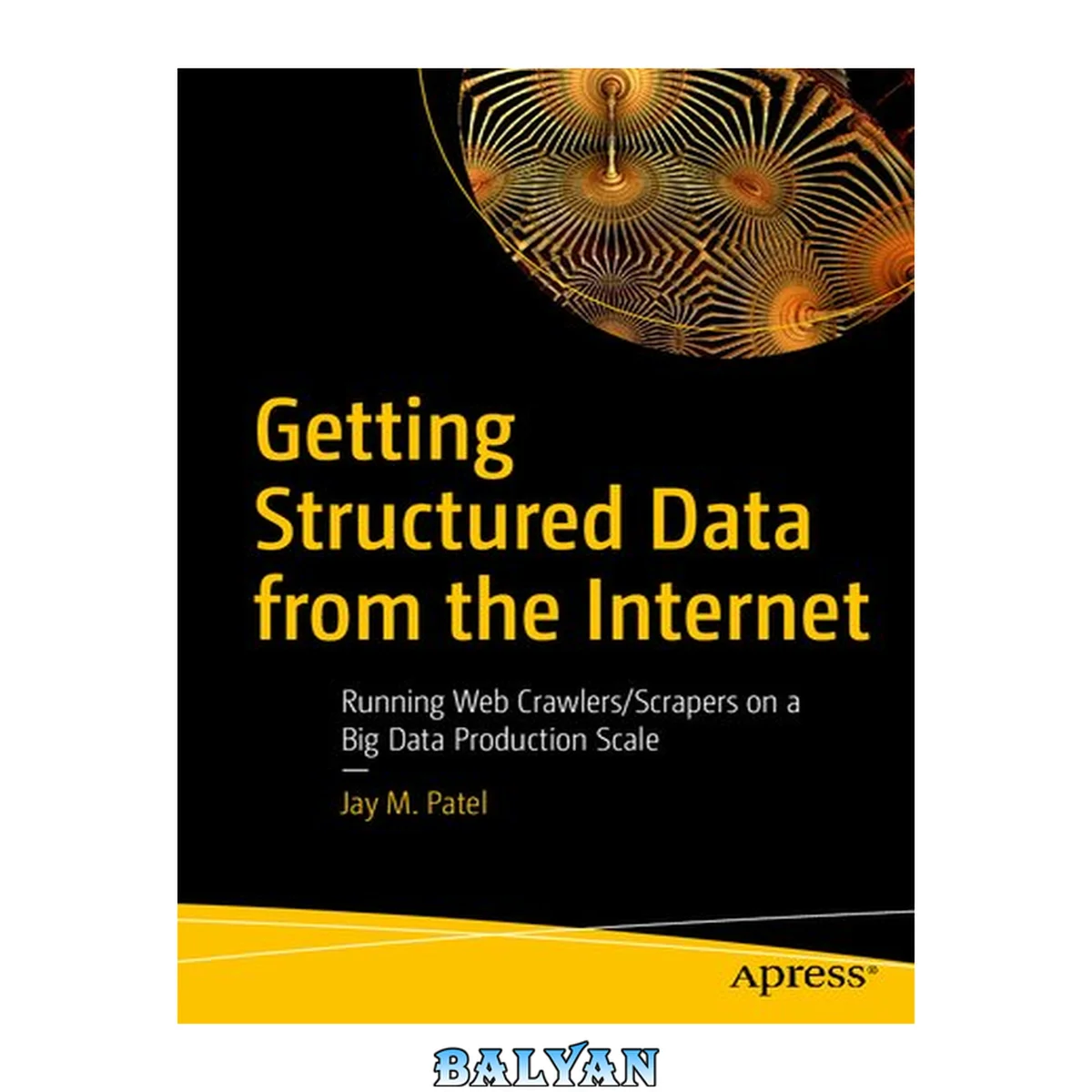
معرفی کتاب «Getting structured data from the internet : running web crawlers / scrapers on a big data production scale» نوشتهٔ Jay M Patel, (19..-....)، منتشرشده توسط نشر Apress : Imprint: Apress در سال 2020. این کتاب در فرمت pdf، زبان انگلیسی ارائه شده است.
Utilize web scraping at scale to quickly get unlimited amounts of free data available on the web into a structured format. This book teaches you to use Python scripts to crawl through websites at scale and scrape data from HTML and JavaScript-enabled pages and convert it into structured data formats such as CSV, Excel, JSON, or load it into a SQL database of your choice. This book goes beyond the basics of web scraping and covers advanced topics such as natural language processing (NLP) and text analytics to extract names of people, places, email addresses, contact details, etc., from a page at production scale using distributed big data techniques on an Amazon Web Services (AWS)-based cloud infrastructure. It book covers developing a robust data processing and ingestion pipeline on the Common Crawl corpus, containing petabytes of data publicly available and a web crawl data set available on AWS's registry of open data. **__Getting Structured Data from the Internet__** also includes a step-by-step tutorial on deploying your own crawlers using a production web scraping framework (such as Scrapy) and dealing with real-world issues (such as breaking Captcha, proxy IP rotation, and more). Code used in the book is provided to help you understand the concepts in practice and write your own web crawler to power your business ideas.**What You Will Learn** * Understand web scraping, its applications/uses, and how to avoid web scraping by hitting publicly available rest API endpoints to directly get data * Develop a web scraper and crawler from scratch using lxml and BeautifulSoup library, and learn about scraping from JavaScript-enabled pages using Selenium * Use AWS-based cloud computing with EC2, S3, Athena, SQS, and SNS to analyze, extract, and store useful insights from crawled pages * Use SQL language on PostgreSQL running on Amazon Relational Database Service (RDS) and SQLite using SQLalchemy * Review sci-kit learn, Gensim, and spaCy to perform NLP tasks on scraped web pages such as name entity recognition, topic clustering (Kmeans, Agglomerative Clustering), topic modeling (LDA, NMF, LSI), topic classification (naive Bayes, Gradient Boosting Classifier) and text similarity (cosine distance-based nearest neighbors) * Handle web archival file formats and explore Common Crawl open data on AWS * Illustrate practical applications for web crawl data by building a similar website tool and a technology profiler similar to builtwith.com * Write scripts to create a backlinks database on a web scale similar to Ahrefs.com, Moz.com, Majestic.com, etc., for search engine optimization (SEO), competitor research, and determining website domain authority and ranking * Use web crawl data to build a news sentiment analysis system or alternative financial analysis covering stock market trading signals * Write a production-ready crawler in Python using Scrapy framework and deal with practical workarounds for Captchas, IP rotation, and more **Who This Book Is For** Primary audience: data analysts and scientists with little to no exposure to real-world data processing challenges, secondary: experienced software developers doing web-heavy data processing who need a primer, tertiary: business owners and startup founders who need to know more about implementation to better direct their technical team Table of Contents About the Author About the Technical Reviewer Acknowledgments Introduction Chapter 1: Introduction to Web Scraping Who uses web scraping? Marketing and lead generation Search engines On-site search and recommendation Google Ads and other pay-per-click (PPC) keyword research tools Search engine results page (SERP) scrapers Search engine optimization (SEO) Relevance Trust and authority Estimating traffic to a site Vertical search engines for recruitment, real estate, and travel Brand, competitor, and price monitoring Social listening, public relations (PR) tools, and media contacts database Historical news databases Web technology database Alternative financial datasets Miscellaneous uses Programmatically searching user comments in Reddit Why is web scraping essential? How to turn web scraping into full-fledged product Summary Chapter 2: Web Scraping in Python Using Beautiful Soup Library What are web pages all about? Styling with Cascading Style Sheets (CSS) Scraping a web page with Beautiful Soup find() and find_all() Getting links from a Wikipedia page Scrape an ecommerce store site Profiling Beautiful Soup parsers XPath Profiling XPath-based lxml Crawling an entire site URL normalization Robots.txt and crawl delay Status codes and retries Crawl depth and crawl order Link importance Advanced link crawler Getting things “dynamic” with JavaScript Variables and data types Functions Conditionals and loops HTML DOM manipulation AJAX Scraping JavaScript with Selenium Scraping the US FDA warning letters database Scraping from XHR directly Summary Chapter 3: Introduction to Cloud Computing and Amazon Web Services (AWS) What is cloud computing? List of AWS products How to interact with AWS AWS Identity and Access Management (IAM) Setting up an IAM user Setting up custom IAM policy Setting up a new IAM role Amazon Simple Storage Service (S3) Creating a bucket Accessing S3 through SDKs Cloud storage browser Amazon EC2 EC2 server types Spinning your first EC2 server Communicating with your EC2 server using SSH Transferring files using SFTP Amazon Simple Notification Service (SNS) and Simple Queue Service (SQS) Scraping the US FDA warning letters database on cloud Summary Chapter 4: Natural Language Processing (NLP) and Text Analytics Regular expressions Extract email addresses using regex Re2 regex engine Named entity recognition (NER) Training SpaCy NER Exploratory data analytics for NLP Tokenization Advanced tokenization, stemming, and lemmatization Punctuation removal Ngrams Stop word removal Method 1: Create an exclusion list Method 2: Using statistical language modeling Method 3: Corpus-specific stop words Method 4: Using term frequency–inverse document frequency (tf-idf) vectorization Topic modeling Latent Dirichlet allocation (LDA) Non-negative matrix factorization (NMF) Latent semantic indexing (LSI) Text clustering Text classification Packaging text classification models Performance decay of text classifiers Summary Chapter 5: Relational Databases and SQL Language Why do we need a relational database? What is a relational database? Data definition language (DDL) Sample database schema for web scraping SQLite DBeaver PostgreSQL Setting up AWS RDS PostgreSQL SQLAlchemy Data manipulation language (DML) and Data Query Language (DQL) Data insertion in SQLite Inserting other tables Full text searching in SQLite Data insertion in PostgreSQL Full text searching in PostgreSQL Why do NoSQL databases exist? Summary Chapter 6: Introduction to Common Crawl Datasets WARC file format Common crawl index WET file format Website similarity WAT file format Web technology profiler Backlinks database Summary Chapter 7: Web Crawl Processing on Big Data Scale Domain ranking and authority using Amazon Athena Batch querying for domain ranking and authority Processing parquet files for a common crawl index Parsing web pages at scale Microdata, microformat, JSON-LD, and RDFa Parsing news articles using newspaper3k Revisiting sentiment analysis Scraping media outlets and journalist data Introduction to distributed computing Rolling your own search engine Summary Chapter 8: Advanced Web Crawlers Scrapy Advanced crawling strategies Ethics and legality of web scraping Proxy IP and user-agent rotation Cloudflare CAPTCHA solving services Summary Index Utilize web scraping at scale to quickly get unlimited amounts of free data available on the web into a structured format. This book teaches you to use Python scripts to crawl through websites at scale and scrape data from HTML and JavaScript-enabled pages and convert it into structured data formats such as CSV, Excel, JSON, or load it into a SQL database of your choice. This book goes beyond the basics of web scraping and covers advanced topics such as natural language processing (NLP) and text analytics to extract names of people, places, email addresses, contact details, etc., from a page at production scale using distributed big data techniques on an Amazon Web Services (AWS)-based cloud infrastructure. It book covers developing a robust data processing and ingestion pipeline on the Common Crawl corpus, containing petabytes of data publicly available and a web crawl data set available on AWS's registry of open data. Getting Structured Data from the Internet also includes a step-by-step tutorial on deploying your own crawlers using a production web scraping framework (such as Scrapy) and dealing with real-world issues (such as breaking Captcha, proxy IP rotation, and more). Code used in the book is provided to help you understand the concepts in practice and write your own web crawler to power your business ideas. What You Will Learn Understand web scraping, its applications/uses, and how to avoid web scraping by hitting publicly available rest API endpoints to directly get data Develop a web scraper and crawler from scratch using lxml and BeautifulSoup library, and learn about scraping from JavaScript-enabled pages using Selenium Use AWS-based cloud computing with EC2, S3, Athena, SQS, and SNS to analyze, extract, and store useful insights from crawled pages Use SQL language on PostgreSQL running on Amazon Relational Database Service (RDS) and SQLite using SQLalchemy Review sci-kit learn, Gensim, and spaCy to perform NLP tasks on scraped web pages such as name entity recognition, topic clustering (Kmeans, Agglomerative Clustering), topic modeling (LDA, NMF, LSI), topic classification (naive Bayes, Gradient Boosting Classifier) and text similarity (cosine distance-based nearest neighbors) Handle web archival file formats and explore Common Crawl open data on AWS Illustrate practical applications for web crawl data by building a similar website tool and a technology profiler similar to builtwith.com Write scripts to create a backlinks database on a web scale similar to Ahrefs.com, Moz.com, Majestic.com, etc., for search engine optimization (SEO), competitor research, and determining website domain authority and ranking Use web crawl data to build a news sentiment analysis system or alternative financial analysis covering stock market trading signals Write a production-ready crawler in Python using Scrapy framework and deal with practical workarounds for Captchas, IP rotation, and more Who This Book Is For Primary audience: data analysts and scientists with little to no exposure to real-world data processing challenges, secondary: experienced software developers doing web-heavy data processing who need a primer, tertiary: business owners and startup founders who need to know more about implementation to better direct their technical team L'écran d'accueil de SpringerLink indique : "Utilize web scraping at scale to quickly get unlimited amounts of free data available on the web into a structured format. This book teaches you to use Python scripts to crawl through websites at scale and scrape data from HTML and JavaScript-enabled pages and convert it into structured data formats such as CSV, Excel, JSON, or load it into a SQL database of your choice. This book goes beyond the basics of web scraping and covers advanced topics such as natural language processing (NLP) and text analytics to extract names of people, places, email addresses, contact details, etc., from a page at production scale using distributed big data techniques on an Amazon Web Services (AWS)-based cloud infrastructure. It covers developing a robust data processing and ingestion pipeline on the Common Crawl corpus, containing petabytes of data publicly available and a web crawl data set available on AWS's registry of open data. Getting Structured Data from the Internet also includes a step-by-step tutorial on deploying your own crawlers using a production web scraping framework (such as Scrapy) and dealing with real-world issues (such as breaking Captcha, proxy IP rotation, and more). Code used in the book is provided to help you understand the concepts in practice and write your own web crawler to power your business ideas. You will: Understand web scraping, its applications/uses, and how to avoid web scraping by hitting publicly available rest API endpoints to directly get data Develop a web scraper and crawler from scratch using lxml and BeautifulSoup library, and learn about scraping from JavaScript-enabled pages using Selenium Use AWS-based cloud computing with EC2, S3, Athena, SQS, and SNS to analyze, extract, and store useful insights from crawled pages Use SQL language on PostgreSQL running on Amazon Relational Database Service (RDS) and SQLite using SQLalchemy Review sci-kit learn, Gensim, and spaCy to perform NLP tasks on scraped web pages such as name entity recognition, topic clustering (Kmeans, Agglomerative Clustering), topic modeling (LDA, NMF, LSI), topic classification (naive Bayes, Gradient Boosting Classifier) and text similarity (cosine distance-based nearest neighbors) Handle web archival file formats and explore Common Crawl open data on AWS Illustrate practical applications for web crawl data by building a similar website tool and a technology profiler similar to builtwith.com Write scripts to create a backlinks database on a web scale similar to Ahrefs.com, Moz.com, Majestic.com, etc., for search engine optimization (SEO), competitor research, and determining website domain authority and ranking Use web crawl data to build a news sentiment analysis system or alternative financial analysis covering stock market trading signals Write a production-ready crawler in Python using Scrapy framework and deal with practical workarounds for Captchas, IP rotation, and more."
دانلود کتاب Getting structured data from the internet : running web crawlers / scrapers on a big data production scale