فناوریهای طراحی و اتوماسیون بنیادی در رباتیک فراساحلی (روشهای نوظهور و کاربردها در مدلسازی، شناسایی و کنترل)
Fundamental Design and Automation Technologies in Offshore Robotics (Emerging Methodologies and Applications in Modelling, Identification and Control)
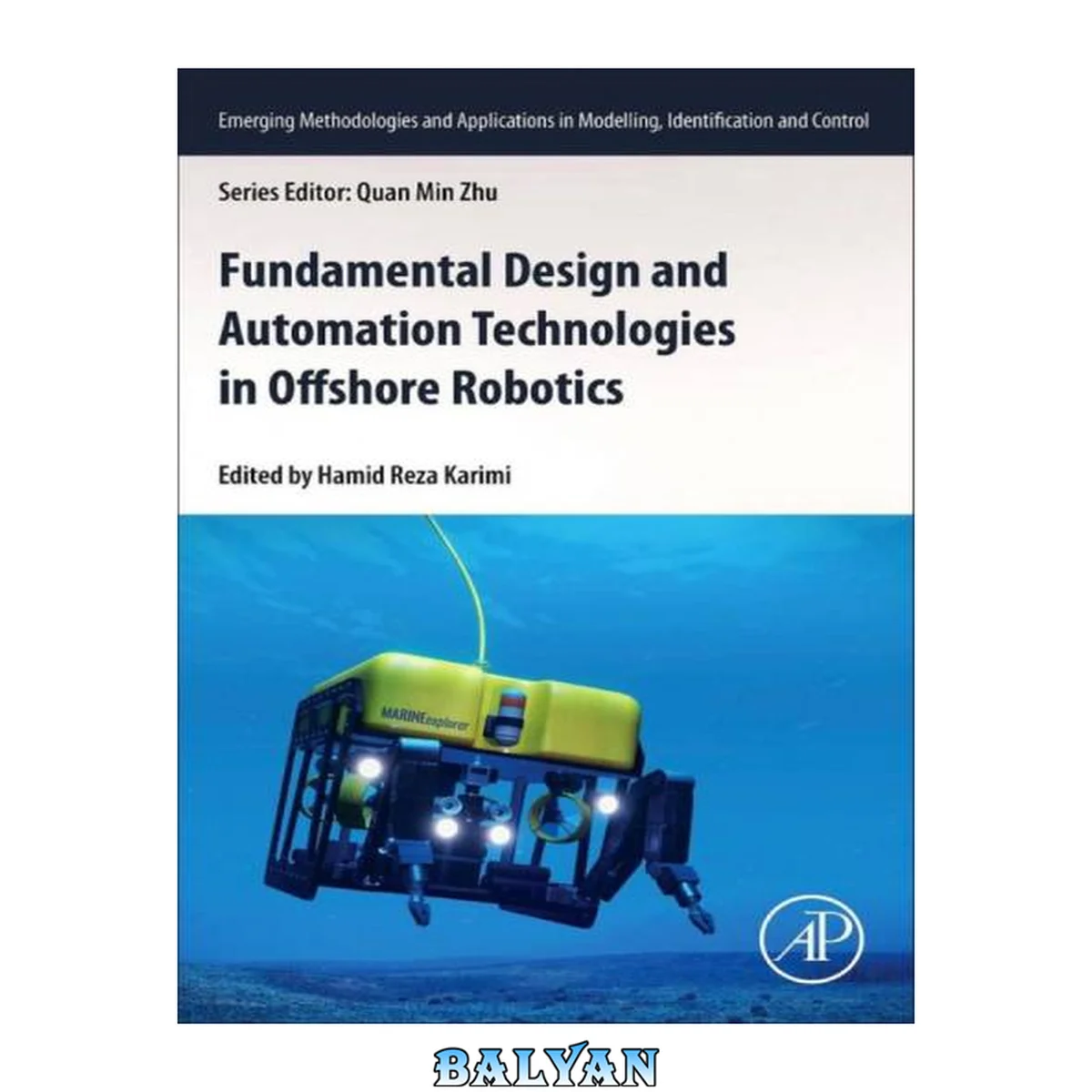
معرفی کتاب «فناوریهای طراحی و اتوماسیون بنیادی در رباتیک فراساحلی (روشهای نوظهور و کاربردها در مدلسازی، شناسایی و کنترل)» (با عنوان لاتین Fundamental Design and Automation Technologies in Offshore Robotics (Emerging Methodologies and Applications in Modelling, Identification and Control)) نوشتهٔ Hamid Reza Karimi (editor)، منتشرشده توسط نشر Academic Press در سال 2020. این کتاب در فرمت pdf، زبان انگلیسی ارائه شده است.
__Fundamental Design and Automation Technologies in Offshore Robotics__ introduces technological design, modelling, stability analysis, control synthesis, filtering problem and real time operation of robotics vehicles in offshore environments. The book gives numerical and simulation results in each chapter to reflect the engineering practice yet demonstrate the focus of the developed analysis and synthesis approaches. The book is ideal to be used as a reference book for senior and graduate students. It is written in a way that the presentation is simple, clear, and easy to read and understand which would be appreciated by graduate students. Researchers working on marine vehicles and robotics would be able to find reference material on related topics from the book. The book could be of a significant interest to the researchers within offshore and deep see society, including both academic and industrial parts. Contents List of contributors Preface 1 Introduction to fundamental design and automation technologies in offshore robotics 1.1 Introduction 1.1.1 Guidance principles for motion control 1.1.2 Autonomous underwater vehicles 1.1.3 Autonomous surface vehicles 1.1.4 Measurement and fault detection References 2 Continuous system integration and validation for underwater perception in offshore inspection and intervention tasks 2.1 System development and integration in deep-sea robotics 2.2 Underwater perception for offshore inspection and intervention tasks 2.2.1 Importance and progress overview 2.2.2 Application scenario: remote dexterous ROV interventions under communication latencies (EU-H2020 DexROV) 2.3 CSI: continuous system integration and validation 2.3.1 CSI validation concepts and use cases 2.3.2 System life cycle stages Stage I: Development stage Stage II: Integration stage Stage III: Validation stage 2.4 SIL: simulation in the loop - synchronization of real-world observations with simulation 2.4.1 Simulation platform 2.4.2 Packaging, virtualization, and networking 2.4.3 Incorporation and synchronization with real-world observations 2.5 System benchmark and validation 2.5.1 DexROV system design and setup 2.5.1.1 Vision system setup Stereo camera system Underwater stereo image rectification 2.5.1.2 Navigation system setup 2.5.1.3 Knowledge database 2.5.2 Panel pose estimation task (TP) 2.5.2.1 Method: accurate fiducial marker-based panel detection 2.5.2.2 Benchmark and validation task 2.5.3 Panel component pose estimation (TC) 2.5.3.1 Method: superellipse-guided active contours-based pose estimation 2.5.3.2 Benchmark and validation task 2.5.3.3 Further system development cycle Stereo camera fidelity enhancement Image enhancement using dark-channel prior 2.5.4 ROV localization (TL) 2.5.4.1 Method: multimodal ROV localization Visual landmark-based odometry Navigation sensor feed odometry Extended Kalman filter 2.5.4.2 Benchmark and validation task 2.5.4.3 Further system development cycle 2.6 Lessons learned 2.7 Future directions and beyond continuous system integration with simulation-in-the-loop Acknowledgment References 3 Azimuth thruster single lever type remote control system 3.1 Introduction 3.2 Composition of control system 3.3 Control functions 3.4 Going-sideways control 3.5 Relationship between single lever and azimuth thruster position 3.6 Navigation 3.7 Turning direction control & direct lever control 3.8 Main engine revolution control 3.9 Operating procedures 3.9.1 Single lever control 3.9.2 Direct lever control 3.9.3 Cautions on operation 3.10 Conclusions Acknowledgment References 4 Autonomous environment and target perception of underwater offshore vehicles 4.1 Introduction 4.2 Methodology 4.2.1 Underwater panoramic image enhancement and mosaicking method 4.2.1.1 Underwater image dataset and preprocessing method 4.2.1.2 Improved underwater image registration method of CNN 4.2.1.3 Underwater image fusion method based on Laplace algorithm 4.2.2 Underwater multitarget image processing 4.2.2.1 C-means clustering and its improved algorithm 4.2.2.2 Improved C-means clustering model clustering association algorithm 4.3 Experimental results and analysis 4.3.1 Results and analysis of underwater sequence images stitching experiment 4.3.1.1 Underwater image enhancement experiment 4.3.1.2 Results and analysis of underwater image registration 4.3.1.3 Results and analysis of underwater panoramic image stitching 4.3.2 Result and analysis of the experiment of multiple target tracking 4.3.2.1 Experimental results and analysis of non-cross-movement 4.3.2.2 Experimental results and analysis of cross-movement 4.4 Conclusions References 5 Autonomous control of underwater offshore vehicles 5.1 Introduction 5.1.1 Preface 5.1.2 Description of control difficulties for underwater vehicles 5.1.3 Models for underwater vehicles 5.1.3.1 Basic model 5.1.3.2 Dynamic model including thruster faults 5.2 Advanced motion control methods 5.2.1 A review of AUV control methods 5.2.2 Common method 5.2.2.1 PID control 5.2.2.2 Observer technique 5.2.2.3 Radial basis function neural network 5.2.3 Prescribed performance control 5.2.3.1 Introduction 5.2.3.2 Basic theory 5.2.3.3 The design of performance function 5.3 Case study 5.3.1 Prescribed performance neural network adaptive trajectory tracking control for AUV 5.3.1.1 Algorithm design 5.3.1.2 Algorithm proof 5.3.1.3 Simulation results 5.3.2 Disturbance-observer-based prescribed performance trajectory tracking control for AUV 5.3.2.1 Algorithm design 5.3.2.2 Algorithm proof 5.3.2.3 Simulation results Conclusion References 6 Development of hybrid control architecture for a small autonomous underwater vehicle 6.1 Introduction 6.2 Design scheme of SAUV 6.3 Hybrid control architecture 6.3.1 Management layer 6.3.2 Function layer 6.4 Case study 6.5 Conclusion References 7 Adaptive sliding mode control based on local recurrent neural networks for an underwater robot 7.1 Introduction 7.2 Problem formulation 7.3 Controller design 7.3.1 Local recurrent neural network 7.3.2 Adaptive sliding mode controller 7.3.3 The improvement of sliding mode switch gain 7.4 Stability analysis 7.5 Experimental studies 7.5.1 Trajectory tracking control experiment 1 7.5.2 Trajectory tracking control experiment 2 7.5.3 Trajectory tracking control experiment 3 7.6 Conclusions References 8 Thruster fault reconstruction for autonomous underwater vehicle based on terminal sliding mode observer 8.1 Introduction 8.2 Problem formulation 8.3 AUV motion modeling 8.4 Fault reconstruction 8.5 Experimental verification 8.6 Conclusions References 9 Robust sampled-data control for dynamic positioning ships based on T-S fuzzy model 9.0 Introduction 9.1 Problem formulation 9.2 Main results 9.3 Numerical examples 9.4 Conclusions References 10 Finite-time control of autonomous surface vehicles 10.1 Introduction 10.2 Preliminaries and problem statement 10.2.1 Preliminaries 10.2.2 Problem formulation 10.3 Homogeneity-based finite-time tracking control scheme 10.3.1 Nominal homogeneity-based finite-time control 10.3.2 Finite-time disturbance observer based HFC 10.3.3 Finite-time unknown observer based HFC 10.4 Simulation studies and discussions 10.4.1 Performance evaluation on the HFC 10.4.2 Performance evaluation on the FDO-HFC 10.4.3 Performance evaluation on the FUO-HFC 10.5 Conclusions Acknowledgments 10.A Proof of Lemma 10.2 References 11 Way-point tracking control of underactuated USV based on GPC path planning 11.1 Introduction 11.2 Problem description and model identification 11.3 Path generation and path tracking 11.3.1 Virtual path generation 11.3.2 Path tracking 11.4 Simulation experiment 11.4.1 Tracking effect 11.4.2 Comparative analysis of simulation 11.5 Conclusions References 12 ESO-based guidance law for distributed path maneuvering of multiple autonomous surface vehicles with a time-varying formation 12.1 Problem formulation 12.2 ESO-based distributed guidance law for distributed path maneuvering of fully-actuated ASVs 12.2.1 ESO-based distributed guidance law design 12.2.2 Stability analysis 12.2.3 Simulation results 12.3 ESO-based distributed guidance law for distributed path maneuvering of underactuated ASVs 12.3.1 ESO-based distributed guidance law design 12.3.2 Stability analysis 12.3.3 Simulation results 12.4 Conclusions References 13 Finite-time extended state observer based fault tolerant output feedback control for UAV attitude stabilization under actuator failures and disturbances 13.1 Introduction 13.2 Quadrotor dynamics and kinematics 13.3 Finite-time observer based fault tolerant attitude control scheme design 13.3.1 Preliminaries 13.3.2 Finite-time extended state observer design 13.3.2.1 Structure of the finite-time extended state observer 13.3.2.2 Finite-time ESO convergence analysis 13.3.3 Finite-time attitude dynamic feedback control algorithm 13.4 Simulation and analysis 13.4.1 Observation performance of the FTESO without actuator failures 13.4.2 Attitude control performance of the FTDFC under actuator failures 13.5 Conclusions References Index Fundamental Design and Automation Technologies in Offshore Robotics (2020) i-iii. doi:10.1016/B978-0-12-820271-5.00002-X
دانلود کتاب فناوریهای طراحی و اتوماسیون بنیادی در رباتیک فراساحلی (روشهای نوظهور و کاربردها در مدلسازی، شناسایی و کنترل)