'Full of All Knowledg' : George Herbert's Country Parson and Early Modern Social Discourse
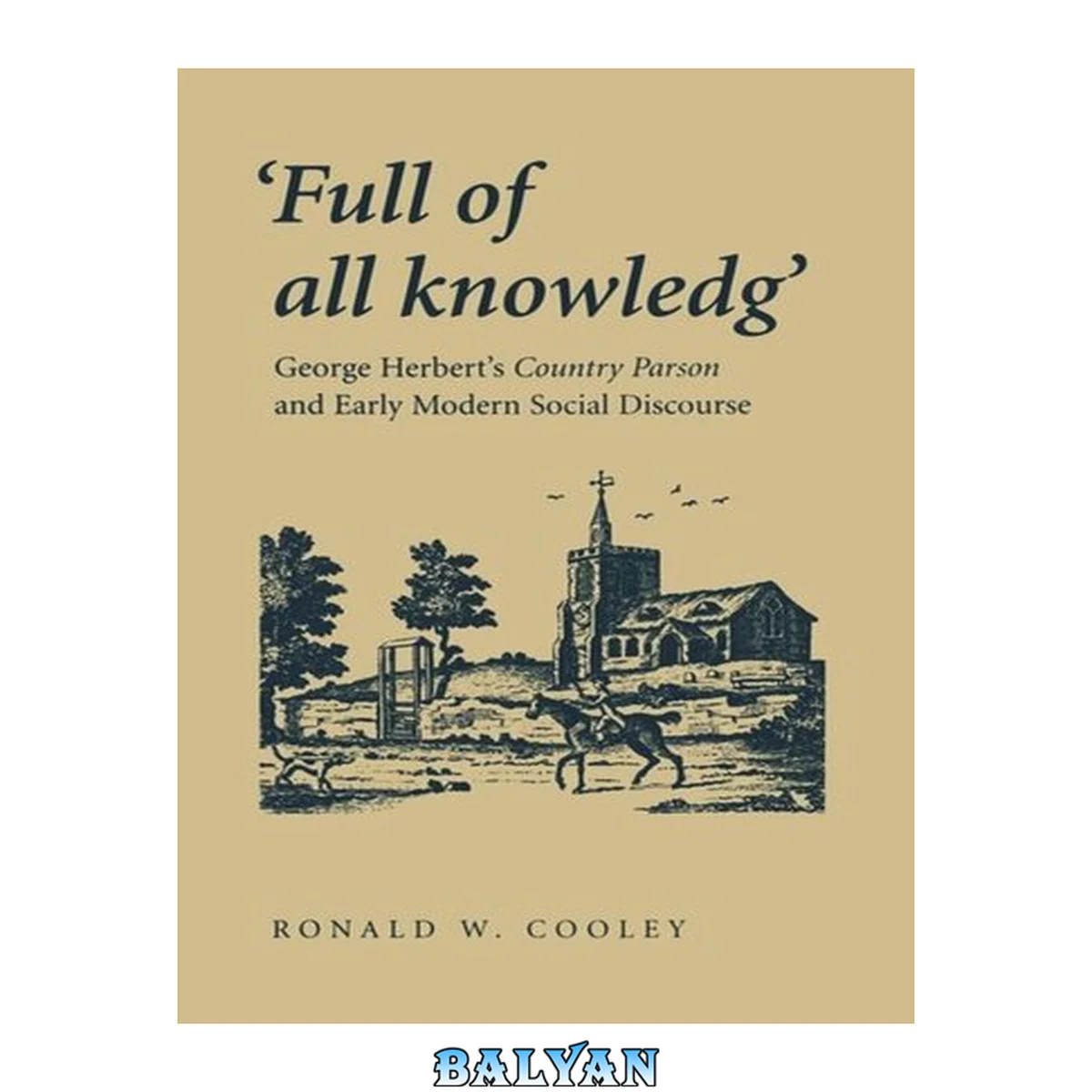
معرفی کتاب «'Full of All Knowledg' : George Herbert's Country Parson and Early Modern Social Discourse» نوشتهٔ Cooley, Ronald W.، منتشرشده توسط نشر University of Toronto Press در سال 2003. این کتاب در فرمت pdf، زبان انگلیسی ارائه شده است.
George Herbert is best known as a seventeenth-century sacred poet, often associated with such writers as John Milton and John Donne, but it is Herbert's portrait of an idealized rural clergyman in The Country Parson which perhaps best shows Herbert's engagement in a wide range of complex social debates. In Full of all knowledg', Ronald Cooley examines the 1632 pastoral manual through four distinct lenses, each representing the perspective of a particular historical sub-specialty: church history, the history of the 'learned professions' (law and medicine), local and agricultural history, and the history of the patriarchal nuclear family.
Cooley argues that in Herbert's portrait of the clergyman who is 'full of all knowledge,' and who counsels parishioners on matters of faith, law, health, agriculture, and family obligation, Herbert engages with contemporary cultural and social ideals, and offers today's scholar a unique opportunity for synthetic literary-historical study. Through his investigation of The Country Parson and a selection of Herbert's later poems, Cooley shows how traditionalist rhetoric and appeals to customary wisdom facilitated innovative practices in agricultural, professional, social, and domestic affairs, and he provides new illumination of the mental and material world of the seventeenth century cleric and poet. In positioning George Herbert as a spokesman for a legal-rational social order, and in placing The Country Parson in its cultural milieu, Cooley reveals a new dimension to Herbert's work and provides a valuable tool for future study of Herbert and seventeenth-century culture and history.
"Cooley argues that in Herbert's portrait of the clergyman who is 'full of all knowledg, ' and who counsels parisioners on matters of faith, law, health, agriculture, and family obligation, Herbert engages with contemporary cultural and social ideals, and offers today's scholar a unique opportunity for synthetic literary-historical study. Through his investigation of The Country Parson and a selection of Herbert's later poems, Cooley shows how traditionalist rhetoric and appeals to customary wisdom facilitated innovative practices in agricultural, professional, social, and domestic affairs, and he provides new illumination of the mental and material world of the seventeenth- century cleric and poet. In positioning George Herbert as a spokesman for a legal-rational social order, and in placing The Country Parson in its cultural milieu, Cooley reveals a new dimension of Herbert's work and provides a valuable tool for future study of Herbert and seventeenth-century culture and history."--Résumé de l'éditeur Contents 5 Acknowledgments 7 1. Introduction 9 2. The Country Parson and the Early Stuart Church 33 3.The Country Parson and the Enclosure of Professional Fields 62 4. The Country Parson and the Parson’s Country 89 5. Pastor as Patriarch: Gender, Family, and Social Order in The Country Parson 120 6. The Country Parson and The Temple: Enabled Readings 143 7. Modernity, Teleology, and The Country Parson 177 Notes 187 Bibliography 217 Index 239