Frontiers of Propulsion Science Progress in Astronautics and Aeronautics
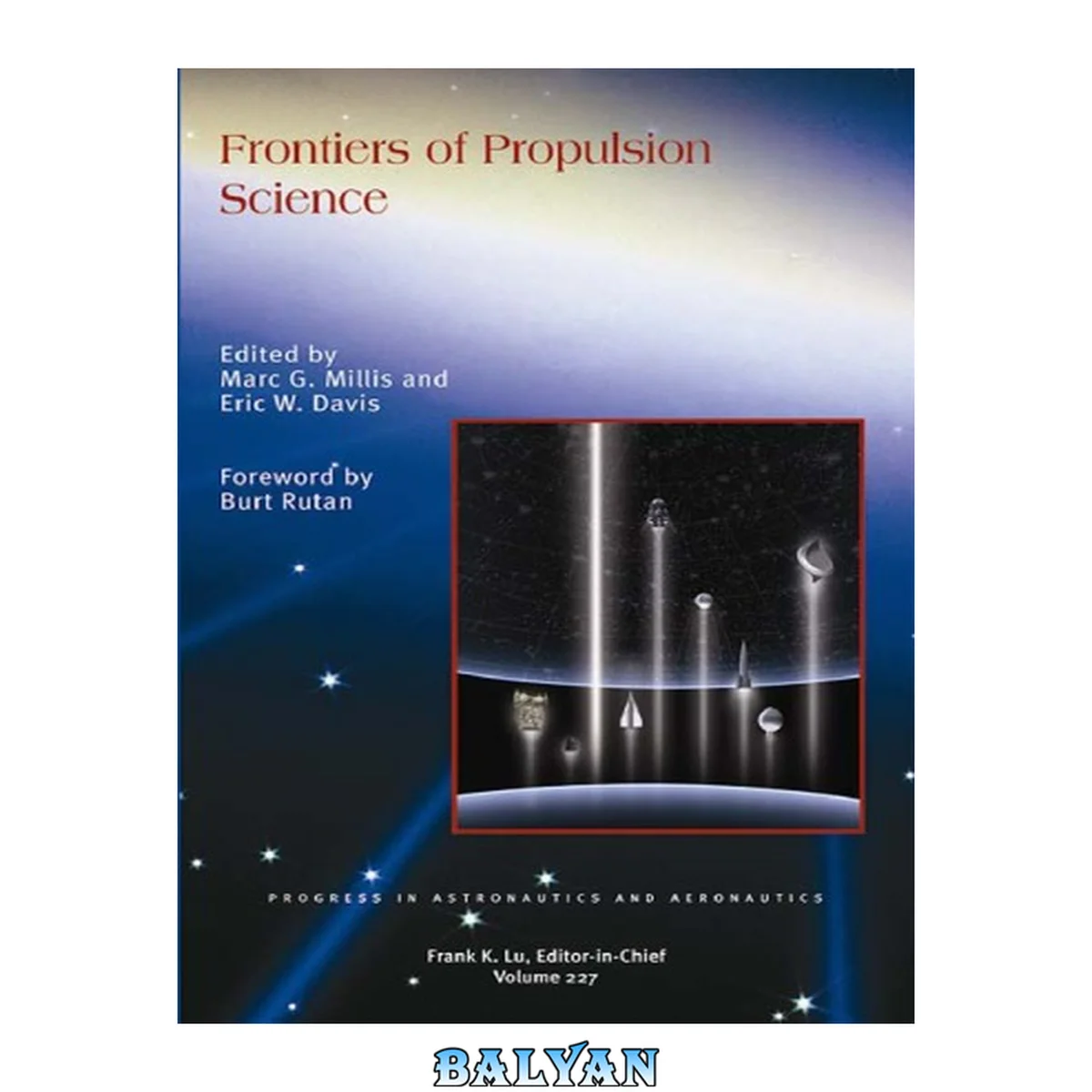
معرفی کتاب «Frontiers of Propulsion Science Progress in Astronautics and Aeronautics» نوشتهٔ Michael، Sullivan، Sullivan III و Marc G. Millis; Eric W. Davis، منتشرشده توسط نشر American Institute of Aeronautics and Astronautics در سال 2009. این کتاب در فرمت pdf، زبان انگلیسی ارائه شده است.
Frontiers of Propulsion Science is the first-ever compilation of emerging science relevant to such notions as space drives, warp drives, gravity control, and faster-than-light travel—the kind of breakthroughs that would revolutionize spaceflight and enable human voyages to other star systems. Although these concepts might sound like science fiction, they are appearing in growing numbers in reputable scientific journals.
This is a nascent field where a variety of concepts and issues are being explored in the scientific literature, beginning in about the early 1990s. The collective status is still in step 1 and 2 of the scientific method, with initial observations being made and initial hypotheses being formulated, but a small number of approaches are already at step 4, with experiments underway. This emerging science, combined with the realization that rockets are fundamentally inadequate for interstellar exploration, led NASA to support the Breakthrough Propulsion Physics Project from 1996 through 2002.
Frontiers of Propulsion Science covers that project as well as other related work, so as to provide managers, scientists, engineers, and graduate students with enough starting material that they can comprehend the status of this research and decide if and how to pursue it in more depth themselves.
Five major sections are included in the book: Understanding the Problem lays the groundwork for the technical details to follow; Propulsion Without Rockets discusses space drives and gravity control, both in general terms and with specific examples; Faster-Than-Light Travel starts with a review of the known relativistic limits, followed by the faster-than-light implications from both general relativity and quantum physics; Energy Considerations deals with spacecraft power systems and summarizes the limits of technology based on accrued science; and From This Point Forward offers suggestions for how to manage and conduct research on such visionary topics.
"Frontiers of Propulsion Science" is the first-ever compilation of emerging science relevant to such notions as space drives, warp drives, gravity control, and faster-than-light travel - the kind of breakthroughs that would revolutionize spaceflight and enable human voyages to other star systems. Although these concepts might sound like science fiction, they are appearing in growing numbers in reputable scientific journals. This is a nascent field where a variety of concepts and issues are being explored in the scientific literature, beginning in about the early 1990s. The collective status is still in step 1 and 2 of the scientific method, with initial observations being made and initial hypotheses being formulated, but a small number of approaches are already at step 4, with experiments underway. This emerging science, combined with the realization that rockets are fundamentally inadequate for interstellar exploration, led NASA to support the Breakthrough Propulsion Physics Project from 1996 through 2002. "Frontiers of Propulsion Science" covers that project as well as other related work, so as to provide managers, scientists, engineers, and graduate students with enough starting material that they can comprehend the status of this research and decide if and how to pursue it in more depth themselves. Five major sections are included in the book: Understanding the Problem lays the groundwork for the technical details to follow; Propulsion Without Rockets discusses space drives and gravity control, both in general terms and with specific examples; Faster-Than-Light Travel starts with a review of the known relativistic limits, followed by the faster-than-light implications from both general relativity and quantum physics; Energy Considerations deals with spacecraft power systems and summarizes the limits of technology based on accrued science; and, From This Point Forward offers suggestions for how to manage and conduct research on such visionary topics. Content: Recent history of breakthrough propulsion studies / Paul A. Gilster -- Limits of interstellar flight technology / Robert H. Frisbee -- Prerequisites for space drive science / Marc G. Millis -- Review of gravity control within Newtonian and general relativistic physics / Eric W. Davis -- Gravitational experiments with superconductors : history and lessons / George D. Hathaway -- Nonviable mechanical "antigravity" devices / Marc G. Millis -- Null findings of Yamishita electrogravitational patent / Kenneth E. Siegenthaler and Timothy J. Lawrence -- Force characterization of asymmetrical capacitor thrusters in air / William M. Miller, Paul B. Miller, and Timothy J. Drummond -- Experimental findings of asymmetrical capacitor thrusters for various gasses and pressures / Francis X. Canning -- Propulsive implications of photon momentum in media / Michael R. LaPointe -- Experimental results of the Woodward effect on a micro-newton thrust balance / Nembo Buldrini and Martin Tajmar -- Thrusting against the quantum vacuum / G. Jordan Maclay -- Inertial mass from stochastic electrodynamics / Jean-Luc Cambier -- Relativistic limits of spaceflight / Brice N. Cassenti -- Faster-than-light approaches in general relativity / Eric W. Davis -- Faster-than-light implications of quantum entanglement and nonlocality / John G. Cramer -- Comparative space power baselines / Gary L. Bennett -- On extracting energy from the quantum vacuum / Eric W. Davis and H.E. Puthoff -- Investigating sonoluminescence as a means of energy harvesting / John D. Wrbanek ... [et al.] -- Null tests of "free energy" claims / Scott R. Little -- General relativity computational tools and convention for propulsion / Claudio Maccone -- Prioritizing pioneering research / Marc G. Millis. This Books Is The First Compilation Of Emerging Science Relevant To Such Notions As Space Drives, Warp Drives, Gravity Control, And Faster-than-light Travel - The Kind Of Breakthroughs That Would Revolutionize Spaceflight And Enable Human Voyages To Other Star Systems. Although These Concepts Might Sound Like Science Fiction, They Are Appearing In Growing Numbers In Reputable Scientific Journals. A compilation of science relevant to such notions as space drives, warp drives, gravity control, and faster-than-light travel - the kind of breakthroughs that would revolutionize spaceflight and enable human voyages to other star systems. It is suitable for managers, scientists, engineers, and graduate students.