Framework Design Guidelines: Conventions, Idioms, and Patterns for Reusable .NET Libraries (paperback) (Addison-Wesley Microsoft Technology Series)
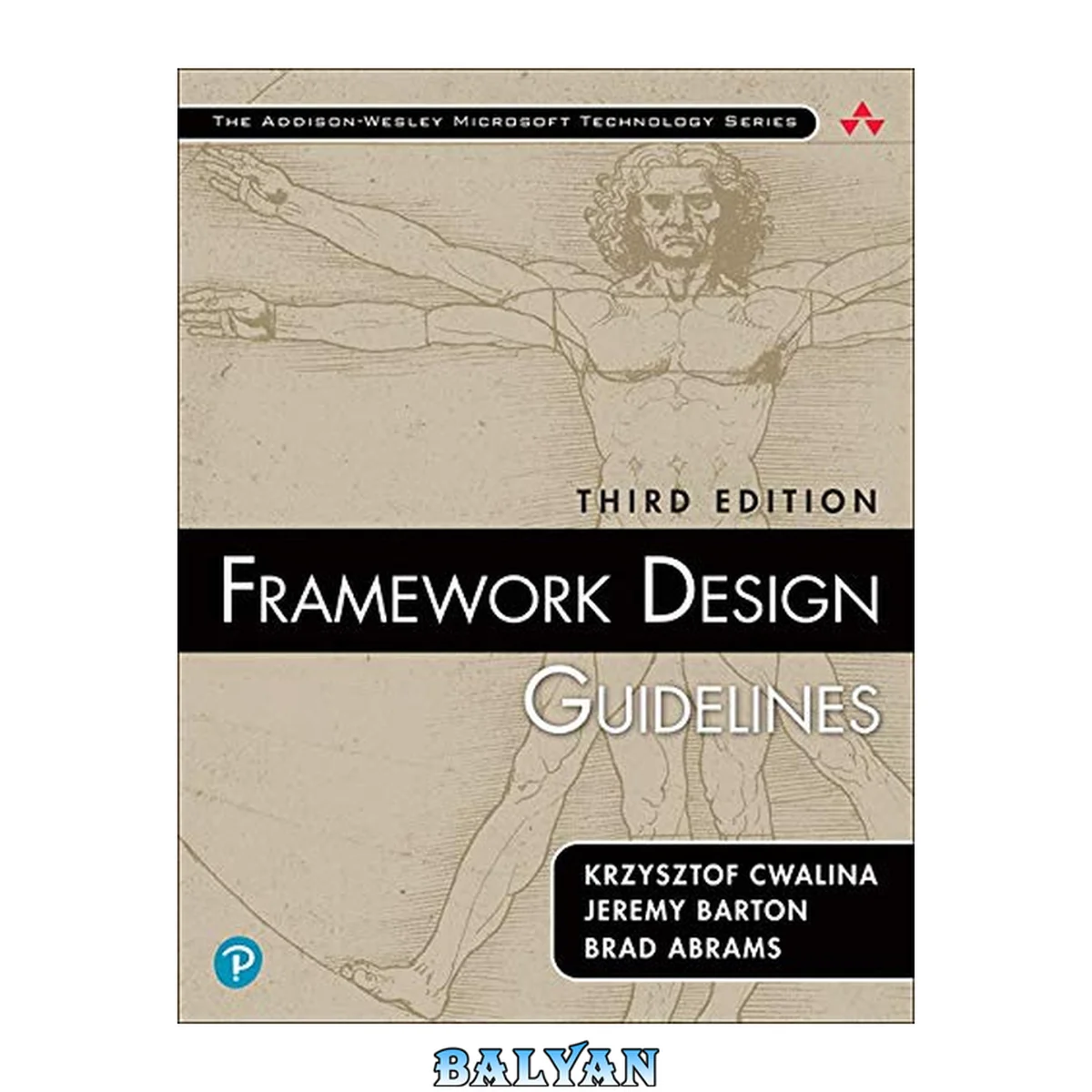
معرفی کتاب «Framework Design Guidelines: Conventions, Idioms, and Patterns for Reusable .NET Libraries (paperback) (Addison-Wesley Microsoft Technology Series)» نوشتهٔ Larry A. DiMatteo (editor)، Cristina Poncibò (editor)، Michel Cannarsa (editor) و Cwalina, Krzysztof, Barton, Jeremy, Abrams, Brad، منتشرشده توسط نشر Addison-Wesley Professional در سال 2020. این کتاب در فرمت pdf، زبان انگلیسی ارائه شده است.
Master Today’s Best Practices for Building Reusable .NET Frameworks, Libraries, and Components “.NET Core [contains] advances important to cloud application developers: performance, resource utilization, container support, and others. This third edition of Framework Design Guidelines adds guidelines related to changes that the .NET team adopted during transition from the world of client-server application to the world of the Cloud.” –From the Foreword by Scott Guthrie Framework Design Guidelines has long been the definitive guide to best practices for developing components and component libraries in Microsoft .NET. Now, this third edition has been fully revised to reflect game-changing API design innovations introduced by Microsoft through eight recent updates to C#, eleven updates to .NET Framework, and the emergence and evolution of .NET Core. Three leading .NET architects share the same guidance Microsoft teams are using to evolve .NET, so you can design well-performing components that feel like natural extensions to the platform. Building on the book’s proven explanatory style, the authors and expert annotators offer insider guidance on new .NET and C# concepts, including major advances in asynchronous programming and lightweight memory access. Throughout, they clarify and refresh existing content, helping you take full advantage of best practices based on C# 8, .NET Framework 4.8, and .NET Core. Discover which practices should always, generally, rarely, or never be used–including practices that are no longer recommended Learn the general philosophy and fundamental principles of modern framework design Explore common framework design patterns with up-to-date C# examples Apply best practices for naming, types, extensibility, and exceptions Learn how to design libraries that scale in the cloud Master new async programming techniques utilizing Task and ValueTask Make the most of the Memory and Span types for lightweight memory access This guide is an indispensable resource for everyone who builds reusable .NET-based frameworks, libraries, or components at any scale: large system frameworks, medium-size reusable layers of large distributed systems, extensions to system frameworks, or even small shared components. Register your book for convenient access to downloads, updates, and/or corrections as they become available. See inside book for details. Cover Half Title Title page Copyright Page Dedication Contents Figures Tables Foreword Foreword to the Second Edition Foreword to the First Edition Preface Acknowledgments About the Authors About the Annotators 1 Introduction 1.1 Qualities of a Well-Designed Framework 1.1.1 Well-Designed Frameworks Are Simple 1.1.2 Well-Designed Frameworks Are Expensive to Design 1.1.3 Well-Designed Frameworks Are Full of Trade-Offs 1.1.4 Well-Designed Frameworks Borrow from the Past 1.1.5 Well-Designed Frameworks Are Designed to Evolve 1.1.6 Well-Designed Frameworks Are Integrated 1.1.7 Well-Designed Frameworks Are Consistent 2 Framework Design Fundamentals 2.1 Progressive Frameworks 2.2 Fundamental Principles of Framework Design 2.2.1 The Principle of Scenario-Driven Design 2.2.2 The Principle of Low Barrier to Entry 2.2.3 The Principle of Self-Documenting Object Models 2.2.4 The Principle of Layered Architecture 3 Naming Guidelines 3.1 Capitalization Conventions 3.1.1 Capitalization Rules for Identifiers 3.1.2 Capitalizing Acronyms 3.1.3 Capitalizing Compound Words and Common Terms 3.1.4 Case Sensitivity 3.2 General Naming Conventions 3.2.1 Word Choice 3.2.2 Using Abbreviations and Acronyms 3.2.3 Avoiding Language-Specific Names 3.2.4 Naming New Versions of Existing APIs 3.3 Names of Assemblies, DLLs, and Packages 3.4 Names of Namespaces 3.4.1 Namespaces and Type Name Conflicts 3.5 Names of Classes, Structs, and Interfaces 3.5.1 Names of Generic Type Parameters 3.5.2 Names of Common Types 3.5.3 Naming Enumerations 3.6 Names of Type Members 3.6.1 Names of Methods 3.6.2 Names of Properties 3.6.3 Names of Events 3.6.4 Naming Fields 3.7 Naming Parameters 3.7.1 Naming Operator Overload Parameters 3.8 Naming Resources 4 Type Design Guidelines 4.1 Types and Namespaces 4.2 Choosing Between Class and Struct 4.3 Choosing Between Class and Interface 4.4 Abstract Class Design 4.5 Static Class Design 4.6 Interface Design 4.7 Struct Design 4.8 Enum Design 4.8.1 Designing Flag Enums 4.8.2 Adding Values to Enums 4.9 Nested Types 4.10 Types and Assembly Metadata 4.11 Strongly Typed Strings 5 Member Design 5.1 General Member Design Guidelines 5.1.1 Member Overloading 5.1.2 Implementing Interface Members Explicitly 5.1.3 Choosing Between Properties and Methods 5.2 Property Design 5.2.1 Indexed Property Design 5.2.2 Property Change Notification Events 5.3 Constructor Design 5.3.1 Type Constructor Guidelines 5.4 Event Design 5.5 Field Design 5.6 Extension Methods 5.7 Operator Overloads 5.7.1 Overloading Operator 5.7.2 Conversion Operators 5.7.3 Inequality Operators 5.8 Parameter Design 5.8.1 Choosing Between Enum and Boolean Parameters 5.8.2 Validating Arguments 5.8.3 Parameter Passing 5.8.4 Members with Variable Number of Parameters 5.8.5 Pointer Parameters 5.9 Using Tuples in Member Signatures 6 Designing for Extensibility 6.1 Extensibility Mechanisms 6.1.1 Unsealed Classes 6.1.2 Protected Members 6.1.3 Events and Callbacks 6.1.4 Virtual Members 6.1.5 Abstractions (Abstract Types and Interfaces) 6.2 Base Classes 6.3 Sealing 7 Exceptions 7.1 Exception Throwing 7.2 Choosing the Right Type of Exception to Throw 7.2.1 Error Message Design 7.2.2 Exception Handling 7.2.3 Wrapping Exceptions 7.3 Using Standard Exception Types 7.3.1 Exception and SystemException 7.3.2 ApplicationException 7.3.3 InvalidOperationException 7.3.4 ArgumentException, ArgumentNullException, and ArgumentOutOfRangeException 7.3.5 NullReferenceException, IndexOutOfRangeException, and AccessViolationException 7.3.6 StackOverflowException 7.3.7 OutOfMemoryException 7.3.8 ComException, SEHException, and ExecutionEngineException 7.3.9 OperationCanceledException and TaskCanceledException 7.3.10 FormatException 7.3.11 PlatformNotSupportedException 7.4 Designing Custom Exceptions 7.5 Exceptions and Performance 7.5.1 The Tester–Doer Pattern 7.5.2 The Try Pattern 8 Usage Guidelines 8.1 Arrays 8.2 Attributes 8.3 Collections 8.3.1 Collection Parameters 8.3.2 Collection Properties and Return Values 8.3.3 Choosing Between Arrays and Collections 8.3.4 Implementing Custom Collections 8.4 DateTime and DateTimeOffset 8.5 ICloneable 8.6 IComparable and IEquatable 8.7 IDisposable 8.8 Nullable 8.9 Object 8.9.1 Object.Equals 8.9.2 Object.GetHashCode 8.9.3 Object.ToString 8.10 Serialization 8.11 Uri 8.11.1 System.Uri Implementation Guidelines 8.12 System.Xml Usage 8.13 Equality Operators 8.13.1 Equality Operators on Value Types 8.13.2 Equality Operators on Reference Types 9 Common Design Patterns 9.1 Aggregate Components 9.1.1 Component-Oriented Design 9.1.2 Factored Types 9.1.3 Aggregate Component Guidelines 9.2 The Async Patterns 9.2.1 Choosing Between the Async Patterns 9.2.2 Task-Based Async Pattern 9.2.3 Async Method Return Types 9.2.4 Making an Async Variant of an Existing Synchronous Method 9.2.5 Implementation Guidelines for Async Pattern Consistency 9.2.7 Classic Async Pattern 9.2.8 Event-Based Async Pattern 9.2.9 IAsyncDisposable 9.2.10 IAsyncEnumerable 9.3 Dependency Properties 9.3.1 Dependency Property Design 9.3.2 Attached Dependency Property Design 9.3.3 Dependency Property Validation 9.3.4 Dependency Property Change Notifications 9.3.5 Dependency Property Value Coercion 9.4 Dispose Pattern 9.4.1 Basic Dispose Pattern 9.4.2 Finalizable Types 9.4.3 Scoped Operations 9.4.4 IAsyncDisposable 9.5 Factories 9.6 LINQ Support 9.6.1 Overview of LINQ 9.6.2 Ways of Implementing LINQ Support 9.6.3 Supporting LINQ through IEnumerable 9.6.4 Supporting LINQ through IQueryable 9.6.5 Supporting LINQ through the Query Pattern 9.7 Optional Feature Pattern 9.8 Covariance and Contravariance 9.8.1 Contravariance 9.8.2 Covariance 9.8.3 Simulated Covariance Pattern 9.9 Template Method 9.10 Timeouts 9.11 XAML Readable Types 9.12 Operating on Buffers 9.12.1 Data Transformation Operations 9.12.2 Writing Fixed or Predetermined Sizes to a Buffer 9.12.3 Writing Values to Buffers with the Try-Write Pattern 9.12.4 Partial Writes to Buffers and OperationStatus 9.13 And in the End A: C# Coding Style Conventions A.1 General Style Conventions A.1.1 Brace Usage A.1.2 Space Usage A.1.3 Indent Usage A.1.4 Vertical Whitespace A.1.5 Member Modifiers A.1.6 Other A.2 Naming Conventions A.3 Comments A.4 File Organization B: Obsolete Guidance B.3 Obsolete Guidance from Naming Guidelines B.3.8 Naming Resources B.4 Obsolete Guidance from Type Design Guidelines B.4.1 Types and Namespaces B.5 Obsolete Guidance from Member Design B.5.4 Event Design B.7 Obsolete Guidance from Exceptions B.7.4 Designing Custom Exceptions B.8 Obsolete Guidance from Usage Guidelines B.8.10 Serialization B.9 Obsolete Guidance from Common Design Patterns B.9.2 The Async Patterns B.9.4 Dispose Pattern C: Sample API Specification D: Breaking Changes D.1 Modifying Assemblies D.1.1 Changing the Name of an Assembly D.2 Adding Namespaces D.2.1 Adding a Namespace That Conflicts with an Existing Type D.3 Modifying Namespaces D.3.1 Changing the Name or Casing of a Namespace D.4 Moving Types D.4.1 Moving a Type via [TypeForwardedTo] D.4.2 Moving a Type Without [TypeForwardedTo] D.5 Removing Types D.5.1 Removing Types D.6 Modifying Types D.6.1 Sealing an Unsealed Type D.6.2 Unsealing a Sealed Type D.6.3 Changing the Case of a Type Name D.6.4 Changing a Type Name D.6.5 Changing the Namespace for a Type D.6.6 Adding readonly on a struct D.6.7 Removing readonly from a struct D.6.8 Adding a Base Interface to an Existing Interface D.6.9 Adding the Second Declaration of a Generic Interface D.6.10 Changing a class to a struct D.6.11 Changing a struct to a class D.6.12 Changing a struct to a ref struct D.6.13 Changing a ref struct to a (Non-ref) struct D.7 Adding Members D.7.1 Masking Base Members with new D.7.2 Adding abstract Members D.7.3 Adding Members to an Unsealed Type D.7.4 Adding an override Member to an Unsealed Type D.7.5 Adding the First Reference Type Field to a struct D.7.6 Adding a Member to an Interface D.8 Moving Members D.8.1 Moving Members to a Base Class D.8.2 Moving Members to a Base Interface D.8.3 Moving Members to a Derived Type D.9 Removing Members D.9.1 Removing a Finalizer from an Unsealed Type D.9.2 Removing a Finalizer from a Sealed Type D.9.3 Removing a Non-override Member D.9.4 Removing an override of a virtual Member D.9.5 Removing an override of an abstract Member D.9.6 Removing or Renaming Private Fields on Serializable Types D.10 Overloading Members D.10.1 Adding the First Overload of a Member D.10.2 Adding Alternative-Parameter Overloads for a Reference Type Parameter D.11 Changing Member Signatures D.11.1 Renaming a Method Parameter D.11.2 Adding or Removing a Method Parameter D.11.3 Changing a Method Parameter Type D.11.4 Reordering Method Parameters of Differing Types D.11.5 Reordering Method Parameters of The Same Type D.11.6 Changing a Method Return Type D.11.7 Changing the Type of a Property D.11.8 Changing Member Visibility from public to Any Other Visibility D.11.9 Changing Member Visibility from protected to public D.11.10 Changing a virtual (or abstract) Member from protected to public D.11.11 Adding or Removing the static Modifier D.11.12 Changing to or from Passing a Parameter by Reference D.11.13 Changing By-Reference Parameter Styles D.11.14 Adding the readonly Modi?er to a struct Method D.11.15 Removing the readonly Modifier from a struct Method D.11.16 Changing a Parameter from Required to Optional D.11.17 Changing a Parameter from Optional to Required D.11.18 Changing the Default Value for an Optional Parameter D.11.19 Changing the Value of a const Field D.11.20 Changing an abstract Member to virtual D.11.21 Changing a virtual Member to abstract D.11.22 Changing a Non-virtual Member to virtual D.12 Changing Behavior D.12.1 Changing Runtime Error Exceptions to Usage Error Exceptions D.12.2 Changing Usage Error Exceptions to Functioning Behavior D.12.3 Changing the Type of Values Returned from a Method D.12.4 Throwing a New Type of Error Exception D.12.5 Throwing a New Type of Exception, Derived from an Existing Thrown Type D.13 A Final Note Glossary A B C D E F G H I J L M N O P R S T U V X Index A B C D E F G H I J-K L M N O P Q-R S T U V W X-Y-Z Framework Design Guidelines, Third Edition , teaches developers the best practices for designing reusable libraries for the Microsoft .NET Framework. Expanded and updated for .NET 7.3, this new edition focuses on new concepts which have altered the current and best practices for developing components in .NET. This book can improve the work of any .NET developer producing code that other developers will use. It includes copious annotations to the guidelines by prominent architects and practitioners of the .NET Framework, providing a lively discussion of the reasons for the guidelines as well as examples of when to break those guidelines Microsoft architects Krzysztof Cwalina, Jeremy Barton, and Brad Abrams teach framework design from the top down. From their significant combined experience and deep insight, you will learn The general philosophy and fundamental principles of framework design Naming guidelines for the various parts of a framework Guidelines for the design and extending of types and members of types Issues affecting--and guidelines for ensuring--extensibility How (and how not) to design exceptions Guidelines for--and examples of--common framework design patterns Guidelines in this book are presented in four major forms: Do, Consider, Avoid, and Do not. These directives help focus attention on practices that should always be used, those that should generally be used, those that should rarely be used, and those that should never be used. Every guideline includes a discussion of its applicability, and most include a code example to help illuminate the dialogue. Framework Design Guidelines, Third Edition, is the only definitive source of best practices for managed code API development, direct from the architects themselves.
دانلود کتاب Framework Design Guidelines: Conventions, Idioms, and Patterns for Reusable .NET Libraries (paperback) (Addison-Wesley Microsoft Technology Series)