پروتئومیک غذایی: پیشرفتهای فناوری، کاربردهای کنونی و چشماندازهای آینده
Food Proteomics : Technological Advances, Current Applications and Future Perspectives
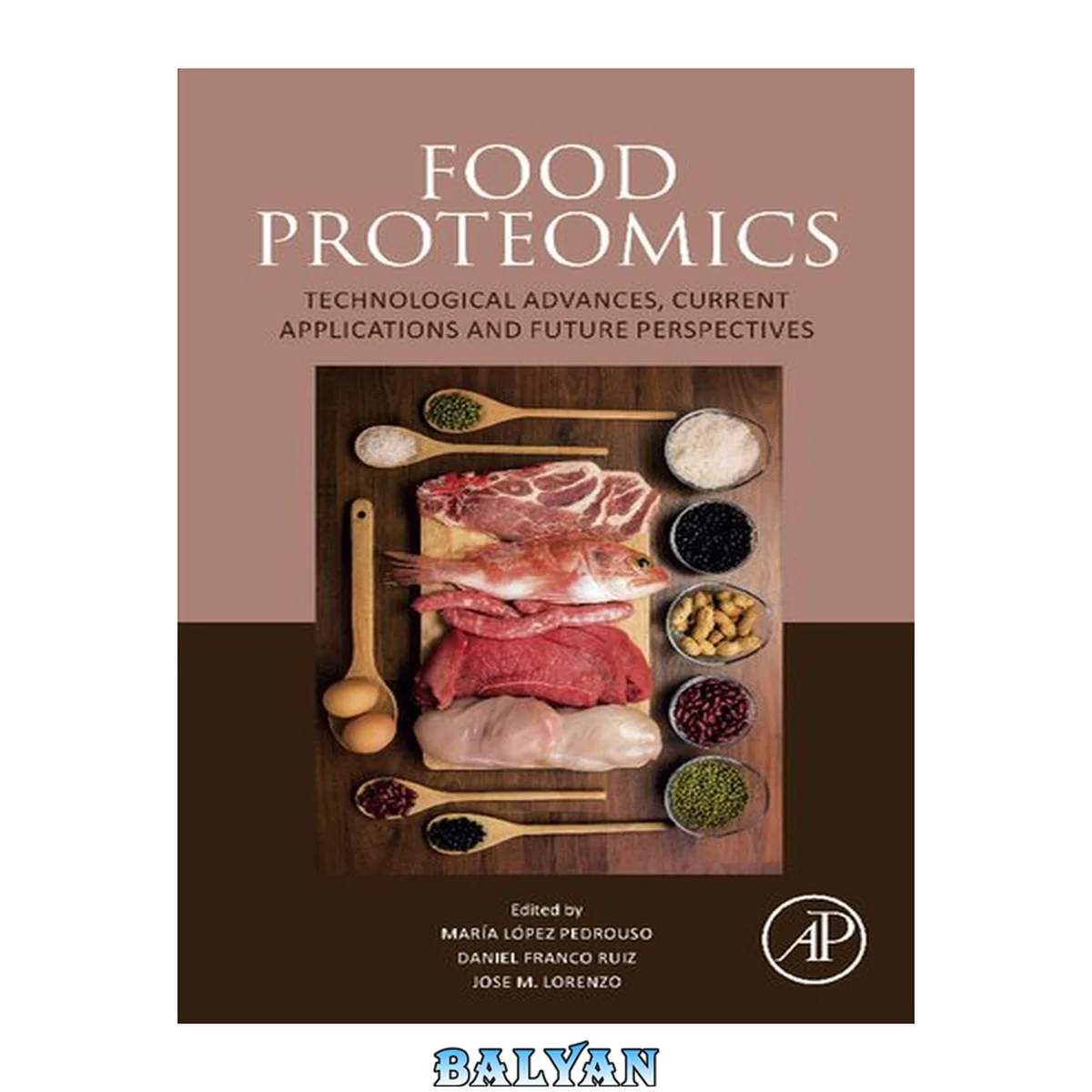
معرفی کتاب «پروتئومیک غذایی: پیشرفتهای فناوری، کاربردهای کنونی و چشماندازهای آینده» (با عنوان لاتین Food Proteomics : Technological Advances, Current Applications and Future Perspectives) نوشتهٔ Maria Lopez Pedrouso, Daniel Franco Ruiz, Jose M. Lorenzo، منتشرشده توسط نشر Academic Press Inc در سال 2022. این کتاب در فرمت pdf، زبان انگلیسی ارائه شده است.
Food Proteomics: Technological Advances, Current Applications and Future Perspectives addresses many of the food proteomic issues in the industry today. Food proteomics continues to be an emerging field, becoming increasingly important in product innovation, food safety, food quality and health. The book is divided into sections describing the role of proteomics in the field of food science, conceptual background methodological aspects, and bioinformatic tools employed in the field. The book describes proteomic studies collected from the most relevant animal and vegetables species in food production and discusses important food challenges from a proteomic point-of-view. This is an essential and practical reference that provides analytical tools to help introduce technical innovations in the food industry with the latest scientific information useful and accessible to new researchers in the field as well as advanced. Includes precise proteomic information on a specific category Provides proteomic studies of the most common vegetable and animal species Presents proteomic methodologies, including bioinformatics for effective analysis in food science Discusses food challenges such as allergens, authentication and food safety Front cover Half title Full title Copyright Contents Contributors About the editors Preface Chapter 1 - IntroductionFood proteomics: technological advances, current applications and future perpectives 1.1 Importance of the food industry and emerging trends in food science 1.2 An overview of technological applications based on food proteins 1.2.1 The impact of proteins on food quality and safety 1.2.2 Bioactive peptides from food proteins 1.2.3 Allergenicity of food proteins 1.2.4 Food authenticity and traceability based on proteomic profiles 1.3 Why proteomics? References SECTION I - Technological advances in food proteomics Chapter 2 - Quantitative proteomics by mass spectrometry in food science 2.1 Introduction 2.2 Proteomics 2.2.1 Protein identification and characterization 2.2.2 Differential/quantitative proteomics 2.2.3 Functional proteomics 2.3 Proteomic workflows 2.4 Sample preparation 2.5 Gel-based or mass spectrometry based approaches 2.5.1 Gel-based proteomics approaches 2.5.2 MS-based proteomics approaches 2.6 Quantitative proteomics in food 2.6.1 Food quality 2.6.1.1 Taste, flavor consistence 2.6.1.2 Nutritional properties 2.6.1.3 Product traceability 2.6.2 Food safety 2.6.2.1 Microbial contaminants (pathogens and toxins) 2.6.2.2 Food allergens 2.6.2.3 Food authenticity and detection of adulterations 2.7 Conclusions and future trends References Chapter3 - Technological developments of food peptidomics 3.1 Introduction 3.1.1 Differences between peptidomics and proteomics 3.2 What type of peptides can we found in food matrices? 3.2.1 Endogenous peptides 3.2.2 Peptides generated during the digestion of food proteins 3.3 Identification of food peptides 3.4 Current workflows in peptide identification 3.5 Quantification strategies in food peptidomics 3.5.1 Labeled vs label-free quantitation 3.5.2 Label-based peptide quantification strategies 3.5.2.1 Relative quantification 3.5.2.1.1 Metabolic labeling 3.5.2.1.2 Chemical labeling 3.5.2.1.3 Enzymatic labeling 3.5.2.2 Absolute quantification 3.5.3 Label-free relative peptide quantification strategies 3.5.3.1 Signal intensity measurement (AUC) 3.5.3.2 Spectral counting (SpC) 3.6 Applications and future trends in food peptidomics 3.6.1 Peptidomics of digestion (digestomics) 3.6.2 Peptidomics in food processing 3.6.3 Peptidomics in biomarker hunting 3.6.4 Peptidomics in food allergens 3.6.5 Peptidomics in food waste valorization 3.6.6 Peptidomic analysis with minimal sample preparation Acknowledgments References SECTION II - Applications of proteomic in food sciences Chapter 4 - Proteomic advances in crop improvement 4.1 Introduction 4.2 Definition and composition of vegetables 4.3 Cereals proteins. Content and classification 4.4 Scope of vegetable and cereal proteins in agriculture and food 4.5 Concept of proteomics and different approaches to proteome analysis 4.5.1 Bottom–up approach 4.5.2 Top–down approach 4.6 Application of proteomics in the improvement of cereal and vegetable crops 4.6.1 Translational plant proteomics 4.6.2 Food safety in cereal and vegetal crops 4.6.2.1 Identification of allergens 4.6.2.2 Identification of pathogens 4.6.3 Consumer protection against labeling fraud 4.6.4 Early detection and treatment of infected crops 4.7 Conclusions Acknowledgment References Chapter 5 - Proteomic advances in seafood and aquaculture 5.1 Introduction 5.2 Proteomics of aquatic organisms and their pathogens 5.2.1 Proteomics of aquatic organisms to describe their physiology 5.2.2 Proteomics of aquatic organisms in response to environmental stressors 5.2.3 Proteomics of the pathogens of aquatic organisms 5.2.4 Proteomics of host–pathogen interactions 5.2.5 Proteomics of food products from aquatic organisms 5.3 Conclusions Funding References Chapter 6 - Proteomics advances in beef production 6.1 Introduction 6.2 Proteomics to investigate cattle breeding, animal performances, and rearing practices 6.2.1 Age at slaughter, genetic merit for carcass weight, growth rate, and path of cattle 6.2.2 Sex/gender 6.2.3 Breed or genotype 6.2.4 Muscle types 6.3 Proteomics to investigate beef quality and impact of post-slaughter effects: a focus on electrical stimulation and aging 6.3.1 Proteomics and electrical stimulation of carcasses 6.3.2 Proteomics and meat aging 6.4 Brief overview on proteomics of meat quality traits and discovery of biomarkers: a focus on beef tenderness and color 6.4.1 Beef tenderness proteomics and putative biomarkers evidenced by integromics 6.4.2 Beef color proteomics and putative biomarkers evidenced by integromics 6.5 Conclusions Acknowledgments References Chapter7 - Proteomic advances in poultry science 7.1 Introduction 7.2 Egg proteomics 7.3 Growth performance 7.4 Meat quality attributes 7.5 Meat quality defects 7.5.1 Pale, soft, and exudative meat 7.5.2 Woody breast, white striping, and spaghetti 7.6 Infectious disease 7.7 Future directions 7.8 Conclusions References Chapter8 - Current trends in proteomic development towards milk and dairy products 8.1 Introduction 8.2 Milk proteins 8.3 Milk proteomics 8.3.1 Concept of proteomics 8.3.2 Analytical techniques 8.3.2.1 Characterization techniques 8.3.3 Proteomics on characterization of milk and dairy products 8.3.4 The advantages of recent proteomics in milk and dairy production 8.3.5 Proteomics to investigate milk and dairy products. “Safety, authenticity, and quality” 8.4 Conclusions References SECTION III - Applications of proteomic in food challenges Chapter9 - Proteomic analysis of food allergens 9.1 Introduction 9.2 Immunological mechanism of food allergies 9.2.1 Immediate food allergies 9.2.2 Delayed hypersensitivity reactions to food allergens 9.3 Food allergens 9.3.1 Allergenicity and cross-reactivity 9.3.2 Food-allergy diagnosis 9.3.3 Proteomics in food-allergy: from discovery to targeted methods 9.3.4 Proteomic studies and allergens in plants 9.3.4.1 Gluten-related disorders 9.3.4.2 Pollen-fruit allergy syndrome 9.3.4.3 Legume allergy 9.3.4.3.1 Peanut allergy 9.3.4.3.2 Soybean allergy 9.3.4.3.3 Lupin allergy 9.3.4.3.4 Lentil allergy 9.3.4.4 Tree nuts allergy 9.3.5 Proteomic studies and allergens in animals 9.3.5.1 Cow’s milk allergy 9.3.5.2 Red meat allergy 9.3.5.3 Egg allergy 9.3.5.4 Fish and shellfish 9.4 Conclusions References Chapter10 - Proteomic approaches for authentication of foods of animal origin 10.1 Introduction 10.2 Proteomic approaches 10.2.1 Electrophoresis-based approach 10.2.1.1 Sodium dodecyl sulfate-polyacrylamide gel electrophoresis (SDS-PAGE) 10.2.1.2 2-dimensional gel electrophoresis (2-DE) 10.2.1.3 2D-differential gel electrophoresis (2D-DIGE) 10.2.1.4 OFFGEL electrophoresis 10.2.1.5 Gel-eluted liquid fraction entrapment electrophoresis (GELFrEE) 10.2.2 Immunoassay-based approach 10.2.3 Mass spectrometry based approach 10.3 Authentication of animal origin foods 10.3.1 Identification of species/breed 10.3.2 Identification of geographical origin/production method 10.3.3 Identification of adulteration/substitution 10.3.4 Identification of additives/ingredients 10.3.5 Identification of processing treatment 10.4 Conclusion References Chapter11 - Application of proteomics to the identification of foodborne pathogens 11.1 Introduction 11.2 Proteomics strategies: discovery and targeted proteomics 11.3 Discovery proteomics for the identification of foodborne pathogens 11.3.1 MALDI-TOF MS for the identification of foodborne pathogens 11.3.2 LC-ESI-MS/MS for the identification of foodborne pathogens 11.4 Targeted proteomics for the identification of foodborne pathogens 11.5 Concluding remarks and future directions Author contributions Funding Conflicts of interest References Chapter12 - Peptidomic approach for analysis of bioactive peptides 12.1 Peptidomic: definition 12.2 Sample preparation and protein isolation 12.3 Peptide purification 12.3.1 Hydrolysis of proteins 12.3.2 Peptide fractionation 12.3.3 Peptide purification 12.4 Peptide detection and data analysis 12.4.1 Detection and identification of peptides 12.4.2 Data analysis: bioinformatic or “in silico” tools 12.5 In silico analysis of bioactive peptides 12.6 Key findings Acknowledgments References Index Back cover
دانلود کتاب پروتئومیک غذایی: پیشرفتهای فناوری، کاربردهای کنونی و چشماندازهای آینده