F# برای سرگرمی و سود
F# for Fun and Profit eBook
معرفی کتاب «F# برای سرگرمی و سود» (با عنوان لاتین F# for Fun and Profit eBook) نوشتهٔ Scott Wlaschin، منتشرشده توسط نشر 2013 در سال 2013. این کتاب در فرمت pdf، زبان انگلیسی ارائه شده است.
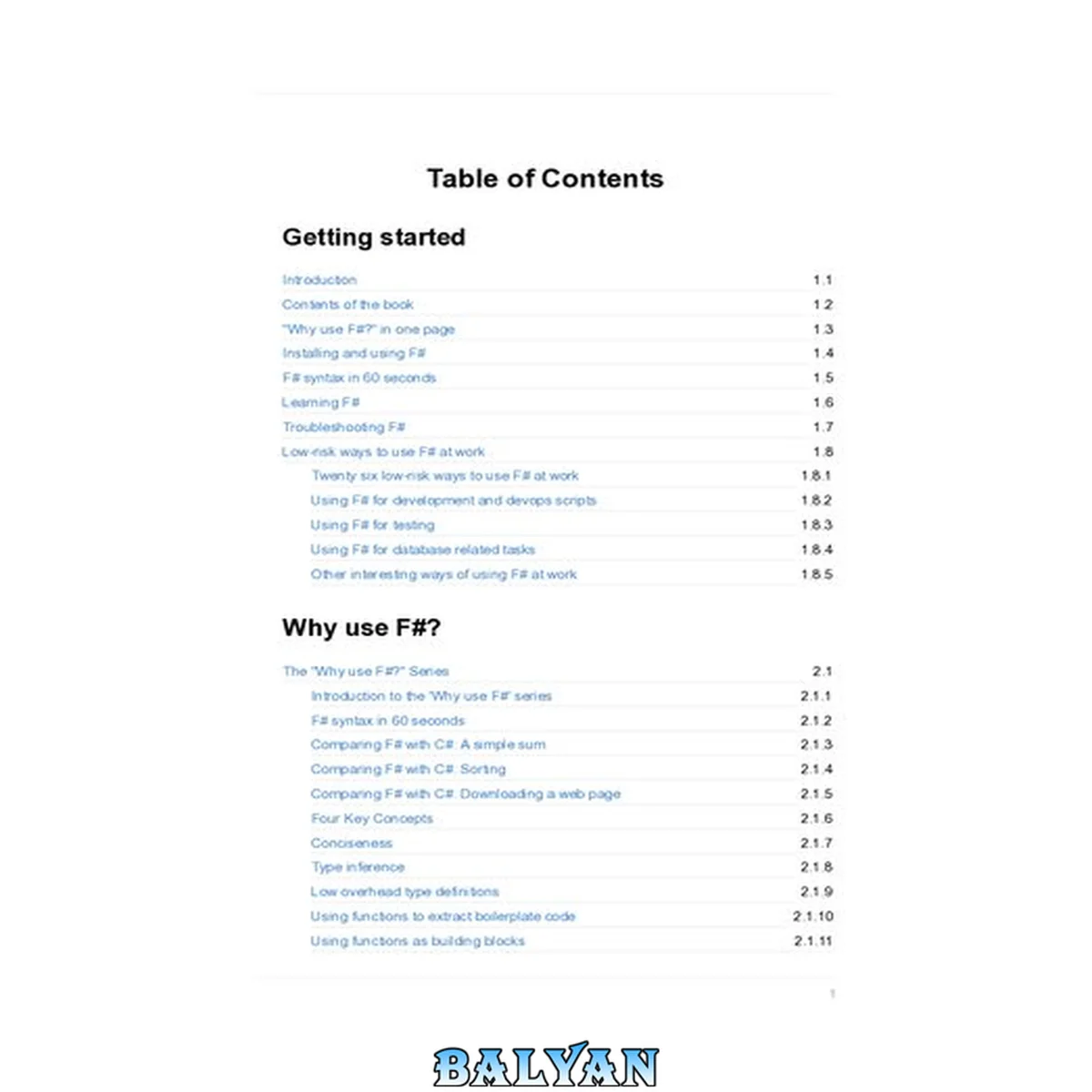
This is an eBook version of the site fsharpforfunandprofit.com, created by popular request for people who want to read it offline on their kindle or phone. Special thanks to Roman Provaznik for the final nag.The site (and this book) aims to introduce you to F# and show you ways that F# can help in day-to-day development of mainstream commercial business software. On the way, the author hopes to open your mind to the joys of functional programming - it really is fun!Many of the posts were not really designed to be in a book, but the author has arranged them so that beginner posts come first, and more advanced posts later. Introduction Contents of the book "Why use F#?" in one page Installing and using F# F# syntax in 60 seconds Learning F# Troubleshooting F# Low-risk ways to use F# at work Twenty six low-risk ways to use F# at work Using F# for development and devops scripts Using F# for testing Using F# for database related tasks Other interesting ways of using F# at work The "Why use F#?" Series Introduction to the 'Why use F#' series Comparing F# with C#: A simple sum Comparing F# with C#: Sorting Comparing F# with C#: Downloading a web page Four Key Concepts Conciseness Type inference Low overhead type definitions Using functions to extract boilerplate code Using functions as building blocks Pattern matching for conciseness Convenience Out-of-the-box behavior for types Functions as interfaces Partial Application Active patterns Correctness Immutability Exhaustive pattern matching Using the type system to ensure correct code Worked example: Designing for correctness Concurrency Asynchronous programming Messages and Agents Functional Reactive Programming Completeness Seamless interoperation with .NET libraries Anything C# can do... Why use F#: Conclusion The "Thinking Functionally" Series Thinking Functionally: Introduction Mathematical functions Function Values and Simple Values How types work with functions Currying Partial application Function associativity and composition Defining functions Function signatures Organizing functions Attaching functions to types Worked example: A stack based calculator The "Expressions and syntax" Series Expressions and syntax: Introduction Expressions vs. statements Overview of F# expressions Binding with let, use, and do F# syntax: indentation and verbosity Parameter and value naming conventions Control flow expressions Exceptions Match expressions Formatted text using printf Worked example: Parsing command line arguments Worked example: Roman numerals The "Understanding F# types" Series Understanding F# types: Introduction Overview of types in F# Type abbreviations Tuples Records Discriminated Unions The Option type Enum types Built-in .NET types Units of measure Understanding type inference Choosing between collection functions The "Object-oriented programming in F#" Series Object-oriented programming in F#: Introduction Classes Inheritance and abstract classes Interfaces Object expressions The "Computation Expressions" Series Computation expressions: Introduction Understanding continuations Introducing 'bind' Computation expressions and wrapper types More on wrapper types Implementing a builder: Zero and Yield Implementing a builder: Combine Implementing a builder: Delay and Run Implementing a builder: Overloading Implementing a builder: Adding laziness Implementing a builder: The rest of the standard methods Organizing modules in a project The "Dependency cycles" Series Cyclic dependencies are evil Refactoring to remove cyclic dependencies Cycles and modularity in the wild The "Porting from C#" Series Porting from C# to F#: Introduction Getting started with direct porting The "Designing with types" Series Designing with types: Introduction Single case union types Making illegal states unrepresentable Discovering new concepts Making state explicit Constrained strings Non-string types Designing with types: Conclusion Algebraic type sizes and domain modelling Thirteen ways of looking at a turtle Thirteen ways of looking at a turtle (part 2) Thirteen ways of looking at a turtle - addendum How to design and code a complete program A functional approach to error handling (Railway oriented programming) Railway oriented programming: Carbonated edition The "Understanding monoids" Series Monoids without tears Monoids in practice Working with non-monoids The "Understanding Parser Combinators" Series Understanding Parser Combinators Building a useful set of parser combinators Improving the parser library Writing a JSON parser from scratch The "Handling State" Series Dr Frankenfunctor and the Monadster Completing the body of the Monadster Refactoring the Monadster The "Map and Bind and Apply, Oh my!" Series Understanding map and apply Understanding bind Using the core functions in practice Understanding traverse and sequence Using map, apply, bind and sequence in practice Reinventing the Reader monad Map and Bind and Apply, a summary The "Recursive types and folds" Series Introduction to recursive types Catamorphism examples Introducing Folds Understanding Folds Generic recursive types Trees in the real world The "A functional approach to authorization" Series A functional approach to authorization Constraining capabilities based on identity and role Using types as access tokens An introduction to property-based testing Choosing properties for property-based testing Commentary on 'Roman Numerals Kata with Commentary' Calculator Walkthrough: Part 1 Calculator Walkthrough: Part 2 Calculator Walkthrough: Part 3 Calculator Walkthrough: Part 4 Enterprise Tic-Tac-Toe Enterprise Tic-Tac-Toe, part 2 Ten reasons not to use a statically typed functional programming language Why I won't be writing a monad tutorial Is your programming language unreasonable? We don't need no stinking UML diagrams Introvert and extrovert programming languages Swapping type-safety for high performance using compiler directives
دانلود کتاب F# برای سرگرمی و سود